Vibe coding, in the founder context, means the impulsive jump-to-build behavior where you start writing production code from a fuzzy idea before running any structured market validation. It is not about AI-assisted development workflows. It is about skipping the hard diagnostic work and letting excitement substitute for evidence. The single best move you can make right now: run one Phase‑0 micro-check before you touch a code editor. A 60–90 minute verbatim customer discovery sprint or a one-page landing presale test costs almost nothing and tells you more than a week of building.
Key Takeaways
Vibe coding is the single most expensive habit early-stage founders develop, and Phase‑0 validation is the only reliable way to break it before it drains your runway.
| Point | Details |
|---|---|
| Define vibe coding early | Impulsive building from a fuzzy idea without market validation drives 43% of startup PMF failures. |
| Run a Phase‑0 check first | Produce an ICP, verbatim quotes, pricing anchors, and a first-value moment spec before any engineering. |
| Use two fast experiments | A landing page presale with modest ad spend and several discovery interviews can provide defensible evidence within a short time frame. |
| Apply numeric go/no-go rules | Solo founders need 3 paid commitments and 5 consistent interviews; small teams need 10 commitments and 40% return activation. |
| Use Klaritea for Phase‑0 | Klaritea converts a one-line idea into a clarity scorecard, build spec, and exportable plan before you write production code. |
Table of Contents
- Why do founders fall into vibe coding?
- What does the evidence say about vibe coding and startup failure?
- How do you know if you're vibe coding right now?
- What should you produce before you write production code?
- Which validation experiments give you real evidence fast?
- When do you actually have enough evidence to build?
- What tools and workflow actually run Phase‑0?
- A short post-mortem: what vibe coding actually costs
- The part most founders do not want to hear
- Klaritea turns your idea into a decision-ready plan before you build
- Sources
- FAQ
Why do founders fall into vibe coding?
The pull is real and the reasons are specific. Speed bias is the most common: the market feels urgent, a competitor just launched, and shipping feels like the only response. Technical comfort amplifies it. Founders who can build often default to building because it is the skill they trust most. Investor and peer pressure add a third layer. Demo-ability matters in early fundraising, and a working prototype looks more credible than a validated hypothesis on a slide.
Underneath those surface drivers sit two psychological traps. Confirmation bias means you interpret every encouraging signal as proof the idea works. Sunk-cost rationalization kicks in after the first sprint: you have already invested two weeks, so stopping feels like waste rather than wisdom. The emotional reward of shipping code creates a false signal of progress. A green build pipeline feels like momentum. It is not.
- Speed bias: urgency replaces evidence as the decision driver
- Technical comfort: building is the path of least resistance for technical founders
- Demo pressure: investors and accelerators reward visible prototypes over validated assumptions
- Confirmation bias: early positive feedback gets weighted far above negative signals
- Sunk-cost rationalization: prior effort makes stopping feel like failure
- Single-person confirmation: one enthusiastic friend or advisor substitutes for ten real customer conversations
Pro Tip: Before your next sprint, spend two hours running an evidence checklist: three verbatim customer complaints from a public forum, one search-volume check on your core keyword, and one pricing test question in a cold outreach message. If you cannot complete it, you are not ready to build.
Shipping an MVP without prior market-signal analysis commonly wastes engineering hours and runway. Demand signals like search volume and verbatim customer complaints are accessible before you write a single line of production code.
What does the evidence say about vibe coding and startup failure?
The data is not ambiguous. CB Insights analyzed 431 VC-backed shutdowns since 2023 and found that "ran out of capital" was cited as the final cause in 70% of cases. Capital exhaustion is the symptom, typically preceded by building the wrong thing as the underlying issue.
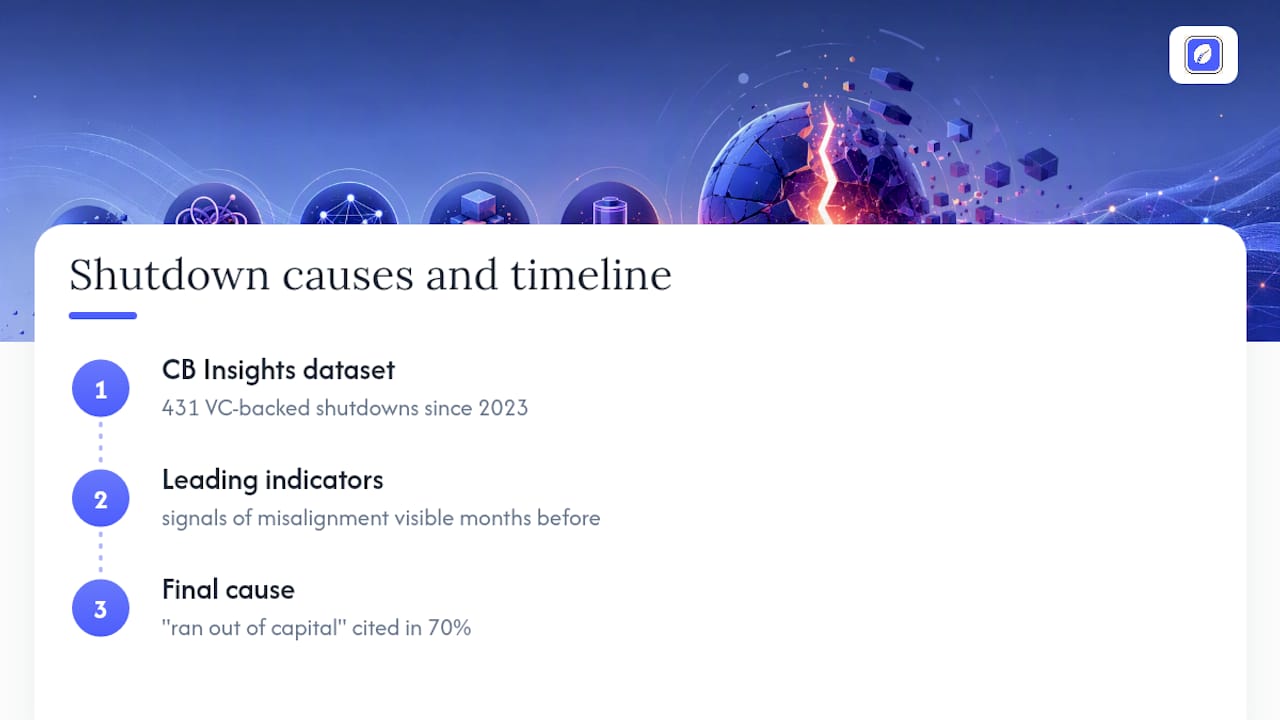
These are leading indicators, not lagging ones. By the time a company runs out of money, the signals of misalignment had been visible for months.
How do you know if you're vibe coding right now?
Self-diagnosis is uncomfortable but fast. Run through this list honestly.
- You started writing code before defining a specific ICP (ideal customer profile)
- Your feature list covers three or more use cases and you have not validated any of them
- You have not collected three verbatim customer quotes describing the problem in their own words
- You have not checked search volume or run a paid ad test on your core value proposition
- You have no pricing test results, not even a single "would you pay $X?" conversation
- One person (you, a co-founder, or a mentor) confirmed the idea and that felt sufficient
- Your team runs standups and PR reviews, which creates a rhythm that feels like validation but is not
Team rituals are a particularly sneaky cover. A daily standup signals discipline. A PR review signals rigor. Neither one tells you whether anyone outside your building wants what you are making.
What should you produce before you write production code?
Phase 0 is a diagnostic stage focused on problem definition and strategic alignment that should precede execution. Treating it as a prerequisite reduces rework and accelerates every phase that follows. Here are the mandatory outputs.
- Target ICP profile: one named persona with a specific job, pain, and context
- One-paragraph value proposition: written in the customer's language, not yours
- TAM/SAM/SOM sketch: even rough numbers force you to confront market size honestly
- First-value moment description: the single thing a user must experience to decide the product works
- Three validated user quotes: verbatim, collected from real conversations, not paraphrased
- Competitive hooks mapping: what alternatives your ICP currently uses and why they fall short
- Pricing anchors: at least two data points showing what your ICP currently pays for adjacent solutions
- One-page build spec: scoped strictly to delivering the first-value moment, nothing else
- Go/no-go metrics: defined before you start, not after you see the results
Skipping Phase Zero increases the chance of scope creep and expensive mid-project pivots. Every output above has a "done" state: the ICP profile is done when a stranger reads it and immediately names someone they know who fits it. The build spec is done when an engineer can estimate it without asking you a single clarifying question.
Pro Tip: If your idea still feels abstract, ask yourself: "What is the one moment where a user first thinks, this actually works?" Write that moment as a two-sentence user story. Your entire build spec should point at that moment and nothing else.
Which validation experiments give you real evidence fast?
Practical validation signals can often be collected in days with low cash outlay. Here is a working menu.
- Landing page presale: a single-page site with a payment button. 1–2 days to build, $50–$200 in ad spend to drive traffic. A small but measurable conversion rate is considered a meaningful signal.
- 5–10 customer discovery interviews: schedule through LinkedIn or a niche community. Zero cost, 1–2 weeks elapsed. You are listening for the same problem described in the same words by different people.
- Paid search keyword test: run a $100–$300 Google Ads campaign on your core search term. 48–72 hours gives you click-through data that no survey can replicate.
- Concierge presale: offer to deliver the outcome manually before building anything. No code, no cost. If people pay for the manual version, they will pay for the automated one.
- Smoke test / ad-to-CTA micro funnel: run a social ad to a waitlist or "notify me" page. $50–$150, 3–5 days. Measures intent without a product.
Pick one or two experiments that match your idea's distribution channel. A B2B tool needs interviews and a concierge presale. A consumer app needs a landing page and a paid search test. Validating a startup idea with community is another low-cost path, especially for products aimed at niche audiences.
Pro Tip: After each interview, pull the three most emotionally charged phrases the customer used and paste them directly into your landing page headline and CTA copy. Customers convert on their own words, not yours.
When do you actually have enough evidence to build?
Gut feel is not a threshold. Set these criteria before you run experiments, then apply them without negotiating.
For a solo founder:
- At least three paid commitments or preorders from people who do not know you personally
- Five or more interviews where the same problem is described without prompting
- At least one pricing test where the stated price produced no objection or immediate pushback
- A landing page conversion rate above a few percent on cold traffic
For a small team (2–4 people):
- Multiple paid commitments or preorders
- Eight or more consistent interviews with verbatim language overlap
- A repeat activation signal: at least A significant fraction of early users return without a reminder within a week
- Funnel conversion above 3% and a cost-per-lead that fits your unit economics model
Identifying the first-value moment and observing real users before expanding is the practical test. If you cannot point to a specific moment where a real user said or did something that confirmed value, you are not there yet. Set conservative thresholds. Preserving optionality costs less than a premature build.
What tools and workflow actually run Phase‑0?
The workflow has six steps: idea intake, research lenses, evidence synthesis, one-page spec, experiment design, and scorecard review. Here is what each step needs.
- Idea intake: write your idea as a single sentence. If you cannot, the idea is not ready.
- Research lenses: use search tools (Google Trends, Ahrefs, or SparkToro) plus public forums (Reddit, G2 reviews) to map demand signals and verbatim complaints.
- Evidence synthesis: pull interview notes and search data into a single document. Look for language overlap.
- One-page spec: scope it to the first-value moment only. Use a product roadmap tool to keep it constrained.
- Experiment design: select one or two experiments from the menu above and set your go/no-go thresholds in writing.
- Scorecard review: score your evidence against the go/no-go criteria before approving any engineering time.
Klaritea runs this entire workflow from a single one-line idea input. Its Clarity, Build, and Run & Scale Lenses give you structured views of your model at each stage. Three AI advisors (Maya for marketing, Devon for business, Priya for ops and QA) research, challenge, and fact-check your assumptions. The output is a clarity scorecard and an exportable build spec you can sync to GitHub or push to Notion or Confluence.
Pro Tip: Use AI synthesis to cluster interview themes, but always keep the raw verbatim quotes in a separate document. The cluster tells you the pattern; the raw quote is what you put in the ad.
A short post-mortem: what vibe coding actually costs
A founder with a background in data engineering had an idea for a B2B analytics dashboard. She spent six weeks building a polished MVP with five filter views, custom export formats, and a Slack integration. Total engineering cost: roughly $14,000 in contractor time and her own hours.

She had spoken to two people before building: a former colleague who said "I'd use that" and a friend who runs a small agency. No ICP profile. No pricing test. No verbatim quotes from strangers. The Slack integration was her own assumption about how buyers work.
At launch, she got 40 signups and zero paid conversions. Exit interviews revealed the core problem: her ICP did not use Slack for analytics workflows. They used email digests. The five filter views were solving a problem she had, not one they had.
If she had run a $150 paid search test and five cold discovery interviews first, she would have learned the email digest preference in week one. A one-page build spec scoped to a single export-to-email feature would have taken two weeks, not six. The lean startup experiment-first approach she skipped would have saved roughly $10,000 and four weeks of runway.
The Phase‑0 lesson mapped directly: no ICP profile, no verbatim quotes, no pricing test, no first-value moment definition. Every item on the checklist was missing.
The part most founders do not want to hear
The hardest thing about avoiding impulsive building is that the behavior feels productive. You are making decisions. You are shipping. The codebase is growing. But productivity and progress are not the same thing before product-market fit.
The founders who get through early stages with runway intact are not the ones who moved fastest. They are the ones who spent two weeks collecting evidence that would have taken two months to discover through building. Disciplined Phase‑0 work does not slow you down. It buys you the optionality to pivot cheaply, kill bad ideas early, and double down on the ones that show real signal.
Klaritea turns your idea into a decision-ready plan before you build
Most founders spend around $15,000 building apps that never see a return. Klaritea exists to close that gap before the money leaves your account.
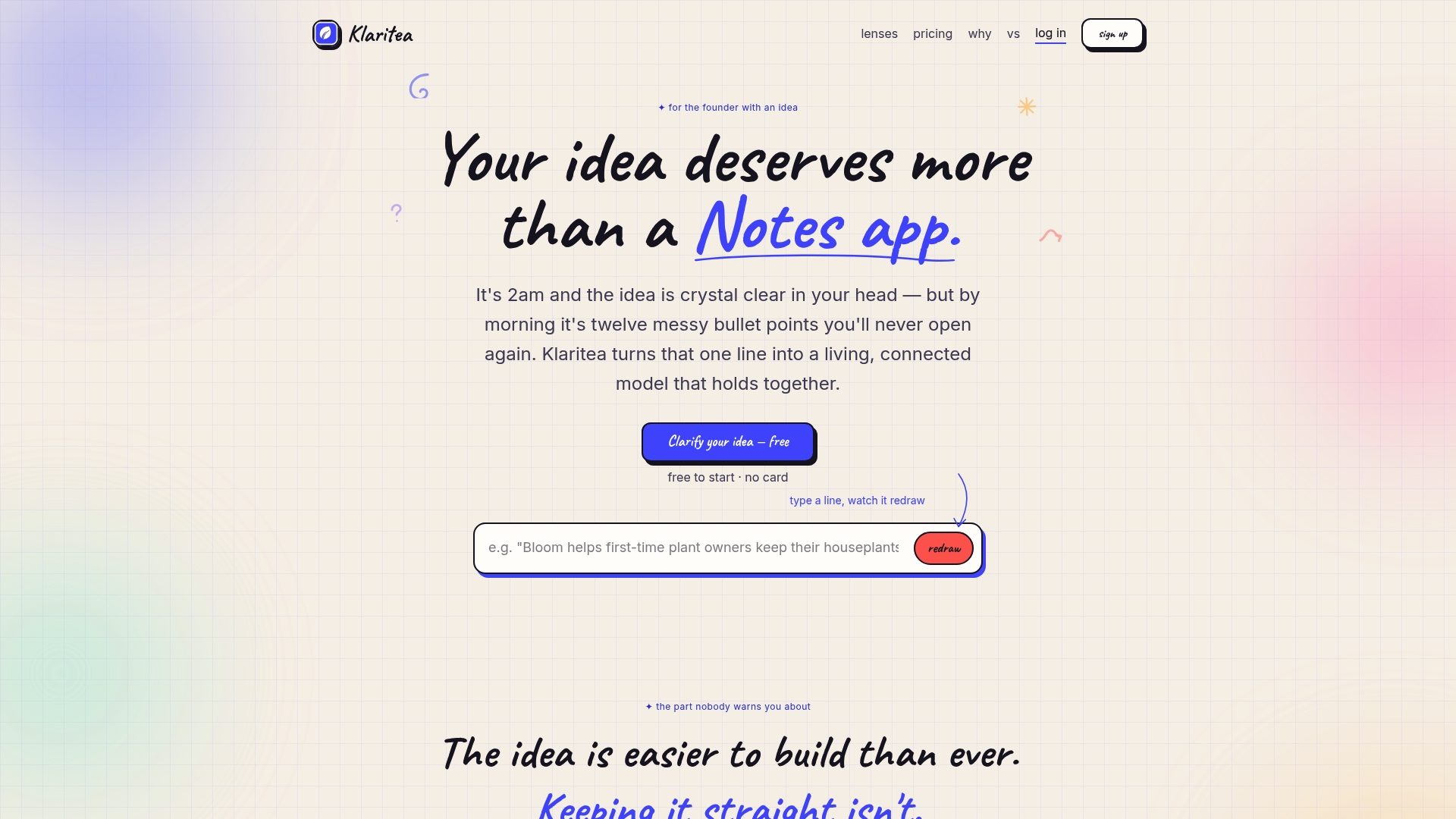
Type your idea in one line. Klaritea's AI advisors research your market, challenge your assumptions, and produce a connected model covering your ICP, TAM/SAM/SOM, competitive landscape, feature map, and a build spec scoped to your first-value moment. Every output maps directly to the Phase‑0 checklist in this article.
- Clarity scorecards show exactly where your idea is strong and where it needs more evidence
- Exportable build specs give your engineer a scoped brief, not a wish list
- GitHub sync and Notion/Confluence export keep your plan connected to your actual workflow
- A free tier lets you start without a credit card
See how Klaritea prevents wasted builds before your next sprint starts.
Sources
- Startup failures: reasons top — CB Insights
- The MVP Trap: Why Shipping Fast is a Dangerous Substitute for Market Evidence
- Phase 0 vs Phase 1 | Think Insights
- Why Early SaaS Founders Build The Wrong Thing (And How To Fix It Before It Kills Your Product) | Atticus Li
- Phase Zero: The design step everyone skips - by Dipaq
FAQ
What does vibe coding mean for founders?
Vibe coding describes the impulsive habit of starting to build a product from a fuzzy idea before running any structured market validation. It is distinct from AI-assisted development; the term here refers to a decision-making failure, not a coding technique.
Why does vibe coding lead to startup failure?
Vibe coding skips the validation work that would surface PMF problems before capital is spent.
How long does Phase‑0 validation actually take?
A focused Phase‑0 sprint typically takes one to three weeks. A landing page presale and five discovery interviews can be completed in under two weeks for under $300 in total spend.
What is the minimum evidence needed before building?
For a solo founder, three paid commitments from people outside your network and five interviews with consistent verbatim language overlap are a defensible minimum threshold before approving engineering time.
How does Klaritea help with Phase‑0?
Klaritea takes a one-line idea and produces a connected model covering ICP, TAM/SAM/SOM, competitive analysis, and a build spec scoped to the first-value moment, with clarity scorecards that show exactly where more evidence is needed.