What is a value proposition generator?
A value proposition generator is an AI-powered tool that takes your business inputs and produces clear, copy-ready statements explaining why customers should choose you over every alternative. The term "value proposition" itself traces back to a 1988 McKinsey & Company paper describing it as a "clear, simple statement of benefits" to a specific customer. These generators operationalize that definition at speed.
The core components a good generator addresses:
- Customer: who specifically you serve
- Problem: the pain or need they feel
- Product: what you offer
- Benefit: the concrete outcome they get
- Differentiator: why you beat the alternatives
One thing worth getting straight: a value proposition is not a tagline, a feature list, or a mission statement. A feature describes what your product does. A value proposition describes what the customer gets. If your statement could sit on a competitor's homepage without anyone noticing, it is not a value proposition yet.
Table of Contents
- How a value proposition generator works
- Why AI-powered generators save founders real time
- Expert strategies to refine AI-generated propositions
- Examples of compelling AI-generated value propositions
- Comparing popular value proposition generator tools
- Klaritea builds the whole model, not just the message
- Key Takeaways
- FAQ
How a value proposition generator works
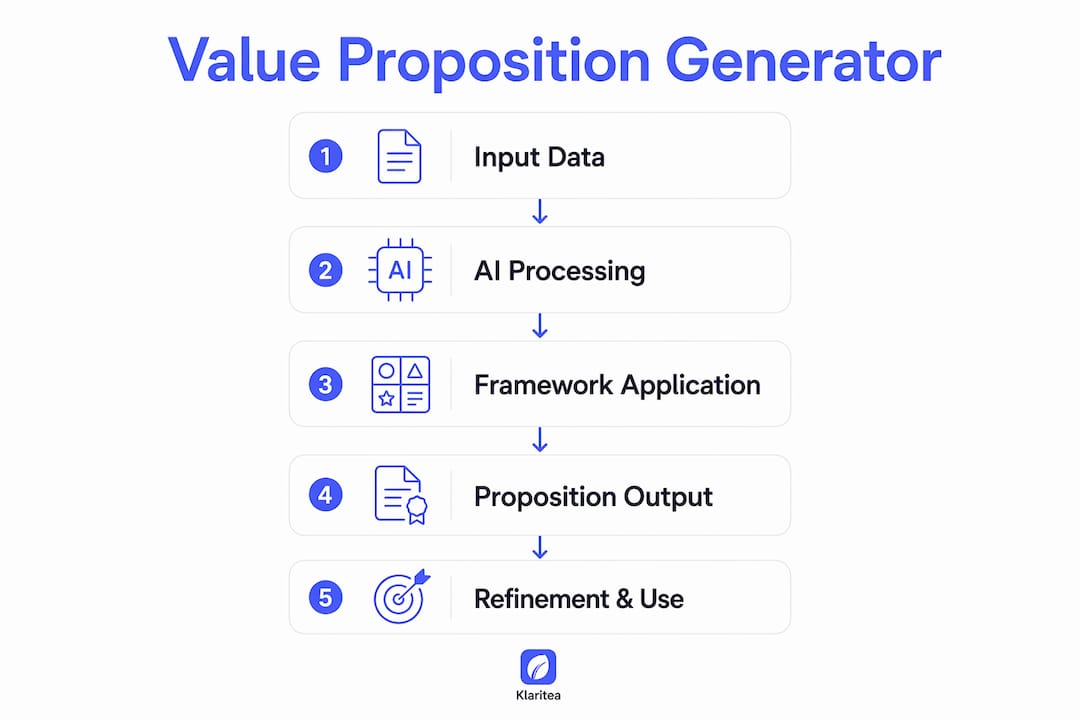
The process is straightforward, but the output quality depends on what you put in.
- Enter your product description. One or two sentences on what you actually built.
- Define your target customer. "Small businesses" is too broad. "Solo marketers at companies under 50 people" is specific enough to work with.
- Name the problem. The pain your customer feels before they find you.
- State the benefit. The concrete outcome you deliver, ideally with a number or timeframe.
- Identify your differentiator. The one thing that would not be true about your competitor.
- Select a framework. Most generators support Geoffrey Moore's Crossing the Chasm template ("For [customer] who [problem], our [product] is a [category] that [benefit], unlike [alternative]"), the Steve Blank XYZ format ("We help [customer] achieve [benefit] by [how]"), and a before/after structure.
- Review multiple outputs. Generators produce multiple copy-ready statements instantly so you can pick the version that lands fastest.
Natural language processing handles tone and clarity, adjusting the output for a homepage headline versus an elevator pitch. The result is several proposition variants ready to test, not a single "correct" answer.
Why AI-powered generators save founders real time
Speed is the obvious win, but the deeper benefit is forcing clarity you might otherwise skip.
- Faster iteration: generating five variants takes minutes, not days
- Jargon removal: AI tools flag vague phrases and push you toward concrete user benefits under 15 words
- Framework consistency: every output follows a proven structure, so nothing critical gets left out
- Testing readiness: multiple versions come out pre-formatted for A/B testing on landing pages
Founders who skip this step pay for it later. Over 80% of founder-built apps never see a return, and unclear value messaging is one of the earliest warning signs. Getting the proposition right before you build is cheaper than pivoting after launch.
Pro Tip: Run the same inputs through at least two different frameworks. The Geoffrey Moore version and the Steve Blank XYZ version will surface different angles, and the contrast often reveals which benefit actually matters most to your customer.
Expert strategies to refine AI-generated propositions
AI output is a starting point, not a finished product. Here is how to close the gap.
- Mine customer language. Open your reviews, support tickets, and cancellation surveys. The exact phrases customers use to describe why they chose you are almost always better than anything your marketing team invents. Mirror that language back in your proposition.
- Test with outsiders. Show your proposition to five people who do not know your business and ask them to explain what you do. If they can repeat back what you do, who it is for, and why it is better, it is working.
- Use the Value Proposition Canvas. This visual tool maps your product features against customer pains and gains, forcing messaging grounded in real needs rather than internal assumptions.
- Segment by persona. Successful founders create segment-specific variants tailored to different buyer personas and channels. What resonates with a CFO differs from what lands with a developer.
- Prioritize clarity over cleverness. A CXL eye-tracking study found that detailed, specific propositions get noticed faster and recalled better than short, vague ones.
Pro Tip: Treat your value proposition as a living document. Plug it into your pitch deck, homepage headline, and onboarding emails, then track which version drives the most signups. The data will tell you what the brainstorm cannot.
Examples of compelling AI-generated value propositions
Seeing the frameworks in action makes the difference between understanding them and actually using them. Here are three examples built from the Geoffrey Moore and Steve Blank templates:

SaaS project tool (Geoffrey Moore): "For remote teams who lose track of deadlines across tools, our platform is a project hub that surfaces blockers before they delay shipping, unlike spreadsheets that require manual updates."
E-commerce subscription (Steve Blank): "We help busy parents get healthy weeknight dinners on the table by delivering pre-portioned ingredients with 20-minute recipes."
B2B analytics tool (before/after): "Right now, your sales team spends three hours a week pulling reports from disconnected systems. With our tool, that becomes a single dashboard updated in real time."
Notice what each one does: names a specific customer, describes a felt problem, states a concrete outcome, and names the alternative being replaced. None of them use buzzwords. None could sit on a competitor's homepage unchanged.
Comparing popular value proposition generator tools
Three tools come up consistently for startups and marketers building propositions from scratch.

IdeaBuddy combines a value proposition builder with a full business idea validation workflow. You work through a guided canvas that covers your customer profile, problem, and solution before generating the statement. It suits founders who want the proposition embedded in a broader business plan rather than as a standalone output.
M1-Project AI focuses on marketing strategy and ICP definition. It generates propositions alongside audience research, which means the output is grounded in market data rather than just your own inputs. Reviews on G2 and Capterra highlight its depth on customer segmentation as a standout feature.
Grammarly AI Value Proposition Generator is the lightest-weight option. You describe your product and audience, and it returns a polished statement in seconds. The tradeoff is depth: it does not walk you through frameworks or force you to name a differentiator, so the output requires more manual refinement. For a first draft or a quick gut-check, it gets the job done.
For AI business strategy tools that go beyond proposition generation into full market modeling, the category has expanded considerably in 2026.
Klaritea builds the whole model, not just the message
A value proposition is one output. Klaritea builds the connected structure underneath it.
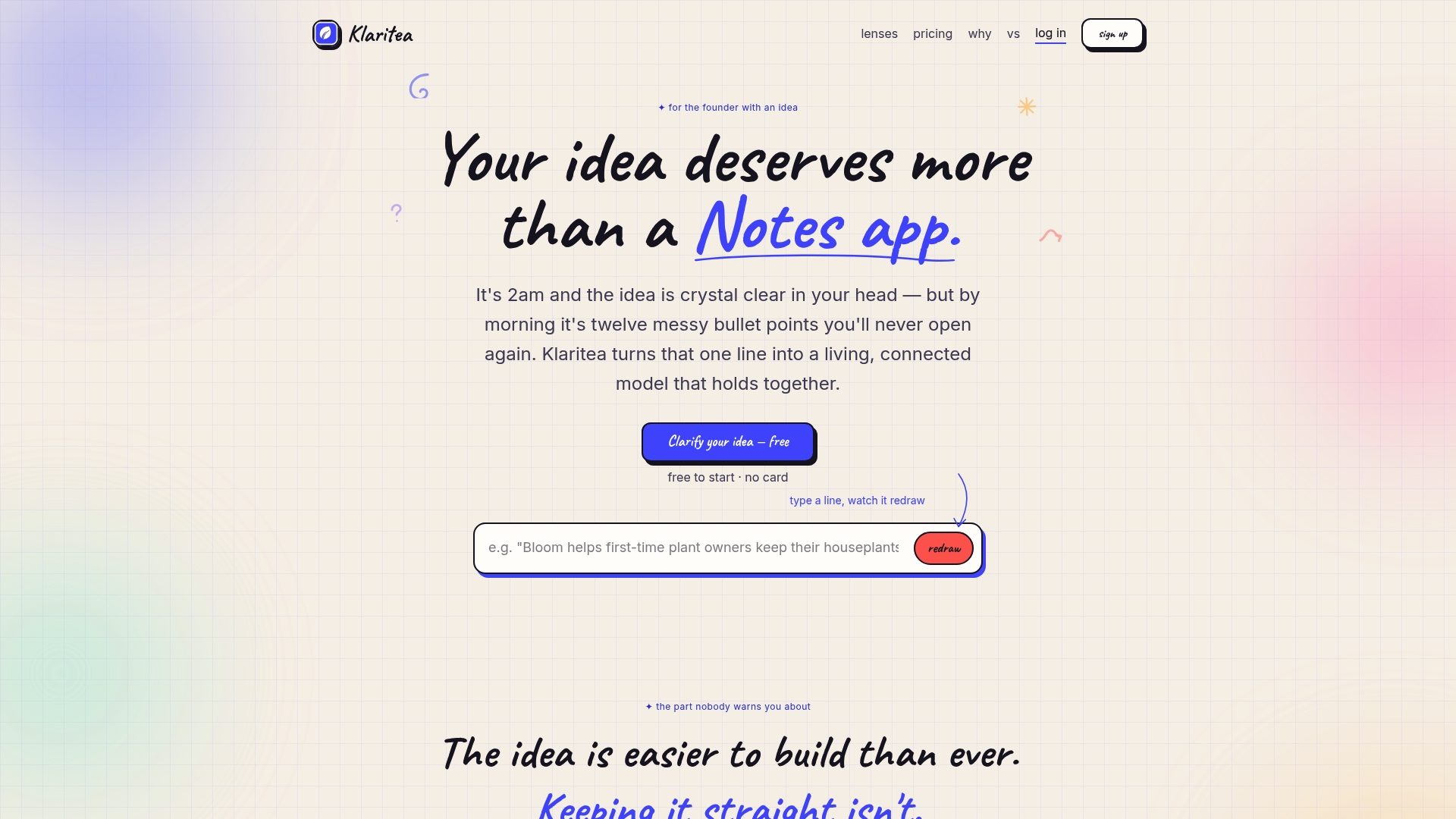
Type your idea in a single line and Klaritea produces your ICP, TAM/SAM/SOM, competitor analysis, feature map, and build spec alongside your positioning. Three AI advisors (Maya for marketing, Devon for business, Priya for ops) research and challenge your idea before you spend a dollar on development. The one connected model means your value proposition is grounded in real market data, not guesswork.
For founders who want to validate before they build, start with Klaritea and get the full picture in one session.
Key Takeaways
AI-powered value proposition generators produce copy-ready statements fastest when you combine proven frameworks with real customer language and outside validation.
| Point | Details |
|---|---|
| Use proven frameworks | Geoffrey Moore's template and Steve Blank's XYZ format cover most positioning needs. |
| Clarity beats length | Effective propositions stay under 15 words and name a concrete benefit, not a feature. |
| Test with real people | Show your proposition to five outsiders; if they can explain what you do, it works. |
| Mine customer language | Reviews and support tickets contain better copy than anything your team invents. |
| Klaritea goes deeper | Klaritea builds your full business model alongside your proposition, grounding messaging in market data. |
FAQ
What is a value proposition generator?
A value proposition generator is an AI tool that takes your product, customer, problem, benefit, and differentiator as inputs and returns copy-ready positioning statements built on proven frameworks like Geoffrey Moore's template.
How long should a value proposition be?
Your homepage headline should be a single statement a visitor grasps in about five seconds, often supported by a one-line subheadline. Under 15 words is the standard target for clarity and impact.
How do I know if my value proposition is working?
Show it to five people outside your company and ask them to explain what you do. If they can answer without follow-up questions, it is clear. Then A/B test two or three versions on your homepage to see which drives more signups.
What is the difference between a value proposition and a mission statement?
A mission statement describes why your company exists. A value proposition tells a specific customer why they should buy from you instead of the alternative. Founders often conflate the two, but they serve completely different purposes.
Can Klaritea help with value proposition creation?
Yes. Klaritea builds your ICP, market sizing, and competitor analysis alongside your positioning, so your value proposition is grounded in a full business model rather than a standalone statement.