A unique selling proposition (USP) is the one specific, provable reason a customer should pick your product over every other option. It's not a slogan. Slogans can be vague; a USP has to be true and checkable.
Use this template: [Brand] helps [target customer] get [measurable benefit] through [differentiator no one else offers].
- Plug it into your homepage headline or your elevator pitch, word for word.
- If you can't name the differentiator in five words, you don't have a USP yet, you have a wish.
- Test it by removing your brand name. If the sentence still describes three competitors, it's not unique.
Key Takeaways
A defensible unique selling proposition names one buyer, one measurable benefit, and one verifiable differentiator, then gets tested before it's trusted.
| Point | Details |
|---|---|
| Define before you decide | A USP is one verifiable claim, not a slogan or a broad value proposition. |
| Gather evidence first | Interview five to ten customers and map competitor gaps before drafting anything. |
| Write outcomes, not features | State what changes for the buyer, like time saved or risk reduced, not a spec list. |
| Validate with cheap tests | Run customer interviews, an A/B headline test, and track conversion lift for two weeks. |
| Match claim type to proof | Emotional claims like Nike's need brand consistency; price claims like Walmart's need receipts. |
| Plan before you build | Klaritea connects your USP draft to market data and competitor analysis so the claim holds up before you spend on development. |
Table of Contents
- What Does Unique Selling Proposition Mean?
- Why Does a Business Need a Unique Selling Proposition?
- How Do You Write a Unique Selling Proposition?
- What Are Some Famous Examples of a USP?
- Is a USP the Same as a Value Proposition?
- How Do You Test Whether a USP Actually Works?
- Pick a USP You Can Actually Keep
- Turn Your USP Draft Into a Tested Business Claim
- Sources
- FAQ
What Does Unique Selling Proposition Mean?
A unique selling proposition tells a customer, in one line, why your brand beats the alternative on something they actually care about. The term comes from Rosser Reeves, the advertising executive who built the concept in the 1940s and 1950s while working on campaigns for brands like M&M's and Colgate. Reeves argued the concept meant something specific, not just "your ad has to be different."
Reeves set three rules: every ad must make a proposition, that proposition must be one competitors either don't or can't make, and it must be strong enough to pull in new customers, according to Wikipedia's history of the concept.
That third rule is the one most founders skip. A cute claim that doesn't move anyone isn't a USP.
- USP: a specific, verifiable product claim
- UVP (unique value proposition): broader, often emotional value across the whole offering
- Positioning: where you sit in the market relative to competitors, long term
Why Does a Business Need a Unique Selling Proposition?
Without a clear differentiator, you're forced to compete on price, and price wars favor whoever has the deepest pockets. Wikipedia's overview notes that a strong USP has to target a specific audience and be a promise the brand can actually keep, or it risks becoming just another commodity option.
A sharp USP also cuts the cognitive load on your buyer. They don't have to compare fifteen feature lists; they just need one reason that matters to them.
- Messaging efficiency: one clear claim outperforms five vague ones in ad copy and landing pages
- Pricing power: buyers pay more when they believe the benefit is exclusive to you
- Metrics to watch: conversion rate lift on your homepage, referral rate, and how much price resistance drops in sales calls
Statsig's guidance on USP measurement points to adoption and engagement metrics as the real proof, not just how catchy the line sounds in a meeting.
How Do You Write a Unique Selling Proposition?
Writing a USP is less about wordsmithing and more about evidence gathering. Skip straight to a clever line and you'll end up with something generic. Here's the order that actually works.
- Gather evidence first. Talk to five to ten customers about what almost stopped them from buying, and map where competitors fall short. The SBA's market research and competitive analysis guidance treats this step as foundational, not optional, before you commit to any differentiator.
- Pick one buyer and one measurable benefit. Not three buyers, not five benefits. "Faster onboarding for solo consultants" beats "great for everyone."
- Draft the one-line claim using the template, and make sure it's verifiable. "24-hour turnaround" can be checked. "Best customer service" cannot.
- Embed proof points everywhere. Zendesk's take on USPs makes the case that a USP only sticks when it shows up in marketing, sales calls, and support interactions, not just an ad.
Once you have a draft, run it through a short validation pass:
- Interview prompt: "If we disappeared tomorrow, what would you miss most?" Their answer should match your claim.
- A/B test: run two landing page headlines, your USP versus a generic benefit statement, and compare signup rate.
- KPI to track for two weeks: conversion rate on the page carrying the claim.
Pro Tip: The most common failure is writing a USP around a feature instead of an outcome. "Cloud-based inventory software" is a feature. "Cut stockouts by tracking inventory in real time from anywhere" is an outcome. Ask yourself: what changes for the buyer's day, their bank account, or their stress level? If your draft doesn't answer that, rewrite it. This mirrors advice from Branding Strategy Insider's analysis of Reeves' work, which flags feature dumping as the most common way brands water down a strong claim.
Micro worksheet: write your product name, then finish this sentence three different ways: "Unlike [competitor type], we're the only ones who ___." Pick the version you could prove in a customer call today, not the one that sounds best on a slide.
What Are Some Famous Examples of a USP?
Seeing a real claim broken down is more useful than another abstract rule. Three brands make the point clearly, each with a completely different angle.
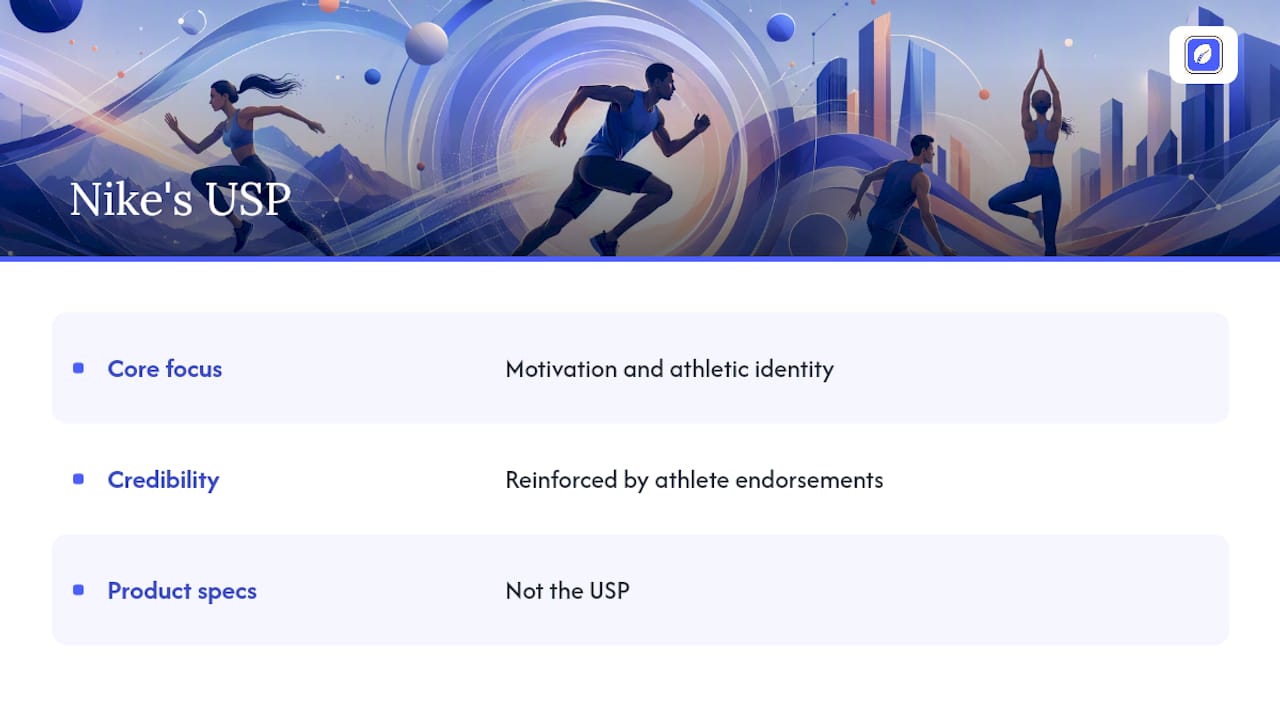
- Nike leans emotional and motivational rather than feature-based. The brand doesn't compete on shoe specs in its core messaging; it sells identity and performance mindset, reinforced through athlete partnerships that make the claim feel earned rather than asserted.
- Starbucks built its USP around consistent experience and service, not just coffee quality. The "third place" positioning, a space between home and work, works because it's demonstrable in every store layout and staff interaction.
- Walmart goes the opposite direction entirely, price and access.
"Save money, live better" is about as verifiable as a USP gets: customers can check the receipt, according to Wikipedia's discussion of price-led USPs.
The takeaway: match your claim type to what your product can actually prove. If you can't back an emotional claim with brand consistency the way Nike or Starbucks does, a price or speed claim you can measure might serve you better.
Is a USP the Same as a Value Proposition?
They overlap but aren't identical, and mixing them up leads to messaging that's either too narrow or too vague. A USP is typically one sharp, objectively checkable claim, while a unique value proposition covers the fuller picture of value, functional and emotional combined, according to Wikipedia's clarification of the two terms. Positioning is broader still: it's your overall stance in the market, built over years, not a single line.
Evaluate any claim across five dimensions before deciding which format fits:
- Target fit: does it speak to one clear buyer, or everyone?
- Differentiator type: functional (speed, price, feature) or emotional (identity, trust)?
- Verifiability: can a customer check it themselves?
- Communication clarity: does it fit in a headline, or does it need a paragraph?
- Channel fit: does it work in a 6 word ad, or only in a sales deck?
Use a short USP on ads and homepages. Save the fuller UVP for your about page or a longer pitch. Positioning statements rarely appear word-for-word to customers; they guide internal strategy instead. If you need a structured way to separate these three, a value proposition generator can help you draft each version side by side.
How Do You Test Whether a USP Actually Works?
Don't guess. Run three cheap tests before you commit ad spend or rewrite your whole homepage around a claim.
- Run five customer interviews asking what almost made them choose a competitor instead, and see if your claim comes up unprompted.
- A/B test two headlines on your landing page, one with your USP, one generic, and measure which converts better over a two-week window.
- Track a short funnel: visits to signups, and watch for drop-off right after the headline.
Watch conversion rate lift, activation numbers, and a simple satisfaction score. Statsig's framework treats these as the real signal, more reliable than whether people say they "like" the line in a survey. If results are flat after two weeks, the claim probably isn't the differentiator you think it is. Go back to the interviews, not the wording.
Pick a USP You Can Actually Keep
Most founders write a USP that sounds great in a pitch deck and falls apart the moment operations can't back it up. A claim about "fastest delivery" means nothing if your fulfillment process can't consistently hit that number. Before you publish anything, check the claim against your actual roadmap and capacity, not your ambitions for next quarter.

Pro Tip: Try selling your USP to your own team first. If your support staff or engineers wince at the claim, customers will eventually catch the gap too. That's exactly the kind of pressure test Klaritea builds into its planning process, connecting your claim to real evidence instead of letting it float free of the business model behind it.
Turn Your USP Draft Into a Tested Business Claim
Most founders write a USP on a whiteboard and never check whether the market, the competition, or their own operations can back it up. That gap is exactly where Klaritea sits. Instead of guessing at a differentiator, you type your idea as one line, and Klaritea builds out the ICP, TAM/SAM/SOM, and competitor gaps that tell you whether your claim actually holds up.
Klaritea's AI advisory board, Maya on marketing, Devon on business strategy, and Priya on operations, stress-tests your claim from three angles before you spend a dollar building anything. The "Clarity" lens shows you exactly where your USP is unproven, while the "Build" lens turns a validated claim into a spec you can hand to a developer or a vibe-coding tool. If you've already got a rough USP draft, run it through Klaritea's connected model, see how it holds up against real market data, and export a landing page brief to test it this week. Start by mapping out why a connected model beats a scattered plan.
Sources
- Unique selling proposition - Wikipedia
- USP Meaning: Definition, Examples, and Metrics That Matter - Statsig
- What is a unique selling proposition? Examples and definition - Zendesk
- Market research and competitive analysis - SBA
FAQ
What is the USP of Nike?
Nike's USP centers on motivation and athletic identity rather than product specs, reinforced through athlete endorsements that make the emotional claim credible.
What is the unique selling proposition of Starbucks?
Starbucks positions itself as a consistent "third place" experience between home and work, backed by uniform service and store design across locations.
What's the difference between a USP and a UVP?
A USP is typically one sharp, checkable claim, while a UVP covers the broader mix of functional and emotional value your whole product delivers.
How do I validate a USP before launching?
Run short customer interviews, A/B test a headline built around the claim against a generic one, and track conversion lift for about two weeks.
Can Klaritea help me write and test a USP?
Yes. Klaritea turns a one-line idea into a connected model covering your target customer and competitor gaps, so your claim is backed by evidence before you build.