TL;DR:
- A SWOT analysis of artificial intelligence helps organizations evaluate internal strengths and weaknesses against external opportunities and threats for strategic decision-making. It reveals AI's speed, pattern detection, and knowledge reuse as key strengths, while unclear ownership and poor data quality are common internal weaknesses. The most significant external threats include regulatory changes and employee distrust, which organizations must monitor continuously for successful AI adoption.
A SWOT analysis of artificial intelligence is defined as a structured framework that maps AI's internal strengths and weaknesses against external opportunities and threats to guide strategic adoption decisions. Business analysts and technology enthusiasts use this framework to cut through hype and make grounded calls about where AI creates real value and where it introduces risk. The AI SWOT framework has become a standard tool in 2026 because AI adoption is no longer optional for competitive organizations. Getting the analysis right separates teams that extract measurable returns from those that burn budget on poorly scoped implementations.
What are the core strengths of artificial intelligence in business?
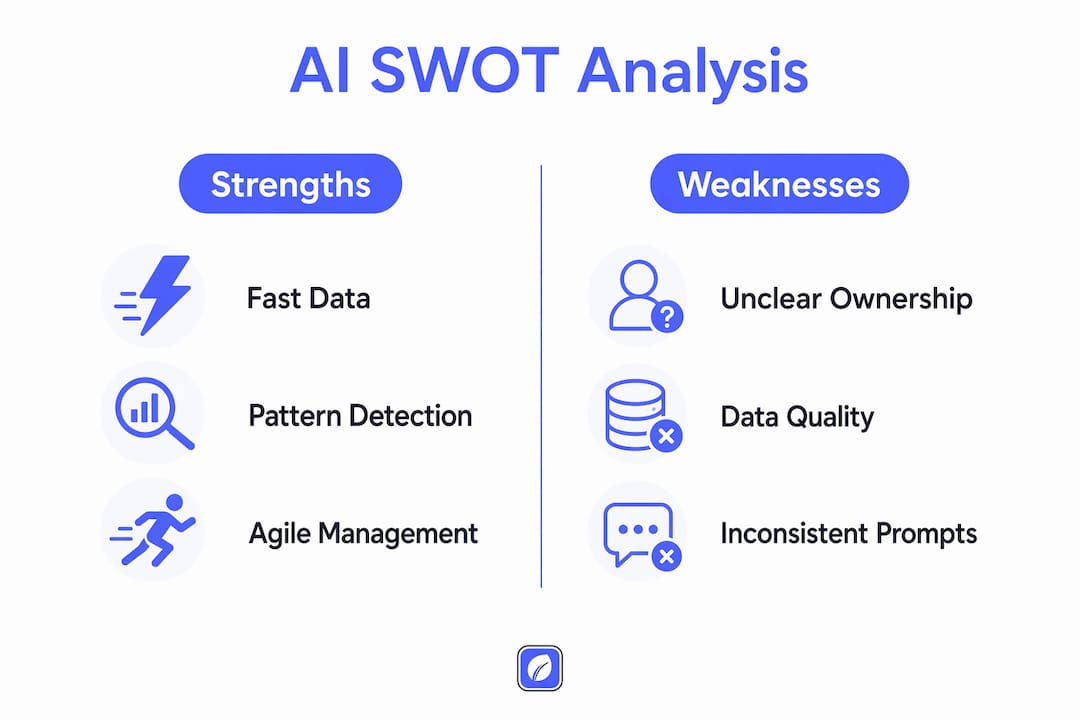
AI's most measurable strength is speed. Systems process datasets in seconds that would take human analysts days to review. That compression of time changes what is possible in planning cycles, customer response, and operational decisions.

The second major strength is pattern detection at scale. AI identifies correlations across millions of data points that no human team could manually surface. This capability directly improves forecasting accuracy in supply chains, financial modeling, and customer behavior analysis.
AI also delivers significant gains in agile project management. Integrating AI into agile workflows enhances sprint planning, backlog prioritization, and effort estimation across development teams. That means faster delivery cycles and fewer estimation errors on complex projects.
Knowledge reuse is a less discussed but powerful strength. AI systems trained on organizational data carry institutional knowledge that survives employee turnover. A well-configured AI model retains context that would otherwise walk out the door with a departing analyst.
Key AI strengths at a glance:
- Processes large datasets faster than any human team
- Automates repetitive tasks, freeing analysts for higher-order work
- Detects patterns and anomalies across structured and unstructured data
- Improves sprint planning and effort estimation in agile environments
- Retains and reuses organizational knowledge at scale
Pro Tip: Audit your existing organizational strengths before deploying AI. AI acts as an amplifier, so strong data practices and clear processes produce outsized gains, while weak foundations produce amplified errors.
What internal weaknesses does AI implementation reveal?
The most common internal weakness is unclear ownership. Organizations deploy AI tools without assigning accountability for outputs, governance, or quality review. Internal weaknesses in AI adoption consistently include unclear ownership, poor data quality, inconsistent use, and the absence of output standards. These are not technology problems. They are organizational design problems.
Data quality is the second critical weakness. AI models are only as reliable as the data they consume. Organizations with fragmented data pipelines, inconsistent labeling, or siloed databases produce AI outputs that mislead rather than inform.
Workforce readiness compounds both issues. Most teams lack training in prompt engineering, output validation, or AI-assisted decision workflows. Without upskilling, analysts default to treating AI outputs as final answers rather than intermediate drafts requiring human review.
- Unclear ownership of AI outputs and governance processes
- Poor data quality undermining model reliability
- Inconsistent prompt usage producing variable results
- No defined standards for when AI output is "ready to use"
- Insufficient workforce training and workflow restructuring
Pro Tip: Treat your AI SWOT analysis as a living document, not a one-time report. Schedule quarterly reviews to update findings as your data, tools, and market conditions change.
What external opportunities does AI present for businesses?
AI opens new business models including mass personalization, predictive advisory services, and autonomous operations that were previously uneconomical to build. These are not incremental improvements to existing models. They represent entirely new categories of value creation.
Faster strategic planning is the most immediate opportunity. AI compresses the time required to generate market intelligence, synthesize competitive data, and produce scenario models. Teams that previously spent three weeks on a strategic review can now complete the same analysis in days.
Real-time competitive intelligence is another major opportunity. AI tools scan news feeds, regulatory filings, patent databases, and social signals continuously. That gives analysts a live view of market shifts rather than a quarterly snapshot.
Human-AI collaboration creates a third category of opportunity. Hybrid teams that combine AI's processing speed with human judgment and contextual reasoning outperform either working alone. The SWOT analysis AI benefits extend furthest when humans remain in the loop to validate, challenge, and act on AI outputs.
| Opportunity | Traditional approach | AI-driven approach |
|---|---|---|
| Market analysis | Manual research, 2–4 weeks | Automated scanning, hours to days |
| Customer personalization | Segment-level targeting | Individual-level real-time adaptation |
| Competitive intelligence | Periodic reports | Continuous live monitoring |
| Strategic planning cycles | Quarterly reviews | Ongoing dynamic updates |
| New business model creation | High cost, slow iteration | Faster prototyping and validation |
What external threats must organizations monitor in AI adoption?
The regulatory environment is the fastest-moving external threat. Governments across the EU, US, and Asia are introducing AI-specific legislation at a pace that outstrips most organizations' compliance cycles. Fast-changing tools and unclear standards create real exposure for teams that build processes around today's AI capabilities without accounting for tomorrow's legal constraints.
Employee distrust is a threat that most organizations underestimate. Analysts who do not understand how an AI system reaches its conclusions will either ignore its outputs or over-rely on them. Both behaviors reduce the value of the investment.
Data security and privacy risks grow with every new AI integration. Each connection between an AI tool and an internal data source creates a potential exposure point. Organizations that move fast without security review accumulate risk quietly.
Vendor lock-in is the fourth major threat. Teams that build critical workflows around a single AI platform become dependent on that vendor's pricing, uptime, and product decisions. Diversifying across tool categories reduces this exposure.
- Rapidly shifting AI regulations across major markets
- Employee resistance and distrust of AI-generated decisions
- Data privacy and security vulnerabilities from new integrations
- Vendor lock-in from overreliance on a single AI platform
- Overconfidence in AI summaries that obscure flawed assumptions
Pro Tip: Use AI-powered monitoring tools to track regulatory changes and competitive signals in real time. The same technology that creates threats can serve as your early warning system.
How does AI transform SWOT from a static report into a live strategy tool?
Traditional SWOT analysis produces a document. AI-powered SWOT analysis produces a process. That distinction changes how organizations plan, respond, and compete.
AI SWOT generators reduce analysis production time from weeks to under two minutes, delivering structured visual outputs. That speed means teams can run scenario-specific SWOT analyses before every major decision rather than once per quarter. The value is not just efficiency. It is the ability to test strategic assumptions in near real time.
The gap between analysis and action remains the biggest design challenge. Most users of AI SWOT tools stop before the action recommendation stage, revealing a process design gap rather than a technology limitation. The tool generates the matrix. The team never converts it into a prioritized action plan.
Effective AI SWOT requires human-in-the-loop validation at every stage. AI surfaces patterns and generates hypotheses. Humans apply context, challenge assumptions, and assign accountability. AI SWOT works best as a collaborative ongoing process grounded in quantitative data, not as a one-time report.
| Dimension | Manual SWOT | AI-driven SWOT |
|---|---|---|
| Time to produce | Days to weeks | Minutes to hours |
| Data sources | Limited, curated | Broad, real-time |
| Update frequency | Quarterly or annual | Continuous |
| Consistency | Varies by analyst | Standardized structure |
| Action conversion | Often stalls | Requires deliberate process design |
For teams evaluating strategic planning AI software, the key differentiator is not generation speed. It is whether the platform supports the full cycle from insight to decision to execution.
Key Takeaways
A SWOT analysis of artificial intelligence delivers the most value when it runs continuously, integrates human validation, and connects directly to prioritized action plans rather than sitting as a static document.
| Point | Details |
|---|---|
| AI amplifies existing strengths | Strong data practices and clear processes produce the largest AI-driven gains. |
| Ownership gaps are the top weakness | Assign clear accountability for AI outputs before deploying any tool. |
| New business models are the biggest opportunity | AI enables mass personalization and predictive services previously uneconomical to build. |
| Regulatory change is the fastest-moving threat | Monitor AI legislation continuously, not just at annual compliance reviews. |
| Analysis without action is the core design flaw | Most teams generate AI SWOT outputs but never convert them into execution plans. |
Why I think most AI SWOT analyses fail before they start
The failure mode I see most often is not bad technology. It is treating the AI output as the deliverable. A team runs a SWOT generator, gets a clean four-quadrant matrix, and files it. Nothing changes. The AI SWOT's real value lies in compressing time and surfacing categories of insight that were previously inaccessible, not in producing a prettier document.
The second failure mode is overconfidence in the black box. AI systems do not explain their reasoning in the way a human analyst would. AI SWOT must overcome the black box challenge with clear governance and iterative human review to avoid misplaced decisions. When an AI flags a threat or identifies an opportunity, the analyst's job is to interrogate that finding, not accept it.
The organizations that get this right treat AI as a first-draft engine and human judgment as the editorial layer. They assign ownership, set review cadences, and build the habit of converting SWOT outputs into ranked action items. That combination is where the competitive advantage actually lives. For teams building this discipline, exploring AI business strategist tools that support the full planning cycle is a practical next step.
— Karl
How Klaritea supports AI-powered strategic planning
Klaritea is built for the moment before you start building. You type a one-line idea and it generates a connected model covering your market, competitors, features, requirements, and build spec. That structure is exactly what a rigorous AI SWOT process demands: a clear, validated view of your position before you commit resources.
The three AI advisors inside Klaritea (Maya for marketing, Devon for business, and Priya for ops and QA) research, challenge, and fact-check your idea from multiple angles. That built-in challenge process mirrors the human-in-the-loop validation that separates useful AI SWOT analysis from overconfident outputs. If you want to see how Klaritea's connected model turns a fuzzy idea into a structured plan, the platform is worth exploring before your next strategic planning cycle.
FAQ
What is a SWOT analysis of artificial intelligence?
A SWOT analysis of artificial intelligence is a structured framework that evaluates AI's internal strengths and weaknesses alongside external opportunities and threats. It gives business analysts a clear map for making adoption and investment decisions.
What are the main strengths of AI in business?
AI's primary strengths include fast data processing, automation of repetitive tasks, pattern detection at scale, and improved agile project management outcomes such as better sprint planning and effort estimation.
What weaknesses does AI implementation typically reveal?
The most common weaknesses are unclear ownership of AI outputs, poor data quality, inconsistent prompt usage, and insufficient workforce training. These are organizational problems, not technology failures.
What opportunities does AI create for technology-driven businesses?
AI enables new business models including mass personalization and predictive advisory services, faster strategic planning cycles, and continuous real-time competitive intelligence that was previously too expensive to maintain.
What is the biggest threat to AI adoption in organizations?
Rapidly changing regulations and employee distrust are the two most immediate external threats. Vendor lock-in and data security vulnerabilities grow in significance as AI becomes more deeply embedded in core workflows.