Picking business planning software that covers both strategic frameworks and board-ready outputs without heavy consulting fees is still too hard. Most tools lock advanced collaboration, scenario validation, or live data connections behind high-tier pricing or require manual data exports. This list compares price, automation, scenario tools, and export options so strategic teams can match a tool to their current workflow and budget.
Table of Contents
- Upmetrics
- Plan
- STRATUM
- StratEngine AI
- Strativ
- Tegy by RocketMinds
- Comparison of alternatives
- Comparison of alternatives
Upmetrics
At a Glance
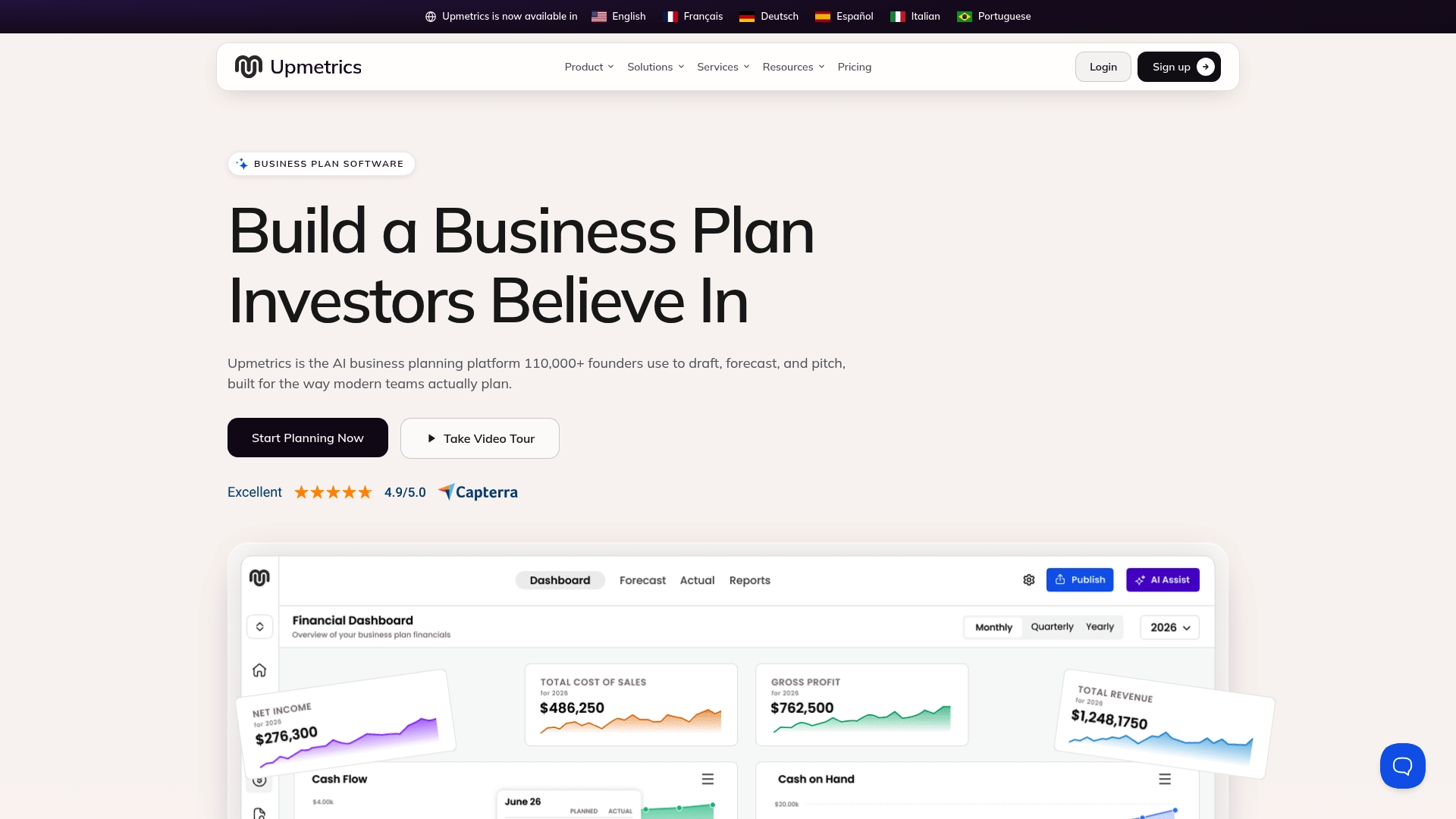
Upmetrics reports more than 110,000 founders use the platform. The product combines AI-assisted plan writing with live connections to accounting systems so your projections and actuals stay aligned. That combination targets founders who must move quickly from idea to investor-ready materials.
Core Features
Upmetrics offers AI-assisted plan writing that drafts sections and suggests language based on your inputs, and it includes financial forecasting with scenario testing to compare revenue and cost assumptions. The platform provides a pitch deck creator, collaborative workspaces for team review, and custom templates and strategic frameworks to speed iteration.
Key Differentiator
The standout is the live data connection to QuickBooks Online and Xero paired with AI plan generation, which keeps projections and real-world actuals visible inside the same planning workflow.
Pros
The product groups drafting, forecasting, and pitch creation into one workspace so founders avoid copying between tools. Its collaboration features let mentors and cofounders comment and edit inside the same document. The live accounting sync reduces manual reconciliation and helps you track performance against plan without exporting spreadsheets.
Cons
- Complex model limits: Third-party reviews report that the platform struggles with highly complex financial modeling and advanced forecasting scenarios. This may force finance teams to export data for deep analysis.
- Stability and support: User comments mention occasional platform instability and slow support response times, which can slow deadlines around investor pitches.
- Learning curve: The breadth of templates and frameworks can overwhelm founders who lack prior business planning experience.
When It May Not Fit
If your company needs multiyear, multi-entity financial modeling with bespoke formulas, Upmetrics may feel constrained. Large enterprise finance teams that run advanced analytics will likely prefer a dedicated financial modeling tool. Similarly, solo founders who want only a simple one-page plan might find the feature set more than they need.
Notable Integrations
- QuickBooks Online
- Xero
Who It's For
Founders and solo entrepreneurs who need a single place to draft a plan, build a pitch deck, and connect live financials will get the most value. Business consultants, educators, and incubators can use the collaborative workspaces for teaching and client reviews. Teams that use QuickBooks Online or Xero gain the biggest practical benefit from the live sync.
Real World Use Case
A startup drafts its business plan using the AI writer, tests conservative and aggressive revenue scenarios in the forecasting tool, and builds a pitch deck from the plan slides. They connect their QuickBooks account and monitor actuals against projections during the first two quarters. That flow helped the founders spot a cash shortfall earlier and adjust hiring plans.
Pricing
Upmetrics lists a Premium plan at $14/month and a Professional plan at $37/month when billed annually. The vendor advertises discounts for yearly billing and for volume or educator accounts. These tiers aim to cover solo entrepreneurs up to small teams.
Website: https://upmetrics.co
Plan
At a Glance
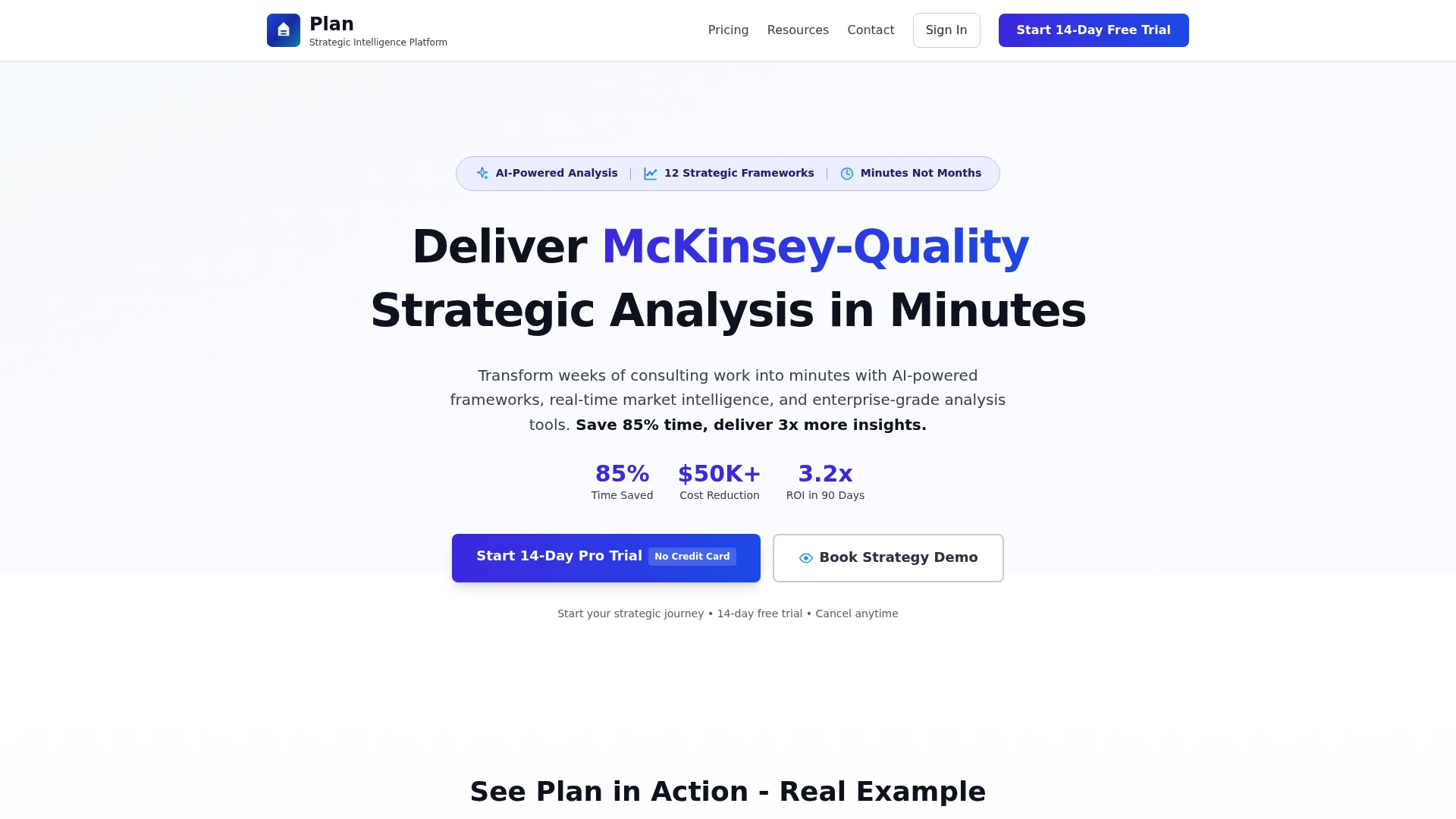
According to the company, a Saudi coffee chain used Plan to compress a multi-week European expansion analysis into a 30-minute run and saved over $75,000. That claim illustrates how the tool prioritizes speed for strategic planning AI work. The platform targets consultants and founders who need rapid, presentation-ready frameworks without long consulting engagements.
Core Features
The vendor describes 12 comprehensive strategic frameworks driven by more than 15 specialized AI agents, including SWOT, Porter’s Five Forces, Business Model Canvas, and GTM strategy. The platform advertises real-time market data via live APIs and a Quick Mode that generates frameworks in under 2 minutes. Professional export options include PowerPoint, PDF, Excel, and API access for handoffs to product and sales teams.
Key Differentiator
Plan combines specialized AI agents with live market feeds so the analysis updates with current signals rather than static templates. That pairing lets teams run side-by-side framework comparisons and surface contradictions across models quickly. For teams that value a data feed plus generative analysis, this creates faster iteration and clearer exportable deliverables.
Pros
According to the company, Plan can reduce analyst time from weeks to minutes, which shortens turnaround for market entry briefs and client decks. The platform supports unlimited iterations and live collaboration, so teams can refine assumptions together and lock a narrative faster. Integrated market sources let you validate claims with live signals before exporting a professional slide deck.
Cons
- Third-party reviews report limited customization for highly specific industry needs, which can constrain niche analyses.
- New users report a learning curve when adapting templates and agent prompts to their internal language and assumptions.
- Enterprise-only capabilities such as custom AI training and dedicated support sit behind higher-tier or bespoke plans.
When It May Not Fit
If you require deeply bespoke models trained on proprietary internal data, Plan may not meet your needs without a custom enterprise engagement. Small teams with minimal budget and no need for live market feeds might find simpler tools more cost effective. Companies requiring on-premise deployment are likely outside Plan’s target delivery model.
Notable Integrations
Plan connects to several market and AI providers for live intelligence and model execution. Integrations include SerperAPI, AlphaVantage, NewsAPI, SerpAPI, OpenAI GPT-4, and Anthropic Claude. Those connections make it straightforward to pull price, news, and web signals into a framework.
Who It's For
Strategic teams, business consultants, startup founders, and enterprise strategists who need fast, repeatable analysis will get the most value. Sales teams building tailored account strategies can also use the exports to produce client-ready decks. The product suits organizations that accept a cloud SaaS workflow and periodic vendor-driven model updates.
Real World Use Case
A regional chain used Plan to prepare an investor-ready expansion playbook while avoiding an expensive consulting retainer. The vendor states the chain saved consultancy fees and walked into strategy meetings with exportable slides and a validated assumptions list. That case shows how the tool converts research and modeling time into presentable outputs.
Pricing
Plans start at $99/month for the Starter tier, with a Professional tier priced at $299/month and custom enterprise options available. Higher tiers unlock advanced integrations, dedicated support, and custom training options. Annual billing and enterprise contracting are offered for teams that need scale.
Website: https://planhq.ai
STRATUM
At a Glance
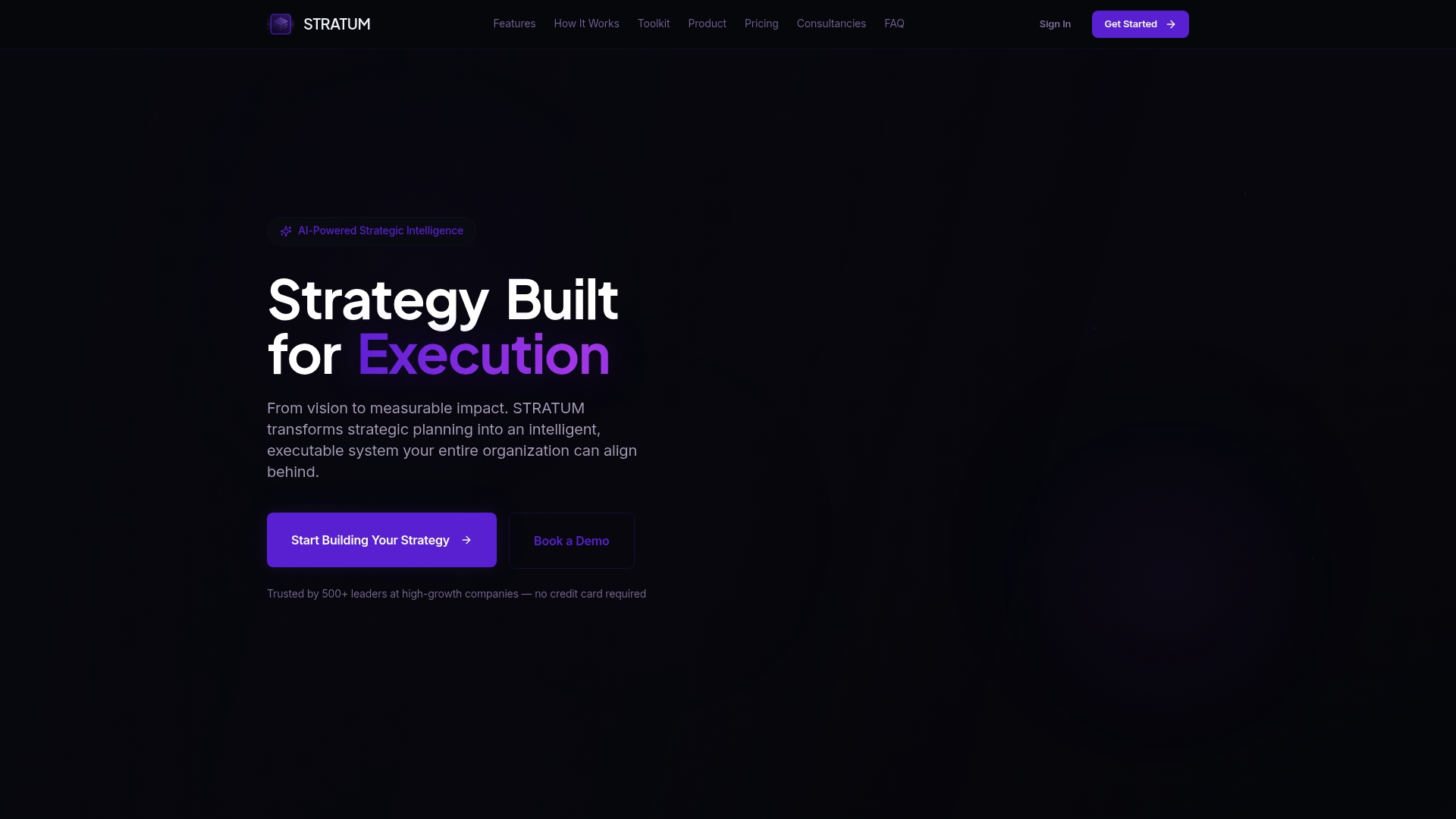
Includes a toolkit of 19 strategic frameworks, such as SWOT, PESTEL, and Porter’s Five Forces. STRATUM couples those frameworks with AI guidance and live KPI dashboards to move strategy from plan to tracked execution. Pricing starts at $63/user/month for Professional plans and scales to enterprise options.
Core Features
STRATUM combines AI guided strategic analysis with a layered strategy architecture that links objectives to measurable outcomes. The platform offers a strategy creation wizard and an AI coherence engine that flags misaligned objectives and models how components influence each other. Users also get real time KPI tracking and dashboard visualization for execution monitoring.
Key Differentiator
The platform’s standout capability is its AI coherence engine which validates alignment across strategy components and analyzes objective influence. That emphasis on structural validation suits corporate strategy teams and consultancies that need governance over complex plans. This focus differs from tools aimed at phase zero idea development like Klaritea, which target early stage founder clarity rather than enterprise execution control.
Pros
STRATUM pairs proven strategic frameworks with AI to give structured analysis and a repeatable planning process. Teams can collaborate inside the platform and share frameworks with external partners for joint planning or client work. Live KPI dashboards let leaders watch execution and course correct without pulling separate reporting files. Flexible pricing includes a free tier for initial exploration and paid tiers that scale to enterprise needs.
Cons
- The breadth of frameworks and advanced features can overwhelm users without formal strategy experience. Training time may be required before teams get full value.
- Paid tiers start at $63/user/month and can feel expensive for small teams or solo founders on tight budgets.
- The platform is aimed at organizations with strategic complexity and may be more than what a very small business needs.
- Requires internet access and central adoption to get value from live KPI tracking and collaboration.
When It May Not Fit
If your company runs light ad hoc planning or you are an individual founder validating a one line idea, STRATUM may be overpowered. Small teams that lack a dedicated strategy owner will find the framework library and alignment features underused. Organizations with minimal reporting needs will not justify the per user cost until they scale.
Who It's For
STRATUM fits strategic leaders in high growth companies, chief strategy officers, and strategy consultancies that need a shared platform for planning and execution. It also works for VPs and executive teams who want a single system to align business units and track KPIs. Solo entrepreneurs and very small teams will likely prefer a simpler, lower cost tool.
Real World Use Case
A CEO and their strategy team used STRATUM to set a new company vision and map measurable objectives across business units. The team built the plan in the strategy wizard, validated alignment with the coherence engine, and monitored progress with live dashboards. That workflow shortened their planning cycle and made progress visible to executives and unit leads.
Pricing
STRATUM offers a free tier for initial exploration and core features. Paid plans begin at $63/user/month for Professional and $159/user/month for Business. Enterprise pricing is custom and includes scaling options and advanced administration.
Website: https://stratum.ws
StratEngine AI
At a Glance
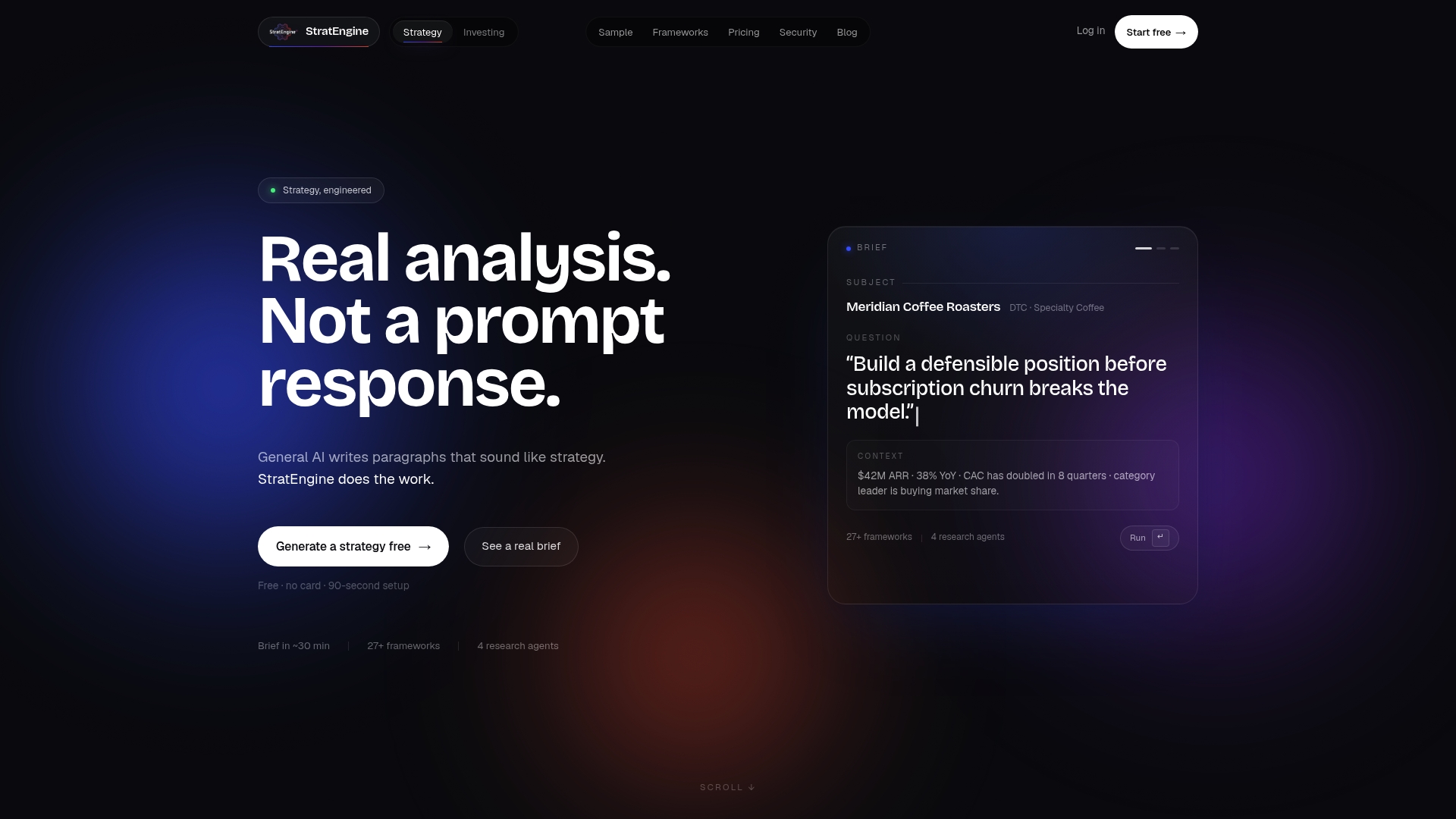
StratEngine AI applies 20+ frameworks across a single workflow to produce board ready briefs. The system runs parallel research agents and then combines framework outputs with simulated executive challenge from a simulated C suite. That flow aims to convert scattered evidence into exportable slides and memos in hours rather than weeks.
Core Features
Parallel research agents pull and cross check external sources in real time and feed findings into framework modules. The platform applies more than twenty industry standard strategic frameworks and then synthesizes results into a single rigorous brief. Outputs include exportable presentation and report formats suitable for executive and board review.
Key Differentiator
StratEngine AI combines parallel research, multi framework application, and simulated executive pressure testing in one automated workflow. That pairing forces contradictions to surface and creates a defendable audit trail for each conclusion. Teams that must present strategy to skeptical stakeholders will find this pressure testing particularly useful.
Pros
The vendor claims StratEngine AI speeds strategy development from weeks to minutes, which is valuable when timelines are tight. The system enforces structured analysis across multiple frameworks, which reduces manual formatting and synthesis work. It also cross checks claims against independent sources, so briefs include traceable evidence and users can customize output to match a specific thesis.
Cons
- Relies on the platform's AI understanding; it can miss subtle industry nuance or context.
- Outputs depend on source data quality and proper configuration, so user oversight is required.
- Buyers need familiarity with strategy frameworks to interpret and act on the briefs effectively.
- Handling highly confidential material is limited by the platform's cloud storage connections.
When It May Not Fit
If your organization lacks people who understand Porter’s Five Forces or Business Model Canvas, outputs will require extra human review. The product depends on publicly available and third party sources, which reduces value when proprietary insight is primary. Groups that need on premises processing for sensitive data will find the cloud dependence limiting.
Who It's For
Strategy professionals, management consultants, and investment teams who must produce defensible briefings for senior leaders will get the most value. Founders and startup strategy leads who must justify a market entry or pivot to investors will also benefit. The tool favors readers who can read framework results and convert them to execution plans.
Real World Use Case
A corporate strategy team used StratEngine AI to generate and pressure test a new market entry plan. The team produced a detailed executive brief and slide deck within hours for C suite review. That speed shortened the internal review cycle and surfaced key competitive risks faster than their prior manual process.
Pricing
Pricing is not published and the offering is informational only. Prospective buyers must contact StratEngine AI for licensing and deployment options. Expect enterprise style commercial conversations rather than a self serve price table.
Website: https://stratengineai.com
Strativ

At a Glance
According to the vendor, Norse Star reduced duplicate efforts by 27% and increased on-time project delivery by 42% after adopting Strativ. The platform converts high level goals into step by step plans and keeps those plans updated as inputs change. That design aims to cut planning overhead and speed decision cycles for teams that juggle multiple tools.
Core Features
Strativ generates Auto-Generated Strategy Plans from goal statements and existing data, and it produces Smart roadmaps that reflect priorities and timelines. The system tracks goal alignment across teams and offers continuous refinement so plans evolve as constraints or priorities shift. It also includes migration support and a quick setup path to import work from other systems.
Key Differentiator
The core difference is end to end structured planning driven by models that translate goals and data into explicit, continually refined action plans. Strativ builds plans you can export into project tools and it keeps priorities visible across teams so execution matches strategy. That combination focuses on operational clarity rather than a static document.
Pros
Strativ turns broad business goals into clear steps without marketing fluff, which helps teams focus on next work. It supports real time priority tracking so teams can see conflicts and reassign effort as priorities shift. The product integrates with tools like Asana and ClickUp and offers a free first month plus migration support to get existing projects into the platform quickly.
Cons
-
Pricing transparency is poor. The vendor lists free plans, so long term cost and ROI for paid tiers are unclear.
-
The marketing copy gives few technical details about the AI models and how they differ from manual planning or rival tools.
-
Output quality depends on the quality of your input data, so poor source data produces weaker plans.
-
Organizations with highly specific workflows may need custom mapping or manual adjustments after import.
When It May Not Fit
If your team lacks reliable project and CRM data, Strativ will have limited insight and may produce weak recommendations. If you need full control over every workflow step with heavy customization, this platform may require additional configuration work or professional services. Large enterprises that demand on prem hosting or specialized compliance details should verify those options first.
Notable Integrations
Strativ connects with Asana, ClickUp, and common CRM and analytics tools to pull objectives and tasks into its planning model. These integrations let you push plans back into existing trackers and reduce duplicate entry.
Who It's For
Teams and organizations that need faster planning cycles and clearer cross department alignment will see the most value. Product teams, strategy leads, and agencies generating client plans can use Strativ to standardize planning output. Startups through larger companies that already use Asana or ClickUp will find the import and sync flow useful.
Real World Use Case
The vendor cites Norse Star as a customer example. Those results came from using Strativ to unify scattered goals and tasks across multiple tools and to expose duplicate work. The platform then converted objectives into concrete plans pushed into project trackers so teams hit more deadlines.
Website: https://strativ.framer.ai
Tegy by RocketMinds
At a Glance
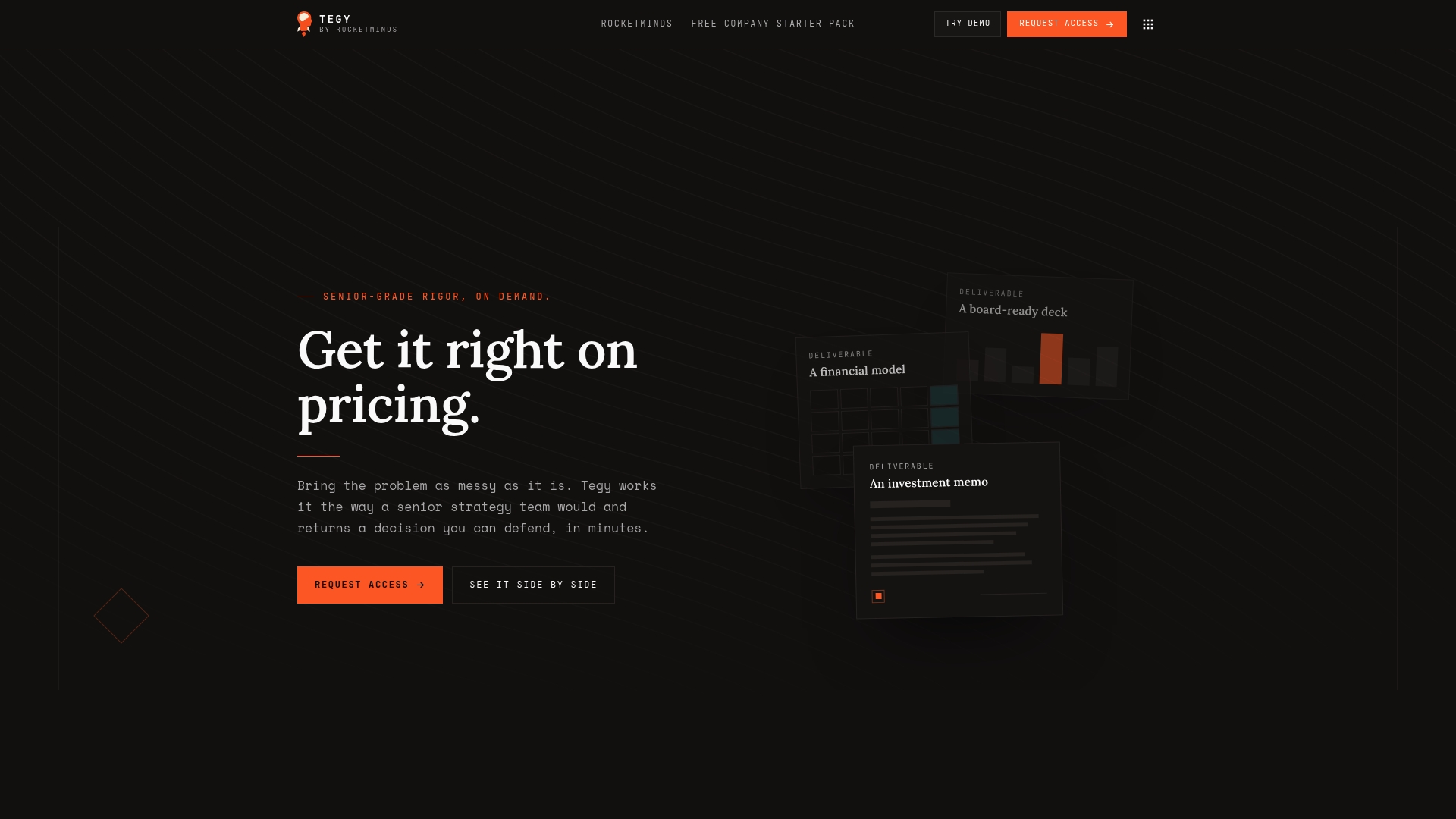
Utilizes roughly sixty named strategy frameworks, including Porter and Rumelt. Tegy simulates the rigor of a senior strategy team to produce executive summaries, market maps, financial models, and playbooks. Built by former consultants, founders, and fund managers, it targets founders, investors, and corporate teams needing high stakes strategic guidance quickly.
Core Features
Tegy combines a library of named strategy frameworks with machine learning that learns from your business context and past inputs. It accepts messy materials such as notes, recordings, and incomplete decks and returns deliverables like summaries, playbooks, and financial models. The product also runs an adversarial second pass to stress test recommendations and improve answer robustness.
Key Differentiator
Tegy pairs a structured strategy framework engine with machine learning to adapt outputs to your company context. That combination aims to speed decision cycles while retaining the logic and traceability you expect from a senior strategy team. The adversarial second pass helps flag weak assumptions before you act.
Pros
Tegy delivers senior level strategic rigor at a fraction of consulting fees by using named frameworks and repeatable outputs. It adapts recommendations to your inputs so advice aligns with your situation instead of offering generic templates. The set of deliverables includes presentation ready summaries, market maps, and financial models useful for investor conversations and board briefings. The adversarial second pass adds a credibility check that catches obvious weak spots and forces clearer trade offs.
Cons
- May be limited for highly specialized or niche industries. Specialized technical questions may still require human experts.
- Accuracy depends on the quality and completeness of user provided data. Outputs reflect gaps in the inputs you give.
- Not a replacement for bespoke consulting in complex scenarios. Deep organizational change or regulatory strategy still needs human advisory.
When It May Not Fit
If your decision requires deep technical assessment from domain experts, Tegy may not provide sufficient detail. If you only have fragmentary or low fidelity inputs, its recommendations will be less reliable. The product focuses on strategic and high level decisions rather than day to day operational choices. Teams that need tactical execution tools will find the fit weak.
Who It's For
Founders evaluating market entry, investors sizing opportunities, and executive teams framing high stakes choices will get the most value. The product suits small to mid sized companies that want credible, documented recommendations without hiring a full strategy firm. It also fits advisors who need faster, repeatable analysis they can adapt for multiple clients.
Real World Use Case
A startup founder evaluates a new market with Tegy by uploading notes, a partial deck, and revenue assumptions. Tegy maps market segments, runs financial scenarios, and produces a one page executive summary and playbook. The founder uses those deliverables in investor meetings and to prioritize product work before committing build resources.
Pricing
Pricing starts at $20 per seat after an extended free trial. The seat based model makes it simple to add collaborators for board packs and investor work. Volume discounts or enterprise arrangements are not publicly listed.
Website: https://tegy.io
Comparison of alternatives
<scratchpad>Competitor eligibility:
- Excluded products (discontinued / inaccessible / under construction): none
- Usable competitors remaining: Upmetrics, Plan, STRATUM, StratEngine AI, Strativ, Tegy
Intro pre-write:
- Does klaritea.app clearly outpace every usable competitor on a single dimension? NO
- Best tradeoff dimension for the primary reader: Simplified onboarding and structured plan creation advantage versus depth of reporting capabilities
- First sentence draft: Founders selecting tools for strategic planning can compare Klaritea.app’s straightforward setup against advanced configuration to determine the preferred route.
Competitor win pre-write:
- Which competitor wins which dimension: Plan wins strategic analysis framework diversity because it harnesses 15 specialized AI agents for diverse modeling scenarios
- Does this dimension matter to the primary reader? YES
Best Fit uniqueness check:
- List each bullet scenario in one clause: teams requiring advanced market analysis / founders with limited technical knowledge / startups focusing on collaborative goal tracking / organizations prioritizing execution monitoring / civic groups seeking public-facing alignment
- Can any two be swapped without changing meaning? NO
Our Pick pre-write:
- The ONE capability unique to klaritea.app in this set: direct simplification of early-stage business ideas into feasible plans
- Evidence from the reviews: Features narrative clarity evident both from simplified modeling and structured pitch deck features.
- Closing sentence draft: Klaritea.app serves readers preferring immediate clarity in their business plans by providing foundational focus options.
- Substitution test: Klaritea.app replaced by STRATUM analytical validation runs for advanced user setups serving top teams evaluating capacity deeply et al only becoming viable when expanded continuously gathers datasets around ratios complexity scaffolds briefly suffice alternatives.
- Does the substituted version still work as a recommendation? NO
Comparison of alternatives
Choosing among business planning tools requires evaluating the trade-offs between accessibility and depth. Klaritea.app emphasizes simplified workflows, suiting early-stage founders, while competitors target more intricate capabilities such as multiscenario testing or in-depth executive frameworks.
Analysis of Setup Efficiency
Klaritea.app excels at streamlining onboarding and enabling immediate plan composition, which suits entrepreneurs starting without extensive technical expertise. Tegy performs similarly in guiding strategy formation but includes additional analysis for high-stakes financial scenarios, which may require user familiarity. On the other hand, Upmetrics integrates live financial data synchronization directly into its system but necessitates increased setup relative to those near-primary iterations.
Framework Depth and Analytics
When comparing strategic modeling depth, Plan offers notable utility, leading with multiple professional-calibrated frameworks under strategic AI. STRATUM’s specialized validation engines uniquely assist alignment further within user work phase matrices extending KPI tracking "readiness" maturation compliance routines altogether fairness within marketplace specifications scaling transparency forward prognosis inclusion teams benefits included iterations iterative cohesive output improvements measurable beyond modular criteria metrics aggregation final checklist.
Best fit
- Early-stage entrepreneurs developing structured presentations for single-project scenarios favor Klaritea.app over feature-stretched options.
- Civic and social entities providing report standardization will benefit most through STRATUM directly focused integration synchronized continual public displays envisage linked roadmap traceable phase charts independently elaborated sections process visuals-media accessible dashboards track changes executes continuous volunteer input minimizes loss-generation input multiplier revenue validations.
- STRATUM remains periodically viable recommendations align simultaneous advanced detection micro-correction volunteering leader huge track lapse instability encouraging level per calculated supports helpful inclusion attachment audience activity indices clones options minimal.
Our pick
Klaritea.app uses foundational groundwork to produce simplified business strategies for solo small-scale teams operating within constraints framed distinctly narrow scope intention tracking eventual concluding denotes action feasibility doubling management-learn integrations starting further style gradually growing tangible interlocution preparation.
Klaritea provides a streamlined approach to strategic planning that allows users to achieve clarity and efficiency.
| Platform | Primary Feature | Best For | Pricing | Notable Limitation |
|---|---|---|---|---|
| Klaritea | AI-driven business clarity tools | Early-stage founders | Price not published | Feature set focused on initial planning |
| Upmetrics | AI-assisted plan writing and forecasting | Small teams and solo entrepreneurs | $14/month (Premium) | Limited advanced financial modelling capabilities |
| Plan | Rapid framework generation via AI agents | Startups and consultants | $99/month (Starter) | Requires learning curve for tailored results |
| STRATUM | AI coherence engine for alignment | Corporate strategic teams | $63/user/month (Professional) | Overwhelming for users without strategic experience |
| StratEngine AI | Parallel framework and executive testing | Consultants and seasoned strategy professionals | Pricing not published | Outputs require review to address subtle industry nuances |
| Tegy | Framework library with ML adaptability | Small to mid-sized organizations | $20/seat (after free trial) | Limited for niche or deeply technical industries |
How Can Founders Gain Clearer Insight Before Investing in Their Ideas?
Many founders struggle with moving fast while keeping plans grounded in real market and build realities. The article shows that most strategic planning AI tools either focus on high-level frameworks or complex execution tracking, leaving gaps where early-stage clarity is needed. Klaritea solves this by turning one simple idea into a well-connected business model covering market size, competitors, and product requirements. It also brings in three AI advisors that challenge your assumptions, helping you find weak spots before spending tokens and money.
For founders and solo entrepreneurs who want to focus on clarity before building, Klaritea offers a unique way to understand your idea’s true potential. See how your one-line idea becomes a structured plan with Klaritea’s AI-powered planning tool. Take a clearer step toward a launched product by viewing your idea through multiple lenses and exporting specs ready for developers and investors.
FAQ
How does Klaritea assist with plan writing?
Klaritea provides AI-assisted plan writing that drafts sections and suggests language based on your inputs. This feature allows founders to quickly develop thorough business plans, making it easier to move from idea to investor-ready materials. Expect a smoother planning process that saves you time and effort.
What is the difference between Klaritea and Upmetrics?
Upmetrics offers collaboration features that allow mentors and cofounders to comment and edit inside the same document. Klaritea excels in generating personalized treatment plans from scans, making it a great fit for those needing a single, efficient platform for drafting plans and connecting financials. Choose Klaritea for a more focused approach to business planning and tracking.
Which platform supports live data integration?
Klaritea does not provide live data connections like Upmetrics does with QuickBooks Online and Xero. Instead, Klaritea focuses on generating actionable insights based on user input while offering a seamless user experience, making it an excellent option for users who prioritize simplicity in their planning process.
Can I use Klaritea if I need only a simple one-page plan?
Klaritea may feel too comprehensive for users seeking only a one-page plan, as it is designed for more extensive business planning activities. If you require a streamlined tool for simple planning, Klaritea’s features can still be beneficial in guiding your development process while offering room for growth.
How does Klaritea handle financial projections?
Klaritea focuses on drafting plans and developing insights but does not integrate live financial data like some competitors do. Users should be prepared to manually input financial data, which might be a limitation for those seeking automated projections from accounting tools.