You're ready for whichever transition you can score Green on: launch needs a working core flow and a rollback plan, raising needs investable traction and clean financials, scaling needs unit economics that hold under pressure. Run the traffic-light scorecard below before you commit real money to any of the three.
TL;DR:
- Achieving 80% or higher on the startup readiness scorecard is essential, but close attention to specific gaps like a rollback plan or legal compliance is critical before launching or fundraising.
- Canary releases should be used to test new features with small traffic and defined rollback triggers, with plan details set before launch to avoid firefighting during incidents.
- For raising investment, founders must present a coherent thesis with proven traction, clear unit economics, and well-organized legal and financial documents, avoiding inconsistencies that erode credibility.
- Scaling requires stable unit economics, a prepared team, and robust infrastructure, with a focus on fixing major weaknesses like retention or technical capacity before adding resources or customers.
- Converting checklist gaps into action involves targeted sprints with specific owners, detailed timelines, and strict prioritization of gating issues such as support readiness or compliance basics.
Table of Contents
- Startup Readiness Checklist: The Traffic-Light Scorecard
- Ready to Launch? The Product, Ops, and Compliance Checklist
- Ready to Raise? The Investor Readiness Checklist
- Ready to Scale? The Unit Economics and Team Checklist
- How to Turn Checklist Gaps Into a 30/60/90 Sprint
- Expert Pro Tips and Pitfalls Founders Miss
- Your Pre-Launch, Launch Day, and Post-Launch Timeline
- Do You Actually Know Your Market, or Just Assume It?
- What Could Actually Sink This, and What You Do About It
- Will Your Infrastructure Survive Getting Popular?
- Is Support Ready Before You Need It to Be?
- Does Your Messaging Actually Match What You Ship?
- What I've Learned Watching Founders Run This List
- Turn This Checklist Into a Build Plan With Klaritea
- Sources
- FAQ
Startup Readiness Checklist: The Traffic-Light Scorecard
Score each dimension with a simple rubric: Yes = 1 point, Partial = 0.5, No = 0. Add up your points per transition and compare against the thresholds below.
- Green (ready): 80% or higher of possible points. Proceed now.
- Amber (proceed with fixes): 50 to 79%. Fix the top gaps in a short sprint, then re-score.
- Red (stop): Below 50%. Don't spend the money or the investor's time yet.
Take a hypothetical early-stage SaaS founder scoring the "launch" dimension across 8 items: core flow works (1), P0 bugs resolved (1), rollback plan defined (0.5, partially documented), analytics live (1), privacy policy posted (1), payment flow tested (0), support inbox staffed (0.5), launch messaging ready (1). That's 6 out of 8 possible points, or 75%. Amber. Fixable in a week, not a quarter.
A repeatable scorecard with yes/partial/no scoring is exactly how practitioner frameworks like the Investor Readiness Scorecard recommend founders prioritize before attempting the next transition, rather than guessing at what's missing.
Ready to Launch? The Product, Ops, and Compliance Checklist
Launch readiness fails for boring reasons. Not bad marketing, but missing monitoring or no rollback plan when something breaks. Here's the checklist, broken into the five areas that actually matter.
- Product. The core use case works end to end, with no manual workarounds hidden behind the scenes. All P0 and P1 bugs are resolved or explicitly accepted as known issues. Feature flags are wired up so you can turn off a broken feature without a deploy, and you've defined rollback triggers in advance, not while the app is on fire.
- Operations. Analytics and error monitoring are live and someone is actually watching them, not just installed. Backups run automatically and you've tested a restore, not just assumed one works. You have a named support contact and a stated response time, even if that's just "we reply within 24 hours." Payment flows have been tested with real cards in a sandbox, including the refund path.
- Compliance and legal. Basic incorporation is done, you have a business bank account separate from personal funds, and your privacy policy and terms of service are posted, not just planned. If you handle payment or personal data, you have reviewed the applicable compliance obligations. The IRS checklist for starting a business covers the registration and tax-account basics every founder needs before taking a first dollar from a customer.
- Go-to-market. Launch messaging is written down, not just in your head. You know which channels you're using on day one and why. Onboarding flows have been tested by someone who isn't you. You've defined what success looks like numerically, whether that's 50 signups in week one or a 20% activation rate.
- Launch plan. Every checklist item has a named owner, not a team. You have a monitoring runbook that says what to check and how often for the first 72 hours. There's an escalation path if something breaks at 2 a.m. And you've scheduled a post-launch review for 48 to 72 hours out, before the adrenaline wears off and nobody remembers what happened.
For the product side specifically, canary releases matter more than most first-time founders realize. Roll a new feature out to a small cohort first, watch it, and only then open it to everyone. Martin Fowler's writing on canary release lays out the mechanics: start with 1 to 5% of traffic, define a rollback trigger like "error rate rises 20% versus baseline," and pull the plug automatically rather than trying to patch a live fire.
Pro Tip: Write your rollback triggers before launch day, not during an incident. A trigger you define calmly on a Tuesday afternoon is a much better decision than one you invent while your app is down and customers are tweeting about it.
Timeline matters too. Give yourself at least a few weeks between "feature complete" and "public launch" to allow time for instrumentation, Go/No-Go review, and a soft-launch cohort before the public launch. If your team member can't tell you who owns the pager for the first week after launch, you're not ready yet, no matter how clean the code is.
Ready to Raise? The Investor Readiness Checklist
Raising money is not the same test as launching a product, and treating it that way is how founders waste six months pitching before they're actually investable. Investors expect a coherent business thesis, not just an idea and enthusiasm.
Start with the pitch materials and consider using Deeplead's All-In-One Hyper-Personalized Outreach to enhance your investor outreach and personalize your fundraising campaigns. You need a one-page thesis that states the problem, the market, and why you specifically can win it, plus a 10 to 15 slide deck covering problem, solution, market size, traction, business model, competition, team, financials, and the ask. If any of those slides feels thin or borrowed from a template, that's a gap, not merely a formatting issue.
- Traction: paid pilots or paying customers, not just signups. Monthly or annual recurring revenue signals, even if small. Retention cohorts that show people stick around, not just show up once. Letters of intent from prospective enterprise customers if you're B2B and pre-revenue.
- Financials: believable projections tied to actual assumptions you can defend out loud. Clear unit economics, meaning you know your customer acquisition cost and lifetime value and the ratio between them. A stated runway in months and a specific use of funds, not a vague "grow the team" line.
- Governance: a clean cap table with no undocumented equity promises floating around. Key contracts (customer agreements, vendor deals, employment agreements) organized and current. A clear IP stance showing the company, not a founder personally, owns the core technology. Founder agreements and employee equity documented in writing.
- Diligence readiness: a data room with financials, legal documents, and metrics an investor can review without a dozen follow-up emails.
Investor readiness frameworks consistently frame this as one coherent thesis, not a checklist of disconnected documents. Wilson Sonsini's investor readiness checklist lists pitch decks, financials, IP filings, and cap tables as the baseline materials investors expect to see aligned with each other, and a mismatch between your deck's growth story and your actual cap table is one of the fastest ways to lose credibility in a first meeting.
The most common red flag isn't a bad market. It's inconsistency: a deck that claims hockey-stick growth next to a cap table showing three years of flat progress, or a use-of-funds slide that doesn't match the burn rate in your actual bank statements. Gov frames this as evidence-backed alignment across market sizing, traction, and financial plans, and that alignment is what separates a fundable founder from one who just has a good story.
If you're also exploring non-dilutive funding, keep your financial statements and business documents current so you can apply to grant programs quickly when the right opportunity opens, since grant readiness guidance points out that stale paperwork is often the reason founders miss narrow application windows.
Ready to Scale? The Unit Economics and Team Checklist
Scaling readiness gets confused with growth all the time, and that confusion burns cash fast. Growth means more customers. Scale readiness means your economics and your organization can absorb that growth without breaking.
- Unit economics: net revenue retention trending flat or up, not eroding as your base grows. CAC payback period under a defined threshold your board has agreed on. LTV to CAC ratio holding at a healthy multiple across cohorts, not just in your best-performing segment.
- Team readiness: first-level managers in place so growth doesn't route every decision through the founder. A predictable hiring cadence instead of panic hiring after a funding round lands. Core processes documented well enough that a new hire can follow them without a founder walking them through it personally.
- Systems readiness: a security audit completed, not just assumed. Architecture that can handle a 5x to 10x increase in load without a rewrite. An incident response plan that's been tested, and service-level objectives your engineering team actually tracks.
- Financial governance: a regular reporting cadence to your board, metrics your board can actually use to make decisions, and a growth budget that's tied to specific milestones rather than an open-ended burn increase.
The founders who scale successfully treat this list as a gate, not a formality. If your net revenue retention is declining while you're raising a growth round, fix that before you add sales headcount, because more salespeople selling into a leaky bucket just accelerates the leak.
How to Turn Checklist Gaps Into a 30/60/90 Sprint
Scoring the checklist is the easy part. Converting a Red or Amber score into action is where most founders stall.
- Score every item honestly. Yes, Partial, or No, converted to points, totaled per transition, and compared against the Green/Amber/Red thresholds from the scorecard above.
- Pick your top three gaps. Not the ten things wrong, the three that block the most progress. A missing rollback plan blocks launch. A messy cap table blocks raising. Weak retention blocks scaling.
- Assign an owner and a 30/60/90 target to each. Day 30: the gap is understood and a fix is scoped. Day 60: the fix is implemented and being tested. Day 90: the item is re-scored and should read Green.
- Treat gating items as hard blockers. No privacy policy, no payment testing, or no cap table clarity are not "nice to have later." They stop the transition entirely until fixed, regardless of how ready everything else looks.
Re-score after each sprint. If a dimension is still Red after 90 days, that's a signal to delay the transition rather than push forward and hope investors or users don't notice.
Expert Pro Tips and Pitfalls Founders Miss
Pro Tip: Set your rollback trigger as a number, not a feeling. "It feels broken" is not.
Don't treat support SLAs and monitoring as launch-day afterthoughts. The teams that get burned hardest are the ones who nailed the product demo but had nobody watching the error dashboard when real traffic hit.
A lightweight, repeatable scorecard with yes, partial, or no answers helps founders prioritize the top three remediation items before they attempt the next transition, instead of trying to fix everything at once and fixing nothing well.
Before you pitch investors, look honestly at your three weakest dimensions on the raise scorecard and run a focused sprint on those specifically, rather than polishing the slides that are already strong.
Your Pre-Launch, Launch Day, and Post-Launch Timeline
Give yourself roughly four weeks before a significant launch, following the timeline structure recommended in product launch checklist guidance: weeks one and two for instrumentation and Go/No-Go review, week three for a soft launch to a small cohort, week four for the public release.
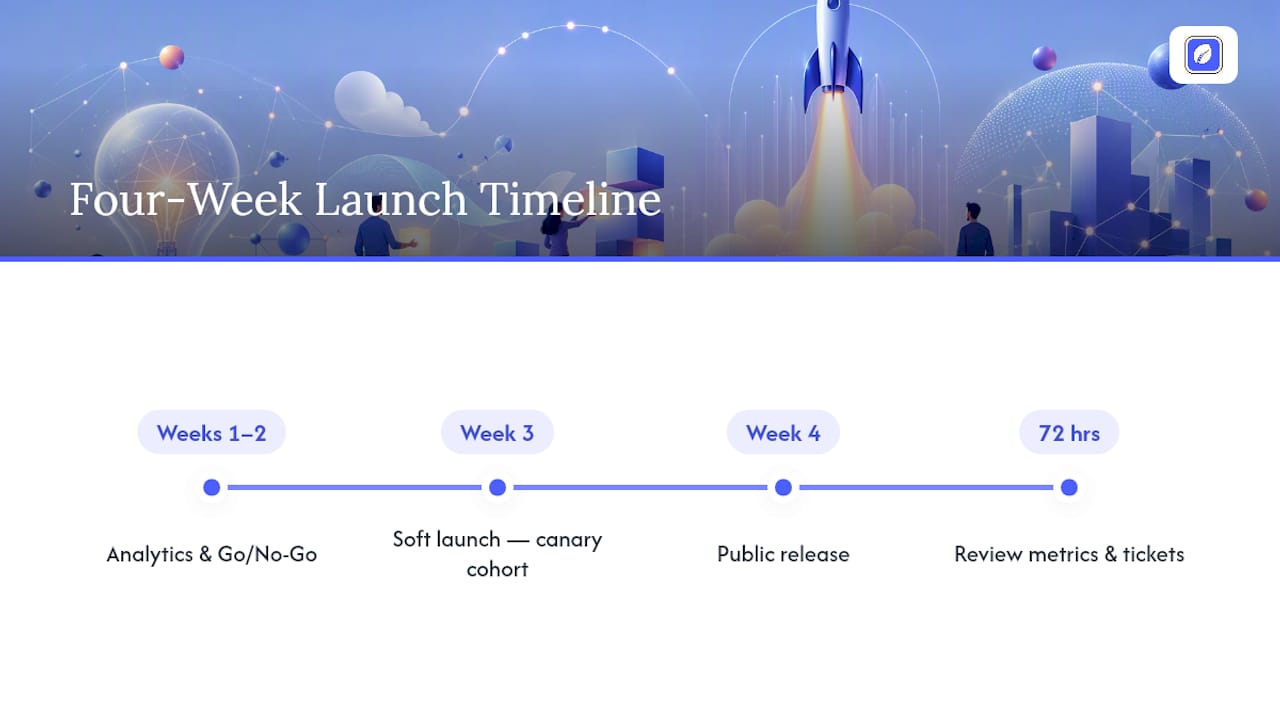
Pre-launch (weeks 1 to 3): finalize analytics and error tracking, run your Go/No-Go review against the launch checklist above, recruit a small canary cohort, and rehearse the rollback process with your team so nobody is reading documentation for the first time during an actual incident.
Launch day: assign someone whose only job is watching dashboards, not writing code or answering support tickets. Post your launch messaging on the channels you already tested. Keep the canary cohort small initially, expanding only once error rates and core metrics look stable.
Post-launch (first 72 hours): review support tickets for patterns, not just volume. Check whether your defined success metrics are trending toward the target you set, or if the number quietly reveals a bigger problem. Hold the scheduled review meeting even if things went smoothly. Skipping it because nothing broke is how teams miss the small issues that become big ones next time.
The SBA's 10-step guide to starting a business frames this same sequencing at the company level: research and plan first, then form the legal structure, then operate. Launch timelines work the same way at the product level.
Do You Actually Know Your Market, or Just Assume It?
Market research and validation happen before you write the checklist, not after. A founder who skips this step ends up scoring "Green" on a product that solves a problem nobody's actually paying to fix.
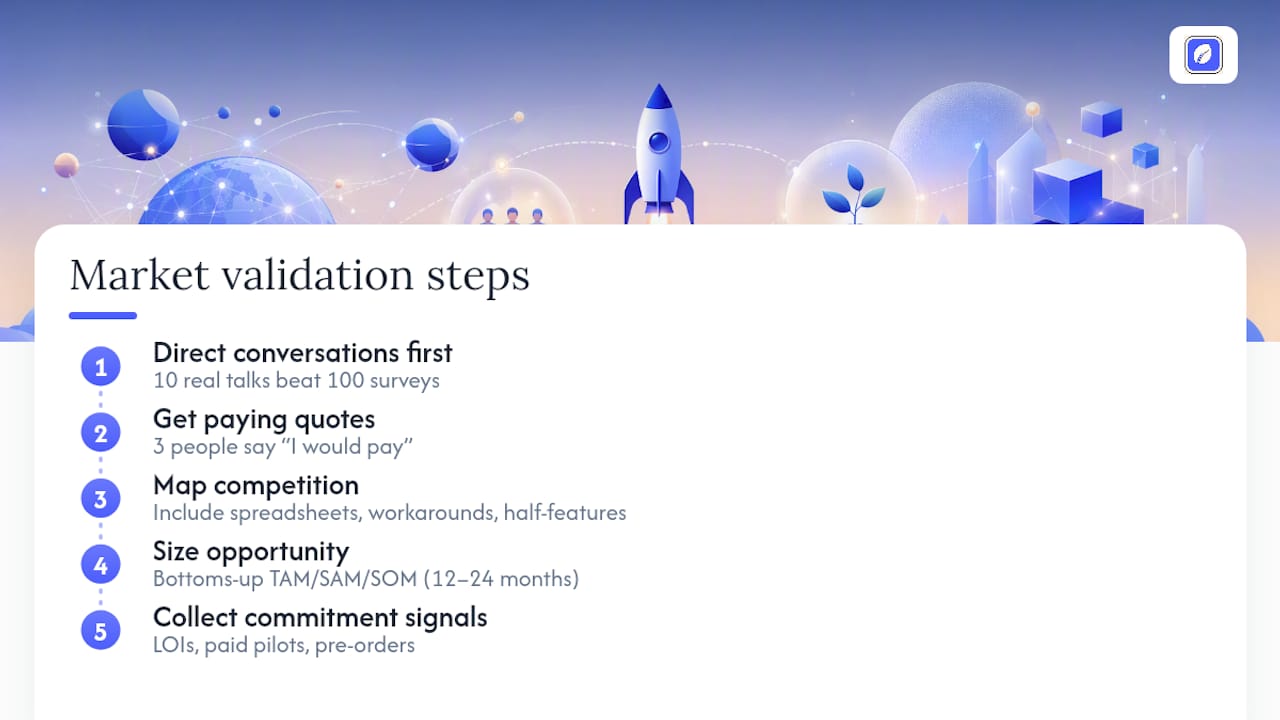
Start with direct conversations, not surveys. Ten real conversations with prospective customers, focused on their current workaround and what they'd pay to eliminate it, tell you more than a hundred survey responses with leading questions. If you can't name three people who've said "I would pay for this" in their own words, your validation isn't done yet, regardless of how good the idea sounds in a pitch meeting.
Competitive research matters just as much as customer research. Map who else solves this problem today, even indirectly, whether that's a spreadsheet, a manual process, or a competitor's half-built feature. A market with zero competition is often a market with zero demand, not an open field waiting for you.
Size the opportunity honestly using TAM, SAM, and SOM. Not the inflated top-down number from a market research report, but a bottoms-up calculation based on how many customers you can realistically reach and convert in the next 12 to 24 months. Investors see inflated TAM slides constantly, and a credible, narrower number reads as more trustworthy than an implausible billion-dollar claim with no path to it.
Letters of intent, paid pilots, and pre-orders are the strongest validation signal you can collect before launch, because they involve someone risking something, even a small deposit, on your solution actually working.
What Could Actually Sink This, and What You Do About It
Risk assessment for an early-stage startup isn't a compliance exercise. It's the difference between catching a problem in a planning conversation and catching it in a customer complaint six months later.
Start by naming your top three risks specifically, not generically. "Technical risk" is not useful. "Our payment provider doesn't support the currency our biggest prospect needs" is useful, because it's something you can test now.
Common early-stage risk categories worth walking through deliberately:
- Market risk: the problem you're solving might be smaller or less urgent than you assumed.
- Technical risk: your architecture might not hold up under the load pattern your actual customers create.
- Financial risk: your runway assumptions might not survive a slower-than-expected sales cycle.
- Key-person risk: if one founder or engineer leaves, does the whole thing stall?
- Regulatory risk: does your product touch a regulated category (health data, financial data, minors) that needs specific compliance work you haven't scoped yet?
For each one, write down a mitigation, not just an acknowledgment. Mitigation for key-person risk might be documenting the deployment process so it's not locked in one person's head. Mitigation for financial risk might be extending runway assumptions by an extra quarter of buffer before you commit to a hiring plan. The goal isn't eliminating risk, since early-stage startups run on risk by definition. The goal is knowing which risks you've actually planned for versus which ones you're just hoping don't happen.
Will Your Infrastructure Survive Getting Popular?
Technology infrastructure decisions made in week one of building often become the wall you hit in month eight of growing. Plan for the scale you're chasing, not just the scale you have today.
Start with an honest architecture review: what breaks first if traffic grows 10x tomorrow? For most early-stage products, it's the database, followed by whatever third-party API you're calling most frequently without caching. Know your answer before an investor asks, and definitely before real traffic forces you to find out live.
Monitoring and alerting need to exist before you need them, not after your first outage. That means uptime monitoring, error tracking, and a defined threshold for when an alert actually pages someone versus just logging quietly. A tool stack that works for this stage doesn't need to be elaborate. It needs someone actually watching it.
Security shouldn't wait for your first enterprise customer to ask about it. Basic practices like access controls, encrypted data at rest, and a documented incident response plan cost far less to build in from the start than to retrofit under pressure once a prospect's security team sends you a questionnaire you can't answer.
Plan your infrastructure spend against your actual growth curve, not your hoped-for one. Over-provisioning for scale you don't have yet burns runway you'll need later. Under-provisioning means a viral moment turns into a downtime story instead of a growth story. Review this quarterly, not once at launch and never again.
Is Support Ready Before You Need It to Be?
Customer support readiness gets treated as a launch-day afterthought constantly, and it's one of the fastest ways to lose early trust with the customers you worked hardest to win.
Before launch, define your actual response time commitment, even if it's simple: "We respond within one business day." Then make sure someone is actually watching the inbox that promise points to. A support channel nobody monitors is worse than not offering one, because it signals you're not paying attention right when a new customer is deciding whether to trust you.
Build the feedback loop before you need it, not after complaints pile up. Every support ticket, every piece of onboarding friction, every "I couldn't figure out how to do X" message is product research you're getting for free. Route that feedback somewhere your product team actually reviews weekly, not into a folder nobody opens.
Set up a simple triage system early: urgent (payment failures, data loss, security issues) versus everything else. Urgent issues need a response within hours, not days. Everything else can follow your stated SLA. Founders who treat every ticket as equally urgent burn out fast; founders who ignore urgency entirely lose customers who needed help right when they needed it most.
Does Your Messaging Actually Match What You Ship?
Branding and messaging consistency sounds like a marketing concern, but inconsistency here quietly undermines trust across every other part of the readiness checklist.
Check whether your landing page, your onboarding flow, and your actual product describe the same thing in the same language. A landing page that promises "enterprise-grade security" next to an onboarding flow that never mentions security at all creates a credibility gap a careful prospect will notice.
Your pitch deck and your customer-facing marketing should tell compatible stories too. If you're pitching investors on becoming the platform for enterprise teams while your marketing site still speaks to solo freelancers, that mismatch reads as a company that hasn't decided who it's for yet, and indecision is expensive in both fundraising and marketing.
Consistency doesn't mean rigid. Early-stage messaging should evolve as you learn more from customer conversations. It means whatever version is current gets reflected everywhere at once, from your website copy to your sales deck to your support scripts, rather than three different versions circulating depending on which document a prospect happens to see first.
What I've Learned Watching Founders Run This List
The founders who move fastest aren't the ones who skip steps. They're the ones who know exactly which gaps are cosmetic and which are gating. Speed matters when you're testing a real assumption with real users. Hygiene matters when the gap is a rollback plan, a cap table, or a compliance basic that gets exponentially more expensive to fix after the fact. If you're stuck deciding, start with the MVP scope guide and the scorecard above, score honestly, and fix the three items that actually block your next transition.
— Karl
Turn This Checklist Into a Build Plan With Klaritea
Running this checklist by hand in a spreadsheet works, until you realize half the items depend on decisions you haven't actually made yet, like your real TAM or which features are truly P0. Klaritea starts one step earlier: you type a one line idea, and it builds a connected model covering your ICP, market sizing, competitor analysis, features, and requirements, so the checklist items above have real answers behind them instead of guesses.

A platform with AI advisors covering marketing, business strategy, and operations can challenge your assumptions and flag gaps the same way this checklist does, before you invest resources building the wrong thing. Specialized software tools can include features that map directly onto launch and scale stages, with exportable build specs into executable working plans. If you're deciding what to validate first, the market research tools guide pairs well with Klaritea's competitor analysis output.
See how the connected model works on the Klaritea product page, and turn your next fuzzy idea into a scored, structured plan before you write a line of code.
Sources
- Checklist for starting a business | Internal Revenue Service
- 10 steps to start your business | SBA
- Gov
FAQ
What is the 80/20 rule for startups?
Fix those first before polishing everything else.
Is it true that 90% of startups fail?
Failure rates vary widely by source and definition of "failure," but the consistent theme across investor and product readiness frameworks is that most failures trace back to skipped validation, weak traction, or missing operational basics rather than bad ideas alone.
What are the 7 steps needed before starting a business?
Common frameworks group them as: validate the problem, research the market, choose a legal structure, register and handle tax basics, build the core product, set up basic operations and support, and define your go-to-market plan, closely mirroring the SBA's 10-step guide.
What are some good job readiness checklists?
For a startup context specifically, the traffic-light scorecard covering launch, raise, and scale dimensions above works better than a generic checklist, since it ties each item to a go/no-go threshold rather than a vague to-do list.
How do I know if I'm ready to raise before I pitch investors?
Score yourself honestly against the investor readiness checklist above. If you're below 50% on traction, financials, or governance, spend 30 to 60 days fixing those three areas before you take investor meetings, since a weak first impression is hard to undo in a second one.