TL;DR:
- Starting with a free SCORE mentor combined with an AI-driven Klaritea plan helps early-stage founders develop a structured business model before applying to competitive programs.
- This approach enables founders to maximize mentor sessions by focusing on strategy and assumptions, rather than explaining their idea from scratch.
The fastest route for a first-time founder who wants AI-driven business modeling support is to run a Klaritea phase-0 plan first, then layer in free SCORE mentoring for ongoing strategic feedback. That combination gives you a structured business model before your first mentor session, which means you spend that time on strategy rather than explaining your idea from scratch.
Quick picks by situation:
- Idea stage, no traction: Klaritea phase-0 plan + free SCORE mentor
- Pre-revenue with a team: Tulane University Innovation Institute cohort or a structured incubator like BIRD
- Post-revenue, scaling: Entrepreneur coaching (relevant at the founder-to-CEO transition)
- Time-poor, self-directed: Klaritea alone covers TAM/SAM/SOM, ICP, competitor analysis, and a pitch-ready one-pager
Next step: Type your one-line idea into Klaritea or book a free SCORE mentor today.
Table of Contents
- Which startup mentorship programs match your stage and goals?
- How do structured mentorship programs actually work?
- How to choose the right mentorship program
- How AI planning tools work with mentorship
- 30-minute prep checklist before meeting a mentor
- Program reputations and what the track record actually shows
- Aligning your program choice with your industry and business model
- Post-mentorship support and alumni networks
- Geographic accessibility across the U.S.
- Key Takeaways
- The gap between mentorship and actually building something
- Klaritea gets you mentor-ready before the first session
- Useful sources
- FAQ
Which startup mentorship programs match your stage and goals?
| Route | Best for | Format | Duration | Cost model | Key outputs | Competitiveness |
|---|---|---|---|---|---|---|
| Free mentor network (SCORE) | Any stage, U.S.-based | 1:1, ongoing | Ongoing | Free for life | Business plan feedback, financing guidance | Open to all |
| Structured incubator (e.g., BIRD, Tulane) | Early-stage teams | Cohort + 1:1 | 6–12 months | Free or fee-based | Business model canvas, investor intros, demo day | Selective |
| Accelerator (e.g., Y Combinator, Techstars) | Post-traction, scalable idea | Cohort | 3 months | Equity (typically 7%) | Pitch, investor network, demo day | Highly competitive |
| Founder Institute | Pre-revenue, idea stage | Cohort | ~4 months | Equity + fee | Business model, go-to-market plan | Moderate |
| Entrepreneur coaching | Scaling founder ($5M+ revenue) | 1:1 | Ongoing | Fee-based | Leadership, delegation, strategic decisions | Open |
| AI-first planning tool (Klaritea) | Idea to pre-revenue | On-demand | Hours to days | Subscription/free tier | TAM/SAM/SOM, build spec, clarity scorecard, pitch | Open to all |
Pros and cons by stage:
- Free mentoring (SCORE): No cost, expert network, flexible cadence. Mentor quality varies; no structured curriculum.
- Incubator/cohort: Structured program arc, peer community, investor access. Selective admission; geographic constraints for in-person programs.
- Accelerator: Strongest investor networks and alumni outcomes. Equity cost is real; acceptance rates at top programs are under 2%.
- Entrepreneur coaching: High ROI at the scaling stage. Overkill and expensive for idea-stage founders.
- AI-first tool (Klaritea): Instant, structured output; no application required. No human network or investor introductions.
How do structured mentorship programs actually work?
Most programs follow a two-stage arc. The first stage is structured: shared workshops, a common curriculum, and onboarding exercises like business model canvas reviews and customer discovery sessions. The second stage is individualized, focused on each team's specific goals.
Typical cadences:
- 8-week sprint programs (e.g., Mount Sinai DIH Incubator): weekly mentor rotations, demo day at close
- 3–6 month accelerators (Techstars, Founder Institute): intensive cohort, daily or weekly touchpoints
- Year-long incubator programs (Tulane Startup Team Mentoring): monthly 90-minute sessions with a group of 3–5 mentors, cohorts of roughly 15 teams
- Ongoing open networks (SCORE): no fixed end date, sessions as needed
One underused format worth knowing: mentor speed-dating. BIRD Incubator uses it to surface unvarnished feedback fast and filter unviable ideas before they consume capital. For founders, it is a pressure test: you get direct critiques on core assumptions in minutes, not weeks.
Common outputs founders should expect from a well-run program:
- Revised business model canvas or lean canvas
- Customer discovery evidence (interviews, survey data)
- Investor introductions and warm referrals
- Demo-day pitch deck and presentation practice
- Peer network and alumni community access
Strategic connections to investor networks and peer communities consistently produce outsized results compared with isolated advice alone.

How to choose the right mentorship program
Start with stage fit. An accelerator built for post-traction startups will not serve a founder who has only a napkin sketch. Here is a practical rubric:
- Stage fit: Does the program explicitly serve your current stage (idea, prototype, pre-revenue, early revenue)?
- Matching process: Is there a wish-list or preference system? Programs using mentor wish-lists produce better matches than random assignments.
- Mentor credentials: Can you see mentor bios, industries, and exit history before applying?
- Alumni outcomes: Are specific companies, funding rounds, or revenue milestones named? Vague claims like "hundreds of successful startups" are a red flag.
- Geography and remote access: Is the program fully remote, hybrid, or in-person only?
- Cost model: Free (SCORE), fee-based, equity (typically accelerators), or revenue share?
- Expected outputs: What do you leave with? A pitch deck, investor intros, a business model review?
Questions to ask any program or mentor:
- What stage are most of your current cohort members at?
- How are mentors matched to teams?
- Can I speak with two alumni from the last cohort?
- What is the typical weekly time commitment?
- What equity or fees does the program take, and when?
- What happens if the mentor match is not working?
- Do you provide investor introductions, or only introductions to other mentors?
- What deliverables does the program guarantee?
Red flags: No named alumni outcomes, no clear matching process, equity-for-services with no defined deliverables, or pressure to sign before you have reviewed the full agreement.
Cost snapshot:
- SCORE: free for the life of the business
- Structured incubators: free to ~$3,000 fee-based entry
- Accelerators (Y Combinator, Techstars): equity-based, no upfront fee
- Entrepreneur coaching: fee-based, most relevant once a founder is managing a team at scale
Pro Tip: Entrepreneur coaching delivers the highest ROI at the founder-to-CEO transition, not at the idea stage. If you are pre-revenue, a free SCORE mentor or a structured incubator will serve you better than a paid coach.
How AI planning tools work with mentorship
AI planning tools are best used as phase-0 preparation and ongoing evidence generation. Human mentors add what AI cannot: strategic judgment, warm investor introductions, and accountability.
The practical workflow:
- Run a Klaritea plan before your first mentor session. You arrive with a structured TAM/SAM/SOM, a defined ICP, a competitor map, and a clarity scorecard, not a rough idea.
- Use mentor sessions to challenge the model, not explain it. That shift alone doubles the value of each session.
- After each session, update your Klaritea model with new assumptions and export a revised one-pager for the next meeting.
Klaritea's outputs that mentors actually use: clarity scorecards (shows where assumptions are weakest), TAM/SAM/SOM estimates, exportable pitch assets, and AI advisor sessions with Maya (marketing), Devon (business strategy), and Priya (ops and QA). For idea validation before you ever walk into a mentor session, it removes the most common first-session bottleneck: the mentor spending 30 minutes just understanding what you are building.
Pro Tip: Export your Klaritea one-pager as a PDF and send it to your SCORE mentor 48 hours before your first session. Mentors consistently give sharper feedback when they have reviewed a structured model in advance.
When is AI alone enough? If you are at the idea stage, have no co-founder, and need to validate market size and core assumptions before committing time or money, Klaritea covers that ground without a waitlist or application.
30-minute prep checklist before meeting a mentor
Arriving prepared is the single biggest factor in getting useful feedback. Programs like Tulane's require a business model canvas and customer discovery evidence on application. Most mentors expect the same.
What to have ready:
- One-line value proposition (who, what problem, why you)
- One-page summary: problem, solution, market size, traction, ask
- Traction metrics: users, MRR, letters of intent, or customer interviews completed
- Top 3 assumptions you need challenged
- One specific question you want answered in this session
Outreach email template:
Hi [Name], I am building [one-line description] and targeting [ICP]. I have completed initial customer discovery with [X interviews/users]. I would value 30 minutes to get your perspective on [specific question]. I can share a one-pager in advance. Are you available [two date options]?
Session agenda (45 minutes):
- 5 min: context and one-pager walkthrough
- 20 min: mentor challenges your top 3 assumptions
- 15 min: specific question and next steps
- 5 min: capture action items and agree on follow-up
Program reputations and what the track record actually shows
Y Combinator and Techstars carry some of the strongest alumni networks in the U.S. accelerator space. Y Combinator alumni include Airbnb, Stripe, and Dropbox; Techstars has backed many companies across its global network. Their acceptance rates are very low, making the application a significant filtering step requiring traction, a clear model, and a compelling team story.
The Founder Institute operates at an earlier stage and accepts founders with only an idea, making it one of the few equity-based programs accessible before product-market fit. Its graduated equity model means you give up less if you leave early.
Tulane's Startup Team Mentoring is notable for its wish-list matching process and year-long cadence. It is not a household name nationally, but its structured approach to mentor-team alignment is a model other programs rarely replicate.
SCORE's reputation rests on scale and accessibility: it is the largest volunteer mentor network in the U.S., and mentoring is free regardless of how long you stay in the program.
Aligning your program choice with your industry and business model
Sector fit matters more than founders expect. A healthcare startup applying to a general-purpose accelerator will get less relevant mentor feedback than one applying to a sector-specific program like Mount Sinai's DIH Incubator, which connects founders directly to health system mentors and SDoH leaders.
For B2B SaaS founders, programs with strong enterprise alumni networks (Techstars corporate tracks, for example) open doors that general programs cannot. For consumer apps, Y Combinator's network and brand recognition carry more weight with early-stage investors.
If your business model is marketplace, hardware, or deep tech, check whether the program has mentors with direct experience in that model. A marketplace founder getting advice from a SaaS-only mentor on unit economics will get structurally wrong guidance on CAC and LTV benchmarks.
Post-mentorship support and alumni networks
The program ends; the network does not. The strongest programs maintain active alumni communities where founders share investor leads, co-founder referrals, and customer introductions long after demo day.
Y Combinator's alumni network is widely regarded as the most valuable ongoing asset graduates receive. Techstars maintains regional alumni groups and an annual global summit. SCORE's alumni have no formal network structure, but the mentor relationship can continue indefinitely.
For cohort-based programs, the peer cohort itself often becomes the most durable network. Founders who go through the same 12-week sprint together tend to stay in contact, share deals, and refer each other to investors for years afterward.
One practical move: before you apply, ask the program how many alumni are actively engaged in the network and whether there is a Slack, Discord, or annual event. A program that cannot answer that question clearly has not invested in post-program community.
Geographic accessibility across the U.S.
SCORE is the most geographically accessible option in the country, with chapters in every state and mentoring available via email, phone, or video. There is no location requirement.
Most accelerators (Y Combinator, Techstars) require in-person attendance for their core program, which means relocating to San Francisco or a Techstars hub city for the duration. That is a real cost for founders outside major metros.
Tulane's program is based in New Orleans but operates with a hybrid model. BIRD Incubator is in-person. The Mount Sinai DIH Incubator targets founders in East Harlem and the broader NYC area.
For founders outside major startup hubs, the practical shortlist is: SCORE (fully remote, free), Founder Institute (chapters in many U.S. cities), and AI-first tools like Klaritea (fully on-demand, no location requirement). The startup tools landscape for remote founders has improved significantly, and a founder in rural Montana can now run the same phase-0 planning workflow as one in San Francisco.
Key Takeaways
The most effective approach for a first-time founder is to combine a free SCORE mentor with an AI phase-0 plan from Klaritea before applying to any competitive program.
| Point | Details |
|---|---|
| Start with free mentoring | SCORE offers free, ongoing 1:1 mentoring to any U.S.-based founder, with no application barrier. |
| Match program to stage | Accelerators require traction; incubators and SCORE serve idea-stage founders without it. |
| Prepare before you apply | Programs like Tulane require a business model canvas and customer discovery evidence on application. |
| Use AI for phase-0 clarity | Klaritea produces TAM/SAM/SOM, ICP, and a pitch-ready one-pager before your first mentor session. |
| Check post-program support | Ask any program how many alumni are actively engaged before you commit time or equity. |
The gap between mentorship and actually building something
Most founders treat mentorship as the destination. It is not. The best mentor sessions I have seen are the ones where the founder walks in with a structured model, gets it challenged hard, and walks out with three specific assumptions to test. That only happens when you have done the pre-work.
The conventional wisdom says "find a mentor early." That is right, but incomplete. Finding a mentor before you have a structured view of your market, your customer, and your core assumptions means you spend the first two or three sessions just getting the mentor up to speed. You are paying for that time in equity, fees, or goodwill, and you are getting orientation instead of strategy.
AI planning tools like Klaritea change that calculus. They do not replace the mentor's judgment or network. What they do is compress the pre-work from weeks to hours, so the human sessions can start at a higher level. The founders who get the most from programs like Tulane or Techstars are almost always the ones who arrive with the clearest model, not the most polished pitch.
One more thing: sector fit and mentor credentials matter more than program brand. A well-matched mentor from SCORE with 20 years in your industry will outperform a famous accelerator with a generic mentor roster. Check the roster before you apply.
Klaritea gets you mentor-ready before the first session
Most founders waste their early mentor sessions explaining what they are building. Klaritea eliminates that problem. Type a one-line idea and it produces a complete, structured business model: ICP, TAM/SAM/SOM, competitor analysis, feature map, build spec, and a clarity scorecard that shows exactly where your assumptions are weakest.
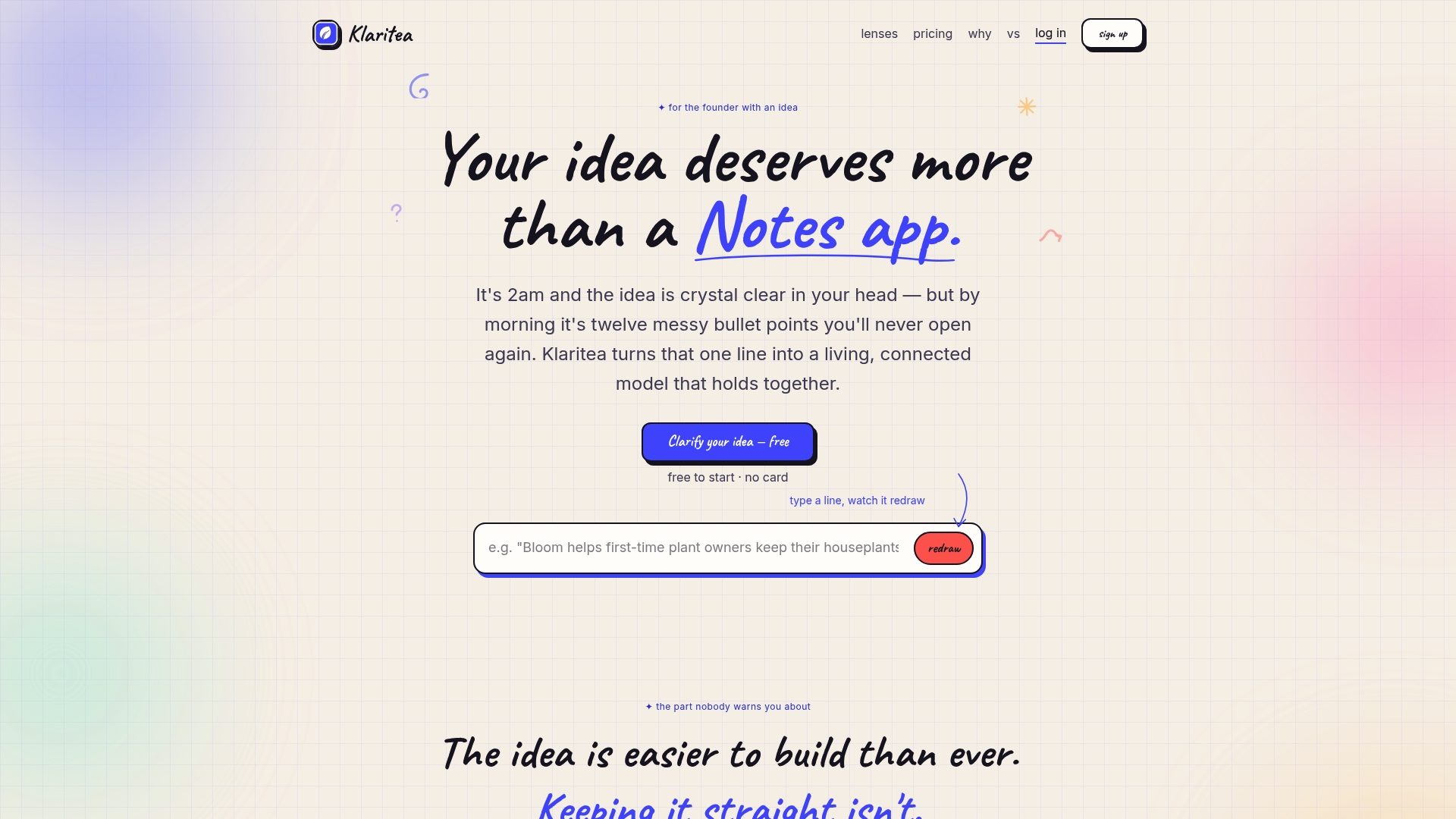
That scorecard is what changes the mentor conversation. Instead of "let me explain my idea," you open with "here is my model, here is where I think the risk is." Mentors respond to that differently.
Key outputs mentors actually use from Klaritea:
- Clarity scorecards that flag weak assumptions before a mentor has to
- TAM/SAM/SOM estimates built from your specific market, not generic benchmarks
- Exportable pitch assets ready for SCORE sessions, incubator applications, or investor decks
- AI advisors Maya (marketing), Devon (business strategy), and Priya (ops and QA) who challenge your model before any human does
Start your phase-0 plan free, then bring the output to your first mentor session.
Useful sources
| Resource | What it covers | Best for |
|---|---|---|
| SCORE / SBA mentoring | Free 1:1 mentoring, workshops, templates | Any stage, U.S.-based founder |
| SCORE.org | Mentor matching, online courses, business resources | Founders ready to book a mentor now |
| Tulane Startup Team Mentoring | Year-long cohort, wish-list matching, 3–5 mentors per team | Early-stage teams seeking structured incubator mentorship |
| BIRD Incubator | Two-stage incubation, mentor speed-dating, AI-focused | Early-stage, AI-focused startups |
| Accelerator Centre | Investor network, peer community, incubation | Founders seeking investor connections |
| Klaritea | AI phase-0 planning, TAM/SAM/SOM, pitch assets | Founders at idea stage, pre-application prep |
| Klaritea blog: startup management | Workflows and tools for first-time founders | Founders building their planning stack |
Which link to use first:
- No traction yet: book a SCORE mentor and run a Klaritea plan in parallel
- Applying to a cohort: review Tulane's application requirements and prepare your business model canvas
- Need investor access: apply to BIRD or the Accelerator Centre once you have a structured model
FAQ
What is the best free mentorship program for U.S. startups?
SCORE is the largest free mentor network in the U.S., offering ongoing 1:1 mentoring at no cost for the life of your business, available via email, phone, or video.
How competitive are accelerator programs like Y Combinator and Techstars?
Both accept under 2% of applicants, making them among the most selective programs available. A structured business model and early traction significantly improve your odds.
When should a founder use an AI planning tool instead of a mentor?
At the idea stage, before you have traction or a structured model, an AI tool like Klaritea covers market sizing, ICP definition, and assumption mapping faster than a mentor can. Use both once you have a model worth challenging.
What do incubator programs typically require on application?
Most structured programs ask for a business model canvas, customer discovery evidence, a pitch deck or one-pager, and a clear statement of your time commitment and goals.
How does Klaritea complement a mentorship program?
Klaritea produces a structured business model, TAM/SAM/SOM, and clarity scorecard before your first mentor session, so you spend that time on strategy rather than orientation.