TL;DR:
- Startup management software unifies project tracking, CRM, billing, and automation into one platform for early teams. Klaritea transforms ideas into structured business models before development begins.
Startup management software is an integrated platform that combines project tracking, CRM, billing, and workflow automation into a single system for early-stage teams. Most founders start by stitching together five or six separate apps, then spend more time managing tools than building their product. The right startup management system eliminates that overhead by giving your team one place to plan, execute, and measure. Klaritea takes this a step further by sitting at "phase 0," turning a one-line idea into a fully structured business model before you write a single line of code.
What core features does startup management software provide?
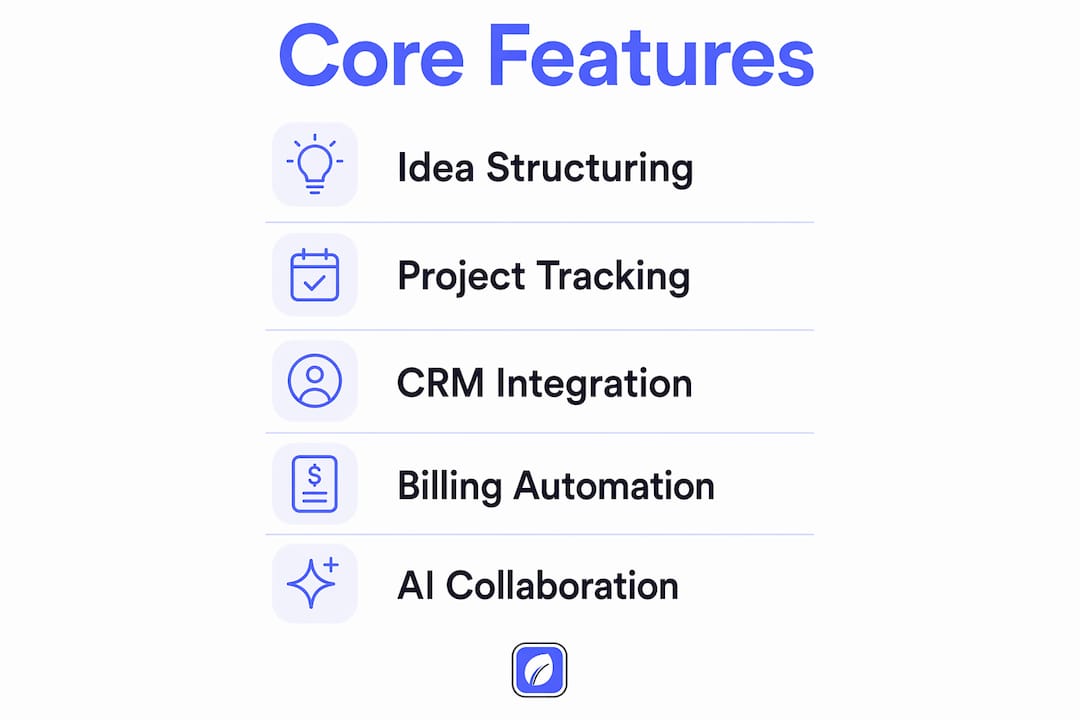
Startup management software covers four functional areas that every early-stage team needs: project management, customer relationship management, billing, and HR. The best platforms connect these modules so data flows between them automatically. A deal closed in CRM, for example, should trigger a project task and a billing record without manual entry.
The most useful features in a startup management system include:
- Multi-project visibility: See all active projects on one screen without switching tabs or apps.
- CRM integration: Track leads, deals, and customer interactions alongside your delivery work.
- Billing and invoicing: Generate invoices and track payments directly from project milestones.
- HR and onboarding modules: Manage contracts, roles, and team access from a central admin panel.
- Workflow automation: Set triggers so routine tasks complete themselves, such as sending a follow-up email when a deal stage changes.
- AI-driven templates: Use pre-built strategy frameworks to set up OKRs, sprint plans, and meeting agendas in minutes.
Most all-in-one startup platforms offer 14-day free trials with full feature access, often without requiring a credit card. That window is enough to run a real sprint cycle and judge whether the platform fits your workflow.
Pro Tip: Test a platform with a live project during the trial period, not a dummy dataset. Real friction shows up fast when actual deadlines and real teammates are involved.
Klaritea adds a layer before any of these operational tools kick in. It converts a one-sentence idea into a connected model covering your ideal customer profile, market sizing, feature list, and build spec. That output feeds directly into whatever project management or CRM tool your team adopts next.
How does startup management software improve productivity?
The biggest productivity gain from a unified startup management system is the elimination of context switching. Every time a founder moves between a task tracker, a spreadsheet, a CRM, and a chat tool, they lose roughly 20 minutes of focused work. A single dashboard stops that cycle.
"Founders risk 'productivity theater' by configuring overly complex boards instead of focusing on shipping deliverables. Effective software provides multi-project visibility without redundant data entry."
Real-time collaboration is the second major benefit. When your designer, developer, and sales lead all work inside the same system, status updates happen automatically. No one needs to ask "where are we on this?" because the answer is visible to everyone.
AI-driven features push this further. Emerging platforms now support autonomous agent coordination, where AI handles meeting agendas, task assignments, and progress check-ins without human prompting. Executive teams using AI-assisted OKR software can implement strategy frameworks within 30 days using pre-built templates and AI authoring agents. That speed matters enormously when you are trying to hit product milestones on a tight runway.

The practical result is a team that spends its time on output, not on status reporting. Automated workflows handle the administrative layer, and founders get their cognitive resources back for decisions that actually move the business forward.
What are best practices for adopting startup management tools?
The most common mistake first-time founders make is adopting too many tools too fast. A lean startup tech stack typically includes around six core tools, centered on CRM, accounting, and project management. Adding more apps beyond that threshold usually creates more overhead than it removes.
Follow this sequence when building your stack:
- Start with one unified platform. Choose a tool that covers at least project management, CRM, and billing before adding anything else.
- Run a 14-day trial with real work. Use an active project, not a test environment, so you can evaluate the platform under real conditions.
- Set up AI templates on day one. Most platforms offer pre-built OKR and sprint templates. Using them from the start cuts your go-live time significantly.
- Keep dashboards simple. Limit your main view to the five metrics that matter most: active tasks, pipeline value, burn rate, sprint velocity, and team capacity.
- Review your stack at 90 days. Cut any tool that your team has not used in the past two weeks. Dead tools create confusion and cost money.
Unified dashboards prevent context switching and reduce the mental load that comes from managing fragmented apps. Solo founders especially benefit from this approach because they carry every function of the business simultaneously.
Pro Tip: Avoid building elaborate project boards before you have a shipped product. A simple kanban with three columns, "To Do," "In Progress," and "Done," outperforms a 20-column board that no one maintains.
Industry leaders advise startups to unify their tech stacks early rather than layering many separate apps. The cost of switching tools mid-growth is far higher than the cost of choosing carefully at the start.
How is AI reshaping startup program management in 2026?
AI-native management systems represent the most significant shift in startup business software since cloud platforms replaced spreadsheets. These systems go beyond task tracking. They simulate full organizational structures, with AI agents that hold defined roles, report to hierarchies, and execute work autonomously.
Agentic orchestration platforms allow founders to delegate tasks and decisions to AI employees with hierarchical organization and adaptive coaching. OneManCompany, for example, is an agentic operating system that lets a solo founder run a simulated company structure. AI staff handle task delegation, performance reviews, and multi-iteration project delivery through a Talent Market where founders hire AI employees for specific roles.
The table below compares traditional task trackers with AI-native management systems across four key dimensions:
| Dimension | Traditional task tracker | AI-native management system |
|---|---|---|
| Task assignment | Manual, founder-driven | Autonomous, agent-driven |
| Meeting management | Scheduled by humans | Agenda-driven, AI-facilitated |
| Performance reviews | Periodic, manual | Continuous, automated |
| Human control level | Full manual control | Adjustable from autopilot to micromanagement |
Emerging AI-native systems integrate human oversight with autonomous agent execution, letting founders choose their desired level of control. That flexibility matters because not every founder is ready to hand off decisions to an AI agent on day one. The best platforms let you start with light automation and increase autonomy as your confidence grows.
The practical implication for first-time founders is significant. You no longer need a full team to run a full operation. AI agents can handle the coordination layer while you focus on product and customers. That is a structural change in what a two-person startup can realistically accomplish.
Key Takeaways
The most effective startup management system unifies project tracking, CRM, billing, and AI automation into one platform, adopted early and kept deliberately simple.
| Point | Details |
|---|---|
| Start unified, not fragmented | Choose one platform covering CRM, projects, and billing before adding any other tools. |
| Trial with real work | Use a live project during the 14-day free trial to surface actual friction points. |
| AI cuts go-live time | AI-assisted OKR templates let teams implement strategy frameworks within 30 days. |
| Simple dashboards win | Limit your main view to five core metrics and cut unused tools at 90 days. |
| AI agents expand capacity | Agentic platforms let small teams delegate coordination work to AI, freeing founders for high-value decisions. |
What I have learned from watching founders choose the wrong tools
The pattern repeats itself constantly. A first-time founder discovers a project management tool, spends a weekend building the perfect board, and then spends the next month maintaining the board instead of building the product. The tool becomes the work.
The founders who move fastest share one habit: they pick the simplest system that covers their actual needs, and they resist the urge to customize it until they have shipped something. Complexity is a form of procrastination. A beautiful dashboard with no shipped product is just expensive decoration.
The second lesson is about timing. Unifying your tech stack at month one costs almost nothing. Doing it at month twelve, when your CRM data lives in one tool, your project history in another, and your billing in a third, costs weeks of migration work and real money. Early consolidation is not just a productivity choice. It is a financial one.
AI augmentation is the third shift worth paying attention to. The future of AI management is not about replacing founder judgment. It is about removing the coordination overhead that consumes judgment. When an AI agent can run your weekly check-in, assign follow-up tasks, and flag blockers automatically, you get your mornings back. That time compounds.
My honest recommendation: start with a platform that covers at least three core functions, run a real trial, and add AI features incrementally. Do not build the perfect system. Build the system that ships your product.
— Karl
Klaritea gives your idea a structure before you build
Most founders reach for startup business software after they have already started building. Klaritea works differently. You type one line describing your idea, and Klaritea builds a connected model covering your market size, ideal customer, feature set, requirements, and build spec before you spend a dollar on development.
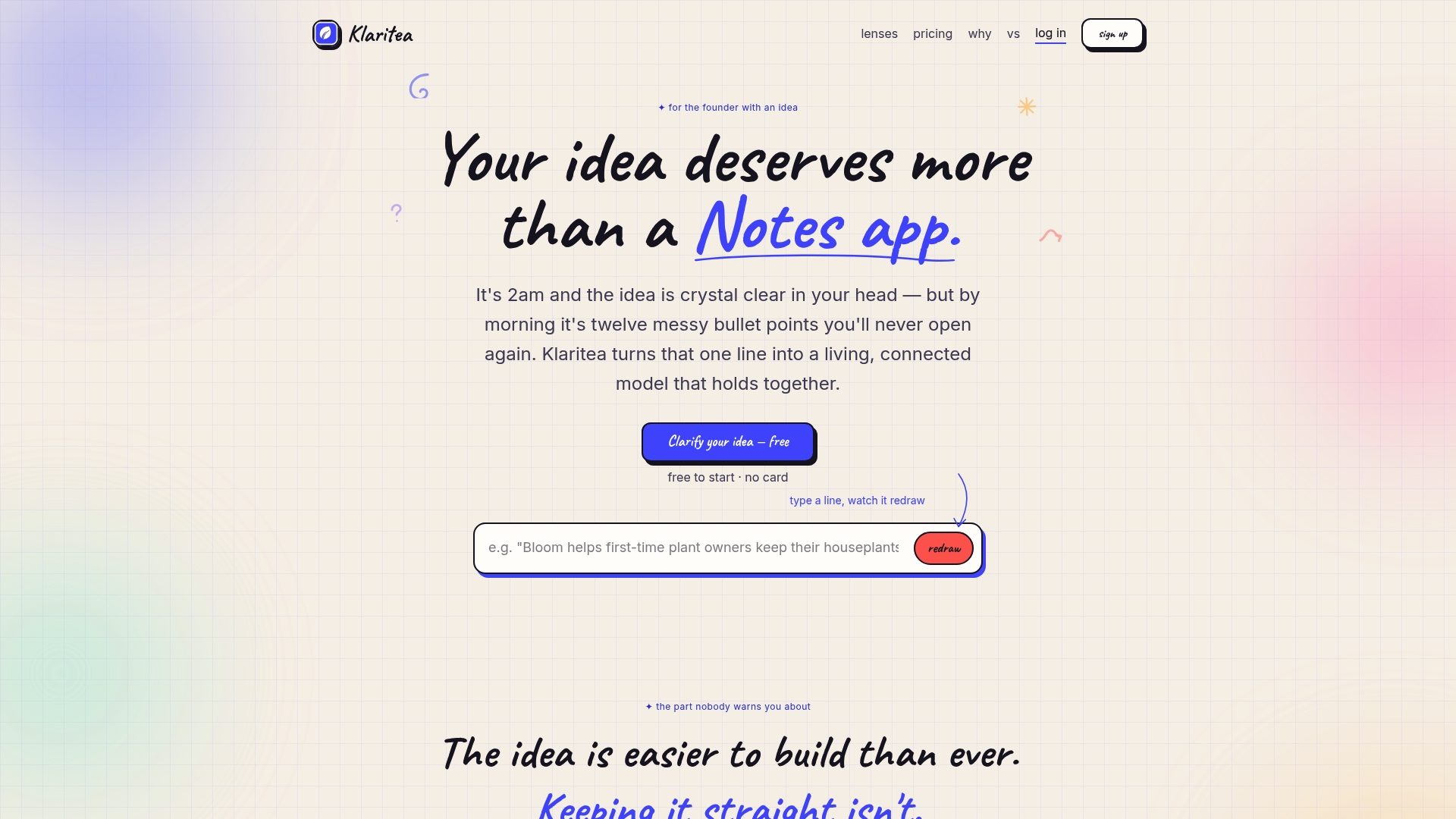
Three AI advisors, Maya for marketing, Devon for business, and Priya for ops and QA, research and challenge your idea from every angle. The output is a clarity scorecard, a printable report, and a build spec you can hand directly to a developer or feed into your startup project management workflow. Klaritea's connected model approach means every part of your business plan links to every other part, so nothing falls through the gaps when you move from idea to execution.
FAQ
What is startup management software?
Startup management software is an integrated platform that combines project tracking, CRM, billing, and workflow automation into one system. It replaces the fragmented app stacks most early-stage teams use.
How many tools should a startup use?
A lean startup tech stack typically includes around six core tools, centered on CRM, accounting, and project management. Adding more apps beyond that threshold usually creates more overhead than value.
How long does it take to implement a startup management system?
Executive teams using AI-assisted OKR tools and pre-built templates can go live within 30 days. Simpler project management setups can be operational within a single week.
What is the difference between a task tracker and an AI-native management system?
A task tracker requires manual input for every assignment and update. An AI-native system uses autonomous agents to assign tasks, run meetings, and conduct performance reviews with adjustable levels of human oversight.
Why should founders use Klaritea before choosing management software?
Klaritea structures your business idea before you build, producing a market analysis, feature list, and build spec from a single input line. That clarity makes every downstream tool, from your CRM to your project board, easier to configure and more useful from day one.