
A software requirements specification is the document that spells out what a system must do before anyone writes a line of code, acting as the contract between stakeholders, developers, and testers. It should be unambiguous, complete, and verifiable, per IEEE's recommended practice. Skip the blank-page problem: open a one-page outline covering scope, users, and constraints today, then expand section by section using the template below.
TL;DR:
- A formal SRS is essential for projects involving multiple teams or compliance, especially when detailed external interfaces and constraints must be documented clearly.
- Requirements should be written as testable "shall" statements with measurable non-functional metrics, paired with verification methods and unique identifiers for traceability.
- Sequencing requirements after agreeing on scope prevents costly rework and ensures stakeholder alignment, making layered drafts crucial for complex projects.
- Using tools like Klaritea can accelerate the transition from a simple idea to a structured, priority-driven requirements document with integrated stakeholder and requirement IDs.
Table of Contents
- What Does a Software Requirements Specification Cover?
- The SRS Template: A Copyable Structure
- How Do You Actually Write an SRS?
- Writing Requirements That Actually Hold Up
- What Belongs in the Interface and Data Section?
- How Do You Verify and Trace Requirements?
- Best Practices and Common Pitfalls
- Examples and a Starter Checklist
- How Klaritea Turns a Rough Idea Into SRS-Ready Inputs
- Where Teams Actually Go Wrong
- Turn Your Idea Into SRS-Ready Requirements Faster
- Sources
- FAQ
What Does a Software Requirements Specification Cover?
A software requirements specification, often shortened to SRS, is the single source of truth a team uses to estimate work, write test cases, and settle scope disputes months into a build. When someone asks "did we agree to build that?", the SRS is where you look. The IEEE Computer Society frames it as a stakeholder-readable document, not an engineering artifact locked away from product and business people.
Ownership typically breaks down this way:
- A product owner or business analyst drafts and maintains it
- Architects and engineering leads review it for feasibility and completeness
- QA uses it to derive test cases and acceptance criteria
Not every project needs a full SRS. A three-person startup validating an idea might get more value from lightweight user stories or a product requirements document. Reach for a formal SRS when multiple teams, vendors, or compliance requirements demand a document everyone can be held to.
The SRS Template: A Copyable Structure
The section breakdown below follows the outline IEEE's SRS standard recommends, later folded into ISO/IEC/IEEE 29148. It's copyable almost as written.
- Introduction. State the document's purpose, the product's scope, and a glossary of terms readers will need. Ambiguous terminology causes more rework than missing features.
- Overall description. Cover product perspective (standalone or part of a larger system), user classes (admin, end user, support staff), and constraints (budget, platform, regulatory).
- Specific requirements. Group functional requirements by feature or module, not by who requested them. List external interface requirements here too, even briefly.
- Non-functional requirements. Performance, security, reliability, usability. These get their own section because they apply across every feature, not to one.
- Appendices. Glossary, reference documents, and a revision history table so nobody argues about which version is current.
Don't invent a new structure for each project. A practical SRS template adapted from this outline gets you further, faster, than a custom format nobody else recognizes.
How Do You Actually Write an SRS?
Writing the document is less about typing and more about sequencing. Rush the order and you'll end up rewriting sections after stakeholders discover they disagreed on scope from day one.
- Elicit requirements first. Run stakeholder interviews, workshops, or clickable prototypes. Different techniques surface different gaps. Interviews catch political sensitivities; prototypes catch usability confusion nobody could describe in words.
- Start high-level, then drill down. Draft a skeleton outline stakeholders can agree on before writing detailed "shall" statements. Getting sign-off on scope early avoids the expensive rework of rewriting fifty detailed requirements because the premise changed.
- Prioritize and allocate to releases. Not everything ships in version one. Tag each requirement with a release or MVP designation so scope creep has a visible home instead of quietly bloating the current build.
- Review, baseline, and manage change. Circulate a draft, collect feedback, then lock a baselined version. After that, any change goes through a lightweight change request rather than a silent edit, a discipline NASA's software engineering handbook treats as non-negotiable for exactly this reason: floating "final" copies erode trust in the document.
Writing Requirements That Actually Hold Up
Functional requirements read best as "shall" statements: The system shall [action] when [condition]. For example: "The system shall lock a user account after five failed login attempts within ten minutes." That phrasing is testable. A tester can pass or fail it without asking you what you meant.
Non-functional requirements need numbers, not adjectives:
- Performance: "95% of API requests shall respond in under 200 milliseconds," a level of measurable rigor standard how-tos insist on for every NFR
- Availability: "The service shall maintain a high level of uptime, regularly monitored"
- Security: "Passwords shall be hashed using bcrypt with a minimum cost factor of 12"
The word "fast" or "secure" alone is not a requirement. It's a hope. Anytime you spot a subjective adjective, stop and ask what number would let a tester verify it.
Pro Tip: Pair every functional requirement with its acceptance criterion in the same line item. Writing them separately almost guarantees they drift out of sync as the document evolves.

What Belongs in the Interface and Data Section?
Most integration failures trace back to an SRS that mentioned an API existed but never documented how it actually behaved. Record the essentials directly in the SRS rather than assuming a separate document will cover it:
- Endpoint and method (GET, POST, and so on)
- Protocol (REST, gRPC, webhook)
- Data format and schema (JSON, XML, field types)
- Authentication method (OAuth, API key, mutual TLS)
- Version and deprecation policy
For a complex integration with dozens of endpoints, reference a standalone interface control document instead of pasting all of it inline. For a simple third-party call, the basics above are enough. Either way, note any third-party assumptions explicitly. If your payment processor caps transaction size or your mapping API rate-limits at 1,000 calls per day, that's a constraint on your system, and it belongs in writing, not in someone's memory. For anything touching sensitive data, detailed security and data-handling requirements deserve their own subsection rather than a single vague line.
How Do You Verify and Trace Requirements?
Every requirement needs a verification method attached at the moment you write it, not months later when QA asks how to test it. NASA's engineering guidance recommends specifying whether verification happens through test, demonstration, analysis, or inspection, decided per requirement based on what's actually checkable.
- State the acceptance criterion alongside the requirement, not in a separate document
- Assign each requirement a unique ID (REQ-LOGIN-001, for example) so it can be referenced anywhere
- Link every requirement to its test case or ticket
A requirements traceability matrix is how you keep this connected instead of scattered across tools.
| Requirement ID | Verification Method | Linked Artifact |
|---|---|---|
| REQ-LOGIN-001 | Integration test | TC-AUTH-001 |
| REQ-PERF | Performance test | TC-PERF |
| REQ-SEC | Security audit | AUDIT-Q1 |
When a requirement changes, the RTM tells you instantly which tests and tickets need re-checking. Without it, change impact analysis becomes guesswork, and audits turn into archaeology.
Best Practices and Common Pitfalls
The single biggest mistake teams make is blending "what" the system does with "how" it's built. Database schema choices and framework decisions belong in a software design document, not the SRS. Mixing the two locks in implementation decisions before anyone's tested whether they're right.
- Write for the least technical stakeholder who needs to approve the document
- Manage the SRS in layers: outline first, detail second, never the reverse
- Never ship a requirement without an acceptance criterion attached
- Version every change; a document with no revision history is a document nobody trusts
Pro Tip: If a requirement can't be tested by someone who wasn't in the room when it was written, rewrite it. That's the fastest gut check for ambiguity.
Examples and a Starter Checklist
A functional requirement example: "REQ-LOGIN-001: The system shall authenticate users using two-factor authentication; verification: successful login with valid credentials and OTP verified through integration testing; test: TC-AUTH-001." A non-functional SLA: "The system shall maintain 99.9% monthly uptime, measured via third-party monitoring."
Before drafting your own, confirm you have:
- Stakeholders identified and their roles assigned
- Scope boundaries agreed in writing
- Acceptance criteria drafted alongside each requirement, not after
- A traceability plan, even a simple spreadsheet, in place from day one
A feature requirements list and a technical specification example are useful starting points to adapt.
How Klaritea Turns a Rough Idea Into SRS-Ready Inputs
Most of the work above assumes you already know your features, users, and constraints. Klaritea exists for the step before that: turning a one-line idea into a structured build spec, feature list, and prioritized requirement set you can drop straight into the template above.
- Build specs map to your "specific requirements" section almost line for line
- Clarity scorecards flag gaps before you baseline, catching the ambiguity a reviewer would otherwise catch weeks later
- Exports to Notion, Confluence, and GitHub carry your requirement IDs forward into the tools your team already tracks work in
Run your idea through Klaritea first, and you start drafting the SRS with a stakeholder map and a first-pass requirement list already in hand, instead of a blank page.
Where Teams Actually Go Wrong
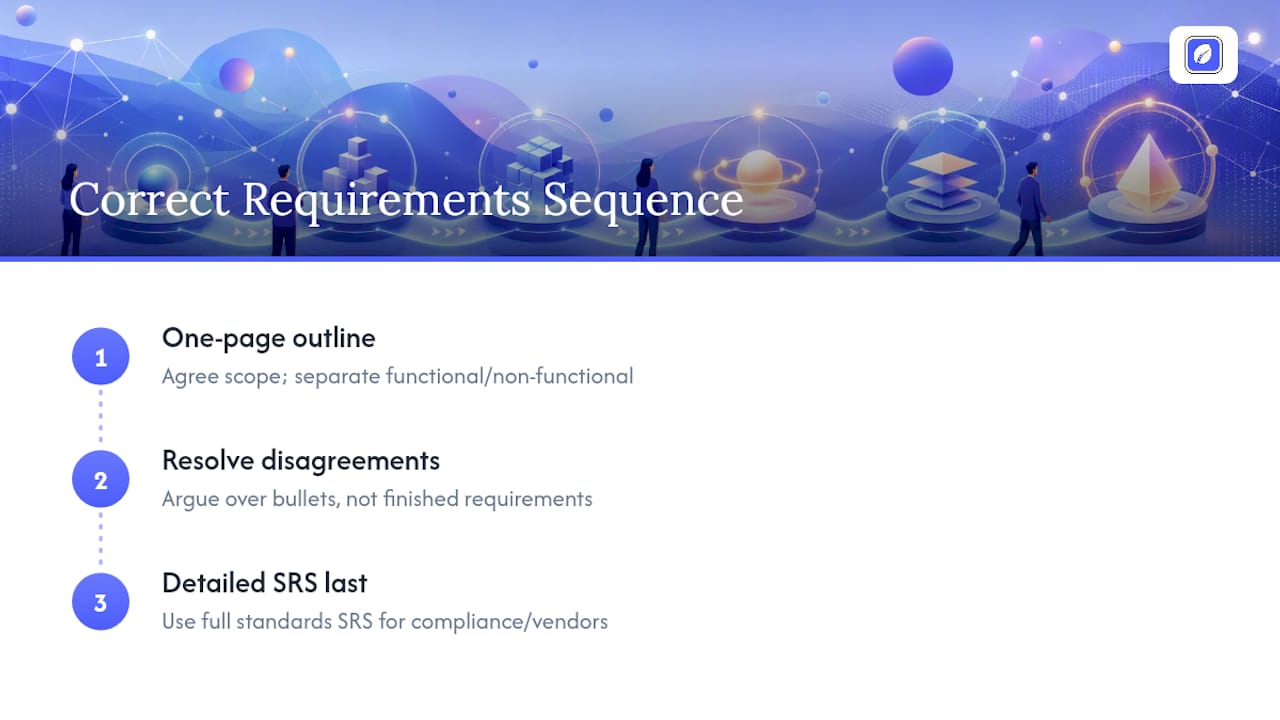
Most teams don't fail at writing individual requirements. They fail at sequencing: they write detailed "shall" statements before anyone's agreed on scope, then spend weeks unwinding disagreements that a one-page outline would have surfaced in a single meeting.
The layered approach isn't bureaucracy for its own sake. It's cheaper to argue over a bullet point than to argue over fifty finished requirements built on a premise nobody actually confirmed. Reach for a full standards-aligned SRS when compliance or multiple vendors demand it. For everything else, a lightweight outline that still separates functional from non-functional requirements will get you most of the benefit at a fraction of the overhead.
— Karl
Turn Your Idea Into SRS-Ready Requirements Faster
Klaritea is the fastest route from a one-line idea to a document you can actually hand a developer, skipping the weeks most founders spend guessing at scope before they write a single "shall" statement. Instead of starting your SRS from a blank page, you start from a build spec Klaritea already generated: feature lists grouped by module, a clarity scorecard flagging ambiguous requirements, and a stakeholder map you can lift straight into your introduction section.
Those outputs export directly to Notion, Confluence, or GitHub, so your requirement IDs carry forward into whatever tool your team already tracks tickets in, no manual re-typing required. If you're staring at a one-line idea and dreading the blank page, see why Klaritea exists and run your first idea through it today.
Sources
- Software requirements specifications
- IEEE Recommended Practice for Software Requirements Specifications (excerpts)
- SWE-109 - Software Requirements Specification (NASA handbook excerpts)
FAQ
What Is a Software Requirements Specification?
A software requirements specification is a document that describes what a software system must do, including its functional and non-functional requirements, written so developers, testers, and business stakeholders can all use it as a shared contract.
How Do I Write a Software Requirements Specification?
Start with a high-level outline covering purpose and scope, elicit requirements from stakeholders through interviews or workshops, write detailed testable "shall" statements, then review and baseline the document before development begins.
How Do I Write a Good Software Requirement?
A good requirement is unambiguous, testable, and paired with an acceptance criterion. Phrase functional requirements as "The system shall [action] when [condition]," and give non-functional requirements a measurable metric instead of a vague adjective.
What Does a Software Requirements Specification Example Look Like?
A functional example reads: "REQ-LOGIN-001: The system shall authenticate users using two-factor authentication; verification: successful login with valid credentials and OTP within 30 seconds." Tools can generate this kind of structured requirement automatically from a one-line product idea.