Control scope creep by baselining scope, enforcing a clear change control process, and tracking work against measurable artifacts as the project runs. Prevention alone is not enough, and neither is a change form nobody reads: you need both a locked reference point and a live process to catch drift before it compounds. The tactics below walk through the artifacts, meetings, and roles that make this work in practice.
TL;DR:
- Scope creep often begins with small, undocumented requests that are easily overlooked but cumulatively cause significant drift.
- Effective prevention requires a clear scope baseline, a formal change process, and regular schedule reconciliation to catch issues early.
- Using connected models, traceability, and structured sign-offs helps maintain alignment and avoids misinterpretation of scope boundaries.
- Monitoring key indicators like change request rates and unlogged hours enables early detection of scope drift before project delivery.
- Once scope creep occurs, rapid impact analysis and formal change approval are necessary to realign the project and control costs.
Table of Contents
- What scope creep is and how it differs from a managed scope change
- Early warning signs your project scope is drifting
- Why scope creep happens in the first place
- The prevention playbook: artifacts, roles, and a cadence
- Monitoring: how to catch scope drift while it's still small
- When scope creep is already happening: how to recover
- How Klaritea's phase-0 model supports these same controls
- The one habit that stops most creeping requests
- Try a phase-0 model before scope creep starts
- Sources
- FAQ
What scope creep is and how it differs from a managed scope change
PMI defines scope creep as the uncontrolled expansion of project or product scope without corresponding adjustments to time, cost, and resources. A managed scope change, by contrast, goes through review, gets approved by someone with the authority to approve it, and comes with an updated budget or schedule to match.

The difference is not the size of the request. It is whether the change passed through a gate. A weak or vague baseline makes that gate meaningless: if nobody agreed exactly what "done" looks like, every new request can be argued as something that was implied all along.
Consider a website redesign scoped for five template pages. A stakeholder asks for "just a quick blog layout too" during a review call. If that request gets built without a change order, it is creep. If it goes through intake, gets a cost and timeline estimate, and is approved with an extended deadline, it is a scope change.
- Scope creep: unapproved, unbudgeted, often undocumented
- Scope change: reviewed, costed, approved, and reflected in an updated baseline
- Both start the same way: someone asks for more
Early warning signs your project scope is drifting
Scope creep rarely arrives as one big ask. It shows up in small, easy-to-wave-off moments that add up before anyone notices. Watching for the pattern matters more than reacting to any single request.
- A stakeholder mentions a new requirement in a meeting but nobody logs it as a change request.
- The same person asks for "just one more thing" more than once in a sprint.
- Acceptance criteria shift after a deliverable was already marked in progress.
- Team members quietly absorb extra work rather than flagging it, because raising it feels like friction.
- Time tracking shows hours on tasks that never appeared in the work breakdown structure.
Build the habit of instrumenting your meetings and tickets so these signals leave a paper trail. Every scope-adjacent comment in a status call gets a timestamp and a name attached in the notes. Every ticket that grows in scope gets flagged rather than quietly edited.
Pro Tip: Train your ears for phrases like "just," "while you're at it," and "one small thing." They almost always precede a request that never gets logged.
Why scope creep happens in the first place
Firefighting individual requests only treats the symptom. The top five causes of scope creep point to systemic gaps that let creep in again and again if you do not close them.
- Optimism bias during planning leads teams to underestimate complexity and leave no room for the unexpected.
- Vague or incomplete requirements without clear acceptance criteria leave room for interpretation later.
- Stakeholder misalignment and undefined decision authority mean multiple people feel entitled to approve changes informally.
- Internal gold-plating, where the team adds polish nobody asked for, expands scope just as surely as an external request does.
- Absent or informal change control means there is no gate to catch any of the above before it becomes committed work.
Removing these drivers takes planning discipline up front, not more vigilance later. A charter that names a single decision-maker fixes stakeholder misalignment before it starts.
The prevention playbook: artifacts, roles, and a cadence
Prevention comes down to a small set of artifacts and the discipline to keep them current. Skip one and the others lose their teeth.
- Scope statement and baseline: write what is in and explicitly what is out, then get sponsor sign-off before work begins.
- Work breakdown structure (WBS): decompose deliverables into testable, measurable work packages so "done" has a concrete definition.
- Requirements traceability matrix: record every requirement's origin, owner, and link to design, build, and test, so a new request has to justify itself against something documented.
- Formal change process: define intake, impact analysis, approval authority, and a service level for turnaround, so requests do not sit in limbo or get approved by whoever answers first.
- RACI and sponsor cadence: name who is accountable for scope decisions and set a recurring checkpoint with the sponsor rather than relying on ad hoc hallway approvals.
The top five causes of scope creep research recommends progressive elaboration: collect requirements in layers, starting broad and getting more detailed as the project matures, rather than trying to nail every detail on day one. That approach makes early agreements realistic instead of setting up disappointment.
Contingency is part of prevention, not an afterthought. The GAO Cost Estimating and Assessment Guide ties reliable cost estimates and built-in contingency directly to managing scope-driven cost growth, and recommends earned value management to catch drift against the baseline early. Build in a reserve sized to the project's uncertainty rather than a flat percentage pulled from habit.
Monitoring: how to catch scope drift while it's still small
Artifacts only work if someone checks them against reality on a schedule. Reconcile your scope baseline, change log, and updated WBS on a fixed cadence, weekly for fast-moving projects, biweekly for longer ones, so drift gets caught in days rather than discovered at the end of a phase.
Real-time tracking makes a measurable difference. A Springer study on scope tracker applications found that implementing a real-time scope tracking tool produced a 25% increase in on-time completion, a 20% improvement in budget adherence, a significant reduction in scope changes, and 48-hour faster response times in the tested environment.
- Track change request rate: a rising number of requests per sprint is an early signal even before any get approved.
- Track the percentage of unlogged work found in time entries against what the WBS defines.
- Watch earned value indicators like cost and schedule performance index for early variance.
- Track rework hours separately, since rework often hides scope changes that were never labeled as such.
Link requirements, tickets, and time tracking so a new task can be traced back to an approved requirement. When it cannot, that gap is the flag.
When scope creep is already happening: how to recover
Once creep has already crept in, the goal shifts from prevention to triage. Move fast, but move with evidence rather than instinct.
- Collect the facts: what was added, when, by whom, and what it has already cost in hours or budget.
- Run an impact analysis covering cost, schedule, quality, and risk, not just the obvious line items.
- Convene the change control board or sponsor review and present the trade-offs plainly, including the option to do nothing.
- Choose one path: accept the change with a funded re-baseline, defer it to a follow-up project or phase, or kill it outright with the rationale documented.
- Record any work that falls outside the current approved scope in a separate cost account so it does not quietly erode funded work.
Controlling scope creep research recommends protecting the baseline this way: every change proposal gets a formal review of its impacts across schedule, cost, and risk before anyone touches a keyboard. Linking rejected or deferred requests to their own tracked account also prevents them from resurfacing informally a sprint later.
Pro Tip: Keep a running "not now" backlog for good ideas that fail the current change review. It gives stakeholders a place to feel heard without touching the live baseline.
How Klaritea's phase-0 model supports these same controls
Klaritea builds a connected model from a one-line idea, covering scope, market, competitors, features, and requirements before any code gets written. That model maps naturally onto the artifacts a PM needs early: the structured feature and requirement lists function like charter and WBS inputs, and the connections between them work like a lightweight traceability matrix linking business goals to build specs.
- The connected model keeps vision, features, and requirements synchronized, so a change in one view surfaces its effect on the others instead of drifting unnoticed.
- Clarity scorecards give a sponsor something concrete to sign off on before build work starts, similar to a scope baseline review.
- The build spec output gives engineering a defined package to build against, the same role a WBS work package plays in traditional planning.
Teams get the most value from these outputs at charter sign-off and again at sprint zero, before the first line of code locks in assumptions nobody agreed to.
The one habit that stops most creeping requests
The single biggest mistake I have seen repeated across projects is treating verbal requests as settled just because nobody objected on the call. "You said yes when we talked about it" is the sentence that kills more budgets than any dramatic scope battle ever does.
The fix is a habit, not a tool: write down every scope-adjacent request the moment it is said, with a timestamp, and raise it through the same channel every time, no exceptions. Once a team commits to record-and-raise, the volume of unlogged creep drops fast because ambiguity has nowhere to hide. Pair it with a clear MVP scope definition up front and the habit has far less to catch.
— Karl
Try a phase-0 model before scope creep starts
Most scope creep starts before a single ticket gets written, in the gap between a fuzzy idea and a plan nobody signed off on. Klaritea turns a one-line idea into a connected model covering market, features, and requirements, so the scope conversation happens once, on paper, instead of repeatedly during the build.
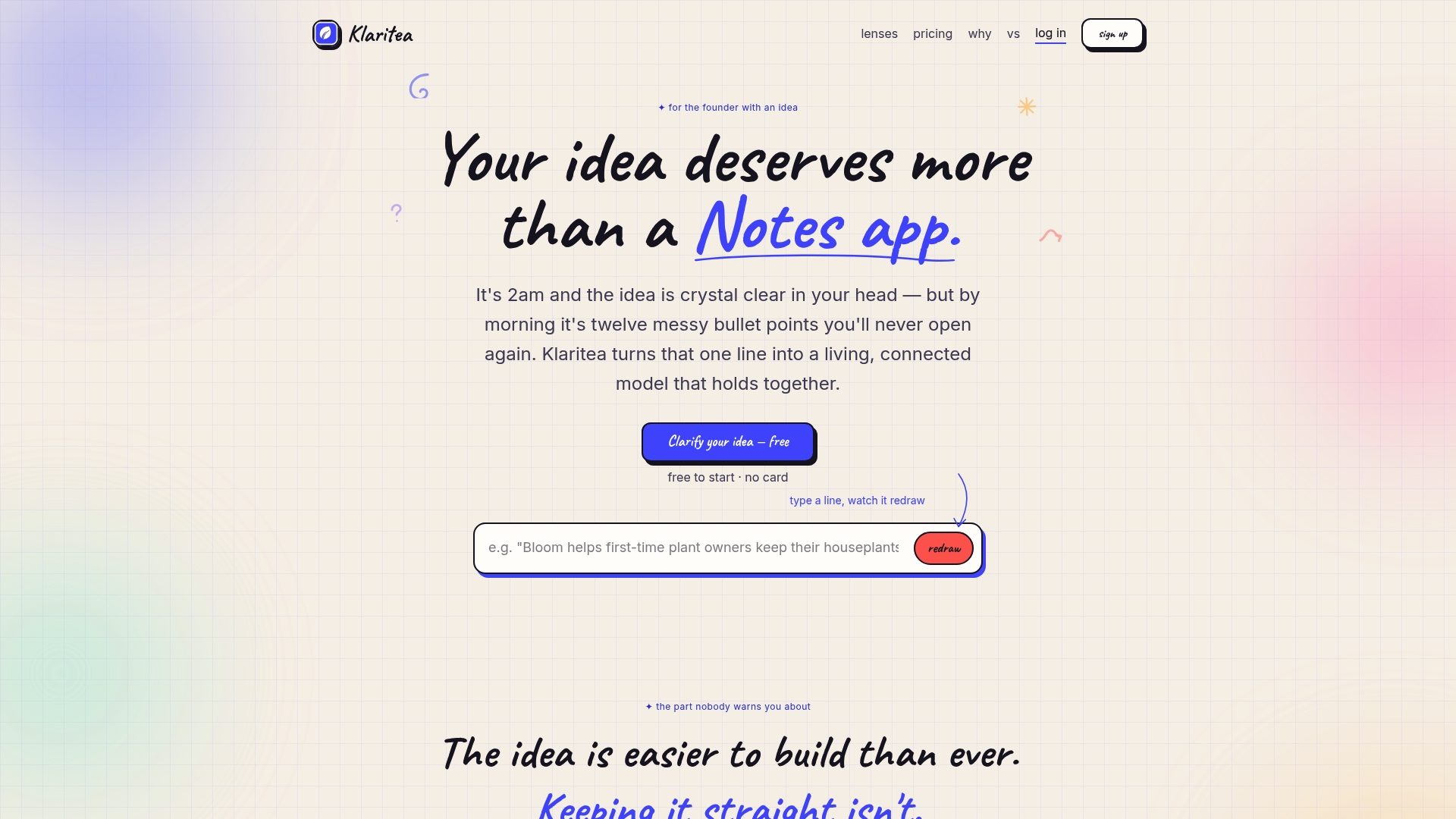
A free tier lets you build an initial model at no cost, and a paid subscription plan adds deeper advisory and export features teams often need once a project moves past the idea stage. Check the pricing page or read more about the reasoning behind one connected model before your next kickoff.
Sources
- Optimizing Software Development Projects: Implementing a Scope Tracker Application to Mitigate Scope Creep
- Scope and stakeholder management
FAQ
How to stop scope creep?
Stop it by locking a scope baseline before work starts, running every new request through a formal change process, and monitoring progress against your work breakdown structure on a fixed cadence. Combining prevention artifacts with active monitoring catches drift while it is still small enough to manage.
What is a famous example of scope creep?
Large public infrastructure and software programs are the most commonly cited category of scope creep, where added features or requirements without matching budget and schedule adjustments led to significant cost growth. The GAO Cost Estimating and Assessment Guide documents how missing contingency planning contributes to this pattern in government programs.
What is scope creep and example?
Scope creep is the uncontrolled expansion of a project's scope without corresponding changes to time, cost, or resources. A common example is a stakeholder asking for an extra feature during a review call that the team quietly builds without logging it as a change or adjusting the deadline.
Why is scope creep bad?
Scope creep erodes budgets and timelines because extra work gets absorbed without the funding or schedule adjustment it actually requires. Left unchecked, it also blurs accountability, since nobody formally approved the added work or its cost.