A Riskiest Assumption Test (RAT) is the smallest experiment you can run that produces decisive evidence on the one belief most likely to kill your idea. It's a test, not a product. Where an MVP asks you to build something shippable, a RAT only asks you to prove or disprove a single claim, fast and cheap, before you write a line of code.
TL;DR:
- Most riskiest assumptions relate to whether customers will pay a specific price, care enough to act, or find the problem sufficiently painful, and should be tested with targeted, minimal experiments.
- Assumption mapping should be limited to 15-25 specific, falsifiable claims prioritized by importance and evidence, focusing on those that threaten the whole idea if wrong.
- Run low-cost tests like landing pages, interviews, or fake buttons first, and only escalate to more complex experiments after initial signals suggest the assumption is valid.
- Always define kill criteria and success metrics before launching a test to prevent rationalizing ambiguous results or scope creep.
- Conduct assumption testing regularly as a weekly routine, moving from informal validations to more rigorous experiments to systematically de-risk your idea.
Table of Contents
- What Is a Riskiest Assumption Test, and How Does It Differ From an MVP?
- How Do You Identify the Riskiest Assumption?
- How Do You Design and Run a RAT?
- How Should You Sequence Multiple RATs?
- What Pitfalls Make RATs Unreliable?
- Making RATs a Weekly Habit, Not a One-Off Event
- Turn Assumption Mapping Into a Repeatable Workflow With Klaritea
- Sources
- FAQ
What Is a Riskiest Assumption Test, and How Does It Differ From an MVP?
A RAT produces evidence: a pass, a fail, or a number you pre-agreed to trust. An MVP produces a product. That distinction sounds small until you realize how many founders skip straight to building because a landing page feels less "real" than an app.
The method rests on three principles. First, falsifiability: the assumption has to be specific enough that a test can actually prove it wrong. Second, minimal cost: you're buying information, not building infrastructure. Third, pre-committed kill criteria, decided before you see any results, so you can't quietly move the goalposts when the data disappoints you.
Rik Higham's original framing put it bluntly: the MVP is dead, long live the RAT, because teams were building products to answer questions a five-dollar landing page test could answer in a weekend. That doesn't mean MVPs are obsolete. Once your riskiest assumptions about desirability and willingness to pay have survived testing, building the real thing is exactly the right move, and a clear read on prototype versus MVP tradeoffs helps you decide how much to build first.
How Do You Identify the Riskiest Assumption?
Every business idea rests on a stack of beliefs about desirability, feasibility, viability, and adaptability. Most of those beliefs are wrong, and you don't know which ones yet. Assumption mapping exists to sort them.
The standard method plots every assumption on a 2x2: Importance on one axis (if this is wrong, does the whole plan collapse?) and Evidence on the other (do you have real observed proof, or is this just a hunch?). Strategyzer's assumption mapping framework argues the top-right quadrant, high importance and low evidence, is where your riskiest assumptions live and where testing pays off fastest.
Running the workshop well means paying attention to a few practical details:
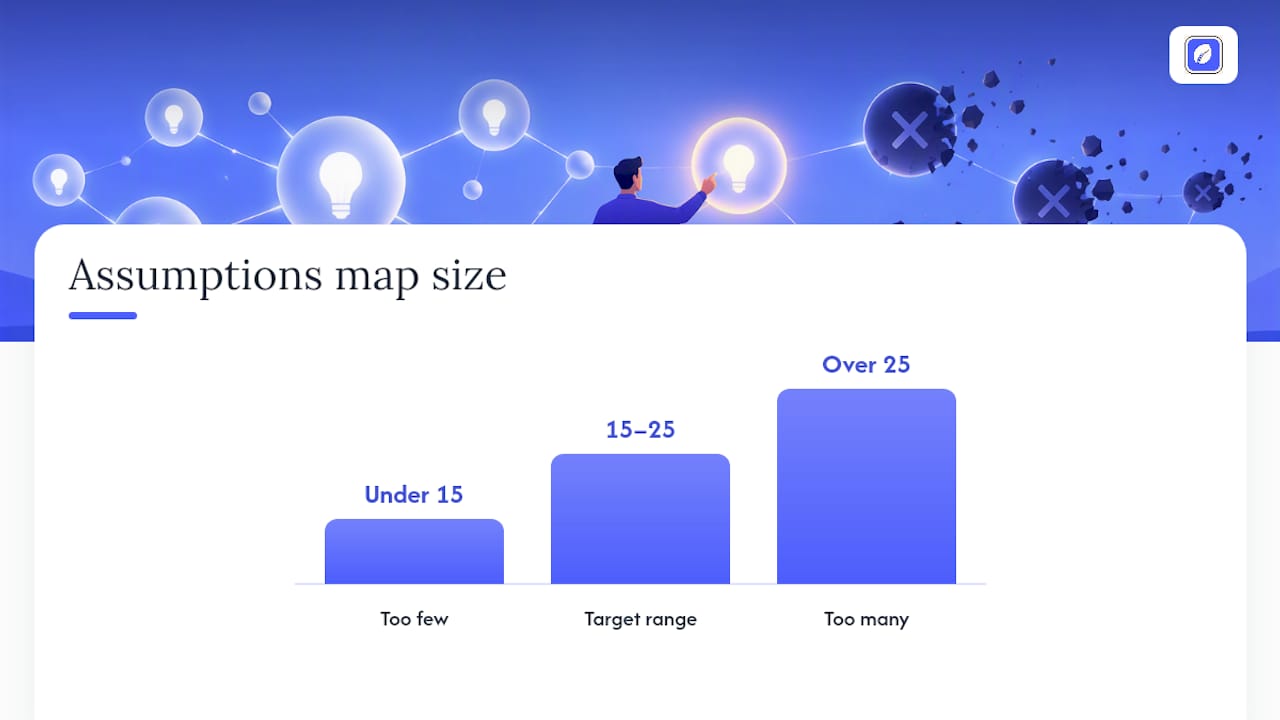
- Cap the map at roughly 15 to 25 assumptions; more than that signals scope that's too broad, fewer suggests the team hasn't dug deep enough.
- Write each assumption as a specific, falsifiable claim, not a vague hope ("customers will pay $20/month" beats "people will like this").
- Surface disagreements out loud. If two founders place the same assumption in different quadrants, that gap is more valuable than the map itself.
- Watch for the team's default bias toward feasibility questions, since those are the easiest to test by building, even when desirability and pricing carry more risk.
How Do You Design and Run a RAT?
Pick the cheapest test that could still convince a skeptic. That's the whole design brief. A few formats cover most early-stage situations, including landing page smoke tests measuring click-through rate or email sign-ups against a specific offer:
- Customer interviews to check whether the problem you assume exists actually bothers anyone enough to act.
- Landing page smoke tests measuring click-through rate or email sign-ups against a specific offer.
- Concierge tests, where you manually deliver the service by hand before automating anything.
- Wizard-of-Oz tests, where the product looks automated but a human is doing the work behind the curtain.
- Fake-door tests, a button or ad for a feature that doesn't exist yet, to gauge demand.
- Explainer videos that pitch the value proposition and track how far viewers get before dropping off.
Once you've picked a format, write the assumption as a single falsifiable sentence: "At least 8% of visitors who see this landing page will enter their email." Then commit to a kill criterion before you launch anything, not after you see the number. Strategyzer's guidance on testing critical hypotheses recommends treating this as step zero, before any Build-Measure-Learn cycle starts. A concrete list of validation formats, including how to run interviews and surveys before you write any code, lives in this guide to validating a business idea.
Pro Tip: Write the pass and fail numbers on a shared doc before you launch the test, and have someone other than the founder sign off on them. That single habit does more to prevent rationalized "wins" than any amount of good intentions.
How Should You Sequence Multiple RATs?
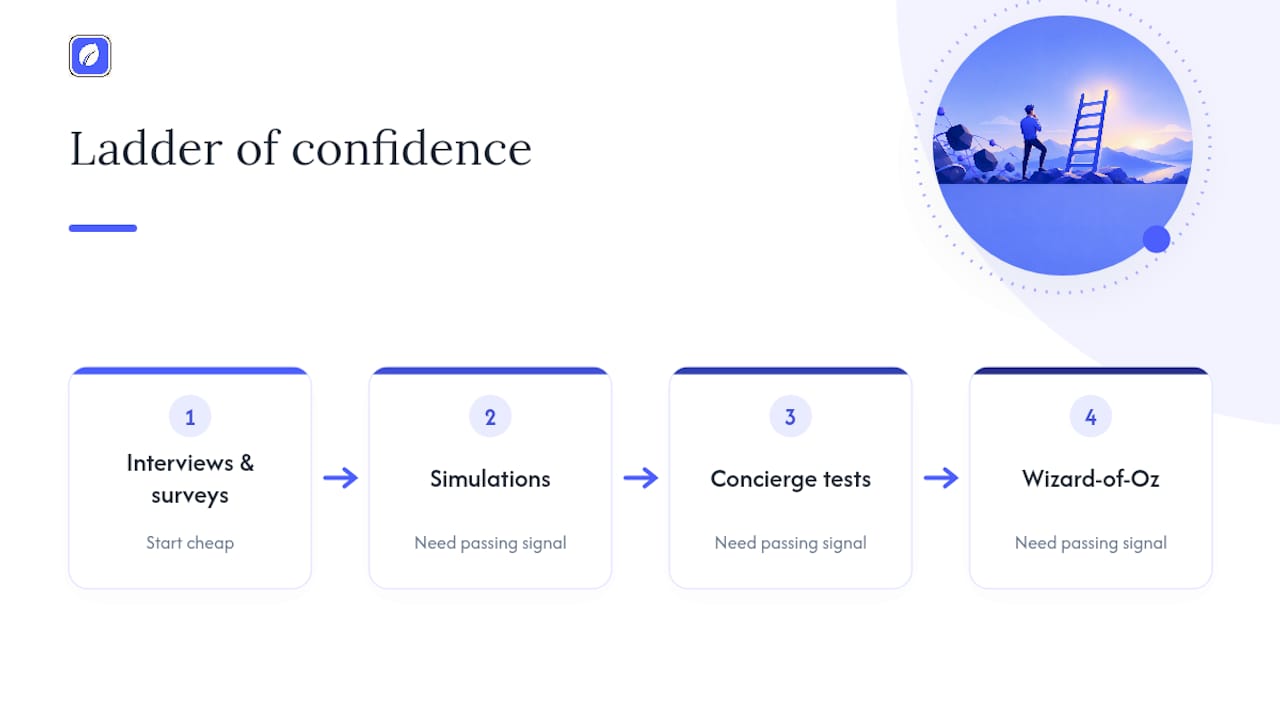
Start cheap, then get more rigorous. A "ladders of confidence" approach means you run interviews and surveys first, then move to simulations, concierge tests, or Wizard-of-Oz experiments only after the low-fidelity signal looks promising. Lean Startup Co.'s advice on avoiding test churn is blunt about why this matters: without predefined metrics and decision deadlines, teams keep re-running ambiguous tests instead of making a call.
The decision logic is simple once you've set it up. A pass moves you to the next riskiest assumption on your map. A fail sends you back to pivot the idea or kill it outright. A stall, meaning the result is genuinely ambiguous, means your test design was flawed, not your idea. Fix the test, don't rerun the same weak one hoping for a clearer answer. Once your top few assumptions have survived this ladder, you've earned the right to build an MVP, and a clear sense of how to scope that MVP keeps the build itself from ballooning back into guesswork.
What Pitfalls Make RATs Unreliable?
The biggest failure mode is running a test without writing down what counts as failure first. Teams that skip this step almost always find a way to read ambiguous data as validation, because nobody wants to kill their own idea. Requiring written success and fail criteria before any test launches removes that temptation entirely.
The second failure mode is scope creep: a RAT that quietly grows into a half-built product because "we're already building it, might as well finish." Police the budget and timeline like they're sacred, because they are.
- Pick metrics that test the assumption directly, not vanity numbers like total page views or app downloads with no context.
- Don't map every assumption in the business; map the ones that would actually end the company if they're wrong.
- Assign one owner and one deadline per test. A RAT with no owner never gets run.
Pro Tip: If your "test" takes more than two weeks or requires hiring anyone, it's stopped being a RAT. Shrink it until it fits in a sprint.
Making RATs a Weekly Habit, Not a One-Off Event
Most founders run one RAT, get excited about the result, and go straight back to building. That's a mistake. The teams that actually de-risk their ideas treat assumption testing as a weekly rhythm: a short mapping session to check which assumption now sits in the top-right quadrant, a two-week micro-experiment to test it, and a pre-committed checkpoint to decide pass, fail, or pivot.
Keep engineers out of it until an assumption survives two or three manual tests. Pulling a developer in early to build a "quick prototype" is usually just scope creep wearing a disguise. The moment worth their time is after desirability and pricing have already cleared the bar, which is exactly the gap a tool like Klaritea's connected model is built to track: it keeps every validated and unvalidated assumption visible in one place, so nobody quietly forgets what was actually proven.
— Karl
Turn Assumption Mapping Into a Repeatable Workflow With Klaritea
Klaritea is the alternative to running assumption workshops on scattered spreadsheets and sticky notes. It turns a one-line idea into a connected model, complete with ICP, market sizing, competitor analysis, and feature scope, then attaches assumption scorecards and experiment templates directly to the parts of your plan they're meant to test.
Instead of rebuilding your assumption map every time the plan shifts, Klaritea keeps it synced: change the pricing assumption and every downstream feature or build spec tied to it flags for review. Three AI advisors, covering marketing, business strategy, and operations, challenge your inputs the way a cofounder would, before you spend a dollar on development. Once your riskiest assumptions clear their RATs, Klaritea exports a build spec you can hand straight to engineers or sync to GitHub.
Start with the Free plan to map your first assumption set, or check the Klaritea and Pro tiers if you're ready to run your full phase-zero workflow, from RAT to build spec, in one connected model.
Sources
- How Assumptions Mapping Can Focus Your Teams On Running Experiments That Matter
- Avoiding waste & test churn: three tips to prep a test
FAQ
What Is Assumption Testing?
Assumption testing means running a small, cheap experiment to check whether a specific belief about your business, like "customers will pay for this," holds up against real evidence instead of opinion. It's the practice behind a riskiest-assumption test, which focuses that testing on the belief most likely to sink the whole idea.
Can You Give Me Some Examples of Bad Assumptions?
A bad assumption is usually vague, unfalsifiable, or untested: "people will love this," "we'll figure out pricing later," or "if we build it, they will come." Each one hides a specific, testable claim, such as an exact price point or a concrete problem severity, that a RAT could actually check.
Can You Give Me Some Examples of Assumptions?
Common early-stage assumptions include desirability claims ("this problem is painful enough that people will change behavior to fix it"), viability claims ("customers will pay $X per month"), and feasibility claims ("we can deliver this reliably at scale"). Each type needs a different test, which is exactly why assumption mapping sorts them by importance and evidence before you pick one to run.
What Are Assumptions and Risks in Project Management?
In project management, an assumption is anything you're treating as true without proof, and the risk is what happens if that assumption turns out false. Riskiest-assumption testing borrows this same logic for early-stage products: map what could be wrong, rank it by how much damage it would do, and test the top of that list first.
How Much Does Klaritea Cost?
Klaritea offers a free tier, a Klaritea plan at $19 per month, and a Pro plan at $99 per month, alongside one-off credit packs starting at $15 for 750 credits. Exact plan features and credit tiers are listed on the pricing page.