Use RICE when you have a large backlog and at least rough usage data, because it ranks items by expected value per unit of effort. Use MoSCoW when you're locked into a release date and need to cut scope fast, because its categories force a yes-or-no call instead of a score. If you have neither data nor a deadline, run ICE first and save RICE for later.
TL;DR:
- Use MoSCoW to quickly categorize work into Must, Should, Could, and Won’t, especially when a fixed deadline and stakeholder disagreement exist.
- RICE is most effective for ranking a large backlog of items with available usage data, requiring honest estimates of Reach, Impact, Confidence, and Effort.
- Combining MoSCoW for scope gating with RICE for detailed prioritization reduces scoring effort and ensures focus on the most valuable items.
- Calibrating impact anchors and setting a Must-cap before sessions help prevent scope creep and ensure reliable prioritization.
- Applying AI-powered tools can accelerate evidence gathering for RICE, improving the accuracy of scores and decision confidence.
Table of Contents
- RICE vs MoSCoW: What Each Method Actually Does
- How Do You Run MoSCoW Without Everything Becoming a Must?
- How Do You Calculate a RICE Score?
- RICE vs ICE and MoSCoW: The Head-to-Head
- Which Method Should You Use? A Decision Guide
- A Hybrid Workflow You Can Copy This Week
- Making Either Framework Stick
- The Case for Getting Evidence Before You Score
- A Faster Way to Build the Evidence Your Scores Need
- Sources
- FAQ
RICE vs MoSCoW: What Each Method Actually Does
The short version: MoSCoW sorts work into buckets, RICE ranks work with a number. That distinction shapes everything else about when each one earns its keep.
MoSCoW categorizes work into Must, Should, Could, and Won't, and it was built for teams racing toward a fixed ship date who need to agree on minimum scope before code gets written. RICE scores each initiative as Reach multiplied by Impact multiplied by Confidence, divided by Effort, and it's built for the opposite problem: a long list of candidate features competing for the same sprint, with no natural deadline forcing a cut.
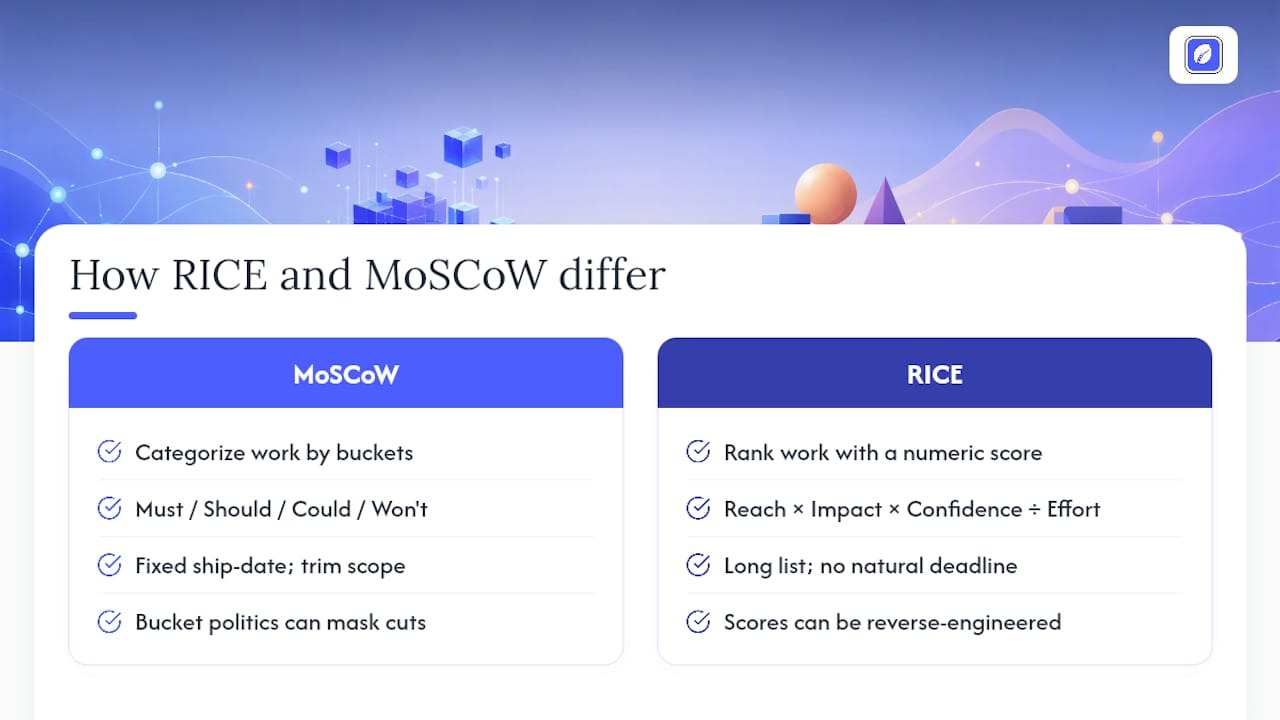
Neither one replaces product strategy. Both are conversation structures. A common critique of prioritization frameworks is that teams reverse-engineer scores to justify a decision they already made, which turns the exercise into theater instead of analysis. That risk shows up differently in each method, and knowing where it hides is most of what separates a useful RICE vs MoSCoW comparison from a superficial one.
How Do You Run MoSCoW Without Everything Becoming a Must?
MoSCoW only works if "Must" actually means something. If a large share of your backlog lands in that bucket, the exercise has failed before the meeting ends.
Here's the discipline test straight from the DSDM framework: read each "Must" item out loud with the phrase "the project will fail without this" attached. If that sentence sounds absurd, the item belongs in Should or Could, not Must.
- Must — the release fails, legally or functionally, without it.
- Should — important, and painful to cut, but the release survives without it.
- Could — nice to have if time and budget allow.
- Won't — explicitly out of scope for this release, stated so nobody re-litigates it later.
A typical MoSCoW session runs 60 to 90 minutes with product, engineering, and one commercial stakeholder in the room. Bring a candidate list in advance; don't build it live, or you'll spend the whole session brainstorming instead of deciding.
The failure mode practitioners run into most often is "everything is a Must," usually because nobody wants to be the person who says no. The fix is a hard cap: decide before the session that Musts can't exceed a fixed share of total scope, and hold the line when people push back. A second fix is reverse scoping from the ship date. Start from the deadline and work backward, asking what genuinely has to exist by then, rather than starting from the wish list and trying to shrink it.
MoSCoW earns its place when you have a hard deadline, a mixed group of stakeholders who disagree about scope, and a need for a documented, defensible cut list. It's a scope tool, not a ranking tool. For a deeper look at applying it to a real launch, see how to define MVP scope before a build starts.
How Do You Calculate a RICE Score?
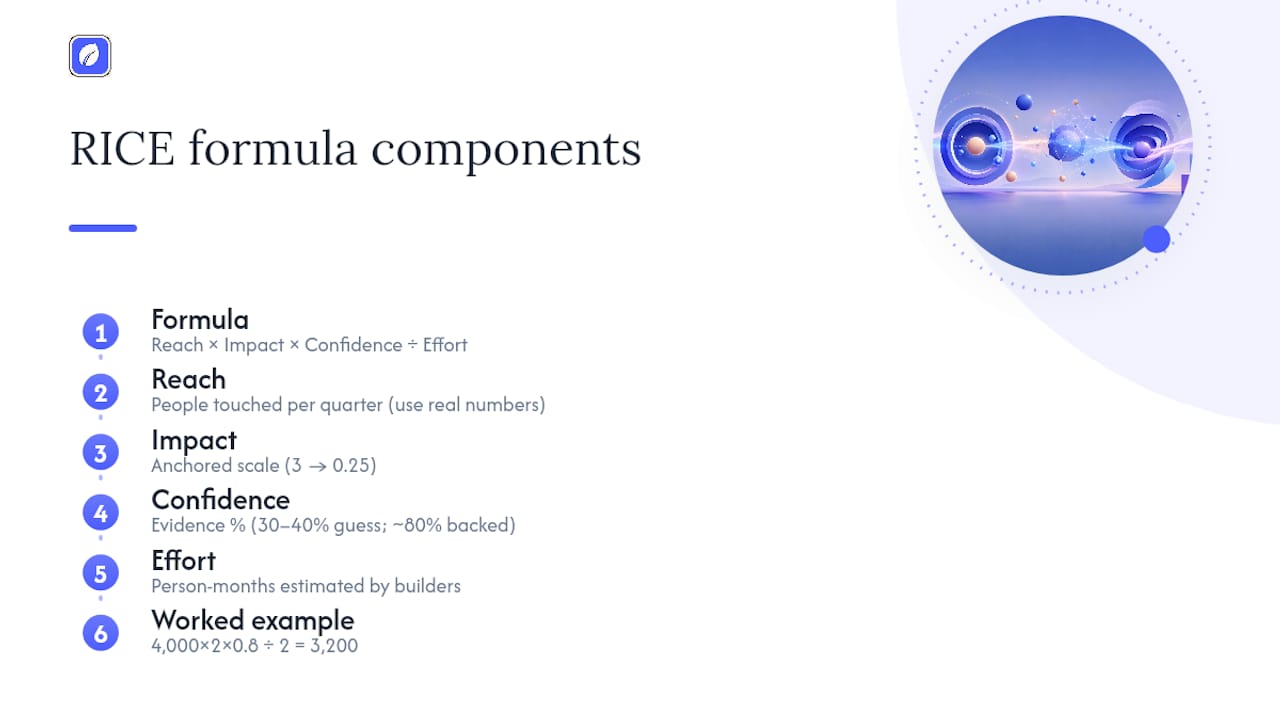
The formula is Reach × Impact × Confidence ÷ Effort. Each input has its own estimation problem, and getting the formula right matters less than getting the inputs honest.
Reach is how many people the change touches in a given period, usually a quarter. Use actual numbers when you have them: monthly active users hitting the affected flow, not a gut-feel guess.
Impact usually runs on a simple anchor scale: 3 for massive impact, 2 for high, 1 for medium, 0.5 for low, 0.25 for minimal. Anchoring the whole team to the same scale before scoring prevents one optimistic PM from inflating every pitch.
Effort is person-months of work, estimated by whoever will actually build it, not by the person proposing the feature.
Confidence is where most RICE scores quietly fall apart. The fix, according to guidance on using RICE with user research, is to treat Confidence as a measure of evidence, not optimism.
Pro Tip: Score Confidence as a percentage of evidence present, not a feeling. Try 30 to 40% when the input is a guess, and roughly 80% when it's backed by analytics or user interviews, per this calibration approach. Writing that number down next to the score keeps it honest six months later.
A worked example: a checkout redesign expected to reach 4,000 users a quarter, with a high Impact score of 2, an Effort estimate of 2 person-months, and 80% confidence backed by session recordings and support tickets, scores (4,000 × 2 × 0.8) ÷ 2 = 3,200.
RICE adds real value on backlogs of 15 or more competing items where you have at least directional usage data. It wastes time on a backlog of five items where the answer is already obvious, or on ideas so early that every input is a guess dressed up as a number.
RICE vs ICE and MoSCoW: The Head-to-Head
RICE, ICE, and MoSCoW solve different problems, which is why comparing them head-to-head matters more than picking a favorite. RICE and its lighter cousin RICE vs ICE both produce ranked lists; MoSCoW produces buckets.
- Output type: RICE outputs a ranked list with a numerical score attached to each item. MoSCoW outputs four labeled groups with no internal ranking inside each group.
- Time to run: MoSCoW sessions typically finish in one meeting. RICE scoring across a large backlog takes longer, since every item needs four separate estimates.
- Data requirements: RICE needs usage data and effort estimates to be credible. MoSCoW needs stakeholder judgment and a deadline, not data.
- Audit trail: RICE leaves a numerical record you can revisit and challenge later. MoSCoW leaves a rationale ("this is a legal requirement") that's harder to argue with but also harder to recalculate.
- Best question answered: RICE answers "which of these forty things should we build first?" MoSCoW answers "what's the smallest thing we can ship by March 1?"
Picture the same three backlog items run through both methods. A compliance fix, a new integration, and a UI polish pass. MoSCoW puts the compliance fix in Must, the integration in Should, and the polish pass in Won't for this release. RICE, run on the same three items, might rank the polish pass above the integration if it reaches far more users for far less effort, even though MoSCoW just told you not to build it this cycle. That's not a contradiction. It's two different questions getting two different honest answers.
Which Method Should You Use? A Decision Guide
Match the method to your situation rather than picking one and forcing every decision through it.
- Backlog of 20+ items with usage data available → Use RICE. Next step: add a low-confidence flag to any item scored on guesswork, and schedule quick user research on your top three before locking the ranking.
- Fixed release date, mixed stakeholder group, scope keeps growing → Use MoSCoW. Next step: run the discipline test on every proposed Must and cap Musts at a fixed share of total scope before the meeting starts.
- Early-stage idea, almost no usage data yet → Use RICE vs ICE's lighter cousin, ICE (Impact, Confidence, Ease), or pause scoring and gather evidence first.
- Large stakeholder spread across departments with conflicting priorities → Use MoSCoW to force an explicit, documented cut, since a numeric score won't settle a political disagreement.
- Small team, short backlog, obvious next move → Skip formal scoring. Neither framework adds value when the answer is already clear to everyone in the room.
Pro Tip: Combining methods costs you a meeting but saves you from scoring items nobody was going to build anyway. Gate first with MoSCoW, then only run RICE numbers on what survives the Must and Should buckets, an approach that measurably cuts scoring effort.
A Hybrid Workflow You Can Copy This Week
The fastest defensible process most teams land on is MoSCoW first, RICE second. It cuts the number of items that need full numerical scoring, because you're no longer scoring things nobody intends to build.
- Gate with MoSCoW (45 minutes). Product, engineering, and one commercial voice sort the full backlog into the four buckets.
- Drop the Won'ts (5 minutes). Document them so the decision doesn't resurface next sprint.
- RICE-score the Musts and Shoulds only (60 to 90 minutes). Engineering owns Effort estimates; product owns Reach and Impact; whoever has the research owns Confidence.
- Rank and schedule (15 minutes). Sequence by RICE score within the Must bucket first, then the Should bucket.
Worked example: three should items survive the gate. A search filter reaches 2,000 users, scores Impact 1, takes 1 person-month, at 60% confidence: score 1,200. A notification redesign reaches 8,000 users, scores Impact 0.5, takes 3 person-months, at 40% confidence: score 533. A dashboard tweak reaches 500 users, scores Impact 2, takes 0.5 person-months, at 80% confidence: score 1,600. The dashboard tweak ships first, not because it feels important, but because the number says so.
Making Either Framework Stick
Scores drift without enforcement. A framework that isn't calibrated and revisited turns into a one-time exercise nobody trusts by the next planning cycle.
- Calibrate Impact anchors as a team before the first scoring session, not during it, so 3 means the same thing to everyone.
- Cap Must-haves at a fixed percentage of scope and apply the discipline test to every item that claims the label, since teams without an explicit cap tend to drift toward putting almost everything in Must.
- Set a Confidence floor for RICE. Anything below roughly 30% goes into a research queue instead of a ranked slot.
- Keep a decision log next to the scores: who estimated what, and on what evidence. Revisit scores every quarter or after a major data update, not on a fixed calendar that ignores what actually changed.
Pro Tip: Uncertainty doesn't disappear when you write a number down. It just gets a place to hide. Log the confidence basis in the same row as the score, and you'll catch the guesses before they ship.
The Case for Getting Evidence Before You Score
Most teams reach for RICE before they have anything real to put in the Confidence column, which is how false precision creeps in. A sensible maturity path runs ICE early, MoSCoW when a deadline appears, RICE once usage data exists, and a custom weighted model only once you've outgrown all three. Structured phase zero work, the kind that produces a clarity scorecard or a build spec before a single line of code exists, gives RICE something honest to score against instead of a guess wearing a decimal point.
— Karl
A Faster Way to Build the Evidence Your Scores Need
An AI-powered planning tool can help you arrive at a defensible RICE score faster than staring at a spreadsheet trying to guess Confidence by implementing proven AI productivity workflows that save time. Instead of scoring features based on gut feel, you feed the framework real structure: an ICP, a TAM/SAM/SOM breakdown, competitor analysis, and a feature map generated from a single one-line idea.
That structured model becomes the evidence base your Confidence column has been missing. Three AI advisors, covering marketing, business strategy, and operations, stress-test the idea before you ever open a backlog, which means the Reach and Impact numbers you plug into RICE come from something more solid than a hunch. Export a clarity scorecard or build spec first, then run your RICE or MoSCoW session on top of it. Start structuring your idea at Klaritea before your next prioritization meeting.
Sources
- RICE Scoring vs MoSCoW vs Weighted: Which Framework Actually Works?
- DSDM project framework — MoSCoW prioritisation
- MoSCoW vs RICE vs ICE: How to Pick the Right One
FAQ
What Is the Difference Between RICE and MoSCoW?
RICE produces a ranked numerical score for each backlog item using Reach, Impact, Confidence, and Effort, while MoSCoW sorts items into four fixed categories, Must, Should, Could, and Won't, without ranking within each bucket.
What Does RICE Stand For?
In product management, RICE stands for Reach, Impact, Confidence, and Effort, the four inputs multiplied and divided to produce a priority score. It has no connection to the CIA or any government agency; that's a different, unrelated acronym.
What Are the Drawbacks of the MoSCoW Method?
MoSCoW's biggest weakness is that it produces no ranking within a category, so two Must items can still compete for the same limited sprint. Without a hard cap on Musts, teams also tend to over-classify items as essential, which defeats the method's purpose.
What Are the Three Main Prioritization Methods Product Teams Use?
RICE, MoSCoW, and ICE cover most situations: RICE for data-backed ranking of large backlogs, MoSCoW for scope cuts against a fixed date, and ICE as a faster, lighter version of RICE for early-stage decisions with little data.
Can I Use RICE and MoSCoW Together?
Yes, and it's often the most efficient approach: gate the backlog with MoSCoW first, then run RICE scoring only on the surviving Must and Should items, which cuts the number of items requiring full numerical estimation.