Ship when your launch gate is green, not when you feel ready. That gate has four lights: the core flow works end to end, monitoring and alerts are live, rollback steps are written down, and a small group of committed early users exists (paid pilots, letters of intent, or genuine day-one signups). Nothing else needs to be perfect.
The fastest move you can make right now is building a one-page checklist with five columns: Task, Owner, Due date, Status, and Go/No-Go. Assign an owner to every row before you assign a deadline.
Pro Tip: If a task can't sway the go/no-go decision, delete it from the sheet. It's noise, not a gate.
This works because release planning for a first product isn't about sequencing features. It's about prioritizing whatever reduces the most uncertainty about whether anyone will actually pay you. Klaritea's phase-0 model exists to turn that prioritization into a structured plan before you write a line of code.
Key Takeaways
A release is ready to ship only when the core flow works, monitoring and rollback are documented, and a small group of committed early users backs the launch.
| Point | Details |
|---|---|
| Use a five-column gate | Track Task, Owner, Due date, Status, and Go/No-Go on one sheet, nothing that can't sway the decision belongs there. |
| Prioritize by uncertainty | Build milestones that test your biggest unknown first, not the feature that's most fun to build. |
| Cut scope ruthlessly | Ask "can the first 10 users get value without this?" for every planned feature before launch. |
| Presell before you build | Letters of intent and paid pilots validate demand better than a waitlist ever will. |
| Plan the phase before code | Klaritea structures the ICP, scope, milestones, and build spec into one connected model before you start building. |
Table of Contents
- Release Planning Guide: The One-Page Launch Gate and Runbook
- How Do You Define Learning Milestones for an MVP?
- How Do You Cut Scope for a First Release?
- What Are the Technical Non-Negotiables Before Launch?
- What's the Minimum Go-to-Market for a First Launch?
- What Should You Do in the First 30 Days After Launch?
- Risk Management and Mitigation During Release Planning
- How Do Small Teams Stay Aligned on Release Readiness?
- What Decision Criteria Belong at the Go/No-Go Gate?
- Karl's Practical Perspective and Non-Obvious Habits That Speed Validation
- How Klaritea Turns a Rough Idea Into a Release-Ready Plan
- Sources
- FAQ
Release Planning Guide: The One-Page Launch Gate and Runbook
Most launch failures aren't technical. They're coordination failures, five people assuming someone else checked the thing that broke. A one-page gate fixes that by forcing five readiness buckets into a single view: product, technical, market, operations, and support.
- Product — core user flow tested by someone who isn't you.
- Technical — monitoring live, rollback steps written, backups confirmed.
- Market — day-one contact list ready, presell commitments logged.
- Operations — support inbox staffed, escalation contact named.
- Support — FAQ or help doc live for the three most likely questions.
Each row gets Task, Owner, Due date, Status, and Go/No-Go. If a task's failure wouldn't stop the launch, it doesn't belong on the sheet, move it to a backlog instead.
The launch-day runbook rides on top of this gate:
- T-60 minutes: final go/no-go review with every owner present.
- T-0: staged rollout begins, watch error rates for 15 minutes before widening.
- T+2 hours: first metrics check, announce publicly only after the watch window clears.
- Anytime: a defined rollback trigger, no debate in the moment.
Pro Tip: Name one person as the single point of escalation for launch day. Two decision-makers means no decisions get made when something breaks at 7 a.m.
Atlassian's launch checklist framework covers this same ground at enterprise scale. You're compressing it into something a three-person team can run without a project manager.

How Do You Define Learning Milestones for an MVP?
A learning milestone is a number you set before launch, not one you notice after. "Five paying users in the first two weeks" is a milestone. "See how it goes" is not.
Concrete examples worth stealing:
- 30% of signups complete the core action within their first session (activation).
- Three signed letters of intent before you write code for a paid feature.
- 10 customer conversations yielding three paying commitments, a threshold strong enough to justify scoping a build.
- Day-7 retention above 20% for your first cohort of 20 users.
Pick milestones by asking which uncertainty is biggest, not which feature sounds impressive. If you don't know whether people will pay, your milestone is a payment event, not a feature-usage event. That's the uncertainty-reduction logic that separates release planning from a generic product roadmap.
Sample size matters more than most founders admit. Five conversations tell you almost nothing; ten to fifteen start to reveal a pattern. Give each milestone two to four weeks before you call it passed or failed. Anything longer and you're not testing, you're stalling. For a deeper framework on setting these thresholds, validating a business idea before you build is worth a closer read.
How Do You Cut Scope for a First Release?
Run this exercise with your whole team in one sitting. List every feature you think v1 needs, no filtering yet. Then ask, one by one: "Can the first 10 users get real value without this?" If yes, it moves to the backlog immediately.
- List everything on a whiteboard or a shared doc, five minutes, no debate.
- For each item, ask the "first 10 users" question out loud.
- Anything that survives goes into v1. Everything else waits.
- Re-rank the survivors by uncertainty reduction, not by how excited you are to build them.
That's the point. Your v1 needs a core flow, basic authentication or payments if money changes hands, minimal analytics to see what's happening, and one support channel. Everything else, onboarding polish, admin dashboards, secondary user roles, is a second release.
Pro Tip: Set a 45-minute timer for the scoping session. Teams that scope for three hours usually end up negotiating their way back into scope creep.
An opportunity assessment done before this exercise makes the "can they get value without this" question much easier to answer, since you already know what the customer actually needs solved.
What Are the Technical Non-Negotiables Before Launch?
Five things need to be true before you flip the switch, and none of them require a dedicated DevOps hire.
- Automated tests pass on the core flow, and a human clicks through it manually once more.
- Monitoring and alerting are live, error tracking, uptime checks, and database backups at minimum.
- Rollback steps exist in writing, not in someone's head.
- Staged rollout starts at 10 to 20% of traffic with a watch window before widening.
- A rollback trigger is defined in advance: error rate at three times baseline, or if the core flow breaks for any user.
Founders should prefer a short, decisive pre-launch gate for small teams: tests pass, monitoring is live, rollback steps in writing, and customer-facing copy is final. Otherwise, hold the release.
One person watches the dashboards for the first two hours after launch, full stop, with a named backup if that person steps away. Escalation is simple for a small team: anything breaking the core flow gets fixed immediately; anything cosmetic waits until morning.
Pro Tip: If your MVP touches AI features, run a light security audit before launch, not after your first incident. A pre-launch QA sign-off covers the rest of the technical surface.
What's the Minimum Go-to-Market for a First Launch?
Skip the press release. Presell instead. A signed letter of intent, a paid pilot, or a calendar commitment from a real prospect tells you more than a hundred newsletter signups.
- Build a day-one list of a small group of warm contacts from your network, relevant communities, or warm outreach, not cold ads.
- Reach out individually with a specific ask: "Would you try this and tell me honestly if it's broken?"
- Soft launch to that list first: invite, watch what breaks, fix it, then announce more broadly.
Presold commitments are the highest-leverage move you can make before launch, more useful than a landing page full of "interested" clicks. Money or a signature beats polite enthusiasm every time.
On launch day itself, watch three things: how many of your day-one contacts actually show up, where they drop off in the core flow, and whether anyone asks to pay. Channel choice shifts by phase, direct outreach pre-launch, community and referral post-soft-launch, paid acquisition only once retention numbers justify the spend.
What Should You Do in the First 30 Days After Launch?
Instrument three metrics before you do anything else: activation (did they complete the core action), day-7 retention, and conversion if you're charging. Validate that your tracking actually fires correctly within the first 48 hours, broken analytics is worse than no analytics.
Read every piece of feedback yourself for the first month. Watch session replays for your earliest users if you can. Ship one meaningful improvement per week rather than batching fixes into a big release, momentum matters more than polish right now.
- Set an evidence threshold before you look at the data: "if activation stays below 20% for two weeks, we pivot the onboarding flow."
- Decide in advance when you'll shift from this linear planning approach into ongoing Agile iteration, usually once your MVP is validated and acceptance criteria stop changing week to week.
- Week-one checklist: confirm analytics fire correctly, read 100% of support tickets personally, schedule three follow-up calls with early users.
Risk Management and Mitigation During Release Planning
Every release carries three kinds of risk: technical (it breaks), market (nobody wants it), and operational (you can't support what you shipped). Treat each one differently instead of lumping them into a single "risk" line item nobody owns.
Technical risk gets mitigated with the readiness checks already covered, staged rollout, monitoring, rollback. Market risk is the one founders underestimate most, and it's the reason uncertainty-first prioritization matters more than a polished feature list. If you haven't tested willingness to pay, that's your biggest exposure, not a missing dashboard widget.
Operational risk shows up when a launch succeeds faster than expected. A founder who preselled to 50 people and gets 40 signups on day one, with no support process, will spend that week firefighting instead of learning. Build a lightweight mitigation plan for each risk category before launch: a rollback plan for technical failure, a pivot trigger for market rejection, and a triage rule (fix breaking issues first, log everything else) for operational overload.
Set a risk review cadence, weekly during the first month is usually enough, where you ask: what's the biggest thing that could go wrong in the next seven days, and do we have a plan if it does? Write the answer down. A risk you've named and planned for is manageable; a risk you haven't discussed is the one that actually sinks the release.
How Do Small Teams Stay Aligned on Release Readiness?
A three-person startup doesn't need a change advisory board, but it does need one shared source of truth. That's what the one-page launch gate actually solves: everyone looks at the same sheet instead of five different Slack threads claiming different levels of readiness.
Daily standups during launch week don't need to be formal. A 10-minute check-in covering "what's blocking your row on the gate" keeps surprises from compounding. The biggest alignment failure in early-stage teams isn't disagreement, it's silent assumption. One founder assumes the other tested the payment flow; neither did.
Name a single decision-maker for the go/no-go call itself. Consensus works fine for feature debates, but launch timing needs one voice that breaks ties when the room is split. That person reviews the gate sheet, confirms every row is green or explicitly waived, and calls it.
Documentation matters more than tooling choice here. Whether your team tracks the launch gate in a spreadsheet, a shared doc, or a lightweight project board, the discipline of writing owner names and dates next to each task is what prevents the "I thought you had that" conversation on launch morning. Export your plan into whatever your team already lives in, Notion or Confluence work fine for this, so nobody has to check a second tool to know where things stand.
What Decision Criteria Belong at the Go/No-Go Gate?
The go/no-go gate needs binary criteria, not vibes. "Core flow works" is binary. "Feels ready" is not, and it's the single most common reason launches slip by weeks with nothing concrete changing in the meantime.
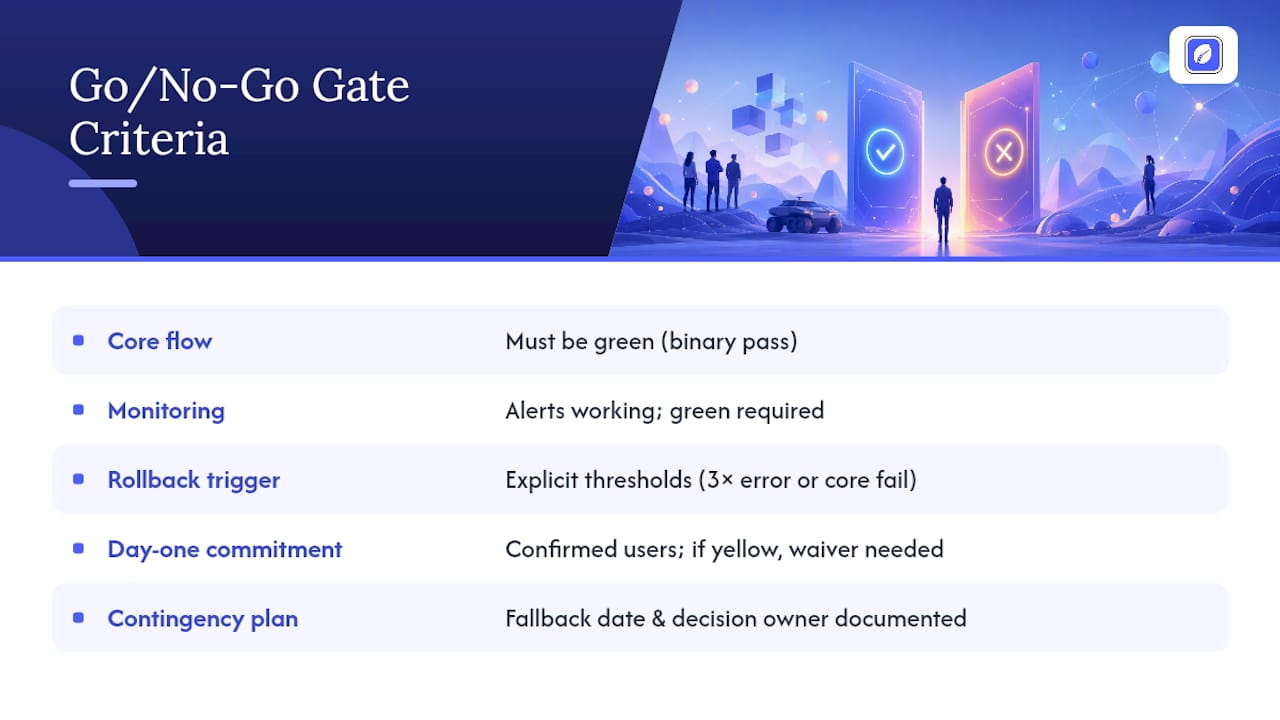
Set your criteria before launch week starts, not during the final meeting when everyone's tired and wants to just ship. A workable go/no-go rule: all five readiness buckets show green, or any yellow row has an explicit owner-approved waiver with a documented reason.
Build a contingency plan for the two most likely no-go outcomes. If the core flow fails in staging, what's the fallback date, and who decides whether to delay by a day or a week? If your day-one commitment list falls through, do you launch anyway to a smaller group, or push the date? Deciding these answers in advance keeps a no-go from turning into a panic.
The rollback trigger deserves its own explicit criteria too: error rate at three times baseline, or any failure in the core flow for any user, pulls the release back immediately, no committee vote required. Write these thresholds down before launch day, because the moment you actually need them is the worst possible time to start debating what counts as "bad enough."
Karl's Practical Perspective and Non-Obvious Habits That Speed Validation
Three habits separate founders who ship cleanly from those who stall: name one escalation owner before launch day arrives, pick a single primary channel instead of spreading thin across five, and presell before you build rather than after.
[Karl's professional background and credentials placeholder] [Case studies or user validation of Klaritea's effectiveness placeholder]
A phase-0 planning tool earns its keep here, not by replacing judgment, but by forcing the milestone, scope, and readiness decisions onto paper before momentum tempts you to skip them.
How Klaritea Turns a Rough Idea Into a Release-Ready Plan
Klaritea builds the structured plan behind everything covered above, before you write a single line of code. You describe your idea in one sentence, and it maps out your ICP, market size, competitors, and feature set into a connected model instead of scattered notes.
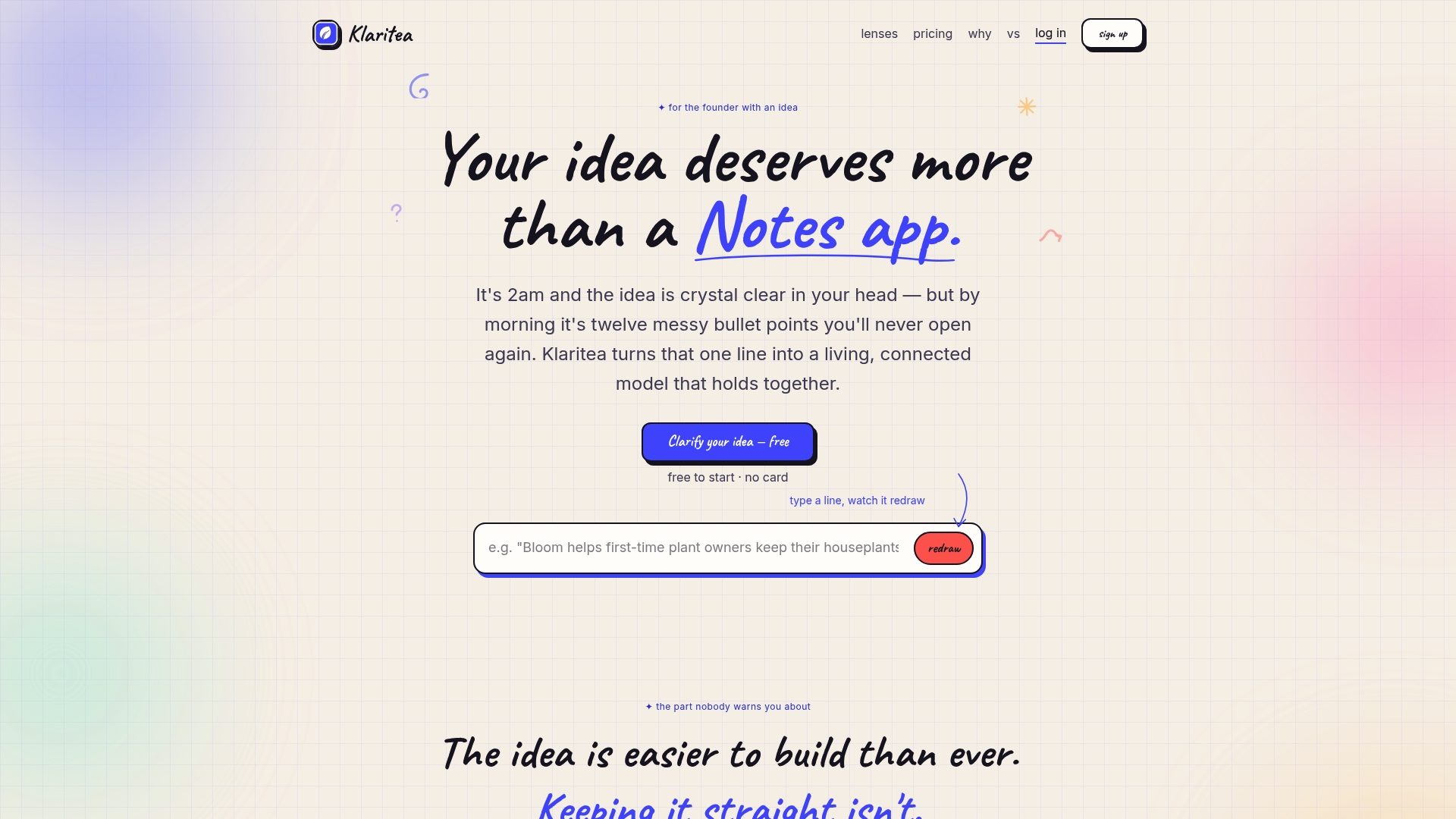
Three AI advisors, Maya on marketing, Devon on business strategy, Priya on operations and QA, challenge and fact-check the plan the way a cofounder would, catching the gaps a solo founder tends to miss. Switch between lenses (Clarity, Build, Run & Scale) to move from validating the idea to specifying the build. First-time founders and small teams get a build spec and clarity scorecard out the other end, exportable to GitHub for engineering handoff or to Notion and Confluence if that's where your team already documents work. If you're staring at a blank doc trying to turn a fuzzy idea into your first launch gate, see how Klaritea's connected model works and start mapping your own plan today.
Sources
- Projectmanagement
- Product launch checklist (Atlassian)
- From Idea to MVP: The Complete Founder's Roadmap (IdeaToMVP)
- Product launch checklist for startups (Inkly)
FAQ
What Is the Difference Between Release Planning and Sprint Planning?
Release planning covers the full path from idea to launch, scope, milestones, and go-to-market, while sprint planning organizes the work inside a two-week execution cycle once you're already building.
What Is Sprint Zero in a Release Plan?
Sprint zero, or phase zero, is the setup period before real development starts, where you validate the idea, define scope, and build the launch gate; Klaritea is built specifically to structure this stage.
What Should a Sprint Zero Checklist Include?
A solid sprint zero checklist covers idea validation, target customer definition, core scope decisions, technical architecture choices, and the first draft of your launch gate criteria.
How Long Should Release Planning Take for a First MVP?
Most founders can validate an idea, scope an MVP, and build a launch gate within two to four weeks; the build itself typically takes longer and depends on scope discipline.
What Belongs on a Release Plan Template?
A usable release plan template includes your learning milestones, the five-bucket launch gate, a day-one contact list, and a rollback plan, all fitting on one page.