Five formats cover almost every situation a product manager faces: Now-Next-Later for early-stage prioritization, a single product timeline for quarterly planning, an agile sprint roadmap for engineering execution, a portfolio view for multi-product companies, and a release timeline for launch coordination. Use Now-Next-Later when priorities shift fast and dates would mislead people. Use a quarterly timeline when executives need a strategic story. Use a sprint roadmap when developers need a two-to-six-week horizon tied to actual tickets. The examples below show what each one looks like filled in, not just described.
TL;DR:
- Using Now-Next-Later is best when priorities shift quickly and precise dates are unreliable, as this format groups work by confidence rather than timelines.
- The critical success factor for roadmaps is including measurable objectives and proof of impact, not just feature lists or rigid deadlines.
- Choose the roadmap format based on the audience, horizon, and level of detail needed, and tailor the content to drive specific decisions like budgets or staffing.
- Simple templates with seven core fields and regular reviews suffice for most teams, while validation tools like Klaritea help ensure initiatives are well-founded before planning.
- Avoid static, feature-only roadmaps; focus on high-level strategies with clear success metrics attached to each initiative.
Table of Contents
- Examples: 4 Practical Roadmap Templates With Mini Samples
- Anatomy of an Effective Roadmap: What to Include and Why
- How to Choose the Right Roadmap Format for Your Audience and Stage
- Templates, Tools, and Quick-Start Copies You Can Reuse
- Phase-0 Readiness: Validate Roadmap Inputs Before You Plan
- Author Perspective: Practical Trade-Offs I Use in Roadmaps
- A Practical Phase-0 Alternative: Klaritea for Roadmap Readiness
- Sources
- FAQ
Examples: 4 Practical Roadmap Templates With Mini Samples
Most product roadmap templates fail for one of two reasons: they lock in dates nobody can hit, or they list features with no strategic thread connecting them. The four formats below solve different problems, and picking the wrong one for your audience is the single most common mistake product teams make.
Now-Next-Later. This format ditches calendar dates entirely and groups work by confidence level instead. A seed-stage startup roadmap might look like this:
- Now: Test two onboarding flows with 50 beta users to cut signup drop-off.
- Next: Build the referral loop once the onboarding data validates retention lift.
- Later: Explore a team-plan tier, pending signal from early adopters asking for multi-seat access.
This structure works because it tells the truth. Nobody knows exactly when "Later" ships, and pretending otherwise erodes trust with stakeholders faster than an honest "we don't know yet."
Single product timeline. This is the classic quarterly grid, organized by theme rather than individual features. Each row gets a one-line "why" and a status tag:
- Q1: Reduce onboarding friction — Why: 42% of signups abandon at step two. Status: In progress.
- Q2: Improve search relevance — Why: Support tickets show users can't find saved items. Status: Planned.
- Q3: Launch team collaboration — Why: Sales loses enterprise deals lacking multi-user support. Status: Committed.
Executives reading this roadmap care about the "why" column more than the feature names. That's the whole point of the format.
Agile sprint roadmap. This one trades quarters for weeks and themes for epics. A six-week horizon might show three epics broken into sprint-sized chunks, each epic tagged with the sprint goal it serves. Instead of "Q1: Reduce onboarding friction," a sprint roadmap says "Sprint 14: Ship progressive profiling on signup form" with a direct link to the epic and the retention metric it's meant to move. Engineering teams live here. Anything longer than two sprints out should stay directional, not committed, because sprint capacity changes too fast for firm promises further out.
Multiple product / portfolio view. Companies running more than one product need swimlanes, one per product line, with a separate row showing cross-product dependencies. A portfolio roadmap won't show every ticket. It shows strategic bets, like "unify billing infrastructure across Product A and Product B by Q3," with dependency arrows pointing to which team's timeline shifts if the other slips. ProdPad's examples of multi-product roadmaps make this distinction clear: portfolio views succeed by omission, not by comprehensiveness.
Anatomy of an Effective Roadmap: What to Include and Why
Every roadmap that actually gets used, rather than built once and forgotten, shares the same six fields. Skip one and the document turns into a wish list dressed up as a plan.
- Objective or strategy: the business goal the initiative serves.
- Theme or initiative: the grouped body of work, not a single feature.
- Timeline or horizon: a quarter, a sprint, or a Now-Next-Later bucket.
- Metric or success indicator: the number that tells you it worked.
- Owner: the person accountable for the outcome.
- Status: a plain tag like planned, in progress, or shipped.
The field teams skip most often is the metric, and it's the one that matters most during prioritization fights. A product roadmap is supposed to be a high-level summary of vision and priorities over time, and that summary only holds up under scrutiny when each line answers "why does this matter" in a way a skeptical stakeholder can check.
Pro Tip: Write the "why" line with this product features generator before you write the feature name. If you can't state the customer problem or metric in one sentence, the initiative probably isn't ready for the roadmap yet.*
Three real-world "why" lines show the pattern:
- "Increase DAU by 15% by simplifying onboarding — 42% of users drop off at step two."
- "Cut support ticket volume 20% by adding in-app search — search-related tickets are our top category."
- "Grow expansion revenue by unlocking team seats — three of our last five churned accounts asked for multi-user access first."
Atlassian's product roadmap guidance makes a similar case: roadmaps built without attached customer insight tend to collapse under the first hard prioritization debate, because nobody can defend a feature that exists only because it sounded good in a meeting.
How to Choose the Right Roadmap Format for Your Audience and Stage
Pick the format by answering four questions in order, not by defaulting to whatever template you used last time.
- Who's the primary audience? Executives want strategy and outcomes. Engineers want scope and sequencing. Customers want a preview of what's coming, stripped of internal detail.
- What horizon makes sense? Weeks for a sprint roadmap, quarters for a strategic timeline, and no fixed dates at all for a Now-Next-Later view when priorities are still shifting.
- What fidelity does the audience need? Themes for leadership, epics and stories for the build team.
- Which format matches that combination? Match the answers above to one of the four formats, and don't force a single roadmap to serve every audience at once.
Before you commit to a format, ask what decision the reader will actually make from it. A roadmap that doesn't drive a decision, whether it's a budget approval, a hiring call, or a sprint commitment, is just a status update wearing a roadmap's clothes.
Watch for three red flags: a presentation-only roadmap that never gets updated after the kickoff deck, internal teams locked to external-facing dates, and a roadmap that's really just a feature backlog with a calendar bolted on. Atlassian notes that roadmaps need different detail for different audiences, which is exactly why one static slide rarely survives contact with more than one stakeholder group.
Pro Tip: Default to directionally dated quarters for executives and tight sprint boards for developers. Trying to satisfy both audiences with one document is how roadmaps turn into fiction.
Templates, Tools, and Quick-Start Copies You Can Reuse
A usable template needs seven fields: team or product, theme, why, horizon, metric, owner, and status. Anything more turns into a spreadsheet nobody updates.
- Shared docs and spreadsheets work fine for small teams and cost nothing to start. HubSpot's downloadable roadmap templates in Excel, Google Sheets, and PDF cover this exact use case.
- Timeline and board apps suit cross-team visibility once more than one squad depends on the same roadmap.
- Discovery tools that link customer evidence directly to initiatives cut the guesswork out of prioritization meetings.
Building a living version takes ten minutes: create a sheet with those seven columns, share the link with your team, and agree on a weekly or biweekly review cadence before anyone adds a single row.
Phase-0 Readiness: Validate Roadmap Inputs Before You Plan
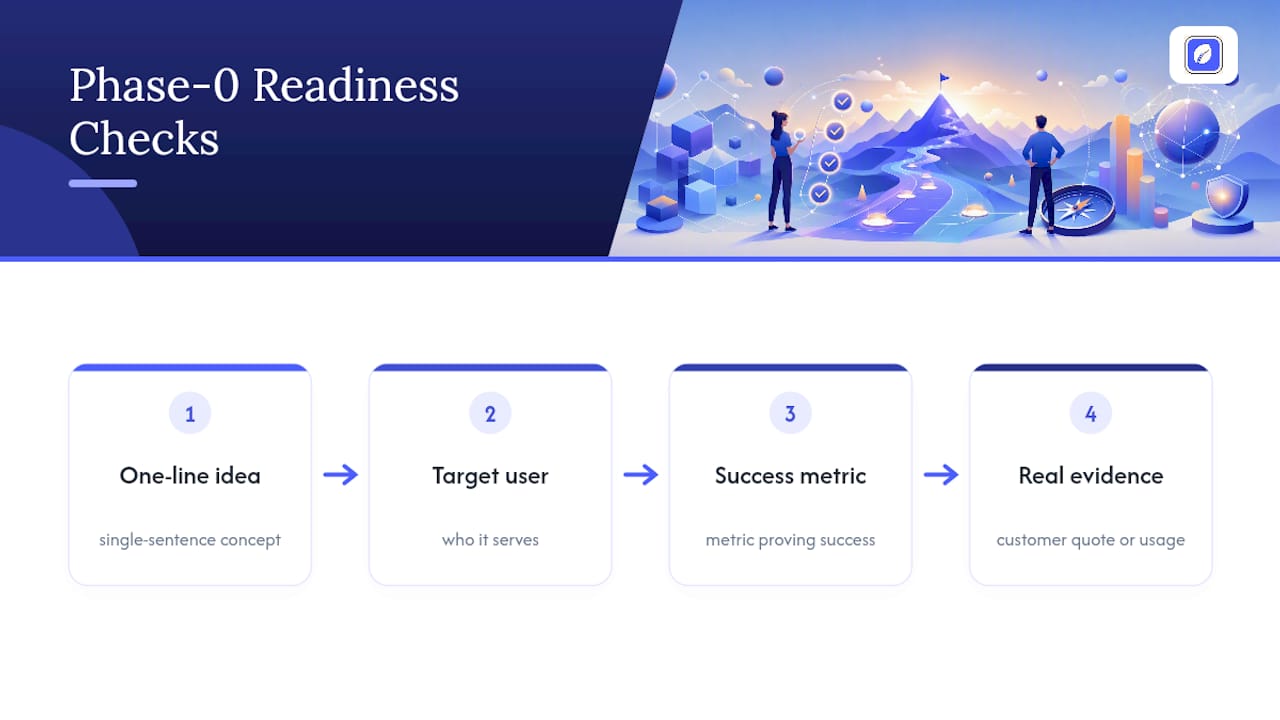
Before a single initiative earns a spot on the roadmap, run it through four checks: the one-line idea, the target user it serves, the metric that proves it worked, and one piece of real evidence, a customer quote or usage number, that it's worth building. Skipping this step is how roadmaps fill up with initiatives nobody asked for.
Author Perspective: Practical Trade-Offs I Use in Roadmaps
Compress detail into themes the moment a roadmap needs to travel outside your team; keep granularity only where the audience will act on it. Skip hard dates until you'd actually stake your credibility on them. My rule of thumb: no initiative earns a spot without a one-line "why" and a number that proves it worked.
— Karl
A Practical Phase-0 Alternative: Klaritea for Roadmap Readiness
Most roadmap advice assumes you already know your ICP, your competitive gaps, and which metric actually proves an initiative worked. Klaritea exists for the step before that. You type a one-line idea, and it builds a connected model covering your target customer, market sizing, competitor analysis, and a feature list grounded in evidence rather than guesswork, the exact inputs a defensible roadmap "why" line depends on.
That matters because the founders who skip validation are the ones who spend heavily on building something nobody buys. A trial run through Klaritea typically produces a clarity scorecard, a build spec, and export options to Notion or Confluence, so the roadmap you build next has real evidence behind every row instead of a wish list dressed up as strategy. Start with your one-line idea at Klaritea and see what the model surfaces before you commit a single sprint to it.
Sources
- Product roadmap guide: What is it & how to create one | Atlassian
- Three Example Roadmaps for Product Managers | ProductPlan
- Product roadmap template - Excel, PDF, Google Sheets | HubSpot
- Product roadmap examples | ProdPad
FAQ
How Do I Make a Product Roadmap?
Start by picking the audience and horizon, then fill in six fields for each initiative: objective, theme, timeline, metric, owner, and status. Attach a one-line "why" to every row before you add it to the document.
What Is a Product Roadmap?
A product roadmap is a high-level summary that maps product vision, strategy, and priorities over time, and it should communicate the strategic reasoning behind each initiative, not just a list of features.
Can You Provide an Example of a Roadmap?
Yes. A Now-Next-Later roadmap for a startup might list "Now: test onboarding flows," "Next: build the referral loop," and "Later: explore a team-plan tier," with no fixed dates attached to any bucket.
What Is the Best Software for Product Roadmapping?
The right tool depends on team size: spreadsheets and shared docs work for small teams, timeline or board apps suit cross-team visibility, and a phase-0 tool like Klaritea helps validate the evidence behind each initiative before it ever reaches the roadmap.