Problem–solution fit means you've confirmed a real, frequent problem exists, that people already limp through it with workarounds or spend money trying to fix it, and that your proposed solution earns enough pull from real prospects to justify building further. You have it when three things line up: the problem shows up regularly for a defined group, that group already pays or improvises to deal with it, and a rough version of your solution gets 3 to 5 paying earlyvangelists to commit, not just nod along in an interview.
Here's the immediate move if you're not sure where you stand:
- Run 20 discovery conversations using Mom Test discipline: ask about past behavior and past spending, never hypotheticals.
- Build a scrappy prototype, landing page, or concierge version of your fix and put it in front of the same people.
- Try to close 3 to 5 paying earlyvangelists, even at a token price or as a deposit.
Pro Tip: If you can't get 20 people to even agree to a 15-minute call about the problem, that's not a scheduling problem. It's your first real signal the pain isn't urgent enough.
The decision rule is simple: if you land your earlyvangelists and see people modifying their behavior (paying, showing up, using the rough thing repeatedly), keep going toward product–market fit. If interviews are polite but nobody pays, changes a habit, or shows up twice, you don't have a building problem. You have a targeting problem, and the fix is narrowing who you're talking to, not polishing the product.
Key Takeaways
Problem–solution fit requires three converging signals working together: a frequent problem, existing workarounds, and 3 to 5 paying earlyvangelists willing to use a rough solution.
| Point | Details |
|---|---|
| PSF is narrow by design | Confirm frequency, workaround evidence, and prototype pull before claiming fit. |
| Behavior beats praise | Interview enthusiasm without payment or repeat use is not a real signal. |
| Earlyvangelists are the proof | Landing 3 to 5 paying earlyvangelists is a stronger signal than many polite interviews. |
| Klaritea structures the process | Its clarity scorecards and AI advisory board map directly to the validation checklist before you build. |
Table of Contents
- What Problem–Solution Fit Actually Means in Practice
- How Problem–Solution Fit Differs From Product–Market Fit
- The Step-by-Step Playbook to Reach Problem–Solution Fit
- Templates and Canvases You Can Copy This Afternoon
- How to Measure Whether You Actually Have It
- Common Mistakes and Red Flags to Watch For
- A One-Page Validation Scorecard and Decision Rules
- A Founder Who Narrowed the ICP and Found Fit
- What Founders Get Wrong About Waiting for Certainty
- How Klaritea Speeds Up the Path to Problem–Solution Fit
- Sources
- FAQ
What Problem–Solution Fit Actually Means in Practice
Problem–solution fit isn't a feeling you get after a good week of interviews. It's a checklist with three specific pillars, and you need real evidence for each one, not just enthusiasm.
- The problem is real and frequent. This isn't "would this be nice to have" territory. You're looking for a problem that shows up on a predictable cadence, weekly, daily, or at a specific recurring trigger, for a tightly defined group of people. A problem someone mentions once and forgets isn't a business.
- The problem is painful enough that people already do something about it. This is the pillar most founders skip. Look for spreadsheets people built themselves, contractors they hired, subscriptions they're already paying for, or clumsy manual processes they tolerate. Workaround evidence beats stated interest every time, because building or paying for a bad fix proves the pain is real.
- The proposed solution is directionally credible. You don't need a finished product. You need enough of a prototype, mockup, or manual concierge version that real prospects react with something more than polite interest, ideally a request to use it again, a referral, or money.
Antler frames the empirical version of this signal cleanly: a workable proxy for problem–solution fit is landing 3 to 5 paying earlyvangelist customers who are willing to tolerate a rough, manual, or incomplete version of your idea because the underlying problem is bad enough to justify it. That small number matters because it's a behavioral signal, not a sentiment one. Getting there is why problem–solution fit sits upstream of everything else. Skip it, and you risk pouring months into a build nobody was actually waiting for.
How Problem–Solution Fit Differs From Product–Market Fit
Founders conflate these two constantly, and the confusion costs real time and money. Problem–solution fit and product–market fit test different things, at different stages, using different kinds of evidence.
Problem–solution fit validates whether a specific problem exists, is painful, and can be credibly addressed. The evidence is mostly qualitative: interview transcripts, workaround stories, and a handful of paying earlyvangelists who behave differently once your rough solution shows up. Product–market fit validates whether a broader market wants what you built badly enough to keep using it, refer others, and grow the business organically. The evidence there is behavioral and quantitative: retention curves that flatten instead of decay to zero, a Sean Ellis survey score, and revenue growth that isn't propped up entirely by paid acquisition.
Here's the practical line for when to stop chasing PSF and start aiming at PMF:
- You've converted at least 3 to 5 earlyvangelists into paying, repeat-using customers, not just interview participants.
- You see the same workaround pattern across multiple unrelated prospects, not just one loud early fan.
- Retention among your earlyvangelist cohort holds steady rather than dropping immediately after first use.
- You have enough volume of usage to run a directional Sean Ellis survey score indicating user disappointment with a meaningful sample.
The classic false positive here is mistaking idea approval for behavior change. Ten people telling you "I would totally use that" in an interview is not the same as one person changing what they do on a Tuesday because your prototype exists. The resource cost of moving to PMF-scale spending (hiring, paid acquisition, feature sprawl) before you've actually proven behavior change is the single most common way early-stage capital gets wasted. AI tools have made it cheap to build a plausible-looking prototype in a weekend, which raises the temptation to skip straight to "build more" instead of running the cheap experiments that would tell you whether it's worth building at all.
The Step-by-Step Playbook to Reach Problem–Solution Fit
This is the sequence. Follow it roughly in order, and resist the urge to jump to building before you've done the talking.
- Define a tight ICP. Not "small business owners." Something closer to "solo bookkeepers managing 15 to 30 client accounts on spreadsheets." The narrower the target, the easier it is to find repeatable patterns.
- Recruit and run a typical number of discovery interviews. Twenty is the number RoadmapOne points to as a useful directional sample, enough conversations to spot a real pattern without burning your entire runway on research. Use Mom Test rules: ask about specific past actions and past spending, never "would you use this?"
- Design a low-cost experiment. Pick one: a concierge service where you manually do the thing for a handful of people, a landing page with a real (if fake-ish) call to action, or a clickable prototype you walk people through live.
- Iterate messaging based on what actually lands. The words that get a reaction in interview five probably aren't the words you started with in interview one. Update your pitch as you go.
- Push for a paid commitment. A deposit, a pre-order, or a signed pilot agreement. Money, even a small amount, is the cleanest signal you'll get.
Timeline check: a realistic sprint looks like a moderate length of several weeks. Week 1 is ICP definition and outreach. Weeks 2 through 4 are interviews and prototype testing in parallel. Week 5 is your pilot sales push. Week 6 is when you sit down with your scorecard and decide, honestly, whether to keep going. Antler's guidance notes that finding PSF often takes 3 to 5 rounds of this cycle, so don't panic if round one doesn't produce a clean answer.
A few recruiting notes that make a real difference:
- Look for people already exhibiting the workaround, not people who might theoretically have the problem. Search niche forums, Reddit communities, LinkedIn groups, or industry Slack channels where the pain gets discussed unprompted.
- Offer something real for their time: a gift card, early access, or a discounted rate once you launch. Free coffee chats attract polite people, not motivated ones.
- Qualify hard. If someone can't describe a specific recent instance of the problem, they're not your earlyvangelist. Move on.
For monetization tests, a pre-order at a modest price, a refundable deposit, or a signed letter of intent with a dollar figure attached all count as meaningful intent. A "sounds interesting, keep me updated" does not.
Pro Tip: Ask interview subjects what they're currently paying, in money or time, to deal with the problem today. If the answer is "nothing, I just live with it," that's not automatically disqualifying, but it does mean your solution needs to be dramatically easier than doing nothing, which is a much harder bar to clear.
For a deeper walkthrough of interview mechanics, Klaritea's founder playbook on discovery interviews covers question sequencing in more detail, and the lean startup experiment framework is worth reading before you design your first concierge test.
Templates and Canvases You Can Copy This Afternoon
You don't need to build these tools from scratch. A few established formats already do the job well, and adapting them takes an afternoon, not a week.
- Problem–Solution Fit Canvas. A one-page grid covering the target customer, the problem statement, existing alternatives (the workarounds), and your proposed solution's core hypothesis. Fill it in before your first interview, then revise it after every five conversations as your understanding sharpens.
- Lean Canvas. At the PSF stage, only a few blocks matter: Customer Segments, Problem, Existing Alternatives, and Unique Value Proposition. Skip the revenue and channel blocks for now, they're premature until you've validated the problem itself.
- A one-page interview script. Five to seven open questions built around past behavior: "Walk me through the last time this happened." "What did you do about it?" "What have you tried that didn't work?" Never ask "would you use X."
For quick tests, a simple landing page with a waitlist form, a Calendly link for concierge onboarding, or a Loom-recorded prototype walkthrough all work fine. The rule for picking a tool at this stage: choose whatever gets you a signal fastest and cheapest, not whatever looks most polished. A rough Google Form beats a custom-coded survey if it gets you answers by Friday.
If you want a more structured way to draft your first canvas and connect it to a business model, Klaritea's idea validator walks through building a structured hypothesis before you spend money on tools or contractors. For interview-to-messaging translation specifically, Moor Marketing's guide to customer pain is a solid reference for turning raw interview quotes into positioning that actually lands.
How to Measure Whether You Actually Have It
Founders often ask, correctly, "how do I know I'm not fooling myself?" The answer is a short list of signals, most of them behavioral rather than verbal.
At the problem–solution fit stage, the signals that matter are workaround evidence (are people already spending time or money to cope), prototype pull (do people ask to use your rough version again unprompted), paid intent (deposits, pre-orders, signed pilots), and pilot conversion (of the people who try your concierge or prototype, how many stick around for a second interaction). None of these require a large sample. A small number of earlyvangelists converting is a workable directional threshold at this stage, per Antler's framework.

Product–market fit metrics live one level up and require more volume. The Sean Ellis survey, asking existing users how they'd feel if they could no longer use your product, is the most widely cited single PMF metric. A high "very disappointed" response rate is the canonical benchmark for strong fit, though seed-stage teams often use a somewhat lower percentage as a directional read given smaller sample sizes. You need real usage data to run this survey meaningfully, which is why it belongs after PSF, not during it.
Retention curve flattening and organic growth are the behavioral confirmations that go beyond what PSF interviews can tell you, because they require people to keep coming back on their own, without you chasing them. Worth noting: PMF benchmarks aren't one-size-fits-all. For B2B SaaS specifically, net revenue retention above 110% is a stronger signal than it would be for a consumer app, so segment your expectations by business model rather than borrowing a number from a different category.
A quick Sean Ellis-style question you can adapt: "How would you feel if you could no longer use [product]?" with options for "very disappointed," "somewhat disappointed," and "not disappointed." Run it once you have at least a few dozen active users, small samples under that make the percentage meaningless.
Common Mistakes and Red Flags to Watch For
Most founders don't fail at problem–solution fit because the problem doesn't exist. They fail because they're measuring the wrong signals or talking to the wrong people.
- No workaround evidence. If nobody in your interviews is currently paying, hacking, or hiring around the problem, the pain might not be sharp enough yet.
- Zero paid intent after a real pilot. Polite enthusiasm with no deposit, pre-order, or signed pilot is a warning sign, not a stall.
- Hypothetical interview questions. "Would you use this?" gets you flattery. "What did you do the last time this happened?" gets you truth.
- Recruitment drift. If your interview pool keeps sliding toward whoever's easiest to reach instead of your actual ICP, your data quietly stops meaning anything.
The corrective actions are straightforward. If you're not finding workarounds, narrow the ICP again, you're probably talking to people who are adjacent to the problem, not living inside it. If interviews go well but nothing converts to payment, switch your experimental method entirely, try a concierge pilot instead of another round of talking. If your questions keep drifting hypothetical, rewrite your script the night before every batch of calls and reread it out loud first.
One especially common trap: founders confuse the idea phase with the product phase, treating enthusiastic interview feedback as if it were proof of a credible cure, when it's really just proof the problem got someone's attention for five minutes. Interview praise without a behavioral follow-through, a second use, a payment, a referral, is weak evidence no matter how good it feels in the moment.
A One-Page Validation Scorecard and Decision Rules
Here's a scorecard you can fill out honestly at the end of your six-week sprint, before you decide what happens next.
- Problem frequency: Does the problem recur weekly or more often for your ICP? Pass/fail.
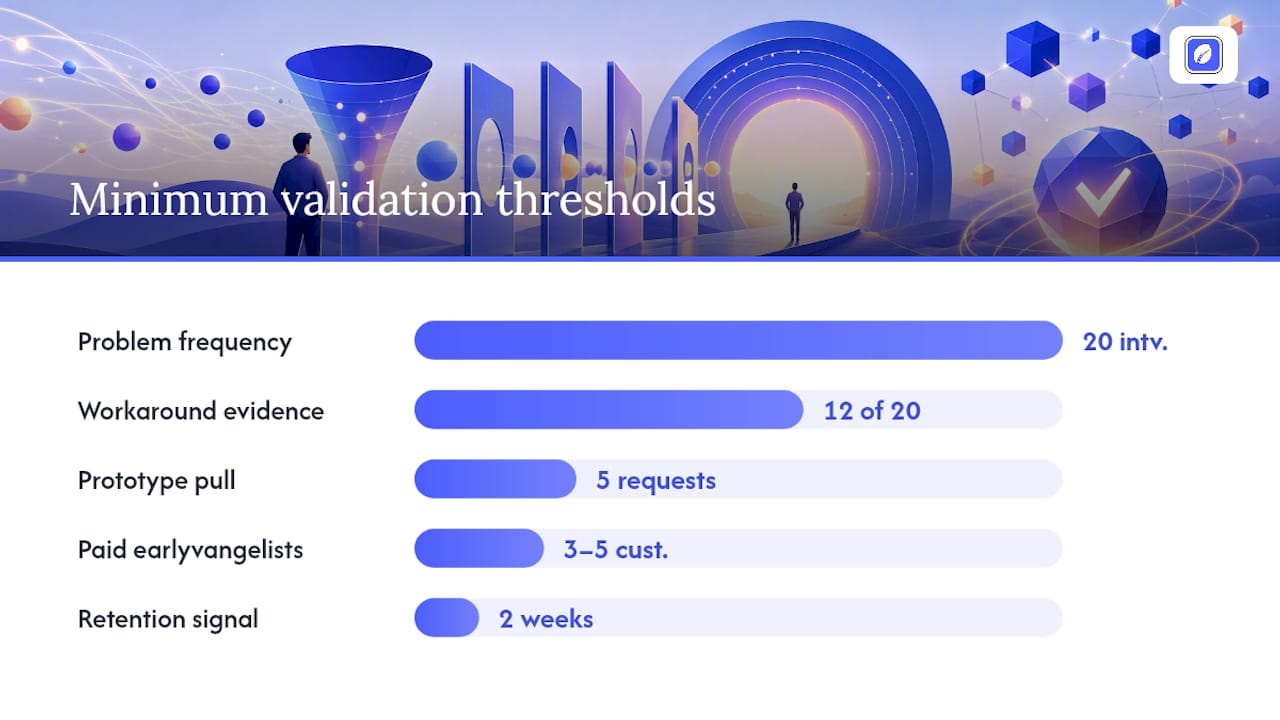
- Workaround evidence: Have at least 12 of your 20 interview subjects described an active workaround? Pass/fail.
- Prototype pull: Have at least 5 prospects asked to use your rough version again unprompted? Pass/fail.
- Paid earlyvangelists: Have you closed 3 to 5 paying customers, even at a token price? Pass/fail.
- Retention among earlyvangelists: Are early users still engaging after two weeks, not just day one? Pass/fail.
If you pass four or five of these, move toward product–market fit work: bigger sample surveys, retention tracking, and cautious scaling of acquisition. If you pass two or fewer, narrow your ICP and run another round before spending more on the build.
Ten interview questions worth stealing, all built around past behavior rather than hypotheticals: "Tell me about the last time this happened." "What did you do about it?" "How much time or money did that cost you?" "What have you tried that didn't work?" "Who else deals with this on your team?" "How often does this come up?" "What would have to be true for you to pay for a fix?" "Have you looked for a solution before? What did you find?" "What's the worst version of this problem you've had?" "If I built a rough version today, would you try it this week?"
| Scorecard item | Evidence type | Minimum sample for confidence |
|---|---|---|
| Problem frequency | Interview self-report | 20 interviews |
| Workaround evidence | Interview + observed behavior | 12 of 20 interviews confirming |
| Prototype pull | Direct user action | 5 unprompted repeat requests |
| Paid earlyvangelists | Transaction data | 3 to 5 paying customers |
| Retention signal | Usage logs | 2 weeks of activity data |
A Founder Who Narrowed the ICP and Found Fit
A common pattern shows up across early-stage teams that eventually reach problem–solution fit: they start too broad, get lukewarm signals, and only find real traction once they cut their target down to something uncomfortably specific.
Picture a founder building scheduling software aimed generically at "service businesses." Interviews were pleasant. Nobody was rude. Nobody paid either. After three unproductive weeks, the founder narrowed the ICP down hard, to independent massage therapists managing their own bookings without a receptionist. That single change surfaced a workaround pattern almost immediately: half the interview subjects were manually copying appointments from text messages into a paper calendar every night.
- Before the narrowing: roughly 20 interviews, zero workaround stories that repeated, zero pilot signups.
- After the narrowing: 20 new interviews within the same tight segment, 14 describing the same manual copying workaround, and 4 earlyvangelists agreeing to a paid concierge pilot within two weeks.
The lesson isn't "scheduling software works." It's that a broad ICP hides patterns, and a narrow one reveals them almost immediately. If your first 20 interviews come back mixed and directionless, the fix usually isn't a better pitch. It's a smaller, sharper target.
What Founders Get Wrong About Waiting for Certainty
Most founders treat problem–solution fit like a finish line they'll recognize when they cross it. It's messier than that. It's a pattern of converging signals, not a single green light, and the founders who get stuck usually aren't lacking data. They're refusing to act on the data they already have.
The instinct to keep interviewing "just a few more people" past interview 20, hoping for a clearer answer, is usually avoidance dressed up as diligence. If your first 20 conversations, run with real discipline, don't show a repeating workaround pattern, more interviews with the same audience won't fix that. What fixes it is narrowing who you're talking to.
What should you actually do this week? Run 10 more interviews, but only with people who match a narrower version of your current ICP. In parallel, build the cheapest possible concierge version of your fix, even if it's just you manually doing the work by email for three people. Then write your one-page scorecard and fill it out honestly at the end of the week, not the end of the month.

Cost and time expectations here are genuinely modest if you choose experiments wisely. A disciplined validation sprint runs a moderate length of several weeks and rarely requires more than a few hundred dollars in incentives, tools, or ad spend to test a landing page. The expensive mistake isn't spending money on validation. It's skipping validation and spending real capital on a build nobody asked for.
How Klaritea Speeds Up the Path to Problem–Solution Fit
Everything in the scorecard above, the ICP definition, the interview structure, the workaround tracking, the paid-intent tests, takes real founder time to organize by hand. Klaritea turns your one-line idea into a connected model that maps directly onto that same checklist: a structured ICP, a build spec, and clarity scorecards that track whether your evidence is actually converging or just feels like it is.
Instead of juggling a Lean Canvas in one tab, an interview tracker in another, and a spreadsheet of workaround quotes somewhere else, Klaritea's AI advisory board, Maya on marketing, Devon on business strategy, Priya on operations and QA, challenges your assumptions the same way a sharp cofounder would, before you've spent a dollar on development. The platform's "Clarity" lens exists specifically for this stage: narrowing your ICP, stress-testing your problem statement, and flagging where your evidence is thin before you move to build. When you're ready to move forward, Klaritea turns that validated thinking into an execution-ready build spec, so the clarity work you did during problem–solution fit doesn't get thrown away the moment you start building. Start by typing your one-line idea into Klaritea and see the connected model it builds around your ICP and problem statement.
Sources
- How To Find Problem Solution Fit For Your First Product - Antler
- Problem-Solution Fit: The Stage Before PMF (And Why It Matters More Now) - RoadmapOne
- The 15 essential metrics and evidence requirements for proving product-market fit in 2026 - Venture Lab
- Measuring product-market fit - Mercury blog
FAQ
What's the difference between problem–solution fit and product–market fit?
Problem–solution fit confirms a real problem exists and your rough solution earns behavioral pull from a handful of early customers. Product–market fit confirms a broader market wants what you built badly enough to keep using it and refer others, measured through retention curves and Sean Ellis survey scores.
What is a problem–solution fit interview?
It's a structured conversation focused on a prospect's past behavior, specifically what they've done, paid, or improvised to deal with a problem, rather than hypothetical questions about whether they'd use your idea. Mom Test discipline is the standard approach.
How do you measure problem–solution fit?
Track workaround evidence from interviews, prototype pull (unprompted repeat use), and paid intent from 3 to 5 earlyvangelist customers. These are directional, behavioral signals rather than a single formula, and they typically emerge across 3 to 5 rounds of validation.
What are the main types of problems and solutions founders should validate?
Definitions vary across frameworks, but the useful distinction for early-stage founders is frequency (how often the problem occurs), severity (how painful it is), and existing workaround cost (what people already spend to cope), against your solution's credibility, cost, and ease of adoption relative to those workarounds.
How many interviews do I need before I can trust the signal?
Around 20 disciplined interviews with a tightly defined ICP is a workable directional sample, enough to spot whether a workaround pattern repeats across unrelated prospects without burning excessive time.