A premortem workshop asks your team to imagine the project has already failed, then work backward to find out why. Run it once your plan is concrete but before you commit real money or engineering time. Done right, you walk out with a short list of named owners, specific mitigations, and dates, not a vague sense that "risk was discussed."
TL;DR:
- Premortems should be scheduled after a project plan is shaped but before resources are committed, ideally using a 90/60/30 days cadence for longer initiatives.
- Keep the group small and diverse, with 4 to 10 participants including insiders, stakeholders, and outside skeptics to maximize perspectives without slowing the process.
- Use a structured format with clear steps—framing, silent cause generation, clustering, prioritization, and ownership assignment—to produce actionable risk mitigation plans.
- The facilitator must maintain discipline, avoid solution mode, and ensure every risk has a specific owner with a due date, or else it remains untracked and vulnerable to recurrence.
- Address cognitive biases like optimism bias and groupthink by framing failure as a future fact and encouraging independent, disconfirming evidence during the silent generation phase.
Table of Contents
- What Is a Premortem Workshop and Why Does It Work?
- When Should You Schedule a Premortem?
- Who Should Attend, and How Big Should the Group Be?
- What Materials and Templates Do You Need?
- The Step-by-Step Premortem Meeting Agenda (60 to 90 Minutes)
- Turning Session Output Into Owned, Tracked Actions
- Facilitator Tips and the Pitfalls That Sink a Premortem
- Handling Disagreements and Conflict During the Session
- What Do Successful Premortem Workshops Actually Look Like?
- What Skills Does a Premortem Facilitator Need?
- What Cognitive Biases Does a Premortem Actually Address?
- Adapting the Premortem to Different Project Types
- How Klaritea Thinks About Premortems in Phase 0 Planning
- Sources
- FAQ
What Is a Premortem Workshop and Why Does It Work?
Psychologist Gary Klein popularized the technique, calling it "prospective hindsight": telling a team to assume failure has already happened, then asking each person to explain why. That single reframe changes the conversation. In a normal risk brainstorm, people hedge, defer to the loudest voice in the room, or avoid naming a colleague's decision as the problem. Framing failure as an already-settled fact makes it socially safe for the person who has quiet doubts to say so, according to Klein's original write-up in Harvard Business Review.
It differs from a standard risk register in one key way: a register asks "what could go wrong," an open-ended question that tends to produce generic answers like "budget overrun" or "scope creep." A premortem asks "it went wrong, why?" which forces specificity.
- Standard brainstorm: broad, optimism-biased, dominated by senior voices
- Risk register: static list, rarely revisited, weak on causal detail
- Premortem: causal, specific, time-boxed, and built for action
When Should You Schedule a Premortem?
Run the session after the plan has real shape (a scope, a rough budget, a timeline) but before you have committed resources you cannot easily pull back. Too early and the team has nothing concrete to critique. Too late and any risk you surface just becomes a complaint about a decision already locked in.
For longer programs, a single session is not enough. A 90/60/30 cadence works well across a 90 day project lifecycle:
- 90 days out (or project kickoff): a broad premortem covering the full plan, aimed at surfacing every plausible failure path before work starts.
- 60 days out (mid-checkpoint): a narrower session focused only on risks tied to decisions made since the first meeting, mitigation status, and anything newly uncertain.
- 30 days out (pre-launch): a final reality check limited to launch-specific failure modes, staffing gaps, and dependencies still unresolved.
If you're running a short, single-phase project, one session right after planning and before kickoff usually covers it. If the project spans multiple quarters, has multiple vendors, or touches regulatory or safety risk, build in at least the 90/60/30 checkpoints rather than treating the premortem as a one-time box to check.
Who Should Attend, and How Big Should the Group Be?
Invite the people who will actually execute the plan, one or two stakeholders who will feel the consequences of failure, and, if you can manage it, one or two outside skeptics with no stake in the project's success. Outside voices catch blind spots insiders have stopped seeing.
Keep the group between 4 and 10 people. Below four, you don't get enough perspective diversity. Above ten, silent generation and the round-robin harvest both slow to a crawl, and quieter participants disengage.
- Senior leaders can attend, but the facilitator needs a plan to stop them from anchoring the room early (more on this below)
- Remote participants should submit their silent-generation ideas through a shared doc or board rather than trying to type live on a call
- Asynchronous pre-submission works well for distributed teams: collect written risks 24 hours before the live session, then spend the live time on clustering and prioritization instead of generation
What Materials and Templates Do You Need?
For a remote session, you need video, a shared virtual board (Miro, Mural, or even a shared spreadsheet), and pre-built columns matching your agenda phases. For an in-person session, stock sticky notes, a writable wall or whiteboard, and a visible countdown timer; timing discipline is most of what keeps a premortem from turning into an open-ended gripe session.
Atlassian's premortem template lays out a workable structure: roughly 10 minutes of facilitator prep, a 60-minute run time, and a group of 3 to 11 people, with columns for the failure scenario, individual causes, clustered themes, and votes.
Useful template column headings:
- Failure scenario (one sentence, dated)
- Individual causes (one per sticky note or card)
- Cluster / theme
- Votes or impact score
- Owner and due date
Store the finished board somewhere the team will actually revisit, not a folder nobody opens again. Atlassian and similar playbooks recommend saving premortem outputs in a shared repository like Confluence or a project tracker, then reviewing it at the next checkpoint.
The Step-by-Step Premortem Meeting Agenda (60 to 90 Minutes)
This is the script. Copy it, adjust the minute counts to your group size, and hand it to whoever facilitates.
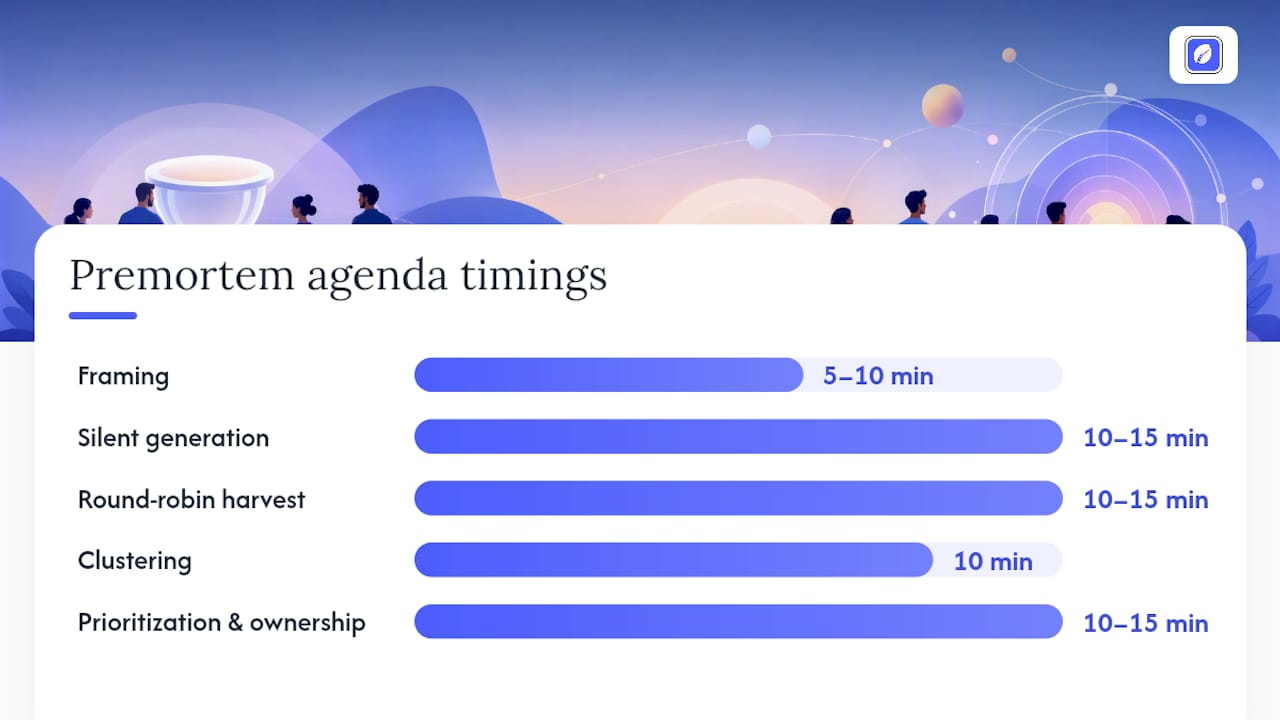
- Framing (5 to 10 minutes). State the failure scenario out loud, with a specific date and specific failure signals: "It's six months from now. We missed our launch date by eight weeks and churned 20% of early customers in the first month. Why?" Vague framing ("the project failed") produces vague answers, so anchor the scenario with measurable signals like missed KPIs or stakeholder backlash.
- Silent individual generation (10 to 15 minutes). Everyone writes their own causes independently, one per note or card, no talking. The facilitator does not contribute ideas here and does not comment on what people write; the job is to protect the silence, not fill it.
- Round-robin harvest (10 to 15 minutes). Go around the room (or the board) and have each person read their causes aloud, one at a time, anonymously if possible. No debating yet. Just collecting.
- Clustering (10 minutes). Group similar causes into themes as a team. This usually cuts 30 to 40 raw items down to 6 to 10 real risk themes.
- Prioritization (10 to 15 minutes). Vote or score each cluster on likelihood and impact. Dot-voting works fine for in-person groups; a simple 1 to 5 scale works for remote boards.
- Ownership assignment (10 to 15 minutes). For each top-ranked risk, name one owner and one specific mitigation with a due date. "Someone should watch the vendor timeline" is not an action. "Maria checks the vendor's delivery status every Friday and escalates by the following Monday if slipped" is.
Pro Tip: Write action items in the format "[Owner] will [specific action] by [date] to reduce [named risk]." If a sentence can't fit that template, it's not an action yet, it's still a worry.
A five-phase, roughly 90-minute version of this exact structure (brief, silent generation, harvest, prioritize, assign ownership) shows up consistently across facilitator guides because it reliably produces usable outputs rather than a pile of sticky notes nobody acts on.
Turning Session Output Into Owned, Tracked Actions
A premortem that ends with a whiteboard full of sticky notes and no follow-up is worse than not running one, because it creates the illusion that risk was handled; using free workflow tools for operations teams can help track premortem actions and reminders to ensure accountability. The clustering step should produce discrete, single-cause risk statements, not paragraphs. If a note reads "communication might break down between teams during the integration phase," push the group to name which teams, which handoff, and what "breakdown" would look like in practice.
Score each discrete risk on likelihood and impact, then feed the top-ranked ones directly into your project's RAID log or risk register, not a separate document that will get lost. Each entry needs:
- A one-line risk statement
- A likelihood and impact score
- A named owner (the person closest to that failure point, not the most senior person in the room)
- A specific mitigation task with a due date
- A follow-up checkpoint where the owner reports status
Klein's original research suggests that imagining a failure as already having happened increases a team's ability to identify specific causes by roughly 30% compared to a standard "what could go wrong" prompt. That gap is exactly what separates a premortem from a routine risk meeting.
Set a report-back expectation at the next checkpoint: each owner gives a 30-second status update, not a full re-litigation of the risk. If nobody has to report back, the mitigation quietly dies.
Facilitator Tips and the Pitfalls That Sink a Premortem
The most common failure mode isn't a bad risk. It's a facilitator who talks too much. During silent generation, the facilitator's job is to read entries anonymously and hold process discipline, not to seed ideas or react to what people write. Contributing during that phase anchors the room around the facilitator's own assumptions before anyone else has a chance to think independently.
Watch for false-comfort scoring, when a group converges on "low likelihood" for every risk because nobody wants to be the pessimist in the room. If every cluster gets rated 1 or 2 out of 5, stop and ask directly: "What would have to be true for this to actually happen?"
Ownership should follow proximity to the failure point, not seniority. The VP does not own the vendor-delay risk if a project coordinator is the one who actually talks to the vendor weekly.
Pro Tip: If a risk cluster ends the session without a named owner and a due date, it doesn't go in the RAID log as "mitigated." It goes in as "unowned," and that status alone tends to get it assigned within a day.
Common failure modes also include slipping into solution mode too early (debating fixes before the full risk list is even harvested) and treating the whole exercise as a one-time compliance step instead of a repeatable checkpoint.
Handling Disagreements and Conflict During the Session
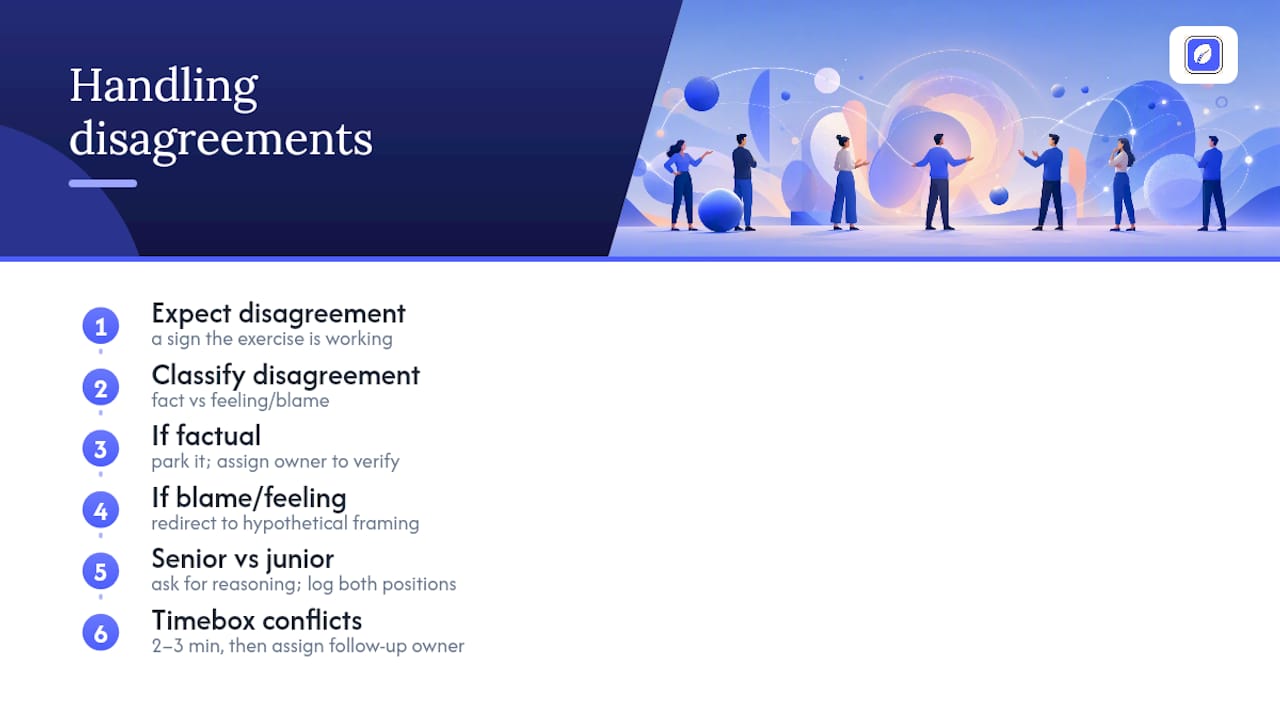
Disagreement during a premortem is usually a sign the exercise is working, not a sign it's broken. The point of the format is to surface views people wouldn't normally say out loud, so expect some friction when two people rank the same risk very differently, or when a stakeholder pushes back on a cause that implicates a decision they made.
The facilitator's job is to separate disagreement about facts from disagreement about feelings. If two participants disagree on likelihood ("this vendor has been reliable" versus "this vendor missed two deadlines last quarter"), that's a factual gap you can resolve by pulling the actual delivery record before the next checkpoint. Don't force a vote to settle it. Park it as an open question with an owner to verify.
If the disagreement is really about blame, tension usually surfaces when a cause names a specific person's earlier decision, redirect the framing immediately. The scenario already happened in this exercise; nobody in the room caused it, because it's hypothetical. That framing takes the sting out of naming a process gap without accusing a colleague.
Senior voices disagreeing with junior ones deserves particular attention. If a director dismisses a junior team member's concern in the room, the facilitator should explicitly ask for the reasoning behind the dismissal rather than letting seniority settle the point by default. One useful move: table the disagreement, log both positions on the board, and let the prioritization vote (not a debate) decide which gets more attention. A quiet vote often surfaces that more people agreed with the junior voice than the room's tone suggested.
Never let a disagreement extend the meeting past its time box. If a conflict can't resolve in two or three minutes, assign it as a follow-up research item with an owner and move on. The goal of the session is coverage and ownership, not consensus on every point.
What Do Successful Premortem Workshops Actually Look Like?
The strongest sessions share a pattern regardless of industry: a tightly scoped failure scenario, a genuinely silent generation phase, and a hard rule that nothing leaves the room without an owner. Facilitator guides that document this format consistently point to the same five-phase shape (brief, generate, harvest, prioritize, assign) as the version that produces durable results, because each phase has a clear output rather than an open-ended discussion.
A software team running a premortem before a major platform migration might surface a cluster around "data migration silently drops records for accounts created in the last 30 days," a specific enough risk that someone can actually verify it before launch, rather than a vague worry about "data integrity." A marketing team prepping a product launch might surface "influencer partners post before the embargo lifts because nobody sent them the exact release timestamp," which turns into a one-line action: assign someone to send a written embargo time to every partner 48 hours out.
What separates a session that changes outcomes from one that's just a nice meeting isn't the industry or the tool. It's whether the risk clusters get specific enough to assign to one person, and whether anyone checks on that person's progress before the next milestone. Sessions that skip the ownership step, even when the discussion itself was sharp and the room was engaged, tend to produce the same risks again at the next checkpoint, because nothing actually got mitigated between meetings.
What Skills Does a Premortem Facilitator Need?
Facilitating a premortem is a different skill than running a status meeting. The facilitator needs to hold silence comfortably, resist the urge to fill dead air with their own opinions, and read a room well enough to catch false-comfort scoring before it derails the prioritization phase.
Three specific skills matter most. First, time discipline: a facilitator who lets the framing step run 20 minutes instead of 10 will run out of time for ownership assignment, the single most important phase. Second, neutral phrasing: the facilitator writes and reads the failure scenario in a way that doesn't imply blame or a preferred answer, since even subtle wording can anchor the group's thinking. Third, the ability to redirect solution-mode conversations back to risk identification, because groups naturally want to start fixing things the moment someone names a problem.
If you're new to facilitation, run a smaller, lower-stakes premortem first (an internal process improvement, not a major client-facing launch) to build comfort with the silence and the redirection before you facilitate one where the stakes are high. Co-facilitating with someone more experienced for your first one or two sessions also helps, since having a second person track time and watch for anchoring frees the lead facilitator to focus on the room.
What Cognitive Biases Does a Premortem Actually Address?
Premortems work because they directly counter a specific set of well-documented thinking errors, not because they're a clever meeting format. Optimism bias, the tendency for planners to systematically underestimate how long things take and overestimate how well things will go, is the main target. Asking a team to assume failure has already happened forces them out of the default optimistic frame that dominates most planning conversations.
Groupthink is the second target. In a normal risk discussion, dissenting opinions get socially expensive to voice, especially when a senior stakeholder has already expressed confidence in the plan. Klein's framing removes that cost: nobody is contradicting the leader's judgment, they're just explaining a fact pattern in a hypothetical future.
The premortem also pushes back against the planning fallacy (treating your specific project as an exception to the base rates that apply to similar projects) and confirmation bias, since the silent generation phase forces people to produce disconfirming evidence before the group has settled on a shared story about why the project will succeed. None of this requires the team to understand the psychology by name. The structure does the work regardless of whether participants have ever heard the terms "optimism bias" or "prospective hindsight."
Adapting the Premortem to Different Project Types
The core structure holds across industries, but what changes is the framing detail in step one and who counts as an "outside skeptic." A software team's failure scenario should center on technical specifics: a failed migration, a scaling issue at a certain user count, a third-party API deprecation nobody tracked. A marketing campaign premortem should focus on timing and channel risk: an embargo break, a channel algorithm change, a creative asset that doesn't clear legal review in time.
For regulated industries (healthcare, finance, construction), build in a compliance-specific failure scenario as a separate agenda item rather than folding it into the general session, since regulatory risk tends to need a narrower group with specific expertise and often a longer silent generation phase to surface subtle compliance gaps.
For a small startup team running a premortem before building a first product, the biggest tailoring is scope. You're not premortemming a five-year program, you're premortemming a specific launch or feature bet. Keep the failure scenario tight ("we launched and got zero signups in week one") rather than broad, and skip the multi-week 90/60/30 cadence in favor of a single, sharper session right before you commit build time.
How Klaritea Thinks About Premortems in Phase 0 Planning
Founders tend to skip the premortem entirely and go straight from idea to building, which is exactly backward. A one-line idea carries dozens of unstated assumptions about market size, competitors, and what customers will actually pay for, and none of those assumptions get tested by writing code.
At Klaritea, we treat this as a Phase 0 problem: clarify the idea, validate the riskiest assumptions, then build. A premortem fits naturally into the "validate" step, run against the structured model Klaritea builds from your one-line idea, covering ICP, market sizing, and competitor positioning, rather than against a plan that's still living in someone's head. If your premortem surfaces "we failed because our target customer wasn't willing to pay this price," that's a signal to revisit the model before a single feature gets built, not after $15,000 has gone into development. Founders using Klaritea's connected model can run that check against a structured build spec instead of a blank page.
Sources
- Performing a Project Premortem (Harvard Business Review)
- How to Run Pre-Mortem Exercises Templates Included (Atlassian)
- How to Run a Pre-Mortem Workshop (Workshop Weaver)
- How to run a premortem (Framework)
- How to Run a Pre-Mortem Workshop (SOMA Project Controls)
FAQ
What Is the Difference Between a Premortem and a Postmortem?
A postmortem happens after a project ends and analyzes what actually went wrong. A premortem happens before the project starts and imagines failure in advance, surfacing risks while there's still time to act on them.
What Does "Premortem" Mean Outside of Project Management?
The term originates in medicine, where a premortem examination refers to evaluating a patient's condition before death. Gary Klein borrowed the concept and adapted it into a planning technique for teams facing high-stakes decisions.
How Do You Actually Run a Premortem?
State a specific failure scenario with a date and measurable signals, have participants silently write individual causes, harvest and cluster those causes as a group, prioritize by likelihood and impact, then assign a named owner and due date to each top risk.
What Is the Purpose of a Premortem in Project Management?
The purpose is to surface specific, actionable failure causes while the plan is still flexible enough to change, and to convert those causes into owned mitigations before resources are committed.
How Long Should a Premortem Workshop Take?
A single session typically runs 60 to 90 minutes with 4 to 10 participants, including roughly 10 minutes of facilitator prep beforehand and time built in for framing, silent generation, harvest, prioritization, and ownership assignment.