
Use a 10-slide pre-seed deck whose only job is to get a meeting, not to close the round. Investors at this stage weigh three things above everything else: the team, the market, and the sharpness of your insight into the problem. Keep the deck to 10, maybe 12 slides. Every claim on it should be checkable in the time it takes to read a text message.
TL;DR:
- Pre-seed decks should strictly contain 10 to 12 slides, each focused on a specific purpose, to maximize the chance of securing a meeting.
- Traction evidence at this stage includes qualified waitlists, signed pilot agreements, or customer discovery interviews, not revenue.
- Market sizing must be bottoms-up, built from explicit assumptions, sources, and realistic adoption rates, rather than top-down estimates based on industry totals.
- The team slide needs to demonstrate founder-market fit and easily verifiable credentials, as investors prioritize the team over early revenues.
- The deck should be simple, skimmable, with checkable data points and clear sources, as investors spend only two to three minutes reviewing it.
Table of Contents
- What Goes in a Pre-Seed Pitch Deck?
- How Long Should Investors Spend Looking at Your Deck?
- What Counts as Traction Before You Have Revenue?
- How Do You Size the Market Without Faking It?
- How Klaritea Turns a Rough Idea Into Slide-Ready Evidence
- What Real Pre-Seed Decks Got Right (and Wrong)
- Tailoring the Deck for Angels, Accelerators, and Micro-VCs
- How to Present Your Deck, In Person or on a Screen
- Making Your Charts and Visuals Actually Readable
- What Actually Separates Decks That Get Meetings
- Build Your Pre-Seed Deck's Foundation Before You Design a Single Slide
- Sources
- FAQ
What Goes in a Pre-Seed Pitch Deck?
The canonical structure is ten slides because it maps to how an investor actually thinks through a decision, not because someone decided round numbers look tidy. ValueAddVC's analysis of pre-seed decks that raised found that the highest meeting rates came from decks running this exact sequence, in this order, at 10 to 12 slides total. Skip a slide and you leave a gap the investor has to fill with assumptions. Add three more and you dilute the argument.
Here's what each slide needs to do:
- Title. One line describing what you do, founder names with contact info, and the round you're raising. No tagline poetry. If someone can't tell what your company does from this slide alone, you've already lost five seconds of a two-minute review window.
- Problem. Paint the scene: who has this problem, how painful it is, and one direct quote from a real prospective customer. A named pain beats a generic market complaint every time.
- Solution. Show the before and after in as few words as possible, then name your wedge, the specific narrow entry point that makes you different from the ten other companies claiming to solve the same thing.
- Why now. One concrete timing data point. A regulatory shift, a cost curve that just crossed a threshold, a platform change that opened a door. Vague appeals to "the market is ready" don't count.
- Market. Start from a bottoms-up wedge (your realistic first customer segment) and build outward to the expansion story. Skip the headline TAM slide with the trillion-dollar circle; sophisticated investors distrust it on sight.
- Product. Screenshots or a short demo flow beat a roadmap diagram every time. Show what exists today, not what you plan to build.
- Traction. Whatever pre-revenue signal you have: waitlist numbers, a signed letter of intent, a pilot commitment, or discovery interview data. Precision matters more than size here.
- Team. Founder-market fit evidence, meaning why you specifically are positioned to win this, with startup job descriptions that actually convert hires and links investors can click to verify (LinkedIn, prior company pages, published work).
- Business model. Who pays, what the pricing shape looks like, and a believable path to the first $1M in revenue.
- Ask. The dollar amount, the instrument (SAFE or priced round), and the specific milestones that money buys you, tied to a runway number.
Antler's guidance for pre-seed founders makes a point worth internalizing: at this stage you often don't have historical data to lean on, so the deck has to sell vision and the team's right to pursue it. That reframes slides like Why Now and Team from "nice to have" into the actual core of your pitch. PitchGrade's template guidance backs this up: pre-seed investors weight founder-market fit and insight quality far more heavily than revenue, because revenue usually doesn't exist yet.
How Long Should Investors Spend Looking at Your Deck?
Not long. DocSend's data on pre-seed decks puts average viewer time at roughly two to three minutes. That's the entire window you get to prove the idea, the team, and the market are worth a follow-up call. Every slide that doesn't earn its place is stealing seconds from one that does.
A few rules follow directly from that constraint:
- Cap the main deck at 10 to 12 slides. Anything more belongs in an appendix or a data room, not the deck an investor opens cold.
- Design for skimming. Use real screenshots instead of mockups, charts a person can read without squinting, and never a slide that's mostly paragraphs.
- Make every number checkable in under five minutes. Name the pilot, date the interview, cite the source. If an investor has to email you to verify a claim, that claim shouldn't be on the slide yet.
- Push detailed financial models, cohort tables, and technical architecture into an appendix. Reference them on the slide ("see appendix, slide 14") rather than cramming them into the main narrative.
Pro Tip: Print your deck at actual size and read it from three feet away. If you can't tell what a chart says from that distance, an investor skimming it on a laptop screen definitely can't either.
What Counts as Traction Before You Have Revenue?
Pre-seed investors don't expect revenue, but they do expect evidence that somebody besides you believes the problem is real. PitchGrade's research confirms that waitlists, letters of intent, pilot commitments, and structured discovery interviews all count as legitimate traction at this stage, as long as they're presented honestly.
Signals that work on a slide:
- A waitlist with a quality filter attached ("340 signups, 62 from companies with 50+ employees") rather than a raw number that could be bots or curiosity clicks.
- A signed LOI or a pilot agreement, named and dated.
- Customer discovery interviews. A common benchmark is 20 to 50 structured conversations, with one or two direct quotes pulled out for the problem or traction slide.
- Prototype usage data, even from a tiny cohort, framed with the actual sample size attached.
The failure mode to avoid is dressing up a five-person trial as if it were a stable metric. State the sample size next to every percentage. If you ran 30 customer interviews, our playbook on structuring those conversations walks through how to log and present the findings so they read as evidence, not anecdote.
How Do You Size the Market Without Faking It?
Skip the top-down slide that starts with a $500 billion industry figure and narrows it down through two arbitrary percentages. DocSend's guidance for pre-seed founders is blunt about this: bottoms-up sizing, built from explicit assumptions, is what credible investors actually want to see.
The formula is simple: define your initial wedge (the exact customer segment you can reach first), multiply by a realistic price point, then layer in a believable adoption rate over a defined time window.
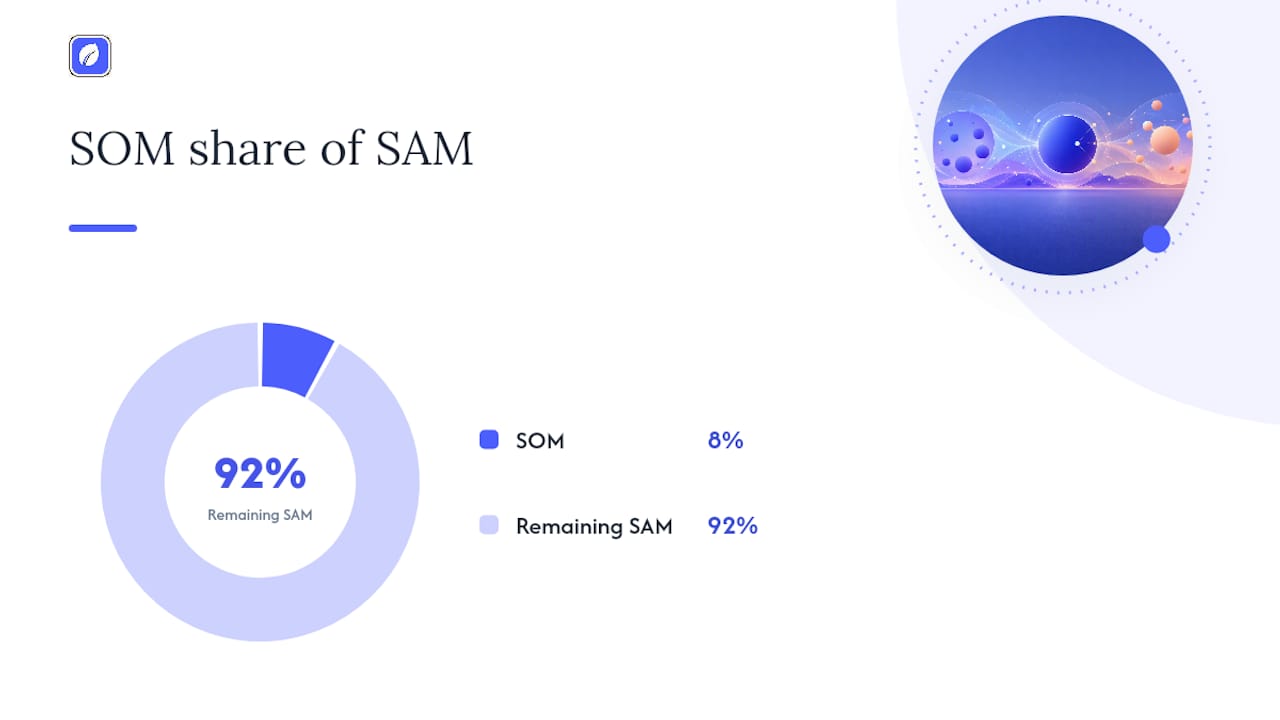
Worked example: 12,000 boutique fitness studios in your target region, at a realistic $150 monthly subscription, gets you a $21.6 million initial SAM. Assume 8% penetration in three years and your SOM lands near $1.7 million in annual recurring revenue. Every number on that line should trace back to a named source: a trade association count, a pricing benchmark from a comparable company, or your own pilot data.
- List your source for the customer count directly on the slide (industry association, government dataset, or a comparable company's public numbers).
- State your adoption assumption as a percentage and a timeframe, never as a bare dollar figure with no path attached.
How Klaritea Turns a Rough Idea Into Slide-Ready Evidence
Most founders don't get stuck writing the deck. They get stuck because the underlying research (who the customer is, how big the wedge really is, what the competition already offers) was never structured in the first place. Klaritea exists for that gap.
You type a one-line description of your idea, and Klaritea builds a connected model around it: an ICP, a bottoms-up TAM/SAM/SOM breakdown, a competitor map, and feature requirements, all cross-referenced instead of scattered across five separate documents. Three AI advisors, Maya on marketing, Devon on business, and Priya on operations and QA, stress-test the assumptions before you ever put them on a slide, working through Clarity, Build, and Run & Scale lenses that mirror the different questions an investor will ask.
- Your traction inputs (interview notes, waitlist data, pilot conversations) map directly into slide-ready wording instead of a raw spreadsheet.
- Your milestone plan turns into an Ask slide with the runway math already attached.
- The competitor map exports straight into the Market slide instead of requiring a separate research sprint.
Pro Tip: Run your idea through the Clarity lens first. If Klaritea's advisors can't get a straight answer out of your one-liner, neither will an investor reading slide one. For a full walkthrough of turning idea-stage inputs into deck outputs, see Klaritea's guide to AI for pitch decks.
What Real Pre-Seed Decks Got Right (and Wrong)
Public teardowns are useful precisely because they show the gap between a good idea and a fundable slide. TechCrunch's breakdown of Five Flute's pre-seed deck, which raised $1.2 million, and similar teardowns of decks like Notably's, point to the same three wins repeated across almost every deck that landed meetings.
- A cover slide with a thesis, not just a company name. It states the bet in one sentence.
- Social proof or a predicate standing in for revenue: a notable advisor, a past exit, a signed pilot with a recognizable name.
- Team credibility established early, with links an investor can click without asking you for them.
The mistakes worth fixing before you send anything: burying the ask on slide 14 instead of stating it plainly at the end, using a top-down TAM slide nobody believes, and writing a Problem slide with no quote from an actual human. Pick your weakest slide right now, set a 30-minute timer, and rewrite it using one of these three fixes. Adapt the tactic, not the specific numbers; a fintech's LOI language won't read the same in a hardware pitch.
Tailoring the Deck for Angels, Accelerators, and Micro-VCs
The 10-slide skeleton doesn't change across investor types, but the emphasis inside it should shift depending on who's reading.
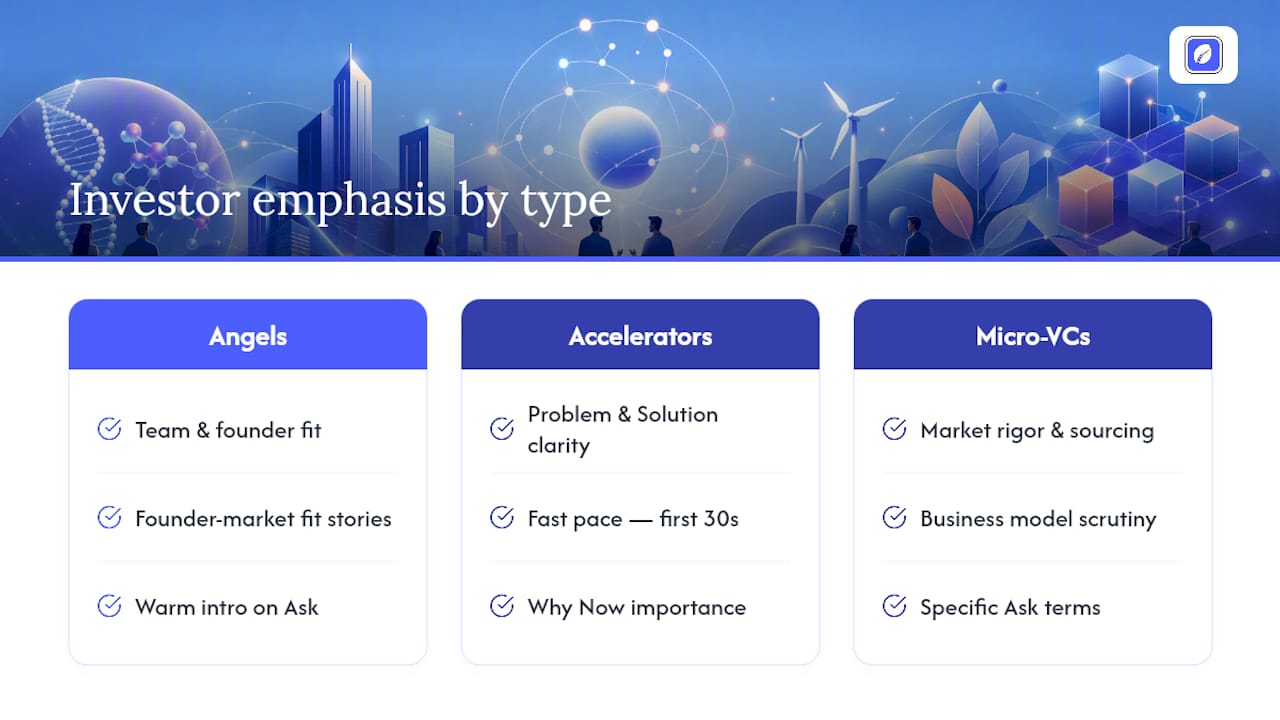
Angel investors are often writing a personal check and deciding almost as much about you as the idea. Lean harder on the Team slide, and don't be shy about founder-market fit stories that a spreadsheet can't capture, why this problem has been eating at you personally. Angels also tend to move faster on relationship trust, so a warm intro line on the ask ("raising alongside three other angels in your network") can matter more than it would with an institutional fund.
Accelerators (Y Combinator, Techstars, and similar programs) read hundreds of decks in a single cycle, so clarity and pace matter more than polish. Make the Problem and Solution slides land in the first thirty seconds, because that's roughly what a screener gives you before deciding to keep reading. Accelerators also care disproportionately about the Why Now slide since their entire model depends on backing companies riding a timing wave.
Micro-VCs writing institutional checks from a fund, even a small one, want to see the Market and Business Model slides hold up under actual scrutiny. They've seen the bottoms-up SAM trick before and will ask follow-up questions, so your sourcing needs to be airtight going in. They also care more about the specific instrument and terms on your Ask slide, since they're often coordinating with other checks in the same round.
Build one core deck, then keep a light variant with two or three swapped slides depending on who's in the room, rather than maintaining three entirely separate decks.
How to Present Your Deck, In Person or on a Screen
The deck is the same either way. How you narrate it isn't.
In person, resist the urge to read every bullet aloud, the investor can already read it themselves. Talk around the slide instead: add the color, the story behind the LOI, the reason you chose this wedge over three others you considered. Keep eye contact more than screen contact, and let a pause sit after your Ask slide instead of rushing to fill the silence.
Remote pitches carry their own traps. Screen-share the deck instead of emailing it ahead of the call whenever possible, because a deck read cold without your narration loses the framing you'd add live. Check that your video call platform doesn't compress your charts into an unreadable blur, this is a real and common failure. Keep your face visible in a corner of the screen if the platform allows it; investors read founder conviction as much through tone and expression as through the words on the slide.
For both formats, rehearse the transition sentences between slides, not just the content of each one. The moments where decks feel amateurish are usually the awkward pauses between slide six and slide seven, not the slides themselves.
Making Your Charts and Visuals Actually Readable
A chart that requires explanation has already failed. If you need thirty seconds to walk an investor through what a graph means, redesign the graph instead of practicing the explanation.
Favor real product screenshots over polished mockups. Investors have learned to discount mockups on sight because they show intention, not reality. A screenshot with a slightly rough edge reads as more credible than a pixel-perfect Figma render, because it proves the thing exists.
Keep every chart to a single takeaway. A line chart with five colored series and a legend in eight-point font is a chart nobody at the meeting will actually read; a simple bar comparing two numbers, labeled directly on the bars instead of in a legend, gets absorbed instantly. Cut axis labels down to the one unit that matters and drop gridlines unless they're doing real work.
Use white space deliberately. A slide with one number, sized large, and a short line of context beneath it often lands harder than a dense slide trying to prove three points at once. Save the dense version for the appendix, where an investor doing real diligence can dig in on their own time.
What Actually Separates Decks That Get Meetings
The founders who send strong decks aren't necessarily the ones with the best businesses. They're the ones who understood that a pitch deck is a filtering document, not a persuasion document. Its job is narrow: convince a busy person that a 30-minute call is worth their time. Everything else, the fundraising strategy, the negotiation, the actual conviction-building, happens after the deck opens the door.
The three non-negotiables haven't changed since the first version of this template circulated: the team slide has to survive a Google search, the market slide has to survive basic arithmetic, and the traction slide has to survive the question "how do you know that?" Miss any one of those and no amount of design polish saves the deck.
Before sending anything, run this 30-minute sweep: read the title slide aloud to someone outside your industry and see if they understand what you do; check that every number has a source attached; confirm the deck is 12 slides or fewer; and make sure the ask states a specific dollar amount tied to a specific milestone, not a vague range.
— Karl
Build Your Pre-Seed Deck's Foundation Before You Design a Single Slide
Most pre-seed decks fall apart not because the design is weak, but because the underlying research never got structured, the TAM was guessed, the competitor list was thrown together the night before, and the traction slide reused numbers nobody double-checked. Klaritea fixes that at the source. You type a one-line idea, and it builds a connected model spanning your ICP, a bottoms-up TAM/SAM/SOM breakdown, a competitor map, and traction templates that map directly onto the canonical slides covered above.
The clarity scorecards flag weak spots (an unverifiable claim, a fuzzy wedge) before an investor ever gets the chance to. Once your model is built, export it into Notion or Confluence on the Pro tier, or sync it with GitHub if you're already building. Klaritea's connected model turns the scattered research every founder does across a dozen tabs into one place your Ask slide can actually cite. Start with your one-line idea and see what the model surfaces before you open a design tool.
Sources
- Pre-Seed Pitch Deck: The 10 Slides That Get Meetings
- Here's how to create a pre-seed pitch deck that gets you funded
- Pre-Seed Pitch Deck Template 2026 - PitchGrade
- How To Build A Winning Pre-Seed Pitch Deck
FAQ
What Should Be in a Pre-Seed Pitch Deck?
A pre-seed deck should cover ten points in sequence: title, problem, solution, why now, market, product, traction, team, business model, and the ask, kept to 10 to 12 slides total.
What Is the 10/20/30 Rule for Pitch Decks?
The 10/20/30 rule suggests 10 slides, a 20-minute presentation, and no font smaller than 30 points; the slide count lines up closely with the 10-slide pre-seed structure covered above.
What Is a Good Pre-Seed Round Size?
Typical pre-seed rounds vary depending on founder experience and location, without specific dollar ranges provided.
How Much Should You Raise at Pre-Seed?
Raise enough to hit a specific, named milestone (a working prototype, a set number of paying pilots, a defined revenue threshold) with about a year of runway, then size the ask backward from that milestone rather than picking a round number first.
Does Klaritea Help With the Market Sizing Slide?
Yes. Klaritea builds a bottoms-up TAM/SAM/SOM model directly from your one-line idea, giving you sourced assumptions you can drop straight onto the market slide instead of guessing at a top-down figure.