Use a PRD when you need product alignment and outcomes; use an SRS when you need verifiable, testable technical requirements. A PRD answers what to build and why, written for product managers and stakeholders. An SRS answers how a system must behave, written in "shall" statements for engineers and QA, often following ISO/IEC/IEEE 29148. Most teams draft a PRD first, then translate its features into an SRS.
TL;DR:
- Early discovery and MVP testing usually need only a PRD; regulated, safety critical, or fixed price work calls for a full SRS before coding.
- Write each SRS requirement as an atomic, testable statement, assign it a verification method, and link it to its PRD feature with consistent IDs.
- Draft the PRD with at least one developer, then involve QA in SRS review; feasibility and testability problems can surface before development.
- Keep ownership separate: a product manager maintains the PRD, while an engineer or requirements lead maintains the SRS as scope changes.
Table of Contents
- PRD vs SRS: side-by-side differences and a quick recommendation
- How to choose: a practical checklist for PRD, SRS, or both
- Anatomy of a PRD: what to include and how detailed to be
- Anatomy of an SRS: sections, standards, and verification
- Mapping process: turn PRD features into SRS requirements
- Best practices: collaboration, traceability, and avoiding pitfalls
- Historical context and evolution of PRD and SRS documents
- Role of stakeholder involvement in creating effective PRD and SRS
- How PRD and SRS fit into Agile, Waterfall, and other methodologies
- Examples or templates of PRD and SRS documents for reference
- Author perspective: pragmatic separation of product and engineering artifacts
- Klaritea: a phase-0 option for clarity before you write either document
- FAQ
- Sources
PRD vs SRS: side-by-side differences and a quick recommendation
A PRD and an SRS answer different questions for different readers. The PRD is owned by a product manager and speaks to stakeholders, designers, and leadership about goals and outcomes. The SRS is owned by an engineer, architect, or dedicated requirements writer and speaks to developers and QA about exact, testable behavior. Atlassian's product management guidance frames the PRD as a collaborative, agile-friendly document that stays intentionally light on implementation detail.
- Audience: PRD serves PMs, designers, and executives; SRS serves engineers, architects, and QA.
- Wording: PRD uses outcome language ("users can reset a password"); SRS uses "shall" statements ("the system shall send a reset link within 60 seconds").
- Testability: PRD features describe intent; SRS requirements must each map to a pass or fail test.
- Timing: PRD comes first, during discovery; SRS follows once scope is stable enough to specify.
| Project type | Recommended document |
|---|---|
| Early-stage MVP or discovery | PRD only |
| Agile feature team with stable backlog | PRD, with lightweight per-feature SRS notes |
| Regulated, safety-critical, or fixed-price contract | PRD and full SRS |
| Internal tool with a single small team | PRD only, informally |
How to choose: a practical checklist for PRD, SRS, or both
Work through these steps in order, and you will land on the right document without guessing.
- Define the goal. Write down the outcome you are trying to produce and who benefits from it.
- Check regulatory or contract obligations. A fixed-price contract, safety-critical feature, or compliance requirement means you need a full SRS.
- Evaluate risk and team distribution. A distributed team, outsourced engineering, or high rework risk favors a written SRS over verbal handoffs.
- Assign ownership. The PM drafts the PRD; an engineer, architect, or requirements writer owns the SRS once scope stabilizes.
Early discovery, product-market fit testing, and iterative MVP work rarely need more than a PRD. Regulatory compliance, safety-critical functionality, or a fixed-scope contract almost always require an SRS before coding starts.
Pro Tip: If you're unsure which document to start with, draft the PRD first and let its open questions tell you which sections need SRS-level precision.
Anatomy of a PRD: what to include and how detailed to be
A PRD stays product-focused and collaborative, never a substitute for engineering detail. Atlassian recommends drafting it with at least one developer involved so ambiguity gets caught early.
- Purpose and problem statement: why this feature exists and what problem it solves for users.
- Personas and use cases: who uses the feature and in what context.
- Success metrics: the measurable signal that tells you the feature worked, tied to a business or user outcome.
- Feature list and prioritization: a ranked set of capabilities, described in plain outcome language rather than technical specification.
- Assumptions and constraints: what you are taking for granted and what limits the solution space.
Keep feature descriptions short: "users can filter search results by price and rating" is enough at this stage. Escalate an item to the SRS once it needs precise timing, error handling, or interface detail that a developer cannot infer from the PRD alone.
Anatomy of an SRS: sections, standards, and verification
An SRS exists to remove ambiguity, which is why NASA's Software Engineering Handbook treats it as the definitive technical specification that all later design and test work is based on.
- Functional requirements: specific system behaviors, each written as a testable "shall" statement.
- Nonfunctional requirements: performance, security, availability, and accessibility thresholds.
- Interfaces: how the system communicates with other systems, APIs, or hardware.
- Data requirements: structures, formats, and validation rules the system must enforce.
- Verification methods: how each requirement will be tested, inspected, or demonstrated.
ISO/IEC/IEEE 29148:2018 requires each requirement to be atomic, verifiable, and traceable, a standard many regulated and enterprise projects must formally meet. For higher-stakes projects, a formal Software Requirements Review, or SwRR, checks the SRS for completeness, consistency, feasibility, and traceability before development begins.
Mapping process: turn PRD features into SRS requirements
Converting a PRD feature into SRS requirements follows a repeatable sequence.
- Extract the outcome and success metric stated in the PRD for that feature.
- Decompose the outcome into functional pieces and interfaces the system needs to deliver it.
- Write atomic "shall" statements for each piece and attach a verification method to each one.
Say your PRD feature is "users can reset a forgotten password." That decomposes into: the system shall send a reset link to the registered email within 60 seconds of request, the system shall expire the reset link after 30 minutes, and the system shall reject a reused reset link. Each statement gets a verification method, such as an automated timing test or a negative test case, so QA can confirm it without interpretation.
Best practices: collaboration, traceability, and avoiding pitfalls
Both documents stay useful only when ownership and review cadence are clear. Assign a PM to own and update the PRD and an engineer or requirements lead to own the SRS, with scheduled reviews whenever scope shifts. A simple traceability matrix, giving each PRD feature a unique ID and listing the SRS requirement IDs that satisfy it, keeps the two documents linked without heavy process overhead, a technique covered in more depth in our requirements traceability matrix guide.

The most common failure mode is a requirement QA cannot test. If a tester cannot write a pass or fail case from a line in the SRS, rewrite it until they can. The second most common failure is letting a PRD absorb so much technical detail that it becomes a weak substitute for an SRS, which blurs ownership and invites rework. Version-control both documents the same way you version code, so every change has a history.
Pro Tip: Before closing any requirements review, pick three SRS lines at random and ask QA to describe the test they would run. If they hesitate, the requirement needs another pass.
Historical context and evolution of PRD and SRS documents
Formal requirements documentation grew out of large government and aerospace software projects, where a single flawed specification could cause expensive or dangerous failures. Early SRS practices trace back to structured waterfall methodologies, where teams froze requirements before design began and treated the SRS as a contract between stakeholders and engineers. NASA's software engineering guidance still reflects that lineage: the SRS remains the technical baseline that performance, interface, and QA work is verified against during formal reviews.
The PRD emerged later as software companies moved faster and needed a lighter artifact focused on market fit rather than exhaustive technical detail. As product management matured into its own discipline through the 1990s and 2000s, the PRD took over the role of describing user needs, business goals, and success metrics, leaving precise technical specification to the SRS or, increasingly, to lightweight engineering notes.
Agile development reshaped both documents again. Rather than freezing requirements upfront, many teams now treat the PRD as a living document updated sprint by sprint, and reserve full SRS rigor for features that are safety-critical, regulated, or contractually fixed in scope. ISO/IEC/IEEE 29148:2018 formalized this flexibility by allowing requirements engineering practices to scale from heavyweight formal specifications down to lightweight, per-feature documentation depending on project risk.

Role of stakeholder involvement in creating effective PRD and SRS
A PRD written in isolation by a single product manager tends to miss constraints that only engineering, design, or sales can surface. Atlassian's guidance recommends drafting the PRD collaboratively with at least one developer from the start, so feasibility questions surface before the document circulates for sign-off rather than after.
Stakeholder involvement matters differently for each document. For a PRD, the goal is breadth: product, design, sales, support, and a technical lead should all have a chance to flag gaps in the problem statement or success metrics. For an SRS, the goal is precision: the people who will build, test, and eventually maintain the system need to validate that each requirement is unambiguous and testable, since they are the ones who will be held to it during a formal review.
Skipping stakeholder review tends to produce two predictable failures. A PRD without engineering input often sets success metrics or timelines the team cannot actually hit. An SRS without QA input often contains requirements that sound precise but cannot be verified, which surfaces only when testers try to write test cases against them. Building review checkpoints into both documents, rather than treating them as a one-time handoff, catches these gaps while they are still cheap to fix.
How PRD and SRS fit into Agile, Waterfall, and other methodologies
In a Waterfall project, the PRD and SRS are sequential, formal gates. The PRD is approved first, the SRS is written and reviewed against it, often through a formal Software Requirements Review, and development does not start until both are signed off. This structure suits regulated industries and fixed-price contracts, where NASA's handbook requires the SRS to be complete, consistent, and traceable before any design work proceeds.
Agile teams use both documents, but treat them as living artifacts rather than fixed contracts. The PRD evolves sprint by sprint as the backlog shifts, and instead of one monolithic SRS, teams often write lightweight, per-feature requirements directly in the ticket or user story, with "shall" style acceptance criteria attached. ISO/IEC/IEEE 29148:2018 explicitly supports this lighter-weight approach, as long as requirements remain atomic and verifiable regardless of format.
Hybrid methodologies, common in enterprise software, often keep a Waterfall-style SRS for the parts of a system that are safety-critical, security-sensitive, or contractually fixed, while letting the rest of the product evolve through Agile PRDs and sprint-level requirements. The deciding factor is rarely the methodology label itself. It is how much verification rigor a given feature actually needs.
Examples or templates of PRD and SRS documents for reference
A usable PRD template covers purpose, personas, success metrics, a prioritized feature list, and assumptions, kept short enough that a stakeholder can read it in ten minutes. Our own practical PRD guide walks through a template built around those sections, with example feature descriptions at the level of detail a PM should write.
A usable SRS template covers functional requirements, nonfunctional requirements, interfaces, data requirements, and a verification method for each line, structured so every requirement maps to a test. Our SRS structure and traceability guide lays out that format in full, including how to keep requirement IDs consistent for traceability. For teams building reporting or analytics features, planning discipline around data and interface requirements matters just as much as the write-up itself, a point echoed in planning guidance for business intelligence projects.
Nonfunctional requirements sections often get thin treatment, especially around accessibility. A developer accessibility checklist covering keyboard navigation and screen reader testing gives SRS authors concrete verification steps to attach to accessibility requirements instead of vague language like "the system should be accessible."
Author perspective: pragmatic separation of product and engineering artifacts
Separating PRD and SRS ownership protects clarity: a PM optimizing for outcomes and an engineer optimizing for verifiability are doing different jobs, and merging them tends to weaken both. Small teams in early discovery can combine the two into one working document. Once a feature touches regulation, safety, or a fixed contract, split them and give each its own owner. Try the checklist above on your next feature before you default to habit.
— Karl
Klaritea: a phase-0 option for clarity before you write either document
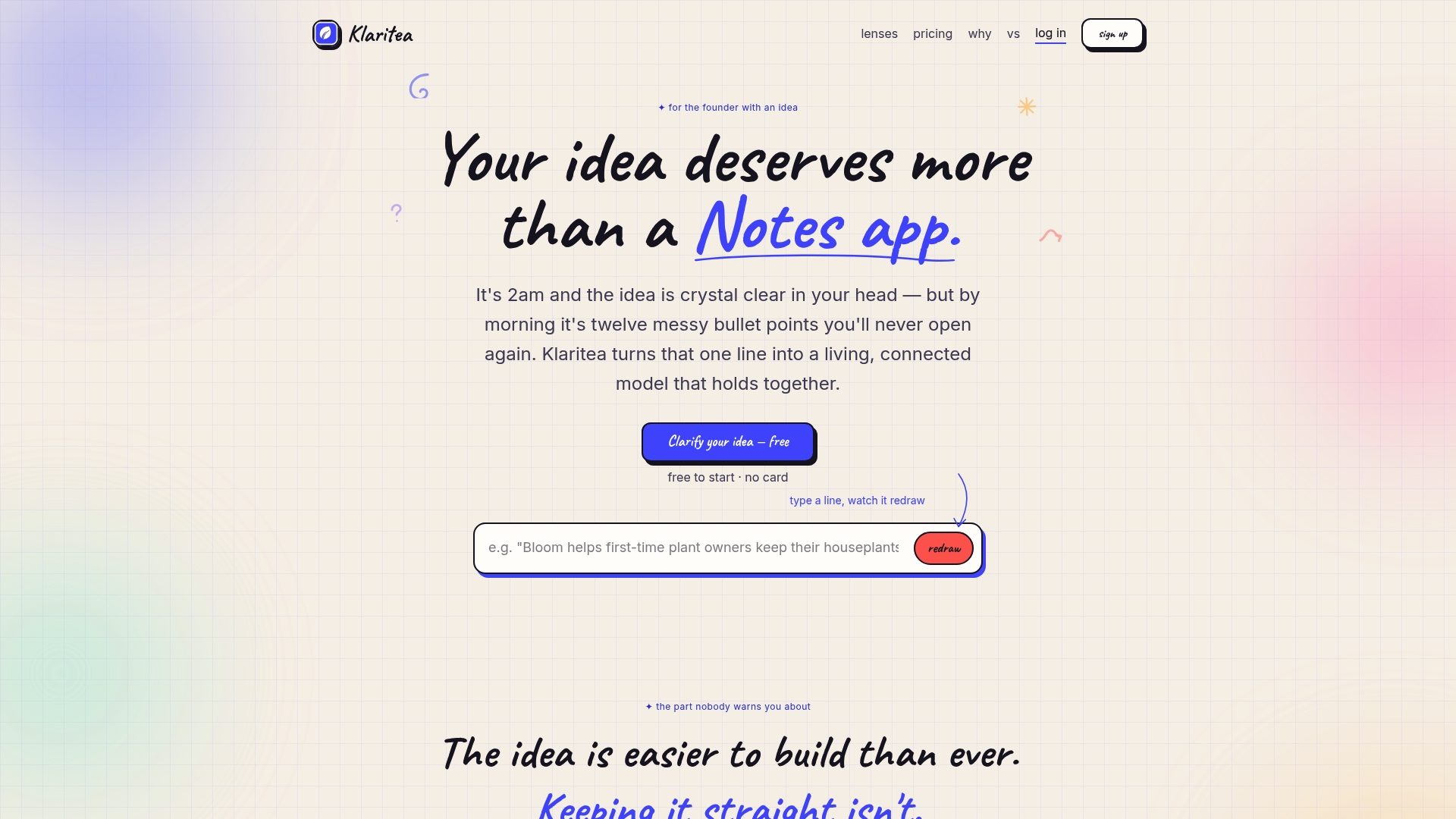
Before a PRD or an SRS makes sense, a team needs a clear, connected view of the idea itself: who it serves, how big the opportunity is, and which features actually matter. That is the gap we built Klaritea to close. You type a one-line idea, and we turn it into a structured model covering your ideal customer, market size, competitors, features, and requirements, with three AI advisors researching and challenging the plan as it forms.
- Consider this step when scope still feels fuzzy and rework risk is high.
- Useful for first-time founders who have not yet validated the idea worth writing a PRD about.
- Outputs include a build spec and a clarity scorecard you can hand straight to whoever drafts your PRD.
Our free tier lets you build the first version of that model at no cost, and the Klaritea plan at $19 a month adds deeper advisory sessions and exports once you are ready to move into PRD and SRS territory. Check the plans and start structuring your idea before you write a single requirement.
FAQ
Is there a difference between PRD and BRD?
Yes. A BRD (Business Requirements Document) focuses on business goals and justification for a project, while a PRD focuses on the product itself, its features, and user outcomes. Our BRD vs PRD comparison breaks down where each fits in a typical project.
What does PRD stand for?
PRD stands for Product Requirements Document. It is a product-focused artifact, typically owned by a product manager, that defines what a product or feature should do and why, without specifying technical implementation.
What is PRD and MVP?
A PRD is the document that defines what a product should do and why, while an MVP (Minimum Viable Product) is the smallest version of that product built to test the idea with real users. A PRD often scopes the first MVP by prioritizing which features are essential for that initial test.
What does a PRD look like?
A PRD typically includes a purpose statement, target personas, success metrics, a prioritized feature list, and stated assumptions or constraints, organized so a stakeholder can read it quickly. Wikipedia's overview of PRDs notes that exact components vary by project and methodology, though these core sections appear in most versions.
When should a project use both a PRD and an SRS?
A project needs both when it moves from early discovery into regulated, safety-critical, or fixed-scope contract work, since the PRD sets outcomes while the SRS makes each requirement testable and traceable. ISO/IEC/IEEE 29148:2018 is the standard most enterprise and regulated teams align their SRS content to in that situation.
Sources
- 29148-2018 - ISO/IEC/IEEE International Standard - Systems and software engineering -- Requirements engineering | IEEE Xplore
- SRS - Software Requirements Specification - SW Engineering Handbook Ver C - Global Site
- What is a Product Requirements Document (PRD)? | Atlassian