A business requirements document (BRD) explains why a project should exist and what outcome the business expects. A product requirements document (PRD) takes that approved direction and spells out what the product must do, how it should behave, and how a team will know it works. Use a BRD when funding or priority still needs sign-off; use a PRD once the initiative is approved and the team needs something buildable.
TL;DR:
- A BRD justifies funding and outlines high-level objectives, scope, stakeholders, and success metrics before detailed design begins.
- A PRD translates the approved business direction into specific features, user flows, and acceptance criteria for engineering teams to build.
- The two documents serve different purposes and audiences; skipping a BRD risks unapproved projects, while ignoring a PRD increases implementation errors.
- Easily missed factors include maintaining traceability of success metrics and constraints during handoff from BRD to PRD.
- The decision to combine or separate the documents depends on team size, regulation, and approval authority, with small teams often favoring a single brief.
Table of Contents
- What Is a BRD (Business Requirements Document)?
- What Is a PRD (Product Requirements Document)?
- BRD vs PRD: Key Differences at a Glance
- When to Use a BRD, a PRD, or Just a Short Brief
- How BRD and PRD Should Connect in Practice
- Sample BRD and PRD Outlines You Can Copy
- Common Pitfalls When Writing BRDs and PRDs
- How Klaritea Maps Idea Inputs to BRD and PRD Outputs
- When a Combined Document Is the Right Call
- Turn Your Idea Into a BRD and PRD Klaritea Can Actually Build From
- Sources
- FAQ
What Is a BRD (Business Requirements Document)?
A BRD captures the business case for a project before anyone touches a design tool. It lays out the objectives, the constraints, the expected return, and the metrics leadership will use to judge success. A BRD defines the business case, expected outcomes, stakeholders, and high-level constraints before solution design begins, which is exactly why it belongs earlier in the process than a PRD.
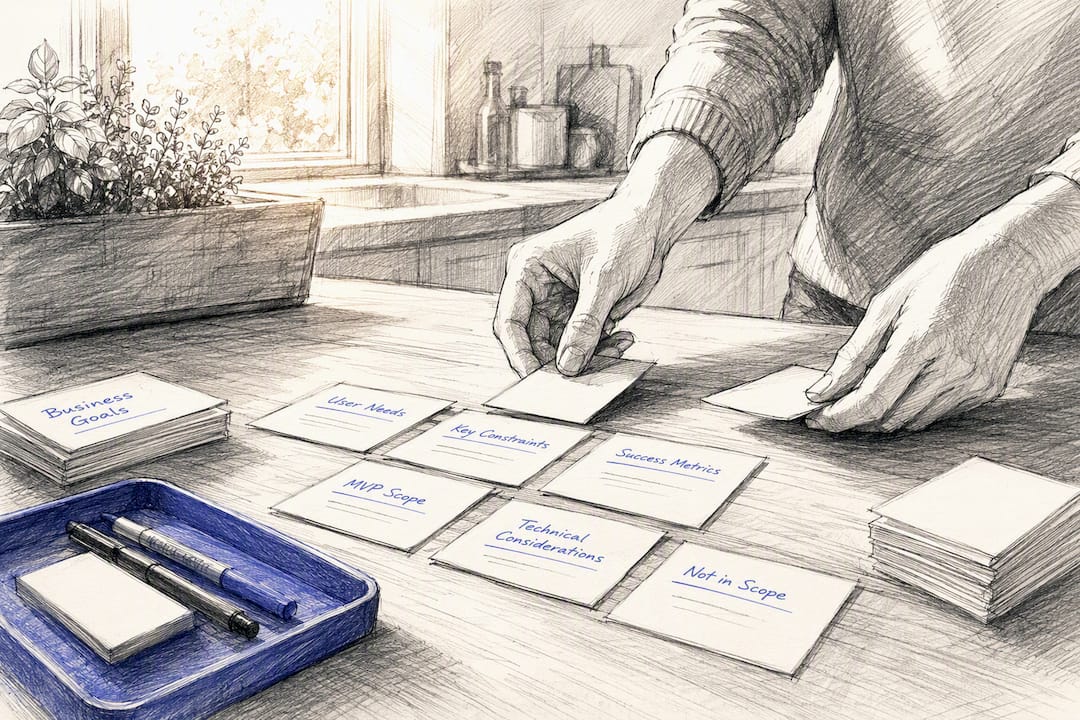
The audience is different too. A BRD gets read by executives, sponsors, finance partners, and business analysts, not by the engineers who will eventually build the thing. It's the document that justifies spending money and reallocating people, so ownership typically sits with a business analyst, program sponsor, or product leader who reports upward. Sign-off usually comes from whoever controls the budget.
A workable BRD generally includes:
- Business objectives: the specific outcome the initiative is meant to produce, tied to a metric.
- Project scope: what's in and explicitly what's out.
- Stakeholders: who's affected, who decides, who gets consulted.
- Assumptions and constraints: budget ceilings, timeline limits, legal or regulatory boundaries.
- Cost-benefit summary: rough return expected against the investment.
- Success metrics: how the business will measure whether the project delivered.
Asana's guidance identifies seven core BRD components and offers a template that covers most of these elements, which is a solid starting point if you're drafting one from scratch. If your organization touches regulated data, this is also the right document to flag privacy or consent obligations before a PRD gets written.
What Is a PRD (Product Requirements Document)?
A PRD picks up where the BRD leaves off. Once the business case is approved, the PRD translates that direction into product behavior: specific flows, feature definitions, and the acceptance criteria a delivery team can actually build against. A PRD turns approved business direction into product behavior, user workflows, features, and acceptance criteria that engineering and QA can act on without guessing at intent.
The audience shifts accordingly. Product managers write it, but designers, engineers, and QA are the ones who live inside it daily. Where a BRD speaks to "why we're doing this," a PRD speaks to "what this needs to do and how we'll know it's done." It's usually created after the BRD gets sign-off, though in fast-moving teams a lightweight PRD sometimes starts in parallel once direction is directionally clear.
A functional PRD typically includes:
- Problem statement: the specific user or business problem being solved.
- User flows: step-by-step paths through the feature or product.
- Feature list: what's being built, prioritized by importance.
- Acceptance criteria: the conditions that must be true for a feature to count as complete.
- Edge cases: the scenarios most teams forget until QA finds them in testing.
- Success metrics: product-level, not business-level (adoption rate, task completion, error rate).
The acceptance criteria section is where most PRDs fall apart in practice. A vague line like "the form should work correctly" gives QA nothing to test against. A better version states the exact input conditions, the expected output, and what happens on failure. That specificity is the entire point of a PRD, and it's the detail a BRD was never meant to carry.
BRD vs PRD: Key Differences at a Glance
The clearest way to separate these two documents is to look at what each one answers and who's reading it.
| Dimension | BRD | PRD |
|---|---|---|
| Purpose | Justifies the business case and expected outcome | Defines product behavior and how to verify it works |
| Audience | Executives, sponsors, business analysts | Product managers, designers, engineers, QA |
| Scope / level of detail | High-level: objectives, constraints, ROI | Granular: flows, features, edge cases, acceptance criteria |
| Timing in lifecycle | Before solution design, during approval | After business approval, during build planning |
| Ownership | Business analyst or program sponsor | Product manager |
| Typical outcome | Funding, prioritization, and sign-off | A buildable spec engineers can implement |
The two documents aren't competing for the same job. A BRD settles whether a project deserves resources at all; a PRD settles what "done" looks like once resources are committed. Skip the BRD and you risk building something nobody agreed to fund. Skip the PRD and you risk engineers guessing at intent, which is where most rework originates. The strongest teams treat the BRD as the gate and the PRD as the blueprint, not as two versions of the same list.
When to Use a BRD, a PRD, or Just a Short Brief
The right document depends less on company size and more on where the risk sits. If the biggest open question is whether this initiative deserves funding or priority, write a BRD first. If the direction is already approved and the real risk is building the wrong thing, go straight to a PRD. Analysts frame this distinction as choosing the artifact based on which failure mode you're protecting against: funding risk points to a BRD, execution risk points to a PRD.
Run through this quickly before you start writing:
- Does this touch multiple teams or departments with different priorities? If yes, a BRD helps align them before anyone builds anything.
- Is there real budget or headcount at stake? If yes, someone with financial authority will want a BRD before approving spend.
- Is the user problem already well understood and the scope small? If yes, a lightweight PRD or even a single user story may be enough. Skip the BRD entirely.
- Does the initiative touch regulated data, compliance, or organizational controls that need sign-off from legal or security? If yes, write a full BRD regardless of team size.
- Is this a small, well-scoped feature for an internal tool with one decision-maker? A short brief covering the problem and the acceptance criteria often replaces both documents.
Sizing matters as much as choosing the right document. A three-person startup adding a minor feature doesn't need a ten-section BRD. A regulated fintech product rolling out a new compliance workflow across four departments does.
Pro Tip: Match the template length to the number of people who need to sign off. If more than two teams have approval authority, use the full version of whichever document applies. If one person decides, a half-page brief usually beats a formal document nobody reads.
How BRD and PRD Should Connect in Practice
The handoff between these two documents is where most product failures actually start, not in the writing of either one individually. A PRD vs BRD gap often shows up as an operational failure: teams skip one document, or bury business context inside engineering tickets where nobody with business context ever reads it again.
Specific fields need to survive the transition from BRD to PRD intact:
- Success metrics defined in the BRD should become the product metrics tracked in the PRD, not get quietly redefined.
- Constraints (budget, timeline, legal limits) from the BRD become out-of-scope notes and technical constraints in the PRD.
- Stakeholder list carries forward so the PRD's review cycle includes the people who approved the original business case.
Three artifacts make this traceable rather than just hoped-for. A requirements traceability matrix links each BRD objective to the PRD features that satisfy it. A decision log records why scope changed between the two documents, so nobody has to reconstruct that reasoning six weeks later. Baselining notes mark the version of each document that was actually approved, which matters the moment someone asks "wait, did we agree to this?"
A simple review checkpoint works well here: business sign-off on the BRD, PM draft of the PRD against that BRD, then a joint review before engineering starts.
Sample BRD and PRD Outlines You Can Copy
Neither document needs to be long to be useful. Most failures come from missing sections, not from brevity.
A compact BRD needs seven headings:
- Business objective: one sentence, tied to a metric.
- Background and problem statement: why this matters now.
- Scope: what's included, what's explicitly excluded.
- Stakeholders: decision-makers and consulted parties.
- Assumptions and constraints: budget, timeline, regulatory limits.
- Cost-benefit summary: expected return against investment.
- Success metrics: how the business measures the outcome.
A compact PRD needs five:
- Problem statement: the user or business problem, one paragraph.
- Target users: who this is for, specifically.
- Success metrics: product-level measures of whether it worked.
- Features and flows: what gets built, in priority order.
- Acceptance criteria: the exact conditions that define "done."
| Document | Core question it answers | Owner |
|---|---|---|
| BRD | Should we fund this, and why? | Business analyst / sponsor |
| PRD | What does the product need to do? | Product manager |
For a deeper walkthrough with worked examples, Klaritea's guide to writing a product requirements document breaks each section down further, and the companion piece on building a feature requirements list shows how PRD features turn into a prioritized backlog.
Common Pitfalls When Writing BRDs and PRDs
Most BRD and PRD failures trace back to a handful of repeatable mistakes, and nearly all of them are fixable with a five-minute review pass before the document ships.
- Mixing audiences in one document. Writing executive-level business rationale and engineer-level acceptance criteria in the same file forces both readers to skim past content that isn't for them. Keep them separate.
- Skipping acceptance criteria entirely. A feature list without conditions for "done" is a wish list, not a spec. QA needs testable conditions, not adjectives.
- Ignoring baselining. When requirements change mid-project without a recorded version history, nobody can explain later why the scope shifted.
- Overloading detail too early. A BRD full of pixel-level feature specs wastes executive attention and duplicates work the PRD will do better.
A quick fix for most of these: before sign-off, ask "could someone outside this meeting read this section and know exactly what to do next?" If the answer is no, the section needs another pass.
Pro Tip: Set a fixed review cadence rather than an open-ended one. A BRD reviewed once at kickoff and once before sign-off, paired with a PRD reviewed at each major milestone, catches drift before it becomes rework.
How Klaritea Maps Idea Inputs to BRD and PRD Outputs
Klaritea builds a connected model from a single-line idea, and that model naturally splits along BRD and PRD lines. The TAM/SAM/SOM sizing, competitor analysis, and clarity scorecard map to the decision-quality questions a BRD is meant to answer: is this worth funding, and how confident should sponsors be in the case. The build spec, feature list, and requirements output map to what a PRD needs: concrete features, flows, and the detail engineers act on.
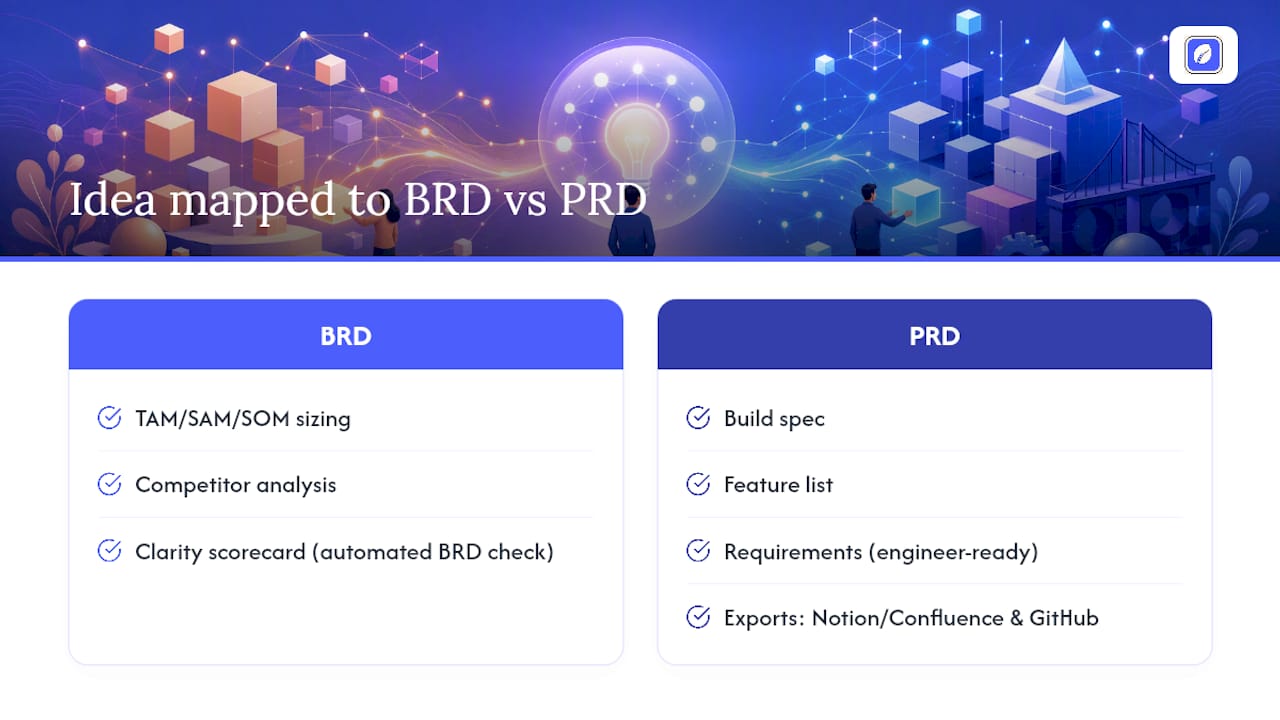
The clarity scorecard in particular functions like an automated BRD gut check, flagging where the business case is thin before anyone commits budget. From there, the build spec exports to Notion or Confluence for teams that need the PRD living alongside engineering documentation, with GitHub sync available for teams that want requirements tracked against actual code.
When a Combined Document Is the Right Call
Separating BRD and PRD makes sense when multiple teams need to sign off independently or when regulatory risk demands a paper trail. But a single combined document often works fine when a team is small and the same people make both the funding and the build decisions — forcing two formal artifacts on a three-person team just adds overhead nobody reads.
Three rules of thumb hold up across most situations I've seen argued out in product teams: combine the documents when one person owns both the budget call and the build call; separate them the moment a second department gets veto power; and always keep acceptance criteria distinct from business rationale, even inside a combined document, because that's the section QA and engineering actually use. The format matters less than whether the reasoning behind decisions survives past the meeting where it happened.
— Karl
Turn Your Idea Into a BRD and PRD Klaritea Can Actually Build From
Most founders don't fail because they wrote a bad BRD or PRD. They fail because they never wrote either one clearly enough to build against, and $15,000 later they're staring at an app nobody asked for. Klaritea starts before that spending happens: type a one-line idea and it builds a connected model covering market sizing, competitor analysis, features, and requirements, then generates a build spec that functions like a PRD your engineers can actually use.
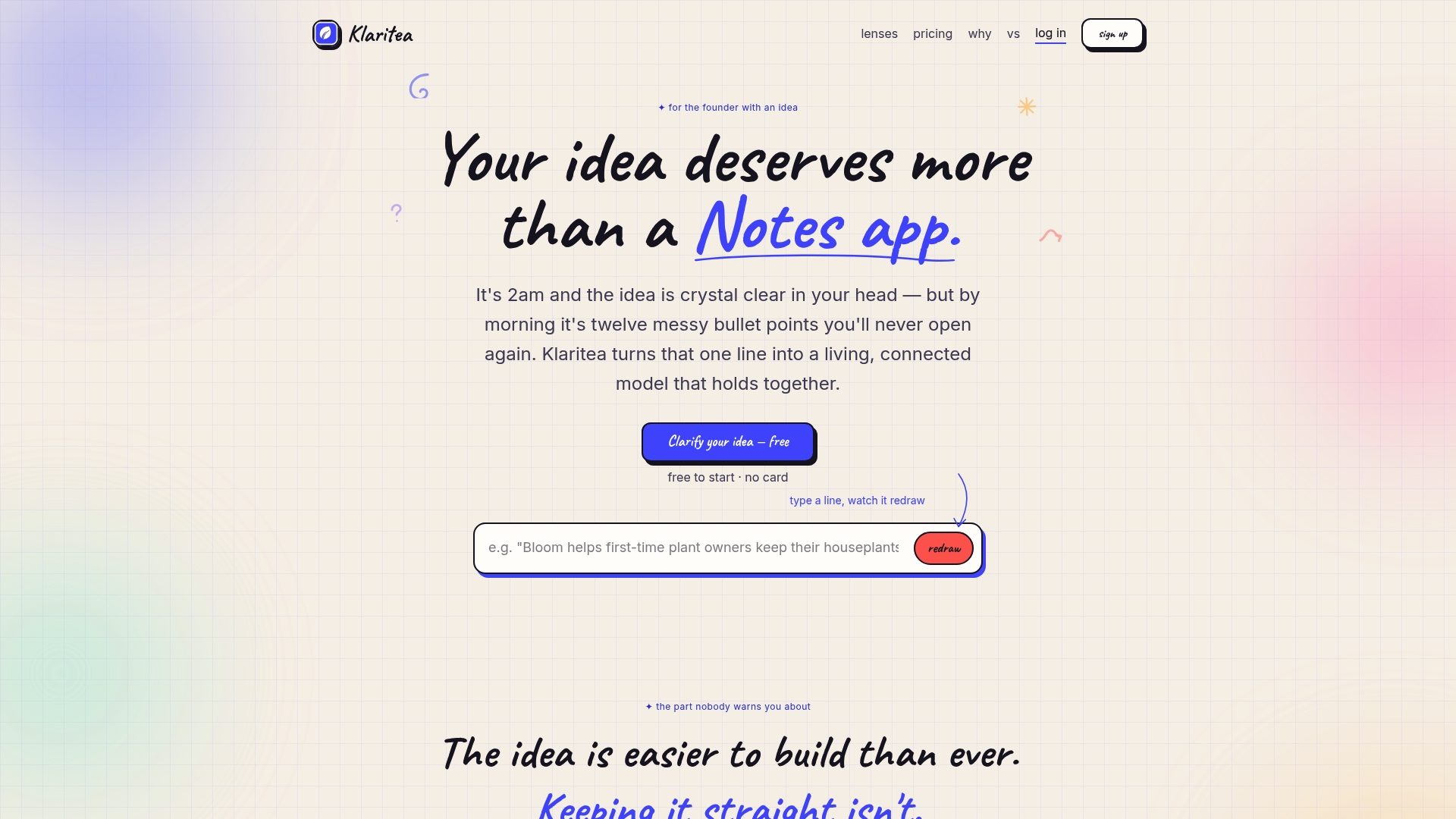
The clarity scorecard gives you the BRD-style gut check on whether the business case holds up, before you write a single line of code or brief a single contractor. From there, export the build spec to Notion or Confluence, or sync it to GitHub if you're already building. If you want to see how the full model works before committing to a plan, check out why Klaritea exists or start turning your idea into a shipped product directly on the homepage.
Sources
- BRD vs. PRD: What’s the difference and when should teams use each? | Plane Blog
- PRD vs BRD: What's the Difference & When to Use Each
FAQ
What's the difference between a BRD and an SRS?
A BRD explains the business case and expected outcomes at a high level, while an SRS or FRD specifies precise implementation instructions for how engineers should build the solution.
What is an example of a PRD?
A PRD for a checkout redesign would include a problem statement about cart abandonment, target user flows, a prioritized feature list, and acceptance criteria specifying exactly what counts as a successful transaction. Klaritea's PRD guide walks through a full worked example.
What does PRD stand for?
PRD stands for product requirements document, the artifact that defines what a product must do, how it should behave, and how a team verifies it works correctly.
What is a BRD in product management?
In product management, a BRD is the document that justifies why a project should happen, covering objectives, scope, stakeholders, and expected return on investment before any product design work begins.
Is a PRD the same as a product specification?
Not quite. A PRD captures the reasoning and alignment behind product decisions, while a separate technical spec or SRS carries the precise implementation instructions that engineering or coding agents follow to build it.