A positioning statement is a one-to-four sentence internal document that names your target customer, the category you compete in, the one benefit that matters most, and the proof that backs it up. Its job is to force marketing, product, and sales to agree on a single, testable claim before a single word of copy gets written. Get it wrong, and every landing page, sales deck, and ad reads like it came from a different company.
TL;DR:
- A positioning statement must clearly define the target customer with specific behaviors or attitudes, not broad demographic segments.
- The statement's category frame should accurately reflect the buyer's mental shelf, such as "project management" versus "async communication," to target the right audience.
- It should include one measurable primary benefit supported by a concrete proof point, with the proof usually coming before the benefit in development.
- A strong positioning statement avoids vague language, multiple benefits, and feature listings, focusing instead on specific frustrations and solutions.
- Validation through sales calls and landing page testing is essential to ensure the statement is clear, believable, and effective before scaling marketing efforts.
Table of Contents
- What a positioning statement actually is (and what it isn't)
- The four components every positioning statement needs
- A copy-ready positioning statement template
- Positioning statement examples by category
- How to write your own positioning statement, step by step
- Common positioning mistakes and quick fixes
- How to test whether your positioning statement actually works
- Why specificity beats cleverness in early-stage positioning
- Speed up the positioning process with Klaritea
- Primary sources and further reading
- Sources
- FAQ
What a positioning statement actually is (and what it isn't)
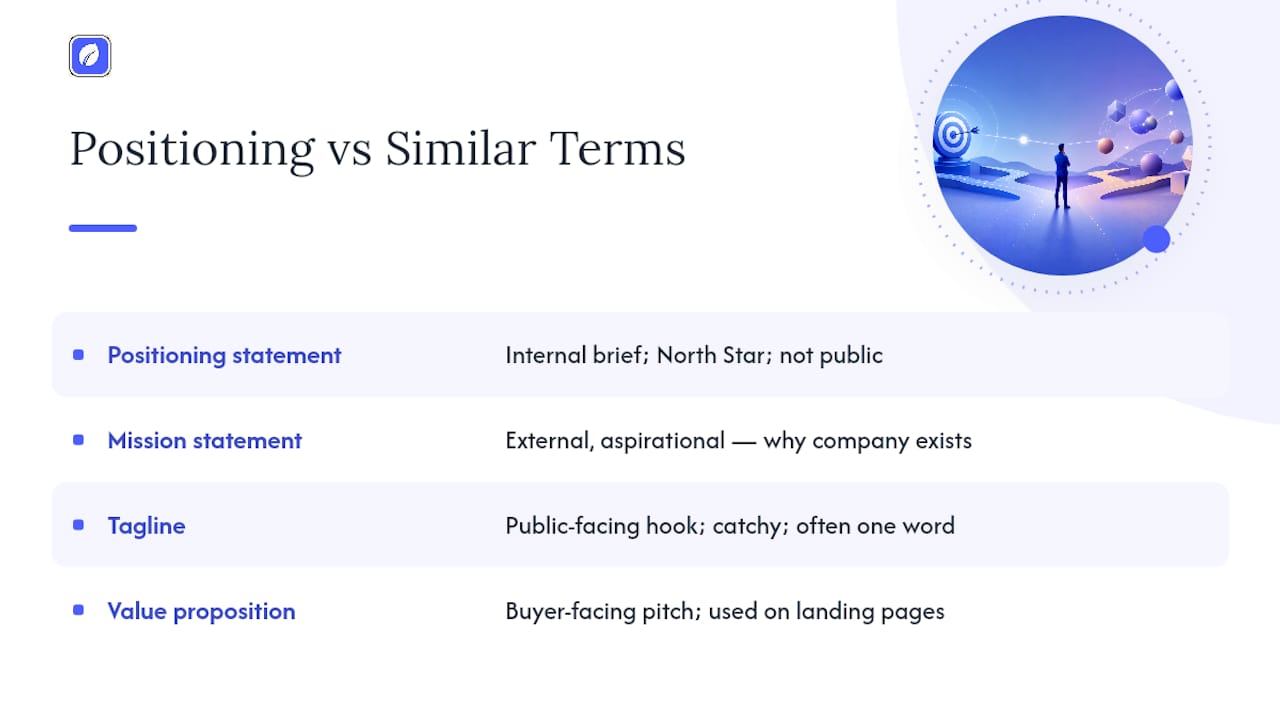
A positioning statement is not a tagline, a mission statement, or a value proposition, even though people mix them up constantly. It's an internal working document, closer to a brief than to marketing copy. Nobody outside your team should ever see the actual sentence.
The confusion usually breaks down like this: a mission statement is external and aspirational (why the company exists). A tagline is a public-facing hook, often clever, sometimes a single word. A value proposition is buyer-facing and derived from positioning. It's the pitch you'd actually put on a landing page. The positioning statement sits behind all of it as the internal "North Star" that keeps those outward messages consistent.
Harvard Business School Online frames brands as "meaning-makers." Positioning is the exercise of deciding, deliberately, what meaning you want customers to attach to you before they decide it for themselves.
Length matters more than people think. One to four sentences is the working range. If you're a solo founder or a two-person marketing team, keep it to a single sentence. The longer it gets, the more likely it's hiding vague thinking behind extra clauses.
The four components every positioning statement needs
Skip any one of these and the statement collapses into a slogan. Apex Brands describes this four-part structure as a strategic constraint, something that limits creative options on purpose so your team stops reinventing the message every quarter.
- Target customer: not "small businesses" but "solo bookkeepers managing 15 to 40 clients on spreadsheets." Behavioral specificity beats demographic buckets almost every time, and Apex Brands makes the same point when it recommends naming attitudes and behaviors over broad segments.
- Competitive frame (category): the mental shelf you're asking to be placed on. "Project management tool" and "async communication layer" put you in front of completely different buyers.
- Primary benefit: exactly one measurable outcome. Not three. One.
- Reason to believe: your strongest, most specific proof point. A number, a mechanism, a credential. Not "high quality."
If you sell into more than one distinct segment, write a separate statement for each. A statement built for enterprise IT buyers will not survive contact with a solo freelancer, and forcing one sentence to serve both usually means it serves neither.
Pro Tip: Write your reason to believe first, before the benefit. If you can't name a specific proof point, the benefit you picked is probably too generic to defend.
A copy-ready positioning statement template
The classic formula still works because it forces every component into place:
For [target customer] who [need], [brand] is the [category] that [primary benefit] because [reason to believe].
Three variations to adapt depending on what you're building:
- Ultra-compact (elevator version): "[Brand] helps [customer] [benefit] through [mechanism]." Good for pitch decks and About pages where four clauses feel bloated.
- Multi-segment version: run the full template once per buyer persona, changing only the customer and reason to believe, keeping the category and benefit fixed where the product genuinely serves both the same way.
- Product-feature version: swap "[brand]" for a specific feature when you're positioning one part of a larger product, useful for feature launches inside an existing SaaS suite.
For tightening language, replace vague nouns like "solution," "platform," or "tool" with a verb phrase describing what the customer actually does differently. "A solution for marketers" says nothing. "The tool that cuts campaign approval time from days to hours" says everything.
Positioning statement examples by category
Real statements, reconstructed from common market patterns, not lifted verbatim from any single company's internal docs. Each one follows the pattern GTM Labs documents across B2B cases: name a specific buyer, set a category frame, state one benefit, contrast against a named alternative.
- B2B SaaS, project management: For distributed engineering teams who lose context switching between five tools, Streamline is the single source of truth for sprint work that replaces Jira-plus-Slack chaos with one connected view. RTB: native GitHub sync that updates status without manual entry.
- B2B SaaS, design collaboration: For product teams tired of sending static mockups back and forth, a browser-based design tool becomes the shared canvas that lets engineers and designers edit the same file live, instead of exporting PNGs. RTB: real-time multiplayer editing with zero installation.
- B2B SaaS, workspace docs: For startups drowning in scattered docs and wikis, an all-in-one workspace becomes the place where notes, tasks, and databases live together, instead of forcing five separate apps. RTB: one search bar covers every document type.
- B2B fintech, payments infrastructure: For developers building online marketplaces, a payments API becomes the fastest way to accept and route money globally, instead of stitching together three regional processors. RTB: single integration covers 135+ currencies.
- B2B, HR software: For HR leads at 50 to 200 person companies drowning in manual onboarding, an HR platform becomes the system that gets new hires productive on day one, instead of a folder of PDFs and email chains. RTB: automated compliance checklists per state.
- DTC, skincare: For people with sensitive skin who've been burned by fragrance-heavy products, a minimalist skincare line becomes the routine that calms redness without a 10-step regimen. RTB: dermatologist-formulated, four ingredients per product.
- DTC, direct-to-consumer mattress: For side sleepers with chronic shoulder pain, a foam mattress brand becomes the mattress that eliminates pressure points, instead of the one-size-fits-all coil mattress from a big-box store. RTB: 120-night trial with pressure-mapping data behind the foam density.
- DTC, coffee subscription: For remote workers who miss their local coffee shop, a subscription roaster becomes the coffee that arrives fresher than what sits on a grocery shelf, instead of stale beans roasted months ago. RTB: roasted and shipped within 48 hours.
- Service business, local: For homeowners who've been burned by contractors who ghost mid-project, a local renovation company becomes the contractor who shows up on the day they say they will, instead of the guy who disappears for three weeks. RTB: fixed-price contracts with a written completion date.
- Service business, B2B agency: For founders who don't have a marketing hire yet, a fractional CMO service becomes the strategy partner who runs marketing like an in-house exec, instead of an agency that bills hours without accountability. RTB: outcomes tied to a monthly retainer, not a time sheet.
- Niche B2B, vertical software: For veterinary clinics still running on paper charts, a practice management tool becomes the system that gets a full patient history in three clicks, instead of digging through a filing cabinet. RTB: built by former vet techs, not generalist developers.
- Feature-level positioning: For sales reps who lose deals to slow follow-up, an inbox automation feature becomes the assistant that drafts the next email before the call ends, instead of a blank reply box and a memory. RTB: drafts pull directly from CRM notes taken during the call.
- Brand-level positioning, apparel: For runners training through winter, a thermal apparel brand becomes the gear that regulates body temperature across a 40-degree range, instead of layering three mismatched pieces. RTB: phase-change material licensed from aerospace insulation.
- Founder-stage positioning, early SaaS: For first-time founders who've never built a go-to-market plan, an early-stage planning tool becomes the structured model that turns a one-line idea into a build spec, instead of a stack of disconnected Notion docs and guesswork.
Notice what's absent from every example: adjectives like "leading," "innovative," or "best-in-class." Every one names a real frustration, a real category, one benefit, and something specific enough to be checked.
How to write your own positioning statement, step by step
Run this as a workshop, not a solo writing exercise. It works in a room with three people or over a focused 45-minute solo block.
- Map the status quo. Write down exactly what your target customer does today without your product. This is the baseline every claim gets measured against.
- List unique attributes. What do you have that alternatives genuinely lack? Be honest, this list is usually shorter than founders expect.
- Convert each attribute into a benefit. "Real-time sync" is an attribute. "Never lose work when your internet drops" is the benefit.
- Select the category frame. Decide what shelf you're on. This single choice shapes every ad, every sales call, every landing page headline.
- Draft the statement. Use the template. Write three versions in fifteen minutes. Don't polish yet.
- Test with five sales calls or customer conversations. Read the statement out loud, or better, test it as landing page copy. Watch for confusion, not politeness.
- Iterate. Revisit whenever buyer behavior, product maturity, or the competitive landscape shifts, not on a fixed calendar.
At each step, produce something tangible: a one-page persona card after step 1, a competitor map after step 2, a proof matrix after step 4, and draft landing copy after step 6. These artifacts matter more than the meeting notes.
Pro Tip: Time-box the drafting step hard. Teams that spend more than 20 minutes wordsmithing before testing almost always end up polishing a claim nobody outside the room understands.
Common positioning mistakes and quick fixes
Most weak positioning statements fail for one of five predictable reasons; healthcare SaaS providers should especially avoid these pitfalls outlined in Common Healthcare SaaS Positioning Mistakes to Fix Now.
- Vague audience. "Businesses of all sizes" tells you nothing. Fix: name the job title, the team size, or the specific pain, like "operations managers at 20 to 100 person logistics companies."
- Multiple benefits crammed into one sentence. "Faster, cheaper, and easier to use" reads as marketing filler, not a claim. Fix: pick the one benefit your customer would fight to keep if you took the others away.
- No reason to believe. "High-quality service" is not proof of anything. Fix: replace it with a specific mechanism, a number, or a credential a competitor can't copy.
- Jumping straight to features. "We have AI-powered dashboards" describes the product, not the outcome. Fix: ask "so what does that let the customer do" until you hit a real benefit.
- Fuzzy category framing. Calling yourself "a platform" says nothing about what shelf you belong on. Fix: name the category your buyer already searches for, even if it feels less exciting.
If two segments need genuinely different reasons to believe, split into two statements rather than forcing a single sentence to flex across both.
How to test whether your positioning statement actually works
Don't skip validation just because the statement feels right in the room. A statement that sounds sharp internally can still confuse the market completely.
- Run five sales or discovery calls using the statement as your opener. If prospects ask "wait, what do you actually do?" more than once, the category frame is off.
- Turn it into landing page headline copy and watch click-through and demo request rates. A statement that reads clearly on the page but doesn't convert usually has a weak or unbelievable reason to believe.
- Run a quick preference test, showing two versions of the statement to a handful of target customers and asking which one they'd trust more.
- Watch for the same objection repeating across conversations. That's usually a sign the reason to believe isn't strong enough to survive scrutiny, and it's worth pressure-testing against real competitor weaknesses before you rewrite.
There's no universal benchmark for "good" click-through or demo rates since they vary wildly by industry and channel, but a sudden drop-off compared to your own historical baseline, or confusion repeating across multiple calls, both signal the same thing: rewrite before you scale spend behind the message.
Why specificity beats cleverness in early-stage positioning
Founders default to broad claims because broad feels safe. "We help businesses grow" offends nobody and excites nobody either. The statements that actually move a sales conversation forward are almost always narrower than the founder's first instinct, sometimes uncomfortably so.
The pattern shows up constantly in early-stage work: a founder writes "for teams who want to work smarter," and the fix is always the same question. Smarter than what, compared to which specific alternative they're using right now? Once you name that alternative, the whole statement gets sharper without adding a single word.
A quick gut check before you finalize anything: could a competitor's marketing team read your statement and swap in their own logo without changing a word? If yes, you haven't positioned anything yet. You've written a mission statement wearing a positioning statement's clothes.
— Karl
Speed up the positioning process with Klaritea
Some positioning tools connect every decision to a visible, live model of your business instead of living in a static doc that goes stale the moment your market shifts. Because the target customer, category frame, competitor map, and feature list are already linked in one connected model, changing one component updates the rest automatically instead of leaving your positioning statement out of sync with your actual product.
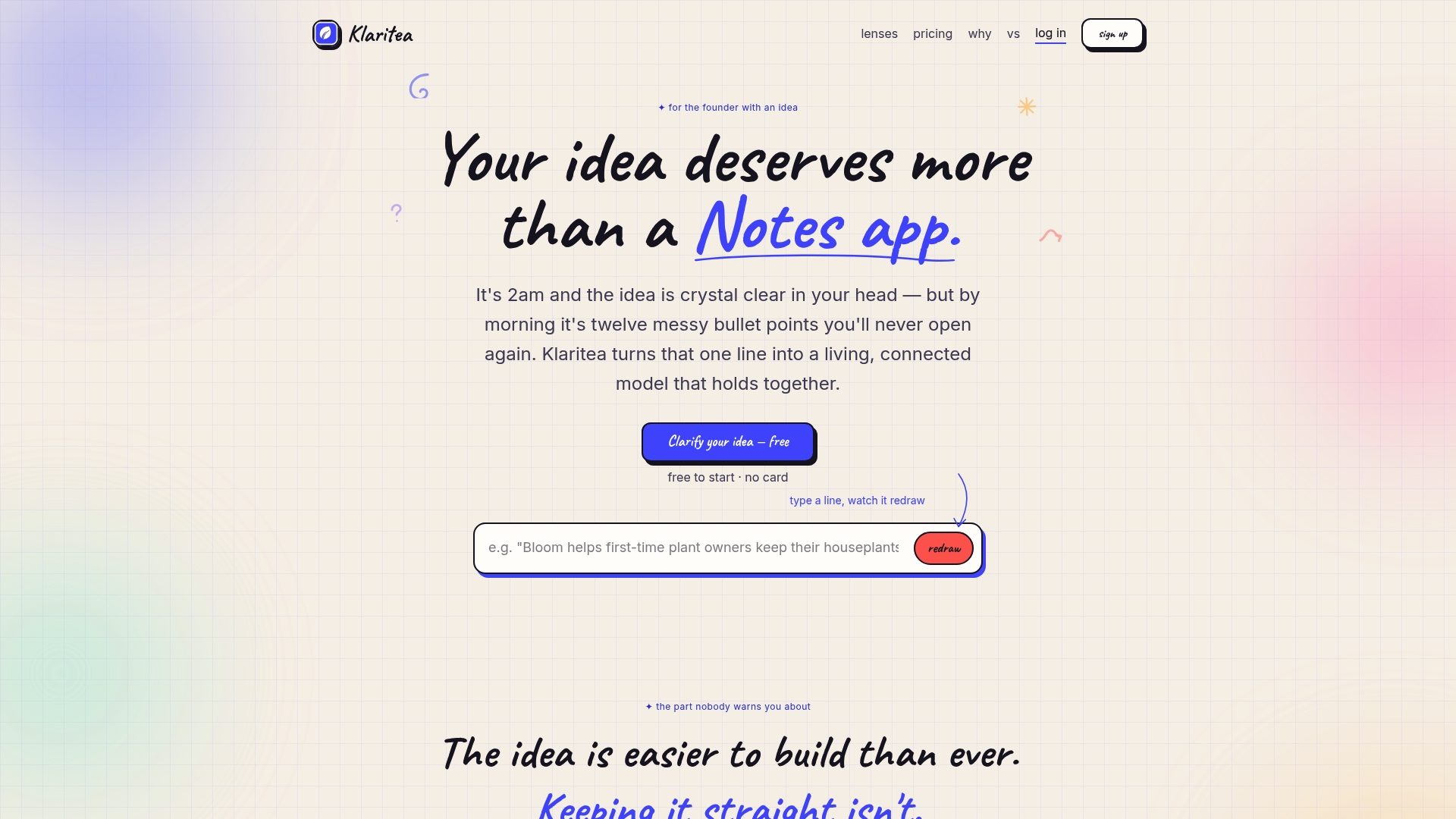
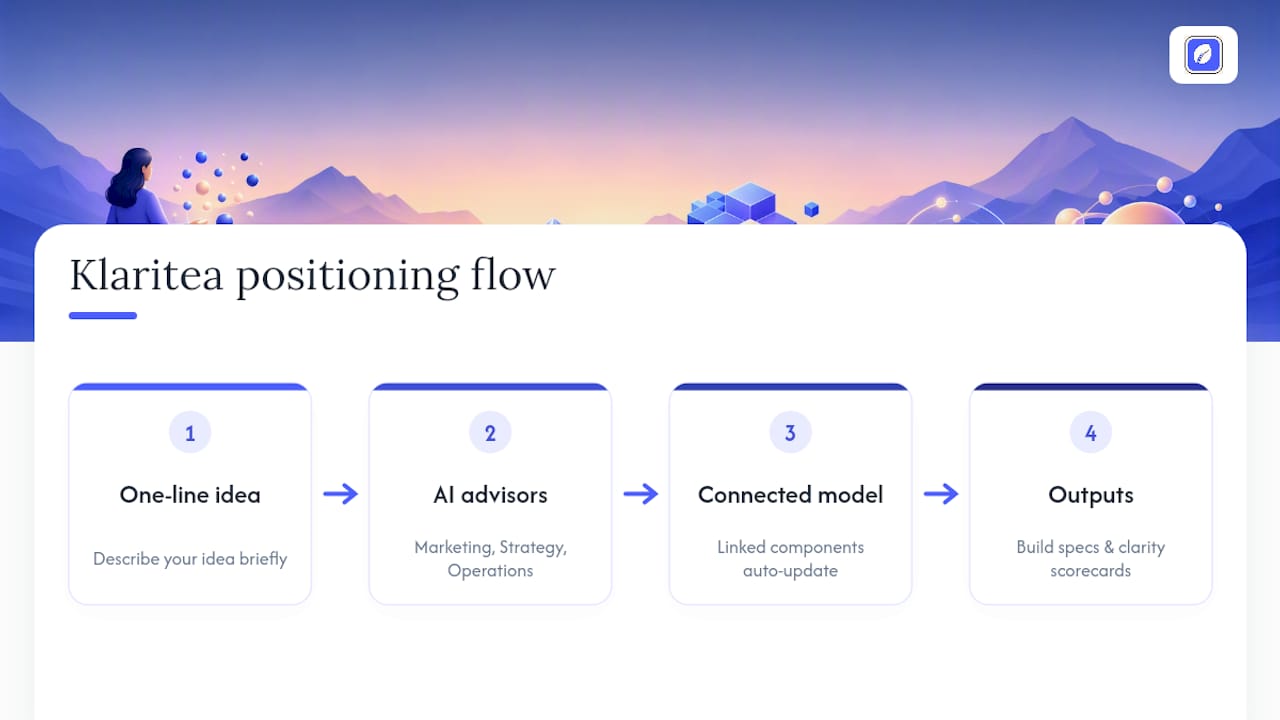
You start with a one-line description of your idea. From there, three AI advisors, covering marketing, business strategy, and operations, challenge your assumptions and help pressure-test the reason to believe before you commit to a direction. That output feeds directly into build specs and clarity scorecards, so the positioning work doesn't just sit in a slide deck, it actually shapes what gets built next.
The Free plan costs $0 a month and is enough to draft and stress-test your first statement. If you need deeper competitor research and exportable artifacts for your team, the Klaritea plan runs $19 a month. Start with the free tier, run the workshop from this article inside it, and see what the connected model surfaces that a blank doc never would.
Primary sources and further reading
For deeper background on the concepts covered here, Harvard Business School Online's guide to brand positioning covers the perception and meaning-making angle in more depth. Apex Brands' structural breakdown walks through the four-part framework with additional worksheets. GTM Labs' collection of annotated B2B examples is worth bookmarking if you want more reconstructed cases beyond the ones listed above.
Sources
- Crafting the Perfect Brand Positioning Statement
- How to Structure a Brand Positioning Statement (2026) – Apex Brands
- Positioning Statement Examples · 10 B2B Cases · GTM Labs
FAQ
How long should a positioning statement be?
One to four sentences is the standard range, and solo founders or lean teams should aim for a single sentence to force clarity early.
What are the four main components of a positioning statement?
Target customer, competitive frame or category, primary benefit, and reason to believe, a structure Apex Brands describes as a deliberate creative constraint rather than a suggestion.
Can you give me an example of product positioning?
"For sales reps who lose deals to slow follow-up, an inbox automation feature becomes the assistant that drafts the next email before the call ends" names a specific user, one benefit, and a concrete reason to believe.
Can you give me an example of brand positioning?
"For homeowners who've been burned by contractors who ghost mid-project, a local renovation company becomes the contractor who shows up on the day they say they will" works at the brand level because the reason to believe, a fixed-price contract with a written date, applies across every job the company takes on.
What is the difference between a positioning statement and a value proposition?
A positioning statement is internal and strategic, guiding how your team thinks about the market; a value proposition is the buyer-facing promise you derive from it and actually put on a landing page or sales deck.
How much does Klaritea cost?
Klaritea offers a Free plan at $0 a month, a Klaritea plan at $19 a month, and a Pro plan at $99 a month, all listed on the pricing page.