An opportunity assessment is a short, structured pre-investment process that tells you whether to pursue, pause, or kill an idea before you spend real money or engineering time on it. Run one correctly and you walk away with three things: a clear problem statement, a scored canvas showing where the idea is strong and where it breaks down, and a defensible go/no-go recommendation you can present to stakeholders.
The outputs are concrete:
- Problem statement — a one-sentence description of the user, their pain, and the impact of that pain
- Clarity scorecard — a scored view of market size, competitive position, demand evidence, and feasibility
- Go/no-go recommendation — a prioritized next step (proceed, run a limited experiment, or stop)
Run an assessment before a sprint, before committing budget, or any time you are choosing between multiple roadmap candidates. It is a phase-0 activity, sitting upstream of discovery, prototyping, and building.
Key Takeaways
A disciplined opportunity assessment, run before any sprint or investment, consistently saves more time and money than it costs — the process of assessing often has more value than the final go/no-go verdict itself.
| Point | Details |
|---|---|
| Start with the problem statement | Write the user, pain, and impact before naming any solution or feature. |
| Use quick filters first | Run an Olsen or RICE score on all candidates before committing to a full canvas on any one. |
| Set kill criteria upfront | Define the evidence threshold that stops the assessment before sunk cost bias takes over. |
| Match framework to context | Use SVPG's 10-question POA for binary decisions; POEM for deep concept grading; Olsen scoring for fast triage. |
| Klaritea accelerates phase-0 | One-line input produces a scored canvas, assumption list, and go/no-go report without manual template setup. |
Table of Contents
- What does an opportunity assessment actually cover?
- How to run an opportunity assessment step by step
- Which framework fits your situation?
- How do you validate demand before you build?
- What does a realistic assessment cost in time and money?
- How do you make a defensible go/no-go decision?
- What biases and red flags can invalidate your assessment?
- What templates and deliverables should you produce?
- How Klaritea speeds up a phase-0 assessment
- A practitioner's perspective on running assessments well
- Klaritea gives you a phase-0 workflow without the setup overhead
- Sources
- FAQ
What does an opportunity assessment actually cover?
Practitioner guides define a product opportunity assessment as a structured pre-check that spans problem framing, market sizing, competitive analysis, demand validation, feasibility, strategic fit, financials, and prioritization. That is broader than a discovery sprint and narrower than a full business case.
The distinction matters. Discovery is exploratory — you are learning what users need. An assessment is evaluative — you are deciding whether a known problem is worth solving for your team, right now. Experiments come after: once the assessment says "proceed," you design tests to validate the riskiest assumptions. Conflating these three activities is one of the most common ways product teams waste time.
When to run a full assessment:
- Before committing a sprint or quarter to a new initiative
- Before a seed or Series A investment decision
- When prioritizing three or more roadmap candidates against each other
- When vetting a partner integration, acquisition target, or platform bet
- When a stakeholder pushes a new idea and needs a structured response
When not to bother:
A full assessment is overkill for a minor bug fix, a small UX improvement with clear user demand, or a quick hunch you can test with a two-day spike. For those, a lightweight alternative works: a five-minute RICE score, a quick competitive search, or a single customer conversation. Reserve the full process for decisions that carry real cost or strategic consequence.
How to run an opportunity assessment step by step
This seven-step sequence gives you a repeatable template you can run in a week for a quick filter or three to six weeks for a standard assessment. Marty Cagan at SVPG recommends answering ten core questions as a baseline — the steps below map directly to that structure while adding practical scaffolding.
Step 1: Frame the problem
Write a single problem statement before you do anything else. The format is simple:
Example: "Early-stage founders struggle to size their market accurately before pitching investors, which causes them to enter due diligence underprepared and lose funding rounds."
Never write the problem statement as a feature list. A statement like "users need a dashboard with real-time analytics" is a solution, not a problem. Keep the focus on the user, the pain, and the outcome they want.
Step 2: Define your target user and ICP
Specify who has this problem most acutely. Name the segment, the job title or life situation, and the context in which the pain occurs. Vague targets ("small businesses") produce vague assessments. A tight ICP ("first-time SaaS founders raising a pre-seed round in the U.S.") gives you a testable, reachable population.
Step 3: Size the market
You need to understand market size through total, serviceable, and obtainable market estimates. For early assessments, use reliable bottom-up approaches rather than vague top-down percentages from broad industry reports. When citing figures, ensure you have credible sources such as government data or well-established databases, as unsupported numbers are assumptions, not evidence.
Step 4: Scan competitors and alternatives
List what your target user does today to solve this problem. That includes direct competitors, indirect substitutes (spreadsheets, manual processes, workarounds), and the "do nothing" option. For each, note the key limitation that your opportunity could address. This is where web data and API evaluation tools can accelerate competitive research by pulling structured data on competitor features, pricing pages, and review signals at scale.
Step 5: List and rank your assumptions
Every assessment rests on assumptions. Surface them explicitly and rank them by risk. A simple table works:
| Assumption | Why it matters | Risk level | Test |
|---|---|---|---|
| Users will pay $X/month | Drives revenue model | High | Pricing microtest or interview |
| Problem occurs weekly | Justifies urgency | Medium | 10 user interviews |
| No dominant incumbent | Affects differentiation | High | Competitive scan |
Step 6: Build a validation plan
For each high-risk assumption, name one test you will run before proceeding. Keep tests cheap and fast. A landing page with a sign-up CTA, five customer interviews, or a concierge MVP can answer most critical questions in under two weeks. More on specific tactics in the validation section below.
Step 7: Write the go/no-go recommendation
Summarize the evidence, state your recommendation (proceed, limited experiment, or stop), and name the next resource ask. One page is enough. If you cannot summarize the case in one page, the assessment is not finished yet.
Which framework fits your situation?
No single framework works for every context. Different assessment methods map to different stakeholder needs and investment sizes — a VC evaluating a seed deal needs different outputs than a product manager prioritizing a roadmap. Here is a practical comparison of the five most-used frameworks.
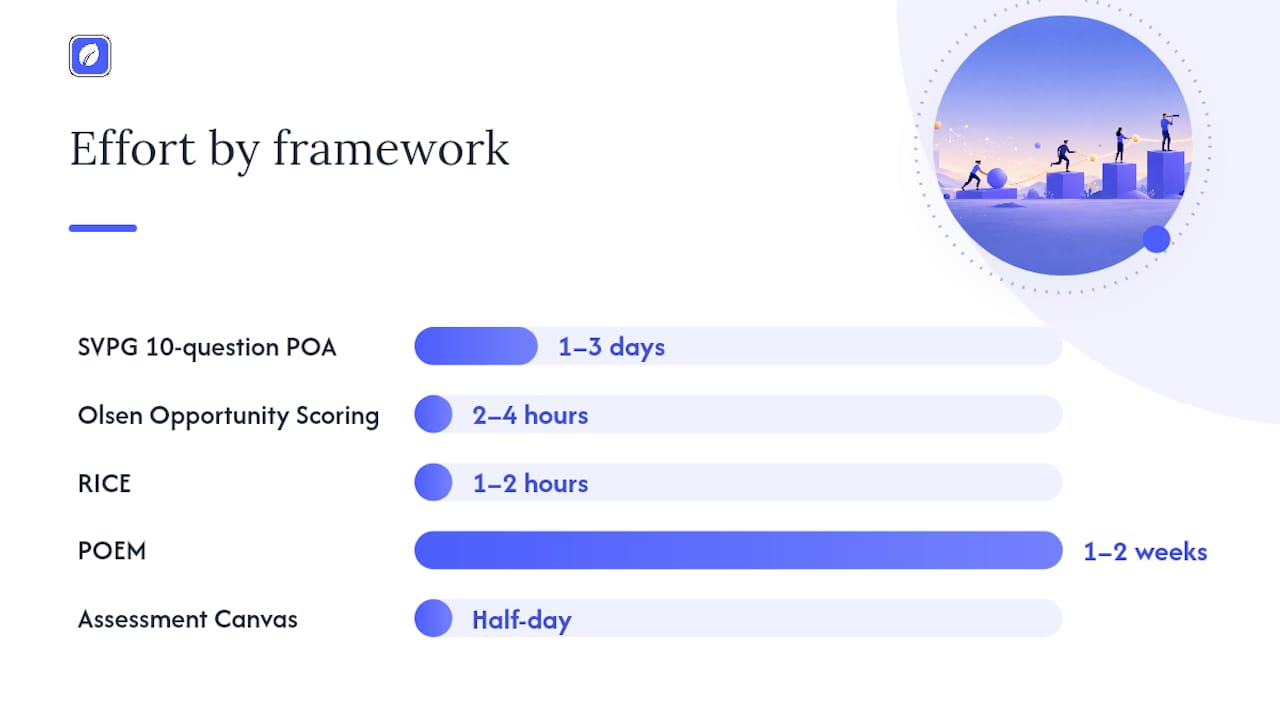
| Framework | When to use | Effort / time | Primary outputs | Data required | Decision clarity |
|---|---|---|---|---|---|
| Cagan / SVPG 10-question POA | Early filter before any sprint | 1–3 days | Go/no-go memo, 10-question doc | Mostly qualitative | High for binary decisions |
| Dan Olsen Opportunity Scoring | Prioritizing many ideas quickly | 2–4 hours | Ranked opportunity list | Qualitative (importance + satisfaction) | Medium (filter, not deep-dive) |
| RICE | Roadmap prioritization | 1–2 hours | Scored, ranked backlog | Estimates (reach, impact, confidence, effort) | Medium |
| POEM | Deep concept evaluation | 1–2 weeks | Graded scorecard across 5 forces | Mixed qual + quant | High for go/no-go |
| Opportunity / Assessment Canvas | Collaborative team alignment | Half-day workshop | Shared canvas, assumption list | Qualitative | Medium-high |
Worked example: Dan Olsen's opportunity score
Dan Olsen's method from The Lean Product Playbook uses two inputs: how important a need is to users (rated 1–10) and how satisfied they currently are with existing solutions (also 1–10). The formula:
Say users rate the need as highly important and existing solutions as poorly satisfying. A high opportunity score signals a strong opportunity worth deeper investigation, while a low score suggests the market is either too small or already well-served. Scores in the mid range warrant a quick experiment before committing further.
The POEM framework grades a product concept across five forces: Customer, Product, Timing, Competition, and Finance. Each force receives a grade, and the average indicates propensity for market success. POEM's real value is that it forces teams to analyze market and timing before listing features, which directly counters solution bias.
Recommended sequencing: run a quick filter (RICE or Olsen scoring) to cut your list to the top three candidates. Then run a canvas or POEM for those three. Reserve the full SVPG 10-question POA for the one or two ideas that survive the canvas stage.
How do you validate demand before you build?
Validation is not about proving you are right. It is about finding out where you are wrong, fast. Academic research on opportunity evaluation confirms that assessments are interpretive judgments about desirability and feasibility — structured validation is what converts those judgments from guesses into evidence.
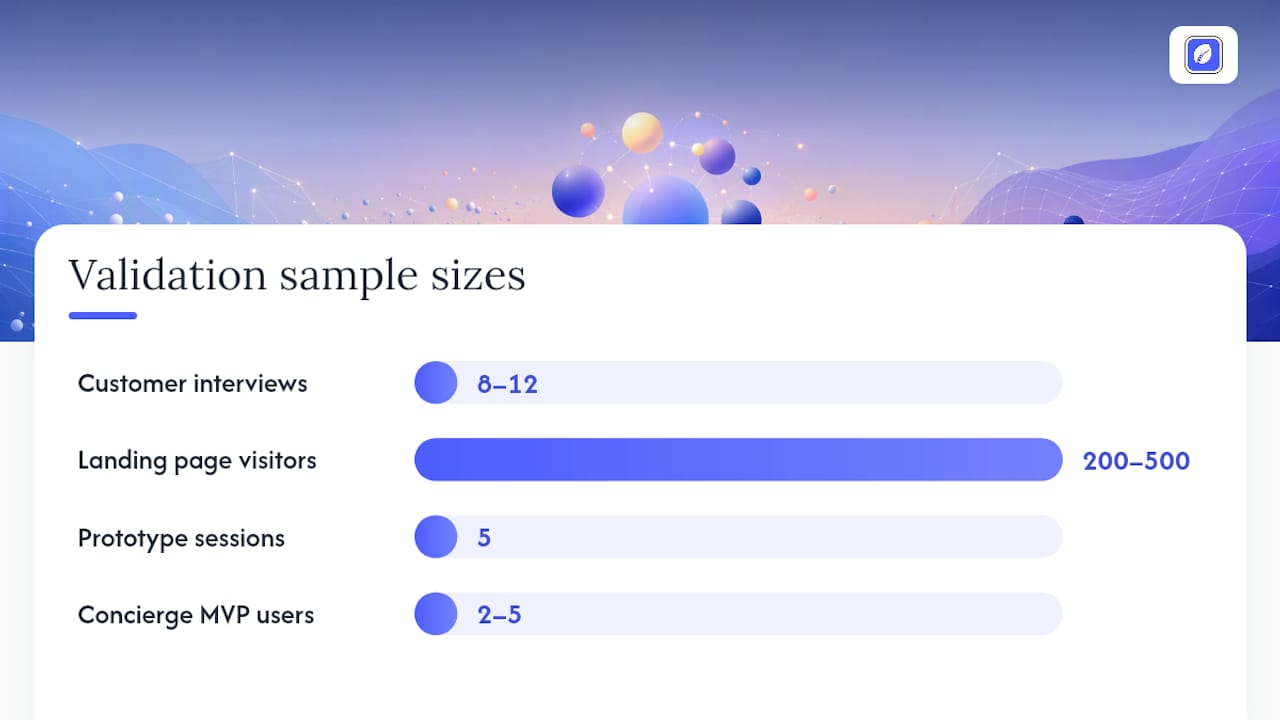
Customer interview starter questions (run 8–12 interviews for a meaningful pattern):
- "Walk me through the last time you dealt with [problem]. What happened?"
- "What do you do today to handle this? How well does that work?"
- "How often does this come up? What does it cost you when it does?"
- "Have you looked for a better solution? What stopped you from buying it?"
- "If a tool solved this perfectly, what would you pay for it per month?"
A pattern is meaningful when at least 70% of interviewees describe the same pain unprompted, rank it in their top three problems, and have tried at least one workaround. Fewer than that and the problem may be real but not urgent enough to drive purchase.
For a deeper interview framework, the customer discovery interview playbook covers question structure, sample sizes, and how to avoid leading your respondents.
Quick experiments to test demand:
- Landing page with CTA — describe the solution, add a sign-up or waitlist button, drive 200–500 targeted visitors via paid ads or community posts, and measure conversion rate. A 5–10% sign-up rate on cold traffic is a positive signal for a B2B SaaS concept.
- Smoke test / pre-sale — offer the product before it exists and measure how many people attempt to buy or provide payment details.
- Concierge MVP — manually deliver the outcome your product would automate for two to five users. This validates willingness to pay and surfaces edge cases before you write a line of code.
- Pricing microtest — present two or three price points to different audience segments and measure drop-off. Tools like Wynter or a simple Typeform survey work for this.
- Prototype usability session — show a Figma mockup to five users and watch where they get confused. Five sessions surface roughly 85% of major usability issues.
Minimum evidence to proceed: at least eight interviews confirming the problem, one experiment showing measurable demand signal, and no single assumption that you cannot test within two weeks. If you cannot recruit users for validation, that itself is a red flag — it usually means the ICP is too vague or the problem is not painful enough to motivate participation.
What does a realistic assessment cost in time and money?
Feasibility and cost estimates depend heavily on team composition and hourly rates, but the ranges below give decision-makers a working baseline. Sequence feasibility checks user-first: confirm the problem and demand before spending time on technical architecture. Teams that reverse this order often build technically sound solutions to problems nobody has.
Feasibility checklist before committing to build:
- Technical dependencies identified (APIs, data sources, third-party integrations)
- Data privacy and compliance requirements noted (HIPAA, CCPA, SOC 2 as applicable for U.S. markets)
- Regulatory or licensing requirements flagged for the target industry
- Go-to-market channel confirmed (you know how you will reach your ICP)
- Team has the skills to execute, or a clear plan to acquire them
Timeline and effort bands:
- Quick filter (1–2 weeks): RICE or Olsen scoring, a competitive scan, and three to five interviews. Suitable for roadmap triage. Effort: roughly 8–16 person-hours.
- Standard assessment (3–6 weeks): Full seven-step process, 8–12 interviews, one demand experiment, POEM or canvas. Effort: 40–80 person-hours. At a blended U.S. contractor rate of $100–$150/hour, that puts the cost at roughly $4,000–$12,000 in labor.
- Deep feasibility plus prototype (6–12 weeks): Adds technical architecture review, a working prototype, and a financial model. Effort: 150–300+ person-hours. Cost varies widely by team composition.
These are illustrative ranges. A solo founder doing the work personally has near-zero cash cost but significant opportunity cost. A funded startup hiring a fractional PM and a UX researcher will land closer to the dollar figures above.
Pro Tip: Run the user validation first, then the technical feasibility check. If you cannot confirm demand in week one, stop before spending money on architecture.
How do you make a defensible go/no-go decision?
A scored assessment without a clear decision rule is just a document. Before you present findings to stakeholders, define the thresholds that map scores to actions.
Step 1: Set your decision bands
Using a 1–10 composite score across your assessment criteria (market size, demand evidence, competitive position, feasibility, strategic fit):
- 8–10: Proceed to sprint or prototype. Strong signal across most dimensions.
- 5–7: Run a limited experiment (landing page, concierge MVP, or a two-week spike) before committing further resources.
- Below 5: No-go. Document the reasoning and revisit only if a key assumption changes.
Step 2: Write the one-page recommendation memo
The memo has four sections:
- Key evidence — three to five bullet points summarizing what you learned (market size estimate, interview findings, experiment results)
- Scorecard snapshot — the composite score and the two or three criteria that drove it up or down
- Recommended next step — one specific action (proceed to sprint, run experiment X, or stop)
- Resource ask — what you need to execute the next step (people, time, budget)
Step 3: Align stakeholders
Brief the decision-maker and any affected team leads before the formal review. Surprises in a go/no-go meeting usually mean the assessment was not socialized early enough. A simple stakeholder checklist:
- Identify who has veto power and who is advisory
- Share the draft memo 48 hours before the review meeting
- Agree in advance on what evidence would change the recommendation
- Set a decision cadence: if no decision is made in the meeting, name a date by which one will be
Rule-based reasoning research shows that individuals apply different judgment rules to the same opportunity and reach different conclusions — which is exactly why explicit thresholds and shared criteria matter more than intuition in a group setting.
What biases and red flags can invalidate your assessment?
Harvard Business School's teaching note on opportunity assessment formalizes the use of structured evaluation to counter the cognitive shortcuts that lead executives to back bad ideas. The biases below are the ones that show up most reliably in product and startup contexts.
Cognitive biases and one-line mitigations:
- Solution bias — you start with a feature and work backward to a problem. Mitigation: write the problem statement before you name any solution.
- Confirmation bias — you interview users who already like your idea. Mitigation: actively recruit skeptics and users of competing solutions.
- Sunk cost bias — you continue an assessment because you have already spent two weeks on it. Mitigation: set a kill criterion before you start ("if we cannot recruit 8 interviewees in 5 days, we stop").
- Market size inflation — you use a top-down TAM figure to make a small market look large. Mitigation: build a bottom-up model from your ICP count and realistic conversion rates.
Red flags that should trigger a reassessment or stop:
- You cannot recruit users from your ICP for validation interviews (the market may be too small or the ICP too vague)
- The competitive scan reveals a well-funded incumbent with high user satisfaction scores
- The problem statement keeps changing between conversations (the pain is not well-defined)
- Feasibility depends on a single third-party API or data source with no alternative
- The financial model only works at a market penetration rate above 10% in year one
If two or more red flags appear, run a limited re-assessment: reframe the ICP, rewrite the problem statement, and run five new interviews before proceeding. A re-assessment takes one to two weeks and costs far less than a failed sprint.
What templates and deliverables should you produce?
A completed assessment should leave a paper trail that any team member can pick up and act on. Here are the core deliverables and their practical formats.
Template list:
- Opportunity canvas — a one-page visual covering problem, ICP, market size, competitors, key assumptions, and recommended next step. Use Miro, FigJam, or a Notion page.
- One-page scorecard — a table with criteria, evidence, score, weight, weighted score, and notes. Export as PDF for stakeholder review.
- Assumption/test table — the table from Step 5 above, maintained as a living document throughout the assessment.
- Recommendation memo — the four-section document from the go/no-go section above.
- Timeline/effort spreadsheet — columns: task, owner, start date, end date, estimated hours, status.
Example scorecard row:
Export and file formats:
- Spreadsheet (Google Sheets or Excel) for the scorecard and assumption table — easy to share and version
- Notion or Confluence page for the canvas and memo — keeps everything linked and searchable
- PDF export of the scorecard and memo for stakeholder presentations and investor decks
For a broader view of how AI-assisted tools fit into this workflow, the best startup tools for founders roundup covers practical toolchains for assessment, roadmapping, and export.
How Klaritea speeds up a phase-0 assessment
Klaritea is built specifically for the phase-0 stage — the work that happens before you write a single line of code or commit a sprint. You type a one-line idea and the platform builds a connected model covering ICP, TAM/SAM/SOM, competitive analysis, features, requirements, and a build spec.
The features most relevant to an opportunity assessment workflow:
- Clarity scorecard — a scored view of your idea across market, problem, and feasibility dimensions, generated from your one-line input
- AI advisory board — three AI advisors (Maya for marketing, Devon for business strategy, Priya for ops and QA) research, challenge, and fact-check your assumptions
- Lenses — Clarity, Build, and Run & Scale views let you switch between assessment mode and execution planning without rebuilding your model
- Exports — Notion and Confluence export (Pro tier) and GitHub sync (paid) so your assessment outputs live where your team already works
A typical Klaritea phase-0 workflow: one-line idea input → AI-generated clarity scorecard → assumption list with risk ratings → go/no-go report with a prioritized next step. The output is a scored canvas, a prioritized test list, and a recommended next step — the same three deliverables described at the top of this guide, produced in a fraction of the time a manual process takes.
For a deeper look at AI-assisted validation workflows, the AI idea validator guide walks through how clarity scoring and quick experiments work together.
A practitioner's perspective on running assessments well
The biggest mistake I see teams make is treating the assessment as a gate rather than a thinking tool. They fill out the template, hit "submit," and wait for someone to approve the next step. That is not what the process is for. The value is in the conversations the template forces — with users, with skeptics on the team, with the data.
A few heuristics that hold up in practice:
- Filter fast, then deep-dive the top three. Run a 30-minute RICE or Olsen score on every candidate before you commit to a full canvas on any of them. You will cut your list by half before you spend a single hour on interviews.
- Recruit your harshest critic as a stakeholder early. The person most likely to kill your idea in the review meeting should see a draft of the assessment before it is finished. Their objections are free consulting.
- Set a kill criterion before you start. Decide in advance what evidence would make you stop. Without a pre-committed threshold, sunk cost bias will keep you going long past the point where the data says stop.
- Keep the problem statement on the wall. Literally. Print it and put it somewhere the team sees it every day during the assessment. Feature creep starts when the problem statement drifts.
- Timebox the whole thing. A standard assessment should not take more than four weeks. If it does, you are either over-engineering the analysis or avoiding a conclusion you already know.
Pro Tip: Pair a PM with a designer or researcher for the interview phase. PMs tend to ask "would you use this?" Researchers ask "what do you do today?" The second question produces far more useful data.
The sequencing matters more than the framework you choose. Start with the user problem, confirm demand with real people, then check feasibility. Teams that reverse this order — starting with what they can build and then looking for a market — consistently produce weaker assessments and worse outcomes.
Klaritea gives you a phase-0 workflow without the setup overhead
Most founders skip the assessment entirely because building the templates, running the scoring, and synthesizing the outputs takes more time than they have. Klaritea solves that directly: type your idea in one line and get a structured clarity scorecard, a competitive snapshot, and a prioritized assumption list in minutes, not days.
The AI advisory board challenges your assumptions the way a good co-founder would, and the Lenses feature lets you move from assessment mode to build planning without switching tools. Exports to Notion and Confluence mean your assessment outputs land in the same workspace your team already uses for sprint planning and documentation.
For founders who want to understand why the connected model approach works before signing up, the Klaritea "Why" page walks through the platform's logic in detail. If you are ready to run your first phase-0 assessment, start with a free account and have a scored canvas in front of you within the hour.
Sources
- Assessing Product Opportunities
- Product Opportunity Assessment: Expert Tips & Tricks
- A Framework For Evaluating Market Opportunity
- A practical guide to opportunity assessment methods
- Opportunity Assessment (TN) - Faculty & Research - Harvard Business School
- Rule-Based Reasoning for Understanding Opportunity Evaluation
- Pmc
- How to assess and prioritise product opportunities
FAQ
What is an opportunity assessment?
An opportunity assessment is a structured pre-investment evaluation that determines whether a market or product idea is worth pursuing. It produces a problem statement, a scored canvas, and a go/no-go recommendation before any sprint or budget is committed.
What questions should you ask when carrying out an opportunity assessment?
The core questions follow Marty Cagan's SVPG framework: What problem does this solve? Who is the target user? How large is the market? Who are the competitors? What is the differentiator? Is the timing right? How will you reach the market? How will you measure success? What are the critical requirements? And finally: proceed, experiment, or stop?
What are the five stages of opportunity recognition?
Opportunity recognition generally follows five stages: identifying a problem or gap, gathering market and user evidence, evaluating desirability and feasibility, testing the riskiest assumptions, and making a go/no-go decision. The structured assessment process in this guide maps directly to those stages.
How long does a standard opportunity assessment take?
A quick filter takes one to two weeks and roughly 8–16 person-hours. A standard assessment covering interviews, a demand experiment, and a full canvas runs three to six weeks and 40–80 person-hours. Deep feasibility work with a prototype adds another six to twelve weeks on top of that.
How does Klaritea support an opportunity assessment?
Klaritea automates the phase-0 setup: a one-line idea input generates a clarity scorecard, ICP definition, TAM/SAM/SOM estimate, competitive snapshot, and assumption list. The AI advisory board challenges assumptions, and exports to Notion and Confluence keep outputs in your team's existing workflow.