TL;DR:
- A one-page, AI-validated business plan plus validation experiments help testers de-risk their first $3,000 to $15,000 investment. Conducting quick demand validation and targeting a 55-65% gross margin are crucial for profitable paid advertising. Klaritea streamlines planning and testing, improving decision-making before inventory commitment.
A one-page, AI-validated online boutique business plan plus two or three validation experiments is enough to test real demand and de-risk the first $3,000–$15,000 of execution. You'll leave this article with a filled one-page plan, two quick validation experiments, and a 90-day to-do list that prioritizes channels matching your margins and product fit. Klaritea, Shopify, Google Ads, and Klaviyo each appear at the right stage. One benchmark worth anchoring to now: most Shopify stores convert 1–3% of visitors — use this range for your initial projections.
Table of Contents
- What goes into a one-page online boutique business plan?
- How do you validate demand before spending big?
- How do you size your market and pick a positioning angle?
- What should you sell, and how do you source it with low risk?
- How do you pick 2–3 channels and build a lean launch funnel?
- What tech stack and operations do you need at launch?
- What financials and KPIs should you track in year one?
- How does AI phase-0 planning cut your execution risk?
- What does your 90-day execution timeline look like?
- What risks should you plan for before you launch?
- How do you build strong supplier relationships from the start?
- Key Takeaways
- Why most boutique plans fail before the first order ships
- Klaritea turns your boutique idea into an execution-ready plan
- Useful sources for founders building their boutique plan
- FAQ
What goes into a one-page online boutique business plan?
A solid ecommerce strategy ties product decisions, customer strategy, and operations into one roadmap. Here is a compact template you can fill in today.
One-Page Template Fields:
- Company snapshot: Name, legal structure (LLC recommended), and one-sentence concept
- ICP (ideal customer profile): Age range, income band, shopping behavior, and top pain point
- Value proposition: What you sell, why it's different, and who it's for
- Core products: 3–5 SKUs to launch, sourcing model, and target price points
- Pricing and margins: Retail price, COGS, gross margin target (aim for a healthy gross margin)
- Primary channels: Pick 2–3 (e.g., paid social + Klaviyo email)
- Key ops: Storefront (Shopify), payments (Stripe), fulfillment model
- Startup costs: Platform fees, first inventory buy, ad test budget, legal/registration
- 90-day goals: Revenue target, first 50 customers, CAC ceiling by channel (limit to keep profitable)
Filled example (sustainable women's tops):
- Company: "Verdana Studio" — LLC, DTC sustainable tops for women 28–42
- ICP: Eco-conscious professional, $65K+ income, shops Instagram and Google
- Value prop: Certified-organic basics at accessible price points ($45–$85)
- Core products: 4 SKUs — two tees, one tank, one long-sleeve; small-batch supplier
- Pricing: $55 retail, $18 COGS, 67% gross margin
- Channels: Google Ads (intent capture) + Klaviyo flows (retention)
- Ops: Shopify + Stripe + self-fulfill first 90 days
- Startup costs: $4,200 (inventory $2,500, ads $800, Shopify/Stripe $200, legal $700)
- 90-day goal: 50 orders, CAC under a reasonable limit, email list of 300
Pro Tip: Register your business and get an EIN before you accept a single payment. Sales tax obligations vary by state — check the SBA's nexus guidelines or use Shopify's built-in tax settings as a starting point.

How do you validate demand before spending big?
Run cheap experiments first. The sequence below costs $100–$1,000 and takes 1–3 weeks per test.
- Landing page with preorder or waitlist — Build a single Shopify page, drive 200–500 visitors via a $100–$200 Google Ads test, and measure sign-up rate. A 15%+ sign-up rate is a green light.
- Paid social creative test — Spend $150–$300 on Instagram or TikTok with 2–3 ad creatives. Target CTR above 1.5%; below 0.8% means the creative or offer needs work.
- Micro-influencer seeding — Send 3–5 products to nano-influencers (5K–30K followers) in your niche. Track referral traffic and saves, not just likes.
- Gated preorder with limited run — Offer 20 units at a 10% discount for early buyers. A 5%+ conversion from landing page visitors signals real purchase intent.
Validation checklist before you launch any experiment:
- Meta Pixel and Google Tag installed and firing
- Payment capture or pledge flow live (Stripe Checkout works)
- Inventory hold policy documented (how many units you'll commit if preorders hit target)
- UTM parameters on every ad link
A 1–3% store conversion rate is the baseline. If your landing page test converts below 1%, fix the offer or the audience before scaling spend.
How do you size your market and pick a positioning angle?
TAM is the total addressable market, SAM is the slice you can realistically reach, and SOM is what you can capture in year one. Three steps:
- Start from a public data point (U.S. women's apparel spend)
- Apply category and niche share assumptions
- Convert to unit and revenue targets
| Step | Assumption | Output |
|---|---|---|
| U.S. women's apparel market | ~$120B total annual spend | TAM baseline |
| Sustainable/eco segment share | ~8% of category | SAM ~$9.6B |
| DTC small-brand reachable share | 0.005% of SAM | SOM ~$480K |
| At $60 AOV | 8,000 orders/year | ~667 orders/month at scale |
Positioning checklist:
- ICP defined (demographics + behavioral triggers)
- One key differentiator stated (material, price tier, aesthetic, values)
- Positioning statement: "For [ICP], [brand] is the [category] that [differentiator] because [proof]."
What should you sell, and how do you source it with low risk?
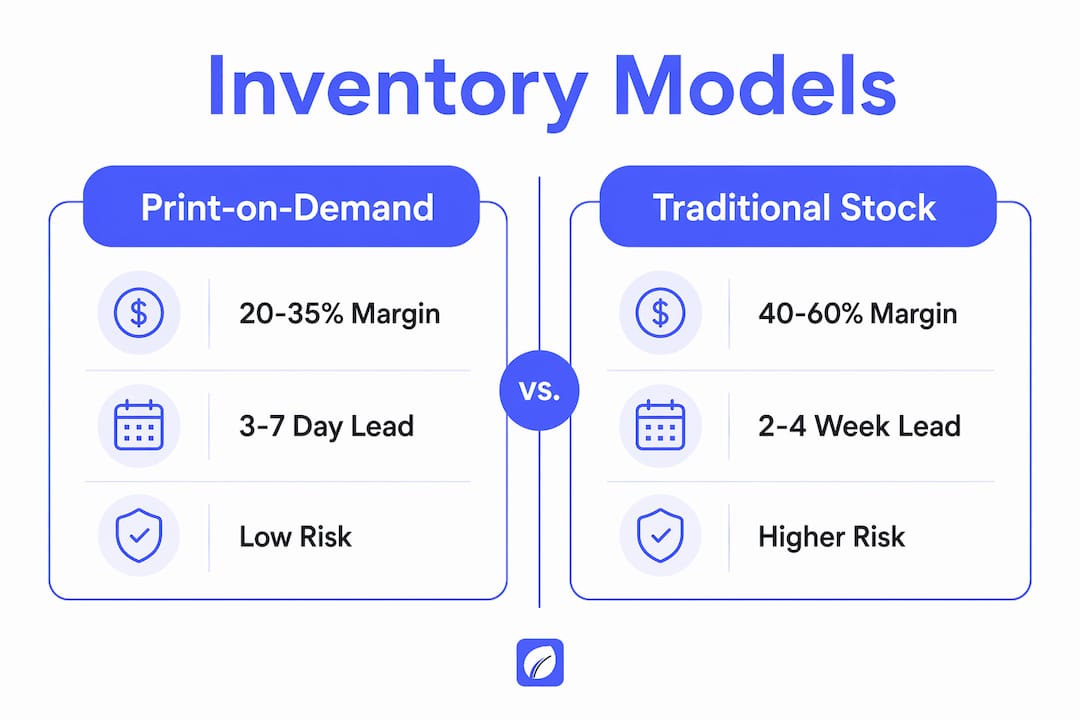
Inventory model choice drives your cash runway more than almost any other early decision.
| Model | Gross Margin | Lead Time | Brand Control | Best For |
|---|---|---|---|---|
| Print-on-demand | 20–35% | 3–7 days | Low | Testing designs, zero inventory risk |
| Dropship | 15–30% | 5–14 days | Low | Fastest launch, hardest to differentiate |
| Small-batch private label | 55–70% | 6–12 weeks | High | Validated demand, brand building |
| Curated multi-brand | 40–55% | 2–4 weeks | Medium | Curation story, lower MOQ risk |
Target gross margin of 55–65% if you plan to run paid acquisition. Below 40%, paid channels rarely pencil out.
Sourcing checklist for first orders:
- Always request a sample before committing to an MOQ
- Negotiate payment terms (50% deposit, 50% on delivery is standard for new relationships)
- Document lead times in writing and build a two-week buffer into your launch date
- Quality-check samples against your spec sheet before approving production
Pro Tip: Start with small brands that should validate DTC first before adding wholesale. Shopify handles payments, hosting, and integrations — keep your first channel simple.
The fastest way to kill cash flow is ordering 500 units of an untested SKU. Start with 30–50 units, sell through, then reorder with confidence.
How do you pick 2–3 channels and build a lean launch funnel?
Boutique ecommerce strategies that work in 2026 focus on 2–3 high-impact channels rather than spreading thin. Here is how to choose:
- High visual differentiation + low AOV ($30–$60): Paid social (Instagram/TikTok) first, Klaviyo retention second
- Higher AOV ($70+) + search-ready category: Google Ads first, email second
- Strong community angle: Organic content + micro-influencer seeding, then email
Sample launch funnel (days 1–90):
- Awareness creative (paid social or Google Ads) drives cold traffic to landing page
- Landing page captures email or preorder (Klaviyo welcome flow triggers immediately)
- Conversion flow: product page → cart → Stripe checkout
- Post-purchase: Klaviyo shipping confirmation + review request + cross-sell at day 14
- Winback flow at day 60 for non-repurchasers
Email and SMS via Klaviyo consistently deliver the highest return on ad spend for stores with an existing customer base. Set up your welcome and post-purchase flows before you spend a dollar on acquisition.
Pro Tip: Keep your 30-day ad budget under $500 until you have a proven creative. Spend $150 testing three ad variations, pick the winner, then scale.
What tech stack and operations do you need at launch?
The minimum viable stack for a boutique launch:
- Storefront: Shopify (handles hosting, checkout, and integrations)
- Payments: Stripe (or Shopify Payments, which runs on Stripe infrastructure)
- Email/SMS: Klaviyo (welcome flow, post-purchase, winback)
- Analytics: Google Analytics 4 + Shopify's native dashboard
- Returns: Loop Returns or a simple email-based policy for the first 90 days
Fulfillment decision checklist:
- Under 20 orders/day: self-fulfill from home or small storage unit
- 20–100 orders/day: evaluate a 3PL (ShipBob, Whiplash)
- Dropship: only if margins allow and you've tested supplier reliability
For customer service, a simple Gorgias or Freshdesk setup with three email templates (order confirmation, shipping update, return request) handles 80% of tickets. AI-powered self-service scales support without proportional headcount growth.
Register your business as an LLC, obtain an EIN from the IRS, and configure Shopify's tax settings to collect sales tax in states where you have nexus.
What financials and KPIs should you track in year one?
Unit economics targets for early-stage boutiques:
- AOV: moderate price range
- Gross margin: 55–65%
- CAC (paid): keep under a portion of AOV for profitability
- LTV/CAC ratio: 3:1 or better by month 6
- Repeat purchase rate: 20%+ by month 12
Worked example at $60 AOV, 1–3% conversion:
| Monthly Traffic | Conversion Rate | Orders | Revenue | Gross Profit (60%) |
|---|---|---|---|---|
| 2,000 | 1% | 20 | $1,200 | $720 |
| 2,000 | 2% | 40 | $2,400 | $1,440 |
| 5,000 | 2% | 100 | $6,000 | $3,600 |
Pro Tip: Track CAC by channel weekly, not monthly. A Google Ads campaign that looks fine at 30 days can be quietly burning cash on the wrong keywords.
How does AI phase-0 planning cut your execution risk?
Before you build anything, an AI planner should produce:
- ICP profile with behavioral triggers
- TAM/SAM/SOM sketch with stated assumptions
- Prioritized channel recommendations based on product and margin
- Validation experiments with pass/fail criteria
- Build spec (what to build, in what order)
- Clarity scorecard showing confidence level per assumption
Klaritea's three AI advisors — Maya (marketing), Devon (business), and Priya (ops and QA) — stress-test your assumptions and generate practical checklists. Devon challenges your revenue model; Maya flags whether your channel mix matches your product's visual appeal; Priya catches operational gaps before they become expensive.
Outputs export to Notion or Confluence (Pro tier), and the build spec syncs to GitHub. That means your plan is not a PDF that collects dust — it's a live document your contractor or developer can act on immediately.
The clarity scorecard is the most underused output. A low score on "customer willingness to pay" is a signal to run a preorder test before ordering inventory — not after.
Pro Tip: Accept AI outputs as a starting framework, then validate the three most critical assumptions with five real customer interviews. Twenty minutes of conversation beats twenty pages of AI-generated research.
What does your 90-day execution timeline look like?
Weeks 1–2: Validate
- Fill the one-page plan (use Klaritea or the template above)
- Build a landing page and run a $150–$200 ad test
- Collect 50+ email sign-ups or 5+ preorders as your go/no-go gate
Weeks 3–4: Build minimum storefront
- Shopify store live with 3–5 SKUs
- Stripe/Shopify Payments configured
- Klaviyo welcome flow active
Weeks 5–8: Launch test campaign
- Run Google Ads or paid social at $300–$500/month
- Track CAC by channel weekly
- Go/no-go: CAC under 30% of AOV by week 8
Weeks 9–12: Fulfill and iterate
- Fulfill first orders, document fulfillment time and return rate
- Activate post-purchase Klaviyo flow
- Milestone: 50 orders, 20% repeat rate target set, top SKU identified for reorder
Go/no-go criteria: If you hit fewer than 15 preorders or a CAC above 40% of AOV by week 8, pause paid spend and revisit your ICP or offer before scaling.
What risks should you plan for before you launch?
Every online boutique faces four categories of risk. Plan a contingency for each before day one.
Demand risk: Customers don't buy at your target price. Contingency: run a preorder test at full price before committing inventory. If conversion is below 1%, test a lower price point or a different SKU.
Inventory risk: Supplier delays or quality failures. Contingency: hold a two-week buffer stock for your top SKU, and qualify a backup supplier before your first production run.
Channel risk: Your primary acquisition channel stops working (algorithm change, CPM spike). Contingency: build your email list from day one so you own a channel that doesn't depend on a platform.
Cash flow risk: Slower-than-expected sales drain runway. Contingency: set a monthly burn ceiling and a hard pause trigger. If monthly burn exceeds gross profit by more than 2x for two consecutive months, pause paid acquisition and shift to organic.
Document these contingencies in your one-page plan. A risk you've named is a risk you can act on.
How do you build strong supplier relationships from the start?
Your supplier is a business partner, not a vending machine. The founders who get priority production slots and better payment terms treat it that way.
Pay on time, every time. Suppliers remember late payers and deprioritize them during busy seasons. Even a small order paid promptly builds more goodwill than a large order paid late.
Communicate clearly and early. If your launch date shifts, tell your supplier two weeks before the delivery date, not two days after. That buffer lets them reallocate production capacity without penalizing you.
Negotiate on terms, not just price. For a first order, ask for a 50/50 payment split (50% deposit, 50% on delivery) rather than 100% upfront. Most small-batch suppliers will agree if you've ordered a sample and demonstrated you're serious.
Visit or video-call before committing to a large MOQ. A 15-minute call reveals more about reliability than 10 email exchanges. Ask about their current lead times, their busiest months, and what happens if a shipment has quality issues.
Explore automation tools for purchase orders and supplier communication early. Even a simple Airtable tracker for MOQs, lead times, and reorder points saves hours as your SKU count grows.
Key Takeaways
A one-page, AI-validated online boutique business plan with two validation experiments and a 90-day timeline is the fastest path from idea to first paying customer.
| Point | Details |
|---|---|
| Fill the one-page plan first | Cover ICP, margins, channels, startup costs, and 90-day goals before spending anything. |
| Run two validation experiments | A landing page preorder test and a $150–$300 paid social test reveal real demand for under $500. |
| Target 55–65% gross margin | Below 40% gross margin, paid acquisition channels rarely generate positive returns. |
| Set up Shopify + Stripe + Klaviyo | These three tools cover storefront, payments, and retention before you need anything else. |
| Use Klaritea for phase-0 clarity | Klaritea's AI advisors, clarity scorecard, and exportable build spec cut time-to-decision before you commit inventory or ad budget. |
Why most boutique plans fail before the first order ships
The conventional wisdom says you need a detailed 20-page business plan before launching. That's backwards. A 20-page document takes weeks to write, is obsolete by the time you finish it, and answers questions investors ask — not questions the market asks.
What actually matters in the first 90 days is a one-page plan you'll look at every week, two validation experiments you'll run in the first two weeks, and a clear go/no-go criterion that forces a decision before you've spent real money. The founders who skip validation and go straight to inventory are the ones who end up with 300 units of a product nobody wanted at the price they charged.
The other thing most guides understate: channel risk is real and it compounds. Building your email list from day one is not a nice retention tactic — it's insurance against the day your paid channel stops working. Klaviyo flows that generate revenue while you sleep are worth more than a perfectly optimized ad account you don't own.
AI planning tools like Klaritea don't replace judgment. They compress the time it takes to get from a fuzzy idea to a structured set of assumptions you can actually test. The clarity scorecard is the most honest output: a low confidence score on "willingness to pay" is the system telling you to run a preorder test before you order inventory. That's the kind of friction that saves $10,000.
Klaritea turns your boutique idea into an execution-ready plan
Most founders spend weeks on a business plan that never gets used. Klaritea compresses that to hours. Type your boutique idea in one line and Klaritea builds a connected model covering your ICP, TAM/SAM/SOM, prioritized channels, validation experiments, and a build spec your developer can act on immediately.
The three AI advisors — Maya, Devon, and Priya — challenge your assumptions on marketing, business model, and operations before you spend a dollar. The clarity scorecard shows exactly where your plan is solid and where it needs a real-world test. Free tier gets you the core model and scorecard. Pro adds Notion/Confluence exports, GitHub sync, and full build spec output.
See why Klaritea works for founders who want structure before execution, or start your free plan and have a one-page boutique plan ready today.
Useful sources for founders building their boutique plan
Start with the one-page plan template, then work through market sizing, then validation experiments. These resources support each stage:
For the one-page plan and business structure:
- Shopify's clothing line business plan guide — nine-section framework aligned with SBA standards; free template included
- StartYourBoutique one-page template — boutique-specific fields covering logistics, marketing, and metrics on one sheet
For ecommerce strategy and channel planning:
- FirstPier ecommerce strategy framework — step-by-step channel selection and KPI structure
- Gorgias ecommerce strategy guide — three-pillar framework (product, customer, operations) with KPI examples
For AI-assisted planning tools:
- Klaritea's AI business plan generator alternatives — what to expect from AI-generated plans and how to evaluate outputs
- Best startup tools for founders — practical tool picks covering the full launch stack
- How to create an online boutique — step-by-step setup guide for founders past the planning stage
FAQ
What should a one-page online boutique business plan include?
Cover your ICP, value proposition, core products, pricing and gross margin targets, 2–3 primary channels, key ops (Shopify, Stripe, Klaviyo), startup costs, and 90-day revenue goals. One page forces prioritization — if it doesn't fit, cut it.
How much does it cost to start an online boutique?
A lean launch typically runs $3,000–$15,000, covering first inventory, platform fees, a small ad test budget, and legal registration. The exact figure depends on your inventory model — print-on-demand starts lower; small-batch private label runs higher.
What gross margin do you need to run paid ads profitably?
Target 55–65% gross margin. Below 40%, the math rarely works once you factor in CAC, returns, and platform fees. Paid channels like Google Ads require enough margin to absorb a reasonable CAC portion of AOV and still generate profit.
How does Klaritea help with an online boutique business plan?
Klaritea takes a one-line idea and builds a connected model covering ICP, TAM/SAM/SOM, channel priorities, validation experiments, and a build spec. The clarity scorecard flags weak assumptions before you commit inventory or ad budget.
What conversion rate should you expect on a new Shopify boutique?
Most Shopify stores convert 1–3% of visitors at baseline. Stores that invest in conversion optimization can reach 4–6%. Use the 1–3% range for your traffic and revenue projections until you have real data.