A one page business plan is a single-page summary of your strategy, priorities, and financial assumptions — specific enough to guide decisions, short enough to share in a meeting. LivePlan describes it as the fastest path to a testable, reviewable strategy, and that framing is exactly right. Think of it less as a document and more as a business GPS: it tells you where you're going, what the next turn is, and when you've gone off course.
Here's a mini-template you can copy right now and start filling:
- Mission/One-liner: We help [target customer] do [outcome] without [pain point].
- Problem: [One sentence on the core problem you solve.]
- Solution/Value proposition: [One sentence on what you offer and why it's different.]
- Target customer: [Specific segment, not "everyone."]
- Revenue model: [How you charge: subscription, one-time, marketplace fee, etc.]
- 90-day milestones: [Three concrete, dated actions.]
- Financial snapshot: [Top-line forecast for 12 months + funding ask, if any.]
- Key KPIs: [Two or three measurable indicators you'll track weekly.]
Pro Tip: Treat this document like a living plan, not a filing cabinet artifact. The best founders revisit it monthly, update assumptions after experiments, and use it as the single reference point for what the team is actually building toward.
Key Takeaways
A one-page business plan is most effective when treated as a living strategy document, updated monthly and used as the team's primary reference for priorities and accountability.
| Point | Details |
|---|---|
| Start with the mini-template | Copy the eight-field template and fill it in under 90 minutes using the timeboxed workflow. |
| Keep every field to 1–2 sentences | Visme's guidance confirms brevity forces clarity — if a field takes a paragraph, the decision isn't made yet. |
| Validate assumptions before sharing | Flag every estimated number explicitly; peer review with a mentor or potential customer before sending to investors. |
| Know when to go longer | Use the one-pager for validation and pitches; switch to a full plan for bank loans, late-stage due diligence, or complex multi-revenue models. |
| Klaritea automates the structure | Type a one-line idea and Klaritea generates a connected plan with market sizing, KPIs, and a printable report ready to share. |
Table of Contents
- Where can you download a ready-made one-page business plan template?
- What fields does every one-page business plan need?
- How do you fill a one-page plan in 30 to 90 minutes?
- What does a filled one-page plan actually look like?
- When should you use a one-page plan versus a full business plan?
- Is your one-page plan actually done? Run this checklist first
- What mistakes do founders make on a one-page plan?
- How do you present a one-page plan to investors, lenders, or partners?
- How Klaritea turns a one-line idea into a structured plan
- Where to get a fillable one-page template right now
- How to tailor your one-page plan for different audiences
- How to keep your one-page plan current over time
- What condensing a complex plan into one page actually costs you
- Why the one-page plan is the most underused management tool in early-stage startups
- Klaritea builds your one-page plan from a single sentence
- Sources
- FAQ
Where can you download a ready-made one-page business plan template?
Getting a fillable template in the right format saves you from staring at a blank page. The sources below are reliable, free, and cover the main file formats founders actually use.
HubSpot's free one-page template covers eight guided sections and downloads in both Word and PDF. The Word version is a good starting point if you're collaborating with a co-founder or advisor, as it supports comments and tracked changes. The PDF is cleaner for sending to an investor cold, maintaining layout integrity.
LegalTemplates offers a guided form that walks you through each field before generating a downloadable PDF or Word file. It's particularly useful if you want guardrails on what to include rather than a blank canvas.
Smartsheet's printable PDF template maps identity, milestones, KPIs, and a compact situational analysis on one page. It's structured for small businesses and works well for internal team alignment rather than investor pitches.
For visually polished output, Visme offers design-forward templates suited to presentations and printable investor-facing one-pagers.
| Format | Best for | Editing | Sharing/printing |
|---|---|---|---|
| Word (.docx) | Collaboration, co-founder edits | Full | Export to PDF when ready |
| Google Doc | Remote teams, real-time edits | Full | Share link or export |
| Investor sends, printing | None (fill before export) | Clean, layout-locked | |
| Web template (HubSpot/LegalTemplates) | Guided fill-in, first draft | In-browser | Download on completion |
If your next step is exporting to Notion, Confluence, or GitHub, start in a Google Doc or Word file so the text is portable. Lock it to PDF only when the plan is final.
What fields does every one-page business plan need?
Visme recommends keeping each section to one or two sentences or a few bullets so everything fits on one page without shrinking the font to unreadable. That constraint is the point: if a field takes a paragraph, you haven't decided what matters yet.
| Field | What to write | Example |
|---|---|---|
| Mission/one-liner | One sentence: who you serve and what outcome you deliver | "We help independent coffee shops fill slow afternoons with local regulars." |
| Problem | The specific friction your customer feels today | "Most cafes lose 30% of afternoon revenue to empty seats between 2–4 PM." |
| Solution/value proposition | What you offer and the key differentiator | "A loyalty app that turns slow hours into targeted flash deals for nearby regulars." |
| Target customer | Segment with a real descriptor, not a demographic blob | "Independent cafes with 1–3 locations in mid-size US cities." |
| Revenue model | How money flows in | "SaaS: $79/month per location, billed annually." |
| 90-day milestones | Three dated, concrete actions | "Pilot with 5 cafes by March 31; 50 active users by April 30; first renewal by May 15." |
| Financial snapshot | 12-month top-line forecast + funding ask | "Projected $48K ARR by month 12; seeking $75K pre-seed." |
| Key KPIs | Two or three weekly-trackable metrics | "Weekly active locations, churn rate, avg redemptions per location per week." |
Pro Tip: Write the KPIs before you write the milestones. If you can't measure a milestone, it's a wish, not a plan. Investor-facing versions should weight traction and unit economics; internal versions should weight execution tasks and owners.
How do you fill a one-page plan in 30 to 90 minutes?
A fill-first-then-refine approach consistently produces more honest prioritization than trying to perfect each field before moving on. Here's a timeboxed workflow:
- 0–10 min: Prep. Open your template. Write your one-liner mission at the top without editing it. Get it down, even if it's rough.
- 10–30 min: Fill core fields. Complete problem, solution, target customer, and revenue model in sequence. One or two sentences each, no more.
- 30–45 min: Set 90-day milestones. Pick three actions with real dates. If you can't name a date, the milestone isn't real yet. Assign an owner to each one.
- 45–60 min: Financial snapshot and KPIs. Estimate 12-month revenue by multiplying your expected customer count by your price. Write the number down even if it feels rough. Then name two or three metrics you'll check every week.
- 60–75 min: Edit for clarity. Read the whole plan aloud. Cut anything that takes more than two sentences. Replace vague words ("grow," "scale," "improve") with specific ones ("add 10 paying customers," "reduce churn below 5%").
- 75–90 min: Peer review. Send it to one person who will give you a straight answer — a mentor, a potential customer, or a co-founder. Ask them: "What's unclear? What's missing? Does the revenue model make sense?"
A working one-page plan can be drafted in under 30 minutes once you have your numbers ready, according to LivePlan's planning resources. The 90-minute version just adds the review loop, which is where the real clarity happens.
Editing checklist before you share:
- Mission is one sentence with a named customer and a named outcome
- Each field is one to two sentences or three bullets maximum
- All three milestones have dates and owners
- KPIs are measurable and have a cadence (weekly, monthly)
- Financial snapshot includes both a forecast and a funding ask (if applicable).
- Assumptions are visible, not buried in the prose
What does a filled one-page plan actually look like?
Two examples below, one for a SaaS MVP and one for a local cafe, both annotated with the assumptions the founder needs to validate first.
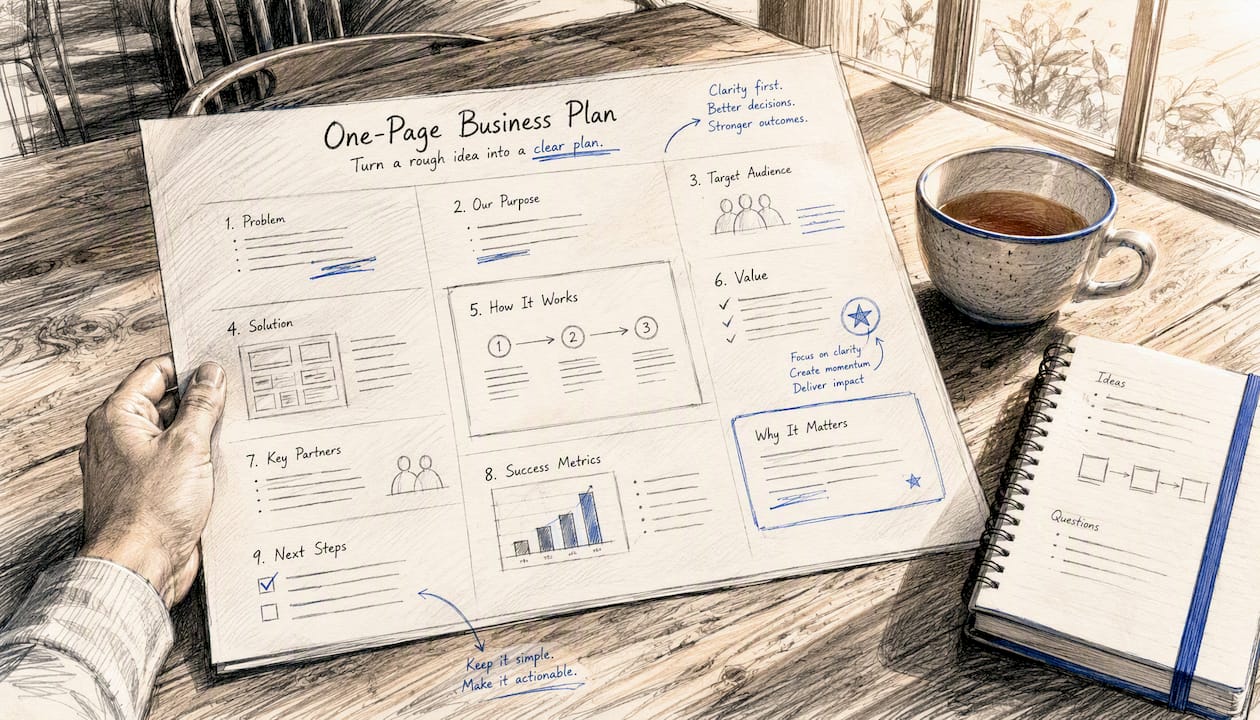
SaaS MVP: loyalty app for independent cafes
| Field | Content | Annotation |
|---|---|---|
| Mission | Help independent cafes fill slow hours with targeted local deals | Validate: do cafe owners see slow hours as their top problem? |
| Problem | Cafes lose afternoon revenue to empty seats | Assumption: 30% revenue loss — confirm with 5 owner interviews |
| Solution | Flash-deal loyalty app for regulars within 0.5 miles | Differentiator: proximity targeting vs. generic loyalty cards |
| Target customer | Independent cafes, 1–3 locations, US mid-size cities | Start with one city; expand after first 10 paying customers |
| Revenue model | $79/month per location, annual billing | Validate willingness to pay before building |
| 90-day milestones | 5 pilot cafes by March 31; 50 active users by April 30; first renewal by May 15 | Renewal is the real signal — prioritize it |
| Financial snapshot | $48K ARR by month 12; seeking $75K pre-seed | Assumes 50 locations at month 12 — aggressive; model a conservative case |
| KPIs | Weekly active locations, churn rate, avg redemptions/location/week | Churn is the leading indicator of product-market fit |
Local retail/cafe: neighborhood coffee and provisions shop
When should you use a one-page plan versus a full business plan?
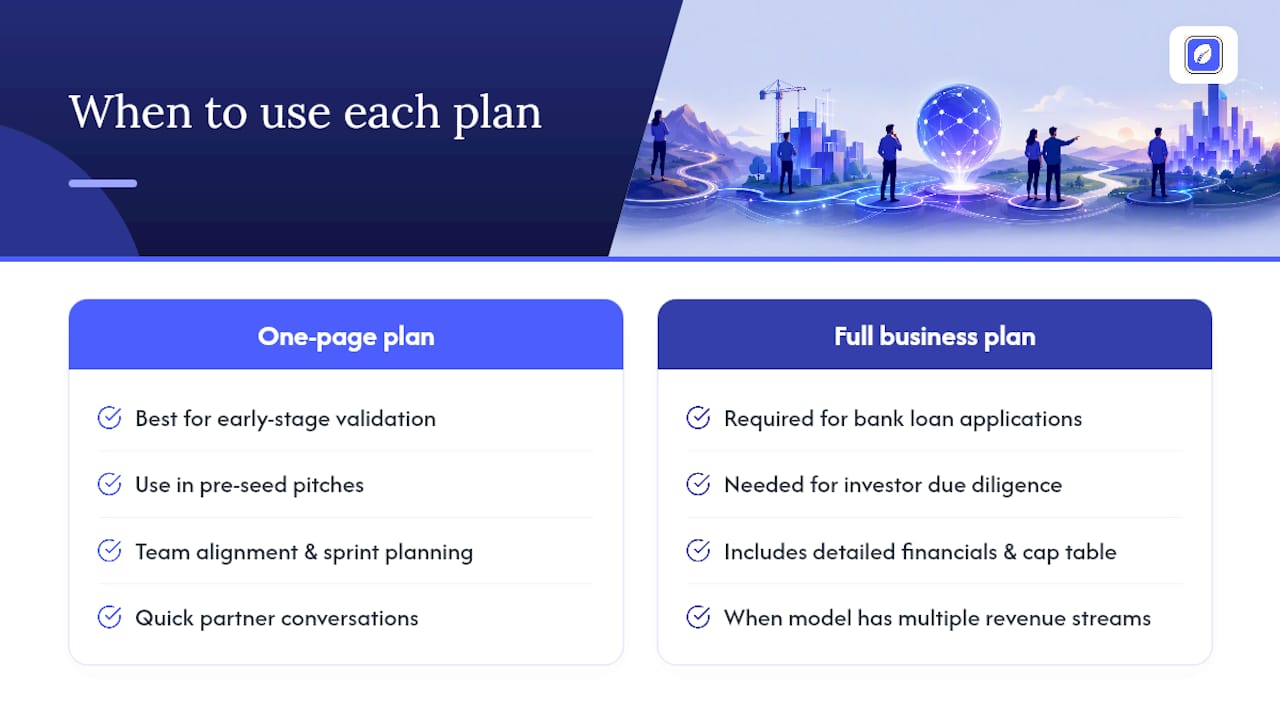
The one-pager fits most early-stage situations better than founders expect. Use it for idea validation, pre-seed pitches, internal team alignment, sprint planning, and quick partner conversations. It forces the clarity that longer documents often obscure.
A full business plan becomes necessary when a bank requires it for a loan application, when a late-stage investor requests detailed financials and a cap table, or when your model has multiple revenue streams that genuinely need separate financial projections. Fit Small Business notes that one-page plans are ideal for early-stage validation and internal strategy, but longer plans remain necessary for formal loan applications or investor due diligence.
The decision rule: If your next conversation is about whether the idea is worth pursuing, use the one-pager. If your next conversation is about signing a check or a loan agreement, build the full plan — and use the one-pager as its outline.
LegalTemplates and similar guides consistently flag that a one-page format can oversimplify complex models. If you have multiple revenue streams, significant startup costs, or detailed risk mitigation requirements, expand to a full plan rather than cramming everything onto one page and losing the clarity that makes the format useful in the first place.
Is your one-page plan actually done? Run this checklist first
Before you send it anywhere, confirm every item below. A plan that fails two or three of these isn't ready.
| Checklist item | What "done" looks like |
|---|---|
| Mission is clear | One sentence, named customer, named outcome — no jargon |
| 90-day priorities listed | Three milestones with dates and owners, not vague goals |
| Financial snapshot included | 12-month top-line forecast + funding ask (even if rough) |
| KPIs defined and measurable | Each metric has a unit and a review cadence |
| Copy is audience-tailored | Investor version emphasizes traction; internal version emphasizes tasks |
| Assumptions are visible | Key numbers are flagged as estimates, not presented as facts |
| Next steps specified | Reader knows what happens after they read this |
| Peer review completed | At least one outside person has read it and given feedback |
The peer review step is the one founders skip most often. Show the plan to a potential customer or a mentor before you show it to an investor. Their confusion will tell you more than any editing pass.
What mistakes do founders make on a one-page plan?
The most common problem isn't missing information. It's vague information that sounds specific.
"Grow revenue" is not a KPI. "Increase monthly recurring revenue from $2K to $8K by June 30" is a KPI. The difference between the two is whether anyone on your team knows what winning looks like next month.
Here's a short problem-and-fix list:
- Too many target customers: Pick one segment. "Small business owners" is not a segment. "Independent coffee shops with 1–3 US locations" is.
- Vague milestones: Replace "launch the product" with "ship beta to 10 paying users by March 15."
- No financial snapshot: Even a rough estimate ("$120K ARR by month 12, assuming 50 customers at $200/month") is better than a blank field.
- Assumptions hidden in the prose: Flag them explicitly. Write "Assumption:" before any number you haven't validated.
- Plan longer than one page: If it's two pages, cut the weakest field, not the font size.
Pro Tip: Assign an owner to every milestone before you share the plan. A milestone with no owner is a milestone that won't happen. Add initials next to each date — it takes 10 seconds and creates real accountability.
How do you present a one-page plan to investors, lenders, or partners?
The one-pager is a conversation starter, not a closing document. How you present it depends entirely on who's in the room.
For investors (two-minute pitch structure):
- Lead with the problem and the market size — investors filter on "is this big enough?" before anything else
- State your traction first if you have any (paying customers, LOIs, waitlist numbers)
- Emphasize unit economics: what does it cost to acquire a customer, and what do they pay over their lifetime?
- Leave the financial snapshot for last — it anchors the ask
For lenders (60-second internal brief):
- Lead with cash flow, not vision
- State collateral or personal guarantee position upfront
- Show the repayment timeline clearly in the financial snapshot
For partners (value-exchange framing):
- Open with what's in it for them, not what you need
- Make the revenue-sharing or referral model explicit in the revenue model field
Prepare a one-page appendix for any audience that asks follow-up questions. Keep it separate from the main plan. Good appendix items: detailed financial model (link or attachment), cap table, sample contracts or LOIs, and market research sources. Never fold these into the one-pager itself — the moment it goes to two pages, the format stops doing its job.
For investor-facing presentations, Visme's visual templates work well for printed leave-behinds. For internal team briefs, startup management software can convert the one-pager's milestones and KPIs directly into tracked execution tasks.
How Klaritea turns a one-line idea into a structured plan
Klaritea is an AI-powered planning workspace built for founders at the earliest stage. You type a single sentence describing your idea, and Klaritea builds a connected model that covers your ideal customer profile, TAM/SAM/SOM estimates, competitor analysis, feature mapping, requirements, and a build spec.
The platform's three AI advisors — Maya (marketing), Devon (business), and Priya (ops and QA) — research, challenge, and fact-check your idea in real time. That means the assumptions you'd normally leave invisible on a one-pager get surfaced and stress-tested before you commit to them.
| Klaritea feature | What it does for your one-page plan |
|---|---|
| One-liner input | Converts your idea sentence into a structured model automatically |
| TAM/SAM/SOM estimates | Fills the market-size context behind your financial snapshot |
| AI advisory sessions | Challenges your assumptions on target customer, revenue model, and KPIs |
| Clarity scorecards | Flags weak or missing fields before you share the plan |
| Export to Notion/Confluence | Moves the plan into your team's existing workflow |
| Printable report | Generates a clean, shareable one-page output |
| GitHub sync (paid) | Connects the plan to your build spec for technical founders |
For founders who want a worked example, the online boutique business plan on the Klaritea blog shows how the platform validates assumptions for a product-based business. If you're comparing AI-assisted planning approaches, the AI business plan generator alternatives post covers the tradeoffs clearly.
Where to get a fillable one-page template right now
If you want a clean, fillable layout without building one from scratch, the options below cover every format. Each source is free and requires no account to download.
The HubSpot one-page template (Word and PDF) is the most widely used starting point for founders. The guided fields make it fast to fill even without prior planning experience.
For a form-based experience that generates a finished document, LegalTemplates walks you through each field and exports to PDF or Word on completion.
Smartsheet's PDF template is the best choice for small businesses that want a structured layout with space for a situational analysis alongside milestones and KPIs.
For coaching-guided templates and planning resources, Champion Business Coaching's ebooks offer structured frameworks for founders who want a more guided approach to their planning process.
How to tailor your one-page plan for different audiences
The structure of the plan stays the same. The emphasis shifts.
Investors care about market size, traction, and unit economics. Lead with those in the financial snapshot and KPI fields. If you have paying customers, put that number in the mission line or the first milestone. Investors read dozens of plans; the traction signal filters faster than any narrative.
Internal teams need execution clarity, not pitch language. Replace "large addressable market" with "50 target accounts in Q1." Swap "compelling value proposition" for "feature X ships by March 15, owner: [name]." The internal version of the plan is a coordination tool, not a persuasion document.
Partners respond to value exchange. If you're pitching a distribution or referral partnership, the revenue model field should make the partner's upside explicit.
When you're writing the value proposition line, AI prompt tools for value propositions can help you sharpen the language quickly, especially if you're struggling to compress a complex differentiator into one sentence.
How to keep your one-page plan current over time
A one-page plan that isn't updated is just a historical document. The format's real value comes from treating it as the central reference for what the business is actually doing right now.
A monthly review cadence works for most early-stage businesses. After each major experiment — a pricing test, a new channel, a product change — update the relevant fields before moving on. The milestones field will change most frequently. The mission and target customer fields should change rarely; if they're shifting every month, the business hasn't found its footing yet.
When a lender or investor asks for more detail, use the one-pager as the outline for a deeper plan. Each field expands into a supporting section: the financial snapshot becomes a full model, the target customer field becomes a market research section, the milestones become a detailed project plan. The one-pager doesn't get replaced — it becomes the table of contents.
Keep a version history, even a simple one. A dated copy of last month's plan next to this month's shows you exactly what changed and why. That record is useful for your own decision-making and credible to any investor who wants to see how your thinking has evolved.
What condensing a complex plan into one page actually costs you
The one-page format forces trade-offs. That's the feature, not the bug. But some trade-offs are worth naming.
Multi-revenue models are the hardest to compress. If your business earns from subscriptions, one-time sales, and a marketplace fee simultaneously, a single revenue model line will either oversimplify or confuse. The fix is to pick the primary revenue stream for the one-pager and note the others in a parenthetical. Save the full breakdown for the appendix.
Risk mitigation disappears almost entirely on a one-page plan. That's fine for internal use and early pitches, but a lender will notice the absence. If risk is relevant to your audience, add one line under the financial snapshot: "Key risk: [X]. Mitigation: [Y]." One line doesn't break the format.
Complex financial models can't live on one page. If your business requires detailed cash flow projections, a cap table, or scenario modeling, those belong in a supporting document. The one-pager carries the top-line number and the ask. Everything else is an appendix.
The deeper problem is that founders sometimes use the one-page format to avoid making hard decisions. A vague target customer field isn't brevity — it's indecision. The constraint of one page should force clarity, not hide the absence of it.
Why the one-page plan is the most underused management tool in early-stage startups
Most founders write a business plan once, file it, and never look at it again. The one-page format breaks that pattern because it's short enough to actually reread.
The real value of a one-page plan isn't the document — it's the discipline of fitting your entire strategy onto one page. That constraint forces you to decide what matters. Every field you fill is a decision about what you're not doing. The founders who use the one-pager well treat it as a weekly reference, not a quarterly filing.
There's also a presentation advantage that gets overlooked. A one-pager you can hand across a table and explain in two minutes creates a different kind of conversation than a 40-page deck. It signals that you know your business well enough to compress it. That confidence reads before you say a word.
The format isn't a shortcut. It's a discipline. And the discipline is what makes the difference between a founder who knows their numbers and one who's still figuring out what they're building.
Klaritea builds your one-page plan from a single sentence
Most founders spend weeks on a business plan that never gets used. Klaritea cuts that to hours by converting your one-line idea into a structured, connected model — complete with market sizing, competitor analysis, feature mapping, and a clarity scorecard that flags what's missing before you share anything.
You get AI advisory sessions from three specialized advisors who challenge your assumptions on marketing, business strategy, and operations. The output is a printable, shareable one-page plan you can export to Notion, Confluence, or GitHub without reformatting. No blank page, no guesswork on structure, no wasted weeks.
See how Klaritea works and start turning your idea into a plan you can actually use.
Sources
- One Page Business Plan Template - Word, PDF
- How to Write a One-Page Business Plan
- Free One-Page Business Plan Template | PDF & Word
- How to Write a Winning One-Page Business Plan + Templates
FAQ
What should be in a one-page business plan?
A one-page business plan should include eight fields: mission/one-liner, problem, solution/value proposition, target customer, revenue model, 90-day milestones with dates and owners, a one-line financial snapshot (12-month forecast plus funding ask), and two or three measurable KPIs.
What is a one-page business profile?
A one-page business profile is a condensed overview of a company's identity, offering, and market position — similar to a one-page plan but focused on describing the business rather than setting strategy or milestones. It's commonly used for introductions to partners or press rather than internal planning.
When does a one-page plan need to become a full business plan?
Use a full business plan when a bank requires it for a loan application, when a late-stage investor requests detailed financials and a cap table, or when your model has multiple revenue streams that need separate projections. For idea validation and early pitches, the one-pager is sufficient.
What is a good example of a one-pager?
A SaaS one-pager might read: mission ("Help independent cafes fill slow hours with targeted local deals"), revenue model ("$79/month per location"), 90-day milestones ("5 pilot cafes by March 31"), and KPIs ("weekly active locations, churn rate, avg redemptions per location"). The local cafe example in this article shows the same structure applied to a brick-and-mortar business.
Can Klaritea generate a one-page business plan automatically?
Yes. You type a one-line idea into Klaritea and it builds a structured plan covering your ideal customer profile, market sizing, competitor analysis, milestones, and KPIs. The output includes a printable report you can share directly or export to Notion, Confluence, or GitHub.