Many startup MVPs typically cost in a broad range influenced strongly by scope, with costs spanning from a few thousand dollars to over one hundred thousand. A no-code landing page test represents very low cost; an AI-native product with compliance requirements represents significantly higher cost.
TL;DR:
- Most MVPs cost between $5,000 and $150,000, with lower ranges suitable for simple testing and higher budgets necessary for AI or regulated products.
- Building for rapid testing with no-code tools typically costs under $5,000 but lacks scalability for investor-ready or compliance-heavy products.
- Features that involve payments, AI, or complex backend logic significantly increase costs, especially as scope expands or integrations become more extensive.
- Planning a detailed scope, including a build spec and acceptance criteria beforehand, can reduce scope creep and lower overall expenses.
- Ongoing costs for infrastructure, maintenance, and compliance can add 15% to 25% annually to the initial build cost, making pre-launch planning crucial.
Table of Contents
- MVP Cost Ranges by Budget Bracket
- What Drives MVP Development Cost Up or Down
- Three Worked MVP Budget Examples
- When No-Code and AI Tools Actually Save You Money
- The Costs Nobody Puts in the Original Quote
- How to Cut MVP Cost Without Cutting the Experiment
- Does Rushing Your MVP Actually Cost More?
- Cut Build Risk Before You Hire Anyone
- A Founder's Take on Picking Your Budget Band
- Plan the Build Before You Fund It
- Sources
- FAQ
MVP Cost Ranges by Budget Bracket
Founders usually ask the wrong first question. They want a single number, but MVP cost only makes sense once you know which bracket you're actually shopping in. Most guides converge on four practical tiers, and each one buys something structurally different, not just "more" of the same thing.
The Tessellatelabs lays out ranges that match what most 2026 practitioners are quoting: $1K to $5K, $5K to $25K, $25K to $80K, and $80K and up. A separate breakdown from Enlight Lab frames a slightly higher working range, roughly $20,000 to $150,000, once you factor in AI or enterprise-grade builds at the top end. Both are right. They're describing different slices of the same market.
Here's what each bracket typically delivers:
- $1K to $5K (DIY/AI-assisted): A single-workflow app built with no-code tools or AI code assistants. Good for testing a landing page, a waitlist, or one core interaction. No real backend architecture, minimal QA, and almost no room for pivots without a rebuild.
- $5K to $25K (freelancer or small studio): A working product with basic authentication, one or two core features, and a simple database. Timelines run four to eight weeks. This is the sweet spot for testing whether people will actually pay for something.
- $25K to $80K (small agency or serious product team): Multi-feature builds with proper QA cycles, a scalable backend, and design polish suitable for investor demos. Expect eight to fourteen weeks and a small team rather than a solo contractor.
- $80K and up (AI-native or compliance-heavy): Products with machine learning pipelines, regulatory requirements, or enterprise integrations. Fourteen weeks or longer, often with a dedicated technical lead.
A word of caution before you pick a bracket: don't budget for the $1K to $5K tier if you need investor-ready polish or you're building in a regulated space like health data or payments. Those goals need the QA rigor and compliance groundwork that only shows up starting around the $25K mark. Trying to shortcut that with a no-code tool usually means paying for the same work twice, once badly and once correctly.
What Drives MVP Development Cost Up or Down
Every quote you get boils down to a simple formula: hours multiplied by rate, plus adders for platform, integrations, and compliance. Scope is the multiplier that matters most, because every added feature doesn't just cost its own hours, it adds testing time, integration surface, and edge cases that ripple through the rest of the build.
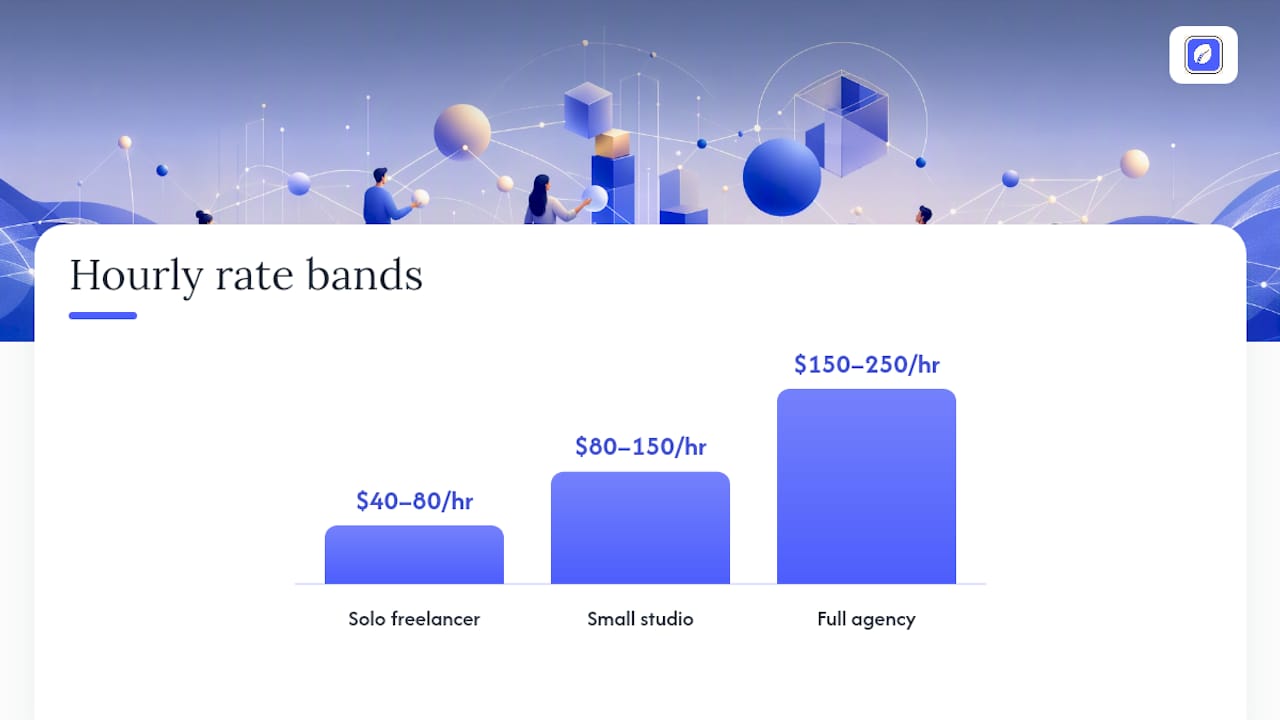
Team model changes your rate dramatically. A solo freelancer using AI coding assistants might charge $40 to $80 an hour. A small studio runs $80 to $150 an hour. A full agency team, with a project manager, designers, and senior engineers, often bills $150 to $250 an hour. None of these is universally "right." A freelancer building a simple CRUD app is efficient. The same freelancer trying to coordinate a five-person AI feature build usually isn't.
Platform choice compounds fast. Building for web only is the cheapest path. Add a native iOS app and a native Android app separately, and you're often paying for three codebases instead of one. Cross-platform frameworks close some of that gap, and Enlight Lab's cost analysis notes that going cross-platform on mobile typically saves 30% to 50% compared to building native iOS and Android in parallel.
Integrations add cost in fairly predictable chunks:
- Payment processing (Stripe or similar): roughly $2,000 to $8,000 depending on subscription logic
- Third-party authentication (social login, SSO): $1,000 to $4,000
- Maps or location services: $1,500 to $5,000
- AI API integration (LLM calls, embeddings): $3,000 to $15,000 depending on complexity
Compliance and QA are where budgets quietly balloon. HIPAA readiness for a health product typically adds $15,000 to $40,000. SOC 2 preparation runs $20,000 to $50,000. PCI compliance for payment handling adds another $10,000 to $30,000, according to Enlight Lab's breakdown. These aren't optional extras you bolt on later. Skip them at MVP stage in a regulated industry, and you'll pay for the retrofit at a much higher rate once you have real users and real liability.
Pro Tip: Get a written estimate of hours per feature before you sign anything, not just a total price. A vendor who won't break down hours by feature usually can't tell you where the money is actually going, which means neither can you when you need to cut scope.
Three Worked MVP Budget Examples
Numbers land better with a real breakdown attached to them. Here are three example builds at three different complexity levels, using generic hourly assumptions so you can adapt the math to your own quotes.
-
Simple web MVP (task management tool). Design: 40 hours at $75/hour = $3,000. Frontend build: 80 hours = $6,000. Backend and database: 70 hours = $5,250. Basic auth: 20 hours = $1,500. QA and testing: 30 hours = $2,250. Cloud hosting setup: $500. Contingency (10%): $1,850. Total: roughly $20,350, landing squarely in the freelancer/small studio bracket.
-
Two-sided marketplace (local services booking app). Design: 60 hours = $6,000. Frontend (web and responsive): 120 hours = $12,000. Backend with two user roles and matching logic: 150 hours = $18,000. Payments integration: $6,000. Auth and profile management: 40 hours = $4,800. QA across both user flows: 60 hours = $7,200. Cloud infrastructure: $1,500. Iteration reserve (20%): $11,100. Total: approximately $66,600, sitting near the top of the small agency bracket.
-
AI-enabled MVP (document analysis assistant). Design: 50 hours = $5,000. Frontend: 100 hours = $10,000. Backend and API orchestration: 140 hours = $19,600. RAG pipeline and vector database setup: $18,000. LLM API integration and prompt engineering: $12,000. Auth: 30 hours = $3,600. QA including AI output validation: 70 hours = $9,800. Cloud and inference infrastructure: $3,000. Contingency (15%): $12,150. Total: roughly $93,150, pushing into the AI-native tier.
The pattern across all three is consistent: payments, AI infrastructure, and multi-role backend logic drive the biggest incremental jumps. Design and basic frontend work stay relatively flat across brackets. The features that touch money, trust, or machine learning are where quotes really diverge.
When No-Code and AI Tools Actually Save You Money
No-code and AI-assisted builders genuinely change the economics of a first version, but they have a hard ceiling, and founders who don't respect it end up paying twice. A single-workflow MVP, something with one core user action and minimal branching logic, is exactly what these tools are built for. Tessellate Labs points to real examples of functional MVPs built for under $5,000 using AI code assistants and no-code platforms, often in a matter of days rather than months.
The trade-off shows up the moment your product needs custom logic, multiple user roles, or anything that doesn't fit the platform's data model. At that point, rework costs stack on top of the original spend rather than replacing it.
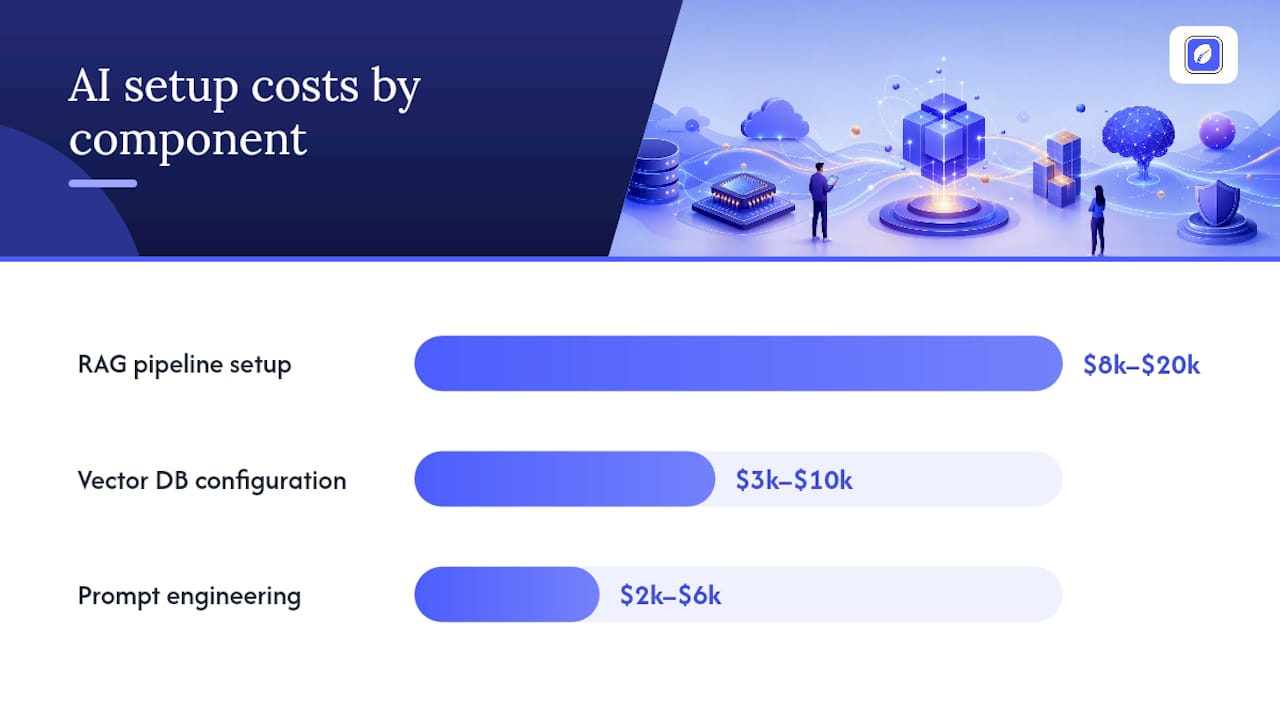
AI features specifically shift a chunk of your budget from build-time to run-time. According to Enlight Lab's analysis, AI features often add 40% to 80% to a comparable traditional build because of the infrastructure involved:
- RAG pipeline setup: $8,000 to $20,000
- Vector database configuration: $3,000 to $10,000
- Ongoing API inference costs: variable, scales with usage
- Prompt engineering and testing: $2,000 to $6,000
The costs that catch founders off guard aren't the build-time ones. They're portability (can you actually export your no-code app if you outgrow the platform), accumulated technical debt from workarounds, and the recurring inference bill that shows up every month whether or not you remembered to budget for it. Model both the one-time build cost and the ongoing run cost before you commit to an AI feature, not just the build cost alone.
The Costs Nobody Puts in the Original Quote
Every MVP quote you receive covers the build. Almost none of them cover the year after launch, and that's where a lot of founders run out of runway they didn't know they'd spent.
The rule of thumb: budget 15% to 25% of your build cost annually for ongoing maintenance, and set aside 20% to 30% of the build cost as an iteration reserve for the first few months post-launch, according to Pexa Studio's cost breakdown.
Beyond maintenance, recurring costs show up in a handful of predictable places: cloud hosting ($50 to $2,000+ a month depending on scale), error monitoring and analytics tools ($0 to $300 a month), transactional email and SMS services ($20 to $500 a month), app store fees ($99 a year for Apple, $25 one-time for Google), and whatever third-party subscriptions your stack depends on.
Compliance one-offs deserve their own line item rather than getting folded into "misc." If you're anywhere near health data, financial transactions, or enterprise sales, HIPAA, PCI, or SOC 2 work isn't a maybe, it's a matter of when. Plan for it early instead of retrofitting it after your first enterprise prospect asks for a security questionnaire.
A $30,000 build, for example, becomes roughly $36,000 in reserve-adjusted spend, plus another $2,000 to $10,000 in first-year infrastructure depending on scale. That's the number to actually raise or save against, not the quote you got from the vendor.
How to Cut MVP Cost Without Cutting the Experiment
The instinct when a quote comes back too high is to cut features randomly until the number looks better. That's how you end up with a cheaper product that no longer tests anything useful. Cut deliberately instead.
- Write a strict in-v1 and out-of-v1 spec, then freeze it. Everything not on the in-v1 list gets built later, no exceptions during the build. Include acceptance criteria for every feature so "done" has an objective definition instead of a subjective one.
- Negotiate fixed-price for the core build, with a time-and-materials cap for iteration. This gives you cost certainty on the part you already know, and flexibility on the part you'll learn about once real users show up.
- Sequence your experiments by risk, not by excitement. Test willingness to pay before you test retention, and test retention before you test scale. Building scale infrastructure for a product nobody wants to pay for is the most expensive mistake in this list.
- Require hand-off artifacts and exportable specs from any vendor. Founders who insist on this reduce rework and avoid vendor lock-in, which lowers total spend over the product's life, not just the initial build, according to Pexa Studio. A requirements checklist built for dev teams is a useful template for defining what "hand-off" should actually include.
- Match your tool to your test. No-code and AI builders fit single-workflow validation. Custom engineering earns its cost once you need multiple user roles, complex business logic, or anything you'll need to scale without a full rebuild.
Scope creep and founder indecision are the two most common reasons final invoices run higher than the original quote, and both are avoidable with a frozen spec and a fast decision cycle, per Pexa Studio's analysis. If you're weighing whether to hire a freelancer, a studio, or an offshore team, understanding how staffing models get evaluated helps you compare quotes on the same basis instead of just comparing dollar totals.
Pro Tip: Before you accept any quote, ask what happens if you need to change one feature mid-build. If the answer involves a change order process longer than a paragraph, that vendor's fixed price isn't as fixed as it looks.
Does Rushing Your MVP Actually Cost More?
Yes, and predictably so.
- Lean tier (four to eight weeks): minimal rush premium if scope stays tight.
- Mid tier (eight to fourteen weeks): rush compression of 30% typically adds a comparable percentage to cost.
- Compliance/AI tier (fourteen-plus weeks): compression here is the most expensive, since regulatory and QA work resists shortcuts.
The less obvious cost driver is decision latency. A founder who takes two weeks to approve a design mockup doesn't just lose two weeks, they lose momentum and often pay for a team sitting idle or context-switching to other clients. Pay for speed when you're up against an investor demo or a genuine market window. Conserve cash and move at a normal pace everywhere else. Mapping this out concretely is exactly what a phase-zero timeline exercise is for.
Cut Build Risk Before You Hire Anyone
The cheapest way to lower your MVP cost isn't negotiating harder with vendors. It's showing up to that negotiation with a spec instead of an idea. A handful of artifacts, done before you write a single line of code or send a single RFP, does most of the heavy lifting: a build spec, a prioritized feature map, written acceptance criteria, a minimal test plan, and an honest estimate of hours by rate for each feature.
These aren't bureaucratic overhead. They're what stops a vendor from filling in the ambiguous parts of your idea with their own assumptions, which is where rework and scope disputes actually come from. This is the exact gap Klaritea's phase-0 planning is built to close: turning a one-line idea into a connected model with a build spec, feature map, and AI advisory input from three specialized advisors before you spend a dollar on development. Clarity at this stage is what makes the rest of this article's numbers hold up in practice instead of drifting upward with every change order.
A Founder's Take on Picking Your Budget Band
If your runway is thin, stay in the $1K to $25K range and design the build around one hypothesis you can actually kill or confirm. Don't build a second feature until the first one has an answer. If you need investor polish or you're touching regulated data, budget for the $25K to $80K-plus tiers from day one, and build the post-launch iteration reserve into your ask, not as an afterthought once the money runs low. Either way, the highest-leverage thing you can do before writing a check is spend a week writing a one-page in-v1 spec, run a landing page test to see if anyone cares, or run a phase-0 plan to see if the idea holds together before a single engineer touches it.
— Karl
Plan the Build Before You Fund It
Klaritea gets you the clarity a vendor conversation actually needs, before you've spent a dollar on development. Instead of walking into a quote request with a vague idea and hoping the agency fills in the gaps correctly, you walk in with a structured model: your ICP, a prioritized feature map, a build spec, and acceptance criteria already defined.
That structure is what prevents the two most expensive mistakes in this article: vague scope that balloons mid-build, and paying for features nobody validated as worth building. Klaritea's AI advisory board, three specialized advisors covering marketing, business strategy, and operations, stress-tests your idea before you hand it to a builder, so the rework happens on paper instead of in production code. Founders can start with the free introductory tier and run the guided idea-to-build-spec flow, or explore why Klaritea's connected model works differently from a standalone research doc or a scattered set of spreadsheets. Either way, the next step is the same: type your idea in, and see the plan before you see the invoice.
Sources
The tiered cost ranges in this piece draw on Tessellate Labs' MVP cost calculator, Enlight Lab's 2026 startup cost guide, and Pexa Studio's full cost breakdown, all worth a closer read for line-item detail beyond this article's scope.
For next steps, Klaritea's own guides on defining MVP scope, validating your idea before you build, and release planning for your first launch walk through the practical side of the checklist above.
- MVP Cost Calculator: What $1K, $5K, $25K & $100K Actually Buys in 2026
- MVP Development Cost In 2026: Complete Startup Guide
- MVP Development Cost 2026: Full Breakdown — Pexa Studio
FAQ
What does "MVP cost" actually mean?
MVP cost refers to the total spend required to design, build, and launch the smallest working version of a product that lets you test a core hypothesis with real users, typically ranging from $5,000 to $150,000 depending on scope and complexity.
How much does it cost to create an MVP?
Most MVPs in 2026 cost between $5,000 and $150,000, with simple no-code builds at the low end and AI-native or compliance-heavy products at the high end; scope and team model are the biggest factors in where you land.
What's a reasonable budget for a first-time founder?
For a first-time founder testing a single hypothesis, the $5,000 to $25,000 bracket usually buys enough product to get honest feedback without overbuilding, and a phase-0 planning step beforehand helps make sure that budget goes toward the right features.
What does MVP stand for?
MVP stands for minimum viable product, the smallest version of a product that lets you learn whether people want it before you invest in a full build.