TL;DR:
- The Lean Startup emphasizes testing assumptions through small experiments to reduce failure rates. It advocates validating customer interest and behavior before building full products. AI tools can accelerate and improve this process by structuring ideas, ranking risks, and generating test specifications quickly.
The Lean Startup is an experiment-first method that converts your assumptions into validated evidence before you build anything. Harvard Business School research puts the startup failure rate at roughly 75%, and the most common cause isn't a bad idea — it's building a product nobody actually wanted. Eric Ries designed the lean startup method to prevent exactly that. The immediate action: pick your single riskiest assumption right now, write it as a testable hypothesis, and design the smallest possible test to prove or disprove it before writing a line of code.
- Your riskiest assumption is the one thing that, if wrong, kills the business.
- A testable hypothesis follows this format: "We believe [customer] will [do X] because [reason]. We'll know we're right if [metric] hits [threshold] within [timeframe]."
- Klaritea structures this entire process from a one-line idea, so you're not starting from a blank page.
Table of Contents
- What are lean startup principles and why do they matter?
- The five core lean startup principles, explained for first-time founders
- How does the Build–Measure–Learn loop work in practice?
- Which metrics actually show real progress?
- How do you run customer discovery interviews that actually work?
- What mistakes do founders make when applying this method?
- How do AI tools speed up the lean startup workflow?
- Your one-week experiment playbook
- Key Takeaways
- The part of lean startup nobody talks about enough
- Klaritea gives you phase-0 clarity before you spend a dollar on development
- Further reading and primary sources
- FAQ
What are lean startup principles and why do they matter?
A startup, in Ries's framing, is not a small version of a big company. It's an institution designed to create something new under conditions of extreme uncertainty. The unit of progress isn't features shipped or revenue projected — it's validated learning: empirical evidence that you've learned something true about your customers and market.
75% of new ventures fail. The lean startup methodology exists to shrink that number by replacing guesswork with structured experiments.
Steve Blank, whose customer-discovery work preceded Ries's synthesis, argues that static business plans may be obsolete for early-stage companies. A plan written on day one is a list of untested assumptions. The lean startup method turns those assumptions into experiments you can run in days, not quarters. AI accelerates this further: hypothesis generation that once took a week of research now takes an afternoon, and customer-discovery scripts can be drafted, tested, and refined before you've scheduled your first interview.
The five core lean startup principles, explained for first-time founders
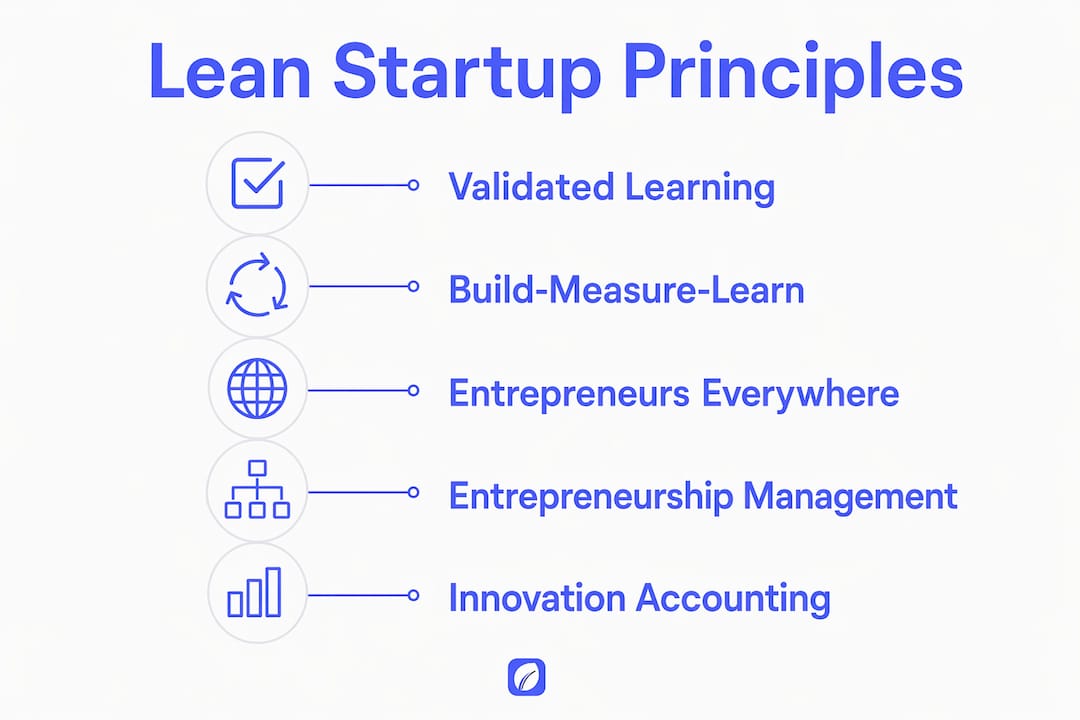
Eric Ries defines five principles that together form the operating system of the lean startup methodology:
- Entrepreneurs are everywhere. You don't need a garage in Silicon Valley. Any person building a new product under uncertainty is an entrepreneur — inside a corporation or a dorm room.
- Entrepreneurship is management. A startup needs a discipline built for uncertainty, not the management playbook written for stable, known markets. Practical action: treat your first 90 days as a management problem, not a product problem.
- Validated learning. Progress is measured by what you've proven true, not by what you've built. Most startups ignore this principle and substitute activity for evidence.
- Build–Measure–Learn. Every cycle of work should produce a testable artifact, a measurement, and a decision. Practical action: never start a build sprint without defining what you'll measure and what result would change your direction.
- Innovation accounting. Replace vanity metrics with a system that shows whether your experiments are moving the business forward. Practical action: set a baseline, tune the engine, and make a pivot-or-persevere call.
The principle most founders skip is validated learning. It's easy to rationalize past decisions as learning. Real validated learning is an empirical process — you design a test before you know the answer, then let the data decide.
How does the Build–Measure–Learn loop work in practice?

The Build–Measure–Learn loop is a steering system, not a waterfall. Each experiment should move one business-model driver — acquisition, activation, retention, revenue, or referral — and include a defined decision rule before you start.
Use this template for every experiment:
| Field | What to write |
|---|---|
| Leap-of-faith assumption | The one belief the business depends on most |
| Hypothesis statement | "We believe [persona] will [action] because [reason]" |
| MVP description | The smallest artifact that tests this hypothesis |
| Target metric | One number (e.g., email signup rate) |
| Measurement method | How you'll collect the data |
| Success threshold | The minimum result that confirms the hypothesis |
| Decision rule | If above threshold → persevere; if below → pivot |
Worked example: You believe freelance designers will pay for an AI brief-writing tool. Your MVP is a landing page describing the tool with a "Join the waitlist" button. Your target metric is a 15% signup rate from 200 unique visitors driven by $50 in paid social ads. If you hit 15%, you run customer interviews with signups. If you don't, you reframe the value proposition and retest.
Pro Tip: Design your MVP to answer exactly one question. According to The Lean Startup methodology, an MVP that doesn't test the leap-of-faith assumption isn't an MVP — it's a product.
Which metrics actually show real progress?
Validated learning is not the same as looking at your dashboard and feeling good. Ries distinguishes it sharply from after-the-fact rationalization: you must design the test before you know the result.
The Three As filter out vanity metrics:
- Actionable: The metric changes based on something you did. Page views are not actionable. Signup rate from a specific ad is.
- Accessible: Anyone on the team can pull the number without a data scientist. Simple cohort reports beat complex dashboards.
- Auditable: You can trace the number back to real customer behavior. If you can't verify it, you can't trust it.
Vanity metrics — total signups, app downloads, social followers — feel like progress and prove nothing. Cohort retention at day 7 and day 30 tells you whether customers are getting value.
Here's a minimal innovation-accounting table to copy into a spreadsheet:
| Cohort | Week | Activated (%) | Retained Day 7 (%) | Converted (%) | Decision |
|---|---|---|---|---|---|
| Cohort 1 | Week 1 | — | 20 | 5 | Pivot onboarding |
| Cohort 2 | Week 2 | — | — | — | Persevere, test pricing |
Set your success threshold before the cohort runs. If retention doesn't hit your threshold, that's a signal to change something specific — not to collect more data hoping the trend reverses.
How do you run customer discovery interviews that actually work?
Customer feedback over founder intuition is the core discipline of customer discovery. The goal of an interview is not to validate your idea — it's to understand the customer's actual problem and behavior.
Short interview script (20 minutes):
- "Tell me about the last time you dealt with [problem area]." (Listen for frequency and pain intensity.)
- "What did you try to solve it?" (Reveals existing alternatives.)
- "What happened? What did you do next?" (Behavioral evidence beats stated preferences.)
- "How much time or money does this cost you today?" (Quantifies the problem.)
Recruiting checklist:
- Target 5–10 interviews per customer segment before drawing conclusions.
- Recruit through LinkedIn outreach, relevant Reddit communities, and your own network first — paid recruiting panels are a last resort.
- Screen for people who have experienced the problem recently, not just people who might have it someday.
Pro Tip: After each interview, write one sentence: "This person would pay for a solution if it [specific condition]." That sentence is your next hypothesis.
Aim for at least 5 interviews per segment. Patterns that appear in fewer than 3 conversations are noise; patterns that appear in 4 or more are worth testing.
What mistakes do founders make when applying this method?
The lean startup method is simple to describe and hard to execute. These are the failures that show up most often:
- Overbuilding before validation. Spending months on a full product when a landing page would have answered the core question. If your MVP takes longer than two weeks to build, it's not an MVP.
- Testing feasibility before desirability. Founders with technical backgrounds default to "can we build it?" The right order is desirability first (do people want it?), then viability (will they pay?), then feasibility (can we build it?).
- Relying on vanity metrics. Total signups, social likes, and press mentions feel like traction. They tell you nothing about whether customers will return or pay.
- Interview bias. Asking "Would you use this?" gets you "yes" from polite strangers. Ask about past behavior instead.
Red flags that an experiment is failing:
- Retention drops below 20% by day 7 with no clear explanation.
- No customer has voluntarily referred anyone else after 30 days.
- You're changing the success threshold after seeing the data.
When an experiment fails, the learning is the output. Write down what the data disproved, update your hypothesis, and run the next test. A failed experiment that produces a clear pivot decision is more valuable than a successful vanity metric.
How do AI tools speed up the lean startup workflow?
AI compresses the time between idea and first experiment from weeks to days. Here's where it adds the most value, and how Klaritea maps to each step:
- Idea structuring. You type a one-line idea; Klaritea builds a connected model covering ICP, TAM/SAM/SOM, competitor analysis, features, and requirements. What used to take a week of spreadsheet work takes minutes.
- Hypothesis ranking. Klaritea's AI advisors — Maya (marketing), Devon (business), and Priya (ops and QA) — challenge your assumptions and surface the riskiest ones to test first.
- MVP spec. The platform outputs a build spec tied to your validated assumptions, so you're not building features that haven't been tested.
- Clarity scorecards. Before you spend a dollar on ads or development, you get a scored view of how clear and defensible your business model is.
- Exports. Results sync to GitHub (paid) or export to Notion and Confluence (Pro), so your experiment log lives where your team already works.
For founders using startup management software to run early experiments, the biggest time savings come from automating the research and structuring steps — not the interviews themselves. Those still require a human.
Look for AI tools that support workflow automation for small teams in your measurement pipeline: automated cohort reports, interview scheduling, and metric dashboards reduce the overhead of running weekly experiments.
Your one-week experiment playbook
| Day | Goal | Who | Output |
|---|---|---|---|
| 1 | Define leap-of-faith assumption and write hypothesis | Founder + AI | One-sentence hypothesis with success threshold |
| 2 | Build MVP (landing page, mockup, or concierge offer) | Founder + AI | Live MVP ready for traffic |
| 3 | Recruit interview subjects and launch ads | Founder | 5–10 confirmed interviews, ad live |
| 4 | Run interviews | Founder | Raw interview notes |
| 5 | Measure MVP metric (signups, clicks, conversions) | AI-assisted | Data table with cohort results |
| — | Analyze: did results hit success threshold? | Founder + AI | Annotated results doc |
| 7 | Decide: pivot or persevere, write next hypothesis | Founder | Decision memo + next experiment |
Estimated costs: $50–$150 in paid social ads for MVP traffic; free or low-cost tools for landing pages (Carrd, Typedream); Klaritea's free tier for idea structuring and hypothesis generation. Total week-one spend can stay under $200 if you recruit through your own network.
Key Takeaways
The lean startup method works because it replaces untested assumptions with validated evidence before you commit time and money to building a full product.
| Point | Details |
|---|---|
| Experiment before building | Design a testable hypothesis and run an MVP before writing production code. |
| Use the Three As for metrics | Metrics must be actionable, accessible, and auditable — not vanity numbers. |
| Customer interviews beat intuition | Talk to 5–10 people per segment; ask about past behavior, not hypothetical interest. |
| Failed experiments have value | A clear pivot decision from a failed test is more useful than ambiguous positive data. |
| Start with Klaritea | Use Klaritea's free tier to structure your idea, rank assumptions, and generate a build spec before your first experiment. |
The part of lean startup nobody talks about enough
The lean startup methodology gets taught as a process problem. Run the loop, measure the right things, don't overbuild. That framing is correct but incomplete.
The harder problem is psychological. Most first-time founders — especially those with business school training — have a deep preference for planning over testing. Academic research on early-stage teams found that MBA-trained founders actively resist learning-by-doing methods, preferring to think their way to an answer rather than test their way there. The lean startup method asks you to be wrong in public, quickly, on purpose. That's genuinely uncomfortable.
The advice that actually helps: treat your first experiment as a question, not a pitch. You're not trying to prove your idea works. You're trying to find out whether it does. That shift in framing makes it easier to design honest tests and read the results without defensiveness.
Klaritea gives you phase-0 clarity before you spend a dollar on development
Most first-time founders skip straight from idea to build. Klaritea sits in the gap — the phase-0 moment before any code is written — and turns a one-line idea into a structured, experiment-ready business model.
Three things Klaritea does that save real time in a one-week experiment:
- Structures your assumptions automatically. Type your idea once; get a connected model covering market size, competitors, and feature priorities — without a week of spreadsheet work.
- Surfaces your riskiest hypothesis first. The AI advisory board (Maya, Devon, and Priya) challenges your thinking and ranks what needs testing before anything else.
- Outputs a build spec tied to validated assumptions. You're not building features that haven't been tested — the spec follows the evidence.
The free tier is enough to run your first experiment. See how Klaritea structures your idea into a phase-0 model and decide whether it fits your workflow before committing to a paid plan.
Further reading and primary sources
These are the sources worth reading directly — not summaries of them:
- The Lean Startup — Eric Ries. The foundational text. Covers validated learning, Build–Measure–Learn, innovation accounting, and pivot-or-persevere decision rules. Read the "Steer" section first.
- Why the Lean Start-Up Changes Everything — Steve Blank, HBR. The clearest argument for why customer discovery replaces static business plans. Supports the customer-discovery and "what it is" sections of this article.
- The Lean Startup Methodology — LeanStartup.com. The official principles page. Use it for the Build–Measure–Learn loop, Five Whys, and MVP-as-experiment framing.
- Lean Startup Model: Key Principles and Stages — Shopify. Practical explainer covering hypothesis categories (desirability, viability, feasibility) and the Three As for metrics. Good for the experiment template and innovation accounting sections.
- Early-Stage Teams and Hypothesis-Based Probing — Wiley/Strategic Entrepreneurship Journal. Academic evidence on team composition and resistance to learning-by-doing. Relevant to the perspective section and the founder-bias warning.
When you reuse the experiment template or innovation-accounting table from this article, attribute the underlying framework to Eric Ries and the specific source that informed it.
FAQ
What are the five lean startup principles?
Eric Ries defines them as: Entrepreneurs are everywhere; Entrepreneurship is management; Validated learning; Build–Measure–Learn; and Innovation accounting. Each principle translates into a concrete founder action, with validated learning being the most commonly skipped.
What is a minimum viable product in the lean startup method?
An MVP is the smallest artifact that tests your leap-of-faith assumption — not a feature-complete first release. If your MVP doesn't answer one specific question about customer behavior, it's not doing its job.
How do you avoid vanity metrics in a lean startup?
Apply the Three As: make every metric actionable (tied to a specific action you took), accessible (anyone can pull it), and auditable (traceable to real customer behavior). Cohort retention and conversion rates meet this bar; total signups and page views usually don't.
How does Klaritea support lean startup experiments?
Klaritea structures a one-line idea into a connected business model, ranks your riskiest assumptions, and outputs a build spec and clarity scorecard — giving you the phase-0 clarity you need before running your first experiment or writing any code.
When should a founder pivot instead of persevere?
Pivot when your experiment results fall below the success threshold you set before the test, and when multiple cohorts show the same pattern. Persevere when results meet or exceed the threshold and the signal is consistent across different customer segments.