
An AI-powered idea validator takes your raw startup concept and runs it through real-time market intelligence, founder behavioral data, and structured frameworks to tell you whether it's worth building. Tools like IdeaProof pull from 50+ authoritative sources to deliver timely market signals, while ValidatorAI draws on behavioral data from a large number of founders to show what actually moves people from idea to action. The result is faster, more objective decision-making before you spend a dollar on development.
What these tools do, at their core:
- Assess audience specificity, problem urgency, and market size
- Generate Lean Canvas outputs and testable hypotheses
- Recommend low-cost experiments based on Pretotyping methodology
- Score your idea across dimensions like channel reachability, MVP scope, and revenue path
- Surface real-time competitive and market data to pressure-test assumptions
What can an AI idea validator actually do for you?
The best AI validation tools cover far more ground than a simple scoring quiz. They combine several capabilities that would otherwise take weeks of manual research.

| Feature Category | What It Delivers |
|---|---|
| Lean Canvas generation | Auto-structured problem, solution, and customer segment mapping |
| Hypothesis creation | Testable statements about audience, urgency, and demand |
| Experiment design | Specific low-cost tests to run before building |
| Market intelligence | Real-time data from authoritative industry and competitor sources |
| Founder behavioral data | Patterns from real founders showing what predicts traction |
| Financial forecasting | Early revenue model and pricing path analysis |
| Scoring and scorecards | Dimension-by-dimension weakness identification |
Foundable's AI Startup Idea Validator scores eight specific dimensions: audience, urgency, existing workaround, promise clarity, reachable channel, next action, MVP scope, and first money path. Each unchecked item becomes a concrete validation task, not just a vague suggestion.
AI automation compresses what used to be a weeks-long research process into minutes. You get from "I think this could work" to "here's the experiment to run" without hiring a consultant or spending hours on Google Trends.
What startup trends does real-time data reveal in 2026?
Founder behavioral data tells a story that surveys never could. When you analyze what hundreds of thousands of founders actually do after running an idea through a validator, patterns emerge around which categories generate the most follow-through.
The most active validation categories in 2026 cluster around AI-assisted productivity, health tech, and B2B workflow tools. Founders in these spaces tend to have clearer problem definitions and more reachable early audiences, which correlates with a higher likelihood of completing validation experiments.
The single biggest validation pitfall: Stanford Online's entrepreneurship faculty identify founder attachment to a technology or solution rather than a genuine customer need as the most common reason ideas fail before launch. Validation removes that blind spot by forcing you to answer whether customers have a compelling reason to buy, not just whether the technology is impressive.
Timing also shapes outcomes. Market readiness affects whether a product launches into demand or into silence. Validation data helps you recognize whether you're early, on time, or late to a category, and that informs your go-to-market approach more than almost anything else.
How to systematically validate your startup idea
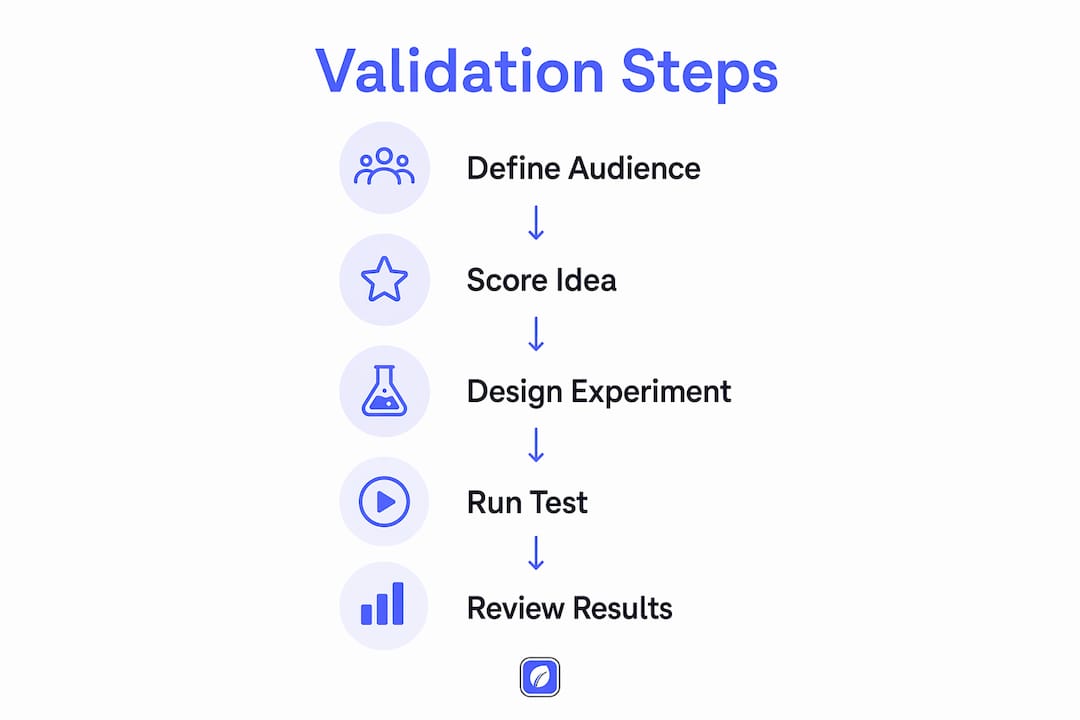
Validation is less about passing a test and more about reducing uncertainty around audience, urgency, and revenue. Here's a structured process that combines AI tools with proven frameworks.
Step 1: Define your audience with precision. Name one specific first audience, not a broad demographic. "Freelance designers who bill hourly" beats "creative professionals."
Step 2: Score your idea against a structured checklist. Use an AI validator to assess urgency, workaround behavior, promise clarity, and channel access. Identify your two weakest dimensions.

Step 3: Generate hypotheses and experiments. Pretotyping methodology focuses on behavioral data over opinions. Design the smallest possible test that produces a real signal: a signup, a booked call, a deposit, or a payment.
Step 4: Run the experiment before writing code. A landing page, a cold outreach sequence, or a concierge workflow costs almost nothing and tells you more than a survey.
Step 5: Interpret the signal and decide. Replies, signups, and payments are real signals. Silence and polite interest are not.
- Avoid asking friends and family for feedback — they won't tell you the truth
- Set your validation threshold before the test, not after
- Track behavioral responses, not stated preferences
Pro Tip: Balance AI-generated insights with direct customer conversations. AI tools identify the right questions; real conversations reveal the answers behind the answers.
How Klaritea structures your idea before you build anything
Klaritea is built for the moment before you write a single line of code. You type a one-line idea, and it builds a connected model of your entire business: ICP, TAM/SAM/SOM, competitor analysis, feature mapping, requirements, build spec, and pitch. That's phase 0 planning, and it's where most founders skip straight to building.
The platform's three AI advisors each bring a distinct lens:
- Maya covers marketing: audience definition, positioning, and channel strategy
- Devon handles business: revenue model, market sizing, and competitive dynamics
- Priya focuses on ops and QA: feasibility, requirements, and build readiness
Each advisor actively researches, challenges, and fact-checks your idea rather than just summarizing it. The result is a clarity scorecard that shows you exactly where your concept is solid and where it needs more work before you invest resources.
Klaritea's "Lenses" feature lets you toggle between Clarity, Build, and Run & Scale views of the same model. As your validation progresses, you're not starting over; you're refining the same connected structure. Outputs include a printable report, GitHub sync for paid plans, and export to Notion or Confluence for Pro users.
The cost rationale is direct: most founders spend $15,000+ building apps that never see a return. Klaritea's phase 0 approach forces clarity before that spending starts. Klaritea is also recognized among the top AI business strategist alternatives for 2026.
Pro Tip: Use Klaritea's Clarity Lens early and often. Each time you get new customer feedback, run it back through the model to see which assumptions shift. The connected structure means one update ripples through your entire plan.
How long does each validation stage typically take?
Validation doesn't have to take months. With AI tools handling research and structure, the timeline compresses significantly.
The idea scoring stage takes 5–30 minutes using an AI validator. You get a structured output with scored dimensions and a prioritized list of weak signals to address.
Hypothesis and experiment design typically runs 1–3 days. You're defining what counts as a real signal, building the smallest artifact that can produce it, and setting your threshold before you launch.
Running the experiment depends on your channel. Cold outreach campaigns produce signals within about a week. Landing page tests with paid traffic can return data within a day or two. Organic community posts vary widely.
Interpreting results and deciding should take no more than a day. If you need weeks to decide what the data means, the experiment wasn't specific enough.
What does idea validation actually cost?
Several AI validators are free with no signup required, including tools built on Pretotyping methodology. Paid platforms range from low monthly subscriptions to usage-based credit models for deeper analysis.
The real cost of validation isn't the tool. It's the time spent on experiments: landing pages, outreach, and early customer conversations. Budget a few hundred dollars for a lean validation sprint using free tools and minimal ad spend. A more thorough validation with paid traffic and multiple experiment rounds can cost significantly more.
Compare that to the alternative. Skipping validation and building first often costs founders thousands of dollars before they discover the market doesn't want what they built. Validation is the cheaper path by a wide margin.
For structured business planning tools, pricing varies by feature depth, but free tiers are widely available for early-stage founders.
How to interpret your validation results
A high score on an AI validator means your idea is ready for a market-facing test. It does not mean the idea will succeed. The proof still comes from real behavior: replies, signups, calls, deposits, and payments.
Read weak scores as a prioritized to-do list. If your channel score is low, you don't have a clear path to reach your first audience. Fix that before running any experiment. If your urgency score is low, the problem may not be painful enough to drive action.
Silence is data. If you run a well-designed experiment and get no response, that's a signal worth taking seriously. Adjust the audience, the promise, or the channel before concluding the idea is dead.
Positive signals need a follow-up plan. A signup list is not revenue. A booked call is not a sale. Define in advance what result would change your next decision, and hold yourself to that standard.
Real-world validation in practice
A founder building a B2B invoicing tool ran her idea through an AI validator and discovered her urgency score was low. The tool flagged that her target audience (small accounting firms) had existing workarounds they were comfortable with. Rather than building, she spent two weeks interviewing 15 accountants and found a narrower, more painful problem: reconciliation errors on multi-currency invoices. She repositioned, rescored, and her revised concept cleared every dimension. She launched a concierge MVP to three paying clients before writing any code.
That's the validation loop working as designed. AI tools surface the weak signals; customer feedback on ideas reveals the real problem underneath. The combination is faster and cheaper than building first and learning later.
Key Takeaways
AI-powered idea validators reduce uncertainty around audience, urgency, and revenue before you invest in building anything.
| Point | Details |
|---|---|
| Start with a scored checklist | Use an AI validator to identify your two weakest dimensions before designing any experiment. |
| Behavioral data beats opinions | Pretotyping-based tools collect real signals like signups and payments, not survey responses. |
| Phase 0 planning prevents waste | Klaritea structures your full business model before you write code, targeting the $15,000+ build-first trap. |
| Set your threshold before testing | Define what counts as a real signal before you launch, so results aren't decided by gut feel. |
| Validation takes days, not months | AI tools compress idea scoring to under 30 minutes; full experiment cycles run 1–2 weeks. |
FAQ
What is an AI idea validator?
An AI idea validator analyzes your startup concept using real-time market data and structured frameworks to score audience fit, problem urgency, and revenue viability before you build.
How is Pretotyping different from standard idea validation?
Pretotyping, created by Alberto Savoia at Google, uses rapid, low-cost behavioral experiments with real customers to collect demand data before development, focusing on what people do rather than what they say.
How long does startup idea validation take?
AI-powered scoring takes 5–30 minutes; designing and running a full experiment cycle typically takes 1–2 weeks depending on your channel and audience.
What does idea validation cost?
Free AI validators are widely available. A lean validation sprint using free tools and minimal ad spend costs a few hundred dollars; a more thorough validation with paid traffic and multiple experiment rounds can cost significantly more.
What's the most common reason startup ideas fail validation?
Stanford Online's entrepreneurship faculty identify founder attachment to a technology rather than a genuine, urgent customer need as the leading cause of validation failure.