What is business idea validation, and where do you start?
Business idea validation is the practice of testing your core assumptions against real market evidence before you spend serious money or time building anything. The goal is not to prove your idea is brilliant. It is to find out fast whether a real problem exists, whether people will pay to solve it, and whether you can reach them profitably.
Four areas need honest answers before you move forward:
- Problem reality: Do enough people actually experience this pain, or are you solving a problem that bothers only you?
- Market potential: Is the addressable market large enough to build a real business, or is it a niche too thin to sustain growth?
- Competitive landscape: Who already solves this, and what would make someone switch to you?
- Willingness to pay: Will people hand over money, not just say they like the idea?
Write every assumption down before you test anything. A written hypothesis gives you a baseline to measure against. Without one, you will unconsciously reinterpret every signal as confirmation. Also define your kill criteria upfront: the specific thresholds at which you stop pursuing the idea. If fewer than 20 of 50 cold prospects agree to a paid pilot call, that is a stop signal, not a reason to tweak the pitch deck.
Table of Contents
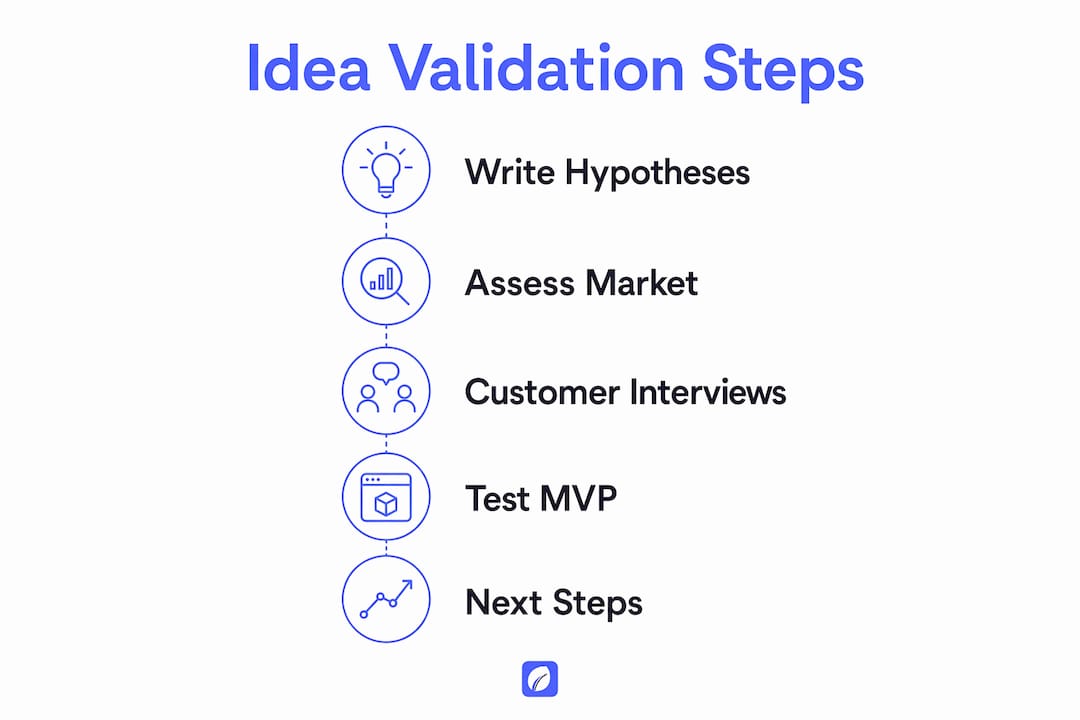
- How to write down your business assumptions and hypotheses
- How do you assess market size without fooling yourself?
- What makes a customer interview actually useful?
- How do you test your MVP without overbuilding it?
- How do you turn validation feedback into a clear next step?
- How Klaritea helps you structure and validate your idea faster
- Klaritea gives you clarity before you commit
- Key Takeaways
- FAQ
How to write down your business assumptions and hypotheses
Vague assumptions produce vague results. "People want a better project management tool" is not a hypothesis. "Freelance designers with three or more active clients spend more than four hours per week on client communication and would pay $29 per month to cut that in half" is.
Every testable hypothesis should name a specific customer, a specific pain, a specific benefit, and a specific price point. Cover at least these four categories:
- Customer: Who exactly is the buyer? Job title, company size, behavior pattern, or life situation.
- Problem: What does the pain cost them in time, money, or frustration right now?
- Solution benefit: What specific outcome does your product deliver, and how does it compare to what they use today?
- Pricing assumption: What would they pay, and how often?
Common pitfalls: assuming "everyone" is your customer, writing hypotheses you cannot measure, and treating a hypothesis as a fact before you have tested it. A hypothesis is a bet, not a belief. Keep each one short enough to fit on a sticky note, and attach a measurable success criterion to it.
How do you assess market size without fooling yourself?
Top-down TAM claims are almost always misleading. Saying "the global project management software market is $6 billion, and we only need 1%" sounds reasonable and means nothing. Build your market estimate from the bottom up instead.
Start with the number of reachable customers in your specific segment, multiply by realistic annual revenue per customer, and you have a defensible serviceable market figure. Then ask what share you could realistically capture in year one and year three given your go-to-market constraints.
A few practical steps:
- Find your wedge: Identify a narrow segment where you have a genuine advantage, whether that is a specific industry, geography, or workflow. Own that before expanding.
- Check unit economics early: If your estimated customer acquisition cost (CAC) approaches or exceeds lifetime value (LTV), the model does not work at any scale.
- Map the competitive landscape: A crowded market is not a bad sign. It confirms real demand exists. The question is whether you have a defensible angle that lets you claim a slice of it. Use forums, Reddit threads, and GitHub issues to find live market signals that reveal authentic customer language and unmet needs.
- Look for gaps, not empty markets: An empty market usually means no demand, not an opportunity.
Pair your market sizing with a quick look at AI business strategy tools that can help you structure competitive analysis without starting from scratch.
What makes a customer interview actually useful?
Most founders ask the wrong questions. They describe their idea and ask, "Would you use this?" The answer is almost always yes, because people are polite. That yes is worthless.

The Mom Test principle flips the script: never ask about your idea. Ask about their life. Ask what they did last time they faced the problem you are solving. Ask what it cost them. Ask what they tried and why it failed. Past behavior is evidence. Opinions about a hypothetical product are noise.
Practical interview guidance:
- Find interviewees outside your network. Friends and family will soften their feedback. Reach out through LinkedIn, industry Slack groups, Reddit communities, or cold email to people who match your target customer profile.
- Ask about frequency and cost. "How often does this happen?" and "What does it cost you when it does?" reveal urgency and willingness to pay far better than any opinion question.
- Listen for workarounds. If someone has built a spreadsheet, hired a freelancer, or duct-taped three tools together to solve the problem, that is a strong signal the pain is real.
- Distinguish polite interest from genuine urgency. "That sounds interesting" is not validation. "I need this now, who do I pay?" is.
Aim for at least 15–20 interviews before drawing conclusions. Patterns emerge around that number.
How do you test your MVP without overbuilding it?
An MVP is the smallest version of your solution that lets you test a specific hypothesis with real users. It is not a beta product. It is not a prototype with every feature. It is a controlled experiment.
Effective MVP formats include:
- Landing pages with a signup or pre-order: A page that describes the product and asks for an email or a deposit tells you whether people are interested enough to act, not just nod.
- Concierge MVPs: You manually deliver the service yourself before automating it. This works especially well for marketplaces and service-adjacent products.
- Pre-orders or deposits: Willingness to pay is the only metric that separates real demand from polite curiosity. A landing page without a price test tells you almost nothing.
- Smoke tests: Run a small paid ad campaign to a landing page. Measure click-through and signup rates against a defined benchmark before building anything.
Track behavioral metrics: conversion rates, deposit amounts, email signups, and return visits. Avoid tracking vanity metrics like page views or social shares. You can run a meaningful 48-to-72-hour validation sprint covering customer calls, cold traffic tests, and a pre-sale offer to get a fast read on problem reality and demand.
How do you turn validation feedback into a clear next step?

Validation data is only useful if you act on it decisively. The biggest trap is collecting signals and then rationalizing your way around the bad ones.
Go back to your kill criteria. If the data says you missed the threshold, stop or pivot. If the data is mixed, ask which specific hypothesis failed and whether a narrower customer segment or a different pricing model would change the outcome.
Decision rules that actually work:
- Green light: Multiple prospects commit to a paid pilot, pre-order, or deposit without heavy persuasion. Market size is large enough to sustain the business. You have a clear competitive angle.
- Pivot signal: Strong problem validation but weak willingness to pay, or the wrong customer segment is responding. Refine the hypothesis and retest with a tighter target.
- Kill signal: Fewer than expected prospects show genuine urgency, no one will pay at a price that makes the unit economics work, or the market is too small. Stop before you sink more resources into it.
Founders who skip predefined go/no-go rules tend to keep chasing ideas long past the point where the evidence has already answered the question. Set the rules before you start, and honor them.
How Klaritea helps you structure and validate your idea faster
Running a rigorous validation process manually is possible, but it is slow and easy to shortcut under pressure. Klaritea is built specifically for this phase, the period before you write a single line of code or hire your first contractor.
You type a one-line description of your idea. Klaritea builds a connected model that covers your ICP, TAM/SAM/SOM, competitive landscape, feature set, requirements, and build spec. Three AI advisors then challenge and fact-check the model from different angles: Maya covers marketing and customer acquisition, Devon stress-tests the business model and revenue assumptions, and Priya reviews operations and quality.
Key capabilities that matter for validation:
- Clarity, Build, and Run & Scale lenses give you three distinct views into your model so you can spot gaps before they become expensive mistakes.
- Kill criteria enforcement is built into the scoring, so the platform flags weak assumptions rather than letting you paper over them.
- Realistic TAM estimates replace the "1% of a $6 billion market" fallacy with bottom-up figures grounded in reachable segments.
- Clarity scorecards show you exactly where your idea is solid and where it needs more evidence.
Pro Tip: Export your Klaritea model directly to Notion or Confluence to share with co-founders or advisors, and sync your build spec to GitHub when you are ready to move from validation to development. This keeps your planning and execution in one connected thread rather than scattered across documents.
Tracking the right metrics for AI-assisted ventures from the start makes it easier to know when your validation thresholds are actually met.
Klaritea gives you clarity before you commit
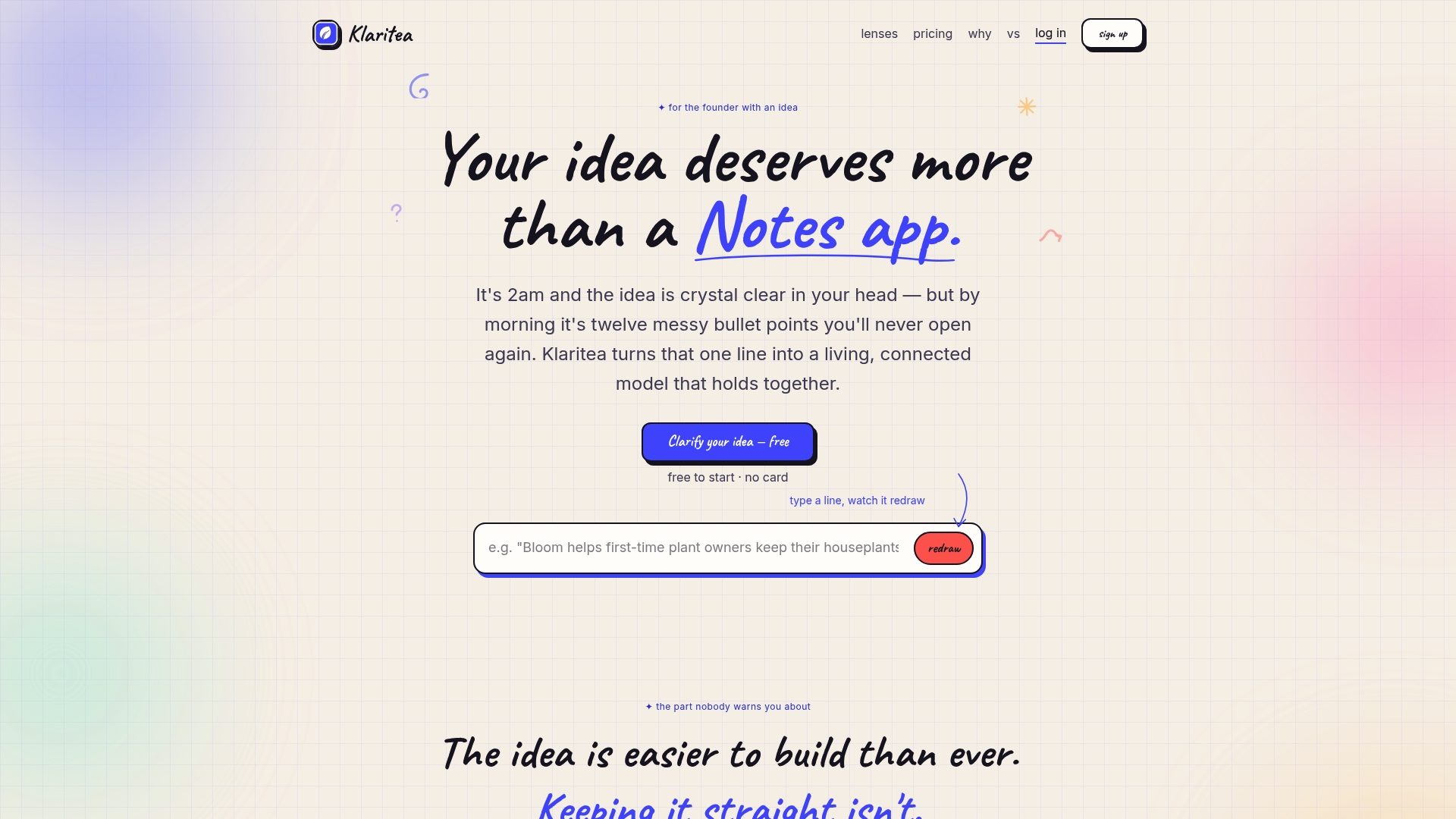
Most founders who build without validating first spend months and real money discovering what a few structured conversations and a landing page test would have told them in a week. Klaritea compresses that learning curve by turning your raw idea into a structured, evidence-grounded plan before you write a line of code.
It is not a research tool you use once. It is a workspace where your idea, your market analysis, your competitive positioning, and your build spec live together and stay connected as your thinking evolves. If you are at the stage where you have an idea but are not sure whether it is worth building, that is exactly where Klaritea is designed to help.
Start your validation process at Klaritea and see how far a single sentence can take you.
Key Takeaways
Validating a business idea requires written hypotheses, bottom-up market sizing, behavioral evidence from real customers, and predefined kill criteria before you invest in development.
| Point | Details |
|---|---|
| Write hypotheses first | Name a specific customer, pain, benefit, and price point before testing anything. |
| Build market size from the bottom up | Top-down TAM claims mislead; start with reachable customers and realistic revenue per customer. |
| Ask about behavior, not opinions | The Mom Test: ask what customers do today, not whether they like your idea. |
| Require behavioral proof | Pre-orders and deposits confirm demand; email signups and compliments do not. |
| Klaritea structures phase-zero validation | Klaritea turns a one-line idea into a connected model with market sizing, competitor analysis, and kill-criteria scoring before you build. |
FAQ
What is the easiest way to validate a business idea?
The fastest route is a combination of 15–20 customer interviews focused on real behavior and a landing page with a pre-order or deposit option. If people will pay before the product exists, demand is real.
How do I know if my business idea is viable?
Viability comes down to three things: enough people experience the problem urgently, the market is large enough to sustain a profitable business, and the unit economics work at a price customers will actually pay.
What counts as a real validation signal?
Signed pilots, deposits, pre-orders, and documented manual workarounds are strong signals. Compliments, survey responses, and "I would definitely use that" are not, because they carry no cost or commitment.
What is an example of business idea validation?
A founder targeting freelance designers builds a simple landing page describing a client communication tool, runs a small paid ad campaign, and offers early access for a deposit. Thirty deposits in 72 hours confirms both demand and willingness to pay before a single feature is built.
How does Klaritea support the idea validation process?
Klaritea takes a one-line idea and generates a structured business model covering ICP, TAM/SAM/SOM, competitive landscape, and feature requirements, with AI advisors challenging assumptions and built-in kill criteria to flag weak spots before you commit resources.