Starting a waste management business in 2026 means picking a focused niche, securing the right permits before you touch a single bin, building a business plan grounded in real local demand, and lining up disposal partnerships before your first truck rolls. Here is the essential roadmap:
- Choose your niche. Municipal, commercial, hazardous, e-waste, construction debris, and industrial waste each carry different regulatory burdens and profit profiles.
- Analyze your local market. Map competitors, identify underserved areas, and research waste stream volumes in your target geography.
- Write a business plan. Cover services, financial projections, operational workflows, and a SWOT analysis.
- Register your business. Choose a legal structure (an LLC is the most common choice for new operators), register your name, and obtain an Employer Identification Number (EIN) from the IRS.
- Get your permits and licenses. Business license, state waste transportation permits, EPA environmental permits for hazardous materials, and commercial driver's licenses (CDLs) for drivers.
- Secure funding. Startup capital for waste management typically runs $160,000 to $500,000 depending on niche and scale.
- Buy or lease equipment. Match truck type and container size to your niche before spending a dollar.
- Hire and train staff. Drivers, operations managers, and safety officers all need role-specific training from day one.
- Build your routes and workflows. Use route optimization software to cut fuel costs and maximize stop density.
- Market and contract. Secure recurring contracts through local advertising, contractor partnerships, and a clear pricing structure.
How to start a waste management business: choosing your niche and market
The single decision that shapes everything else is which type of waste you will handle. Waste management divides into distinct sectors: municipal solid waste, commercial waste, industrial waste, hazardous materials, electronic waste (e-waste), and construction and demolition debris. Each one carries its own certification requirements, equipment needs, and regulatory framework.

Starting broad sounds appealing, but it almost always backfires. A hauler trying to serve residential, hazardous, and construction clients simultaneously spreads compliance resources thin and struggles to build route density. Focusing on one niche first lets you master the permits, train staff correctly, and build a tight geographic cluster of accounts before expanding.
How to identify an underserved niche in your area
Local market analysis is where most aspiring operators skip ahead too fast. Before you register anything, spend time mapping who already operates in your target area, what waste streams they serve, and where the gaps are. The SBA's market research tools are a practical starting point for demographic and business density data.

Look at construction permit activity in your county (a proxy for debris volume), the number of restaurants and retailers (commercial organic waste), and any industrial parks without dedicated hauling contracts. County solid waste management plans, often published by state environmental agencies, show you exactly what volumes move through your region and which sectors are growing.
Pro Tip: Contact your state's environmental agency and request the current list of licensed waste haulers in your county. That list tells you who your competitors are and, more usefully, which waste types have thin coverage.
Waste specialization at a glance
| Niche | Typical permit complexity | Relative startup cost | Key equipment |
|---|---|---|---|
| Municipal solid waste | Moderate | High | Rear-load or automated side-load trucks |
| Commercial waste | Moderate | Moderate–high | Front-load trucks, dumpsters |
| Construction debris | Low–moderate | Moderate | Roll-off trucks, containers |
| Hazardous waste | Very high | High | Specialized containment vehicles |
| E-waste / recycling | Moderate | Moderate | Box trucks, sorting equipment |
| Industrial waste | High | High | Tankers, roll-off, specialized containers |
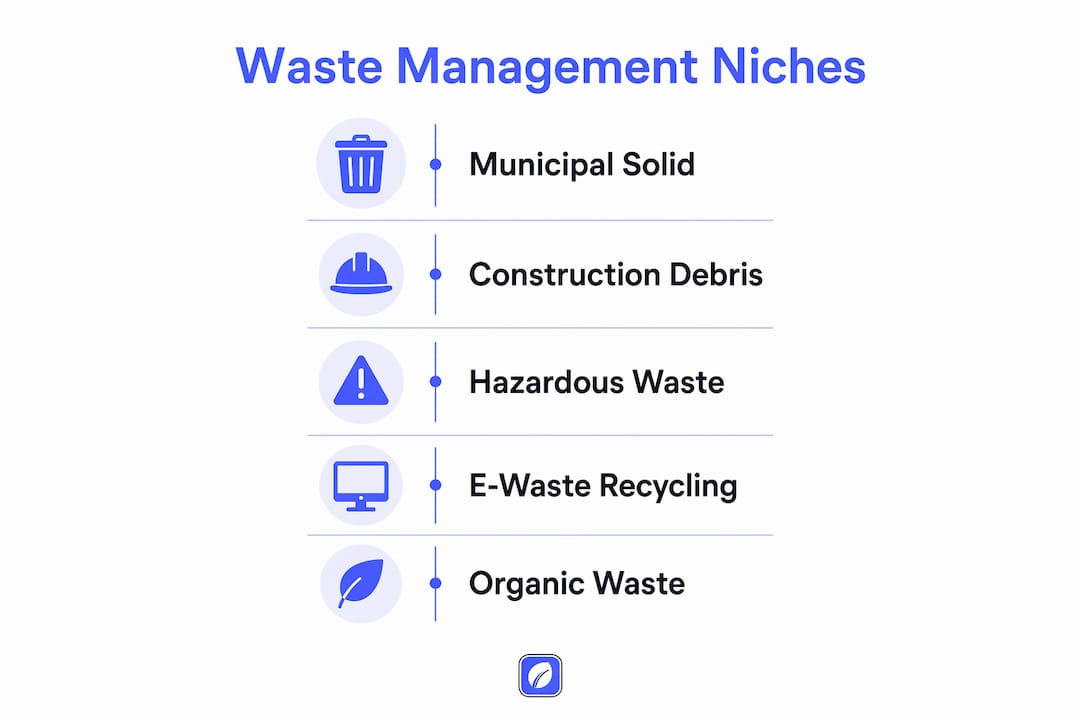
The cost column reflects the $160,000–$500,000 startup range cited earlier. Construction debris and e-waste recycling tend to sit at the lower end; hazardous and industrial operations push toward the top.
What goes into a solid waste management business plan?
A business plan for a waste management startup is not a formality. It is the document that tells a lender whether you understand your cost structure, tells a regulator that you have thought through disposal logistics, and tells you whether the numbers actually work. The SBA's business plan guide outlines the standard sections, and for waste management, a few deserve extra attention.
Your operational workflow section needs to be specific. Which disposal facilities will accept your waste stream? What are their tipping fees? How many stops can a single truck complete per day given your target geography? These numbers feed directly into your pricing model and your break-even timeline.
Key elements your plan must cover:
- Industry and market overview. Local waste volumes, competitor landscape, and regulatory environment.
- Service description. Exactly which waste types you will collect, transport, and where they will be processed.
- Operational plan. Truck routes, driver schedules, disposal facility agreements, and safety protocols.
- Financial projections. Revenue per account, cost per route mile, equipment depreciation, permit fees, and insurance premiums for at least three years.
- Leadership and staffing. Who runs operations, who handles compliance, and what qualifications each role requires.
- SWOT analysis. Honest assessment of your regulatory exposure, capital constraints, and competitive advantages.
Choosing the right legal structure
Most new waste management operators register as a limited liability company (LLC). The LLC structure separates personal assets from business liabilities, which matters a great deal in an industry where environmental violations and vehicle accidents can generate large claims. A sole proprietorship offers simplicity but leaves your personal finances exposed.
Once you choose a structure, register your business with your state's secretary of state office, then apply for an EIN through the IRS. The EIN is required to open a business bank account, hire employees, and file business taxes. Both steps take less than a day online.
What permits and licenses do you need to operate legally?
Regulatory compliance is the primary barrier to entry in waste management, and the EPA makes clear that all required permits must be secured before collection services begin. There is no grace period for operating without them.
The permit stack varies by waste type and state, but the core requirements look like this:
- General business license. Required in virtually every U.S. jurisdiction; obtained from your city or county.
- State waste transportation permit. Most states require a separate permit to transport solid or liquid waste on public roads.
- EPA environmental permits. Mandatory for hazardous waste handlers under the Resource Conservation and Recovery Act (RCRA). The EPA's hazardous waste permitting process involves inspections, detailed facility plans, and financial assurance requirements.
- Commercial driver's licenses (CDLs). Any driver operating a vehicle over 26,001 pounds gross vehicle weight rating needs a CDL. Hazardous materials endorsements are required for drivers transporting regulated hazardous waste.
- OSHA compliance. Workers handling waste must receive training under OSHA's Hazard Communication Standard (HCS) and, for hazardous waste sites, the HAZWOPER standard (29 CFR 1910.120).
State-level requirements add another layer. California's Department of Toxic Substances Control, for example, has its own hazardous waste transporter registration process separate from federal EPA permits. New York's Department of Environmental Conservation maintains its own waste transporter permit program. Check your state environmental agency's requirements early, because processing times vary widely.
Insurance coverage you cannot skip
Three types of insurance are non-negotiable for a waste hauler:
- Commercial vehicle insurance. Covers your trucks and trailers; minimum coverage limits are set by federal and state DOT regulations.
- General liability insurance. Protects against property damage and bodily injury claims from your operations.
- Environmental liability (pollution) insurance. Covers cleanup costs and third-party claims if a spill or contamination event occurs during transport or at a customer site.
Hazardous waste operators typically also carry professional liability coverage. Get quotes from insurers who specialize in environmental and transportation risks, not general commercial carriers, because standard policies often exclude pollution events.
Pro Tip: Hazardous waste permitting is the biggest startup challenge in this industry. Engage an environmental attorney before you submit your first permit application, not after your first rejection.
How do you fund a waste management startup and buy the right equipment?
Startup capital for waste management is real money. The $160,000–$500,000 range reflects equipment, permits, insurance, and working capital, and leasing rather than buying trucks can bring you in at the lower end. The SBA's startup cost calculator helps you build a realistic pre-launch budget line by line.
Common funding paths:
- SBA loans. The SBA 7(a) loan program covers working capital and equipment purchases for qualifying small businesses. Terms are generally more favorable than conventional commercial loans.
- Equipment financing. Many truck dealers and leasing companies offer financing specifically for commercial vehicles, often with lower down payments than bank loans.
- USDA rural development grants. If your service area includes rural communities, USDA programs sometimes fund waste infrastructure.
- Personal savings and angel investors. Early-stage operators often combine personal capital with a small number of investors who understand the industry's recurring-revenue model.
Matching equipment to your niche
Buying the wrong truck is an expensive mistake. Each waste type calls for a specific vehicle configuration:
- Rear-load trucks handle residential and small commercial stops efficiently.
- Front-load trucks serve commercial dumpsters at restaurants, retailers, and office buildings.
- Roll-off trucks are the workhorses of construction debris and large industrial accounts.
- Specialized containment vehicles are required for liquid or hazardous waste transport.
Container sizing matters just as much as truck type. A commercial account generating two cubic yards of waste per week needs a different bin than a construction site generating 30 cubic yards. Mismatching container size to account volume either leaves money on the table or creates overflow complaints that cost you the contract.
Leasing makes sense in the first 12–24 months. It preserves cash for permits, insurance, and working capital while you validate your route density and contract pipeline. Once you have stable recurring revenue, buying tends to be cheaper over a five-year horizon.
How to hire staff and build operational workflows that hold up
The three roles you need to fill before your first route runs are a CDL-licensed driver, an operations manager who understands DOT and OSHA compliance, and a safety officer (which in a small startup is often the same person as the operations manager). Trying to run routes, handle compliance paperwork, and manage customer calls yourself is how new operators burn out in the first six months.
Driver training goes beyond CDL certification. Your team needs to complete:
- DOT hazardous materials training if they transport regulated waste.
- OSHA HAZWOPER training (24 or 40 hours depending on role) for hazardous waste operations.
- Emergency response procedures specific to your waste types.
- Proper waste handling and documentation protocols for each account type.
Standardized workflows are what separate operators who scale from those who stay stuck at three trucks. Every driver should follow the same pre-trip inspection checklist, the same chain-of-custody documentation for regulated waste, and the same customer communication protocol when a pickup is delayed or a container is overfilled. Inconsistency in any of these areas creates compliance exposure and customer churn.
Route optimization software has become standard for competitive haulers, cutting fuel costs and maximizing the number of stops per shift. Pair it with a customer billing system so invoicing runs automatically at the end of each route cycle. For broader operational tracking, workflow automation tools help regulated-industry startups keep compliance documentation current without manual overhead.
Pro Tip: Build your employee handbook around OSHA and DOT requirements from day one. Retrofitting a compliance culture onto an existing team is far harder than hiring into one.
What marketing strategies actually work for waste management startups?
Waste management is a relationship business. Your first ten accounts will almost certainly come through direct outreach, not Google Ads. That said, a credible digital presence matters more than most new operators expect, because commercial clients and property managers will search your name before signing a contract.
Effective marketing channels for a new waste hauler:
- Direct outreach to contractors and property managers. Construction companies, commercial real estate firms, and restaurant groups all need reliable hauling. A direct call or visit beats any ad.
- Local business associations and chambers of commerce. These are where the decision-makers for commercial accounts actually gather.
- Google Business Profile. Free to set up, and it puts you on the map for local searches. Reviews from early customers compound over time.
- Partnerships with recycling facilities and transfer stations. Referrals flow both ways when you have a working relationship with disposal partners.
- Eco-friendly positioning. If your operation diverts waste from landfills or offers certified recycling, say so clearly. Commercial clients with sustainability reporting requirements will pay a premium for documented diversion rates.
Pricing and contract structure
Tiered pricing works well in waste management. Charge by container size, pickup frequency, and waste type, then offer a small discount for annual contracts versus month-to-month. Annual contracts give you predictable revenue and reduce the cost of customer acquisition over time.
Effective marketing combines local advertising, contractor partnerships, eco-friendly positioning, and transparent pricing to attract and retain both commercial and residential customers. The operators who build durable businesses are the ones who make reliability their primary selling point. A missed pickup costs you more in reputation than it does in the refund.
For customer relationship management, a basic CRM tool tracks contract renewal dates, service complaints, and upsell opportunities. Pair it with startup project management software to keep your growth initiatives organized as you add accounts and routes. Secure document management for compliance records and client contracts is also worth setting up early; data room tools built for startups handle exactly this kind of regulated-document workflow.
Expert insights on licensing complexity and niche focus
The operators who launch successfully share one habit: they treat permitting as a pre-launch project, not a parallel task. Hazardous waste permitting in particular involves inspections, financial assurance filings, and state-level reviews that can take many months. Starting the process 12–18 months before your planned launch date is not overcautious; it is the realistic timeline.
Licensing delays are the most common reason waste management startups miss their launch window. An environmental attorney who specializes in your state's regulatory framework will cost money upfront, but a single rejected permit application or a compliance violation in the first year costs far more. Budget for legal counsel the same way you budget for insurance.
Niche focus does more than simplify compliance. Successful operators build dense, recurring contracts in underserved geographic or material-specific niches, which reduces the need for large fleets. A tight cluster of commercial accounts in a two-mile radius generates better margins than a scattered mix of residential and industrial stops spread across a county.
Profit margins depend more on contract quality and disposal efficiency than on fleet size. Establishing agreements with disposal facilities and processing centers before you launch is what separates operators who hit profitability in year one from those who spend year two renegotiating tipping fees. Lock in your backend partnerships first, then sell the front end.
Pro Tip: Begin the permitting process 12–18 months before your planned launch date. Build compliance into your company culture from the first hire, not as a checklist item but as the operating standard everyone is trained to.
Klaritea helps you build the plan before you spend the money
The biggest risk in launching a waste management business is not the competition. It is starting without a clear, connected picture of your market, your costs, and your regulatory path. Most founders discover the gaps after they have already committed capital.

Klaritea is an AI-powered planning workspace that turns a one-line business idea into a structured model covering your market size (TAM/SAM/SOM), competitor landscape, feature requirements, and a build spec you can actually execute. Three AI advisors (Maya for marketing, Devon for business strategy, and Priya for operations and QA) challenge your assumptions and surface the questions you have not thought to ask yet.
Before you spend $160,000 on a truck and permits, build your connected business model with Klaritea. Clarity before capital is how you avoid the mistakes that sink most startups in year one. Start with Klaritea and turn your waste management idea into an execution-ready plan.
Key Takeaways
Starting a waste management business requires a focused niche, pre-secured permits and disposal partnerships, and sufficient startup capital before your first route runs.
| Point | Details |
|---|---|
| Niche focus drives margins | Targeting underserved geographic or material-specific niches builds dense recurring contracts and reduces fleet requirements. |
| Permits come first | All required licenses and EPA permits must be secured before collection services begin, with hazardous waste permitting taking the longest. |
| Startup capital range | Expect $160,000–$500,000 depending on niche; leasing equipment keeps you at the lower end while cash flow stabilizes. |
| Contract quality over fleet size | Profit margins depend more on disposal efficiency and contract quality than on how many trucks you operate. |
| Plan before you spend | Finalizing disposal facility agreements and vendor acceptance before launch prevents costly operational disruptions in year one. |
FAQ
How profitable is a waste management business?
Profitability depends heavily on contract quality and disposal efficiency rather than fleet size. Operators who build dense recurring accounts in a focused niche tend to reach stable margins faster than those who chase volume across multiple waste types.
Is it hard to start a waste management company?
The regulatory burden is the main challenge. Securing business licenses, state waste transportation permits, CDLs, and EPA environmental permits takes time and money, and hazardous waste permitting is particularly complex. Starting with a lower-regulation niche like construction debris reduces that barrier considerably.
What are the four types of waste management?
Waste management generally covers four approaches: source reduction (preventing waste from being generated), recycling and reuse, waste treatment (composting, incineration, chemical processing), and disposal (landfill). Commercial hauling businesses typically operate across the collection and transport phase that feeds all four.
Can you make money from waste management?
Yes, and the recurring-revenue model is one of the industry's strongest features. Commercial and municipal clients sign multi-year contracts, which creates predictable cash flow. The operators who build the most durable businesses focus on contract quality and disposal efficiency rather than expanding their fleet prematurely.