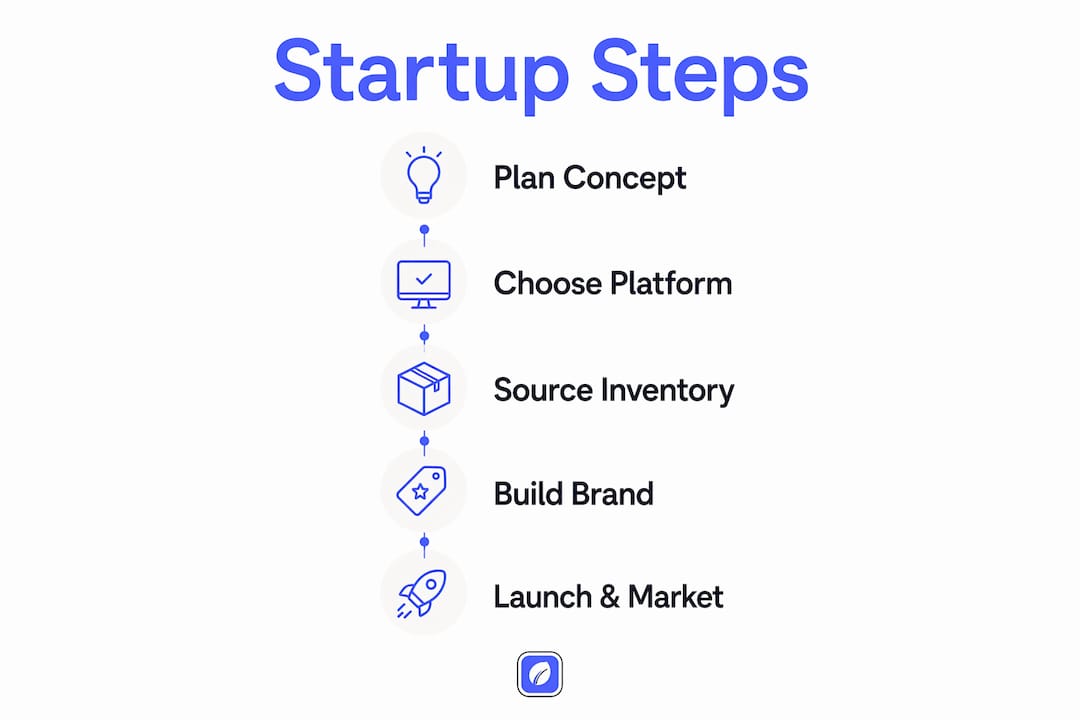
Creating an online boutique comes down to six core steps: define your niche and target market, choose an e-commerce platform, source your inventory, build your store and brand, launch with a marketing plan, and track performance from day one. Most first-time founders get tripped up not by the technical setup but by skipping the planning phase entirely.
- Define your niche before you buy a single product or register a domain
- Write a structured business plan covering your ICP, TAM/SAM/SOM, and competitor landscape
- Choose your platform based on your budget, technical comfort, and growth goals
- Source inventory using a model that matches your cash flow (dropshipping, wholesale, or print-on-demand)
- Build your store with a custom domain, cohesive brand identity, and optimized product pages
- Launch and market through social media, SEO, and influencer partnerships
- Track and optimize using analytics from your first week of sales
Pro Tip: Most boutique founders skip the business plan and go straight to picking products. That's the fastest way to build something nobody wants. Plan for at least two weeks before you touch a platform.
Table of Contents
- How do you plan your boutique concept and find your market?
- Which e-commerce platform is right for your boutique?
- How should you source and manage inventory for your boutique?
- How do you build your store and brand identity from scratch?
- What does a boutique launch and marketing plan actually look like?
- What do timelines and startup costs look like for first-time founders?
- What legal steps do you need to take before selling online?
- How do customer service and order fulfillment affect your boutique's reputation?
- Which analytics tools help you optimize boutique performance?
- Key Takeaways
- FAQ
How do you plan your boutique concept and find your market?
Your niche is the single most important decision you'll make. It shapes your product selection, pricing, brand voice, and the customers you attract. Trying to sell everything to everyone is how boutiques die quietly in year one.
Start by mapping what you're genuinely interested in, then cross-reference that with real market gaps. Are there underserved customers in sustainable activewear? Plus-size formalwear? Handmade jewelry for a specific aesthetic? Passion keeps you going; a market gap keeps you profitable.
- Build a buyer persona with demographics, buying habits, pain points, and style preferences
- Size your market using TAM/SAM/SOM analysis to understand realistic revenue potential
- Run a competitor audit to identify what existing boutiques are missing
- Craft your unique value proposition in one sentence before you write anything else
This is where AI-driven planning tools pay for themselves. Klaritea's connected business model takes your one-line idea and builds out your ICP, market sizing, and competitor analysis automatically, so you're not guessing at spreadsheets. The platform's AI advisory board (Maya for marketing, Devon for business, Priya for ops) actively challenges your assumptions before you spend a dollar on inventory.
Pro Tip: Your value proposition should answer: "Why would someone choose my boutique over the five they already know?" If you can't answer that in ten seconds, keep refining.
Which e-commerce platform is right for your boutique?
Platform choice locks in your costs, your design flexibility, and your integration options for years. The major players each serve different founder profiles.

E-commerce platforms offer customizable storefronts, payment gateway integrations, and inventory management built in. The differences come down to pricing structure, ease of use, and how much you want to customize.
Decision checklist before you commit:
- Does it support your preferred payment gateways (Stripe, PayPal, Shop Pay)?
- Can you customize the storefront without hiring a developer?
- Does it handle inventory tracking and low-stock alerts?
- What are the transaction fees on your expected monthly volume?
- Does it integrate with your fulfillment and shipping tools?
- Is there a free trial or low-cost entry tier to test before committing?
Platforms like Shopify, WooCommerce, BigCommerce, and Squarespace all cover the basics. Shopify is the most beginner-friendly with the largest app ecosystem. WooCommerce gives you more control if you're comfortable with WordPress. BigCommerce suits founders who anticipate scaling fast. Squarespace works well for design-forward boutiques with smaller catalogs.
How should you source and manage inventory for your boutique?
Your sourcing model determines your startup costs, your margins, and how much risk you carry. There's no single right answer, but each model has a clear profile.
Dropshipping lets you offer products without holding inventory. A third-party supplier ships directly to your customer. Startup costs stay low, but you sacrifice branding control and depend entirely on supplier reliability. It's the right starting point for testing demand before committing to bulk orders.
Wholesale buying means purchasing in bulk at reduced rates. You control packaging and branding, but you need storage space and upfront capital. Better margins once you know what sells.
Print-on-demand works for boutiques built around custom designs. No inventory risk, but per-unit costs are higher and production times can frustrate customers expecting fast shipping.
Made-to-order suits premium or artisan boutiques. It eliminates overstock entirely but requires longer lead times and clear customer communication.
- Vet every supplier with sample orders before listing their products
- Set reorder points in your inventory system to avoid stockouts on top sellers
- Build your fulfillment strategy into your business plan from day one, not as an afterthought
- Write your return and shipping policies before you launch, not after your first complaint
How do you build your store and brand identity from scratch?
Branding is not a logo. It's the complete experience a customer has from the first Instagram post to the unboxing. Around 81% of consumers say they need to trust a brand before they'll consider buying, which means your visual identity, voice, and story need to be consistent before you go live.
Store essentials:
- Custom domain with a
.comextension - Mobile-responsive theme (over half of e-commerce traffic is mobile)
- Product pages with SEO-optimized titles, descriptions, and alt text
- Secure checkout with SSL certificate
- Clear return policy and shipping information on every product page
Brand elements to lock in early:
- Logo, color palette, and font suite
- Brand voice (playful, minimal, editorial, earthy)
- A short brand story that explains why this boutique exists
Pro Tip: Use Klaritea's Clarity and Build lenses to pressure-test your brand positioning against your ICP before you finalize anything. It surfaces misalignments between what you think you're selling and what your target customer actually wants.
What does a boutique launch and marketing plan actually look like?
A launch without a marketing plan is just opening a door in an empty building. You need traffic before you need sales.
Pre-launch checklist:
- Test every checkout flow on mobile and desktop
- Set up Google Analytics 4 and Meta Pixel before your first ad
- Create social profiles on Instagram and TikTok at minimum
- Build an email list with a pre-launch landing page offering a discount or early access
- Schedule your first two weeks of content before you go live
Effective boutique marketing combines SEO, social media, influencer partnerships, and paid ads. Instagram remains the primary discovery channel for fashion boutiques. TikTok drives viral moments. Pinterest drives sustained organic traffic for style-focused brands.
- Partner with micro-influencers (10K–100K followers) in your niche for higher engagement rates than celebrity placements
- Encourage user-generated content from your first customers with a branded hashtag
- Run Google Shopping ads once you have at least 20 products live
- Publish SEO-optimized blog content (lookbooks, style guides) to build organic traffic over time
What do timelines and startup costs look like for first-time founders?
Most online boutiques launch in two to six weeks, depending on sourcing lead times and how quickly you finalize your brand. Dropshipping boutiques can go live in as little as two weeks; wholesale models take longer because of minimum order quantities and shipping times.
Typical startup cost categories:
- E-commerce platform subscription: $29–$299/month depending on tier
- Domain registration: roughly $10–$20/year
- Branding (logo, photography): $200–$2,000+ depending on DIY vs. professional
- Initial inventory (wholesale): $500–$5,000+ for a starter collection
- Marketing budget (first 90 days): $300–$1,500 for paid ads and influencer fees
- Legal registration (LLC filing): $50–$500 depending on your state
Stat to know: E-commerce sales in the U.S. are projected to reach $2 trillion by 2030. The market is growing, but so is the competition, which is exactly why structured planning before launch matters more than speed.
Budgeting tips:
- Start with dropshipping or print-on-demand to reduce upfront inventory risk
- Allocate at least 20% of your startup budget to marketing, not just product
- Build a three-month cash reserve before you launch paid advertising
- Track cost-per-acquisition from your first sale, not your first month
What legal steps do you need to take before selling online?
Skipping legal setup is the most common and most expensive mistake first-time boutique founders make. Operating as a sole proprietor offers zero liability protection. If a customer sues or a supplier dispute escalates, your personal assets are exposed.
Forming an LLC creates a separate legal entity that protects your personal finances from business liabilities. File through your state's Secretary of State website. Costs range from $50 to $500 depending on the state.
After forming your LLC, apply for an Employer Identification Number (EIN) for free through the IRS website. You'll need it to open a business bank account, collect sales tax, and hire employees later. Most states also require a seller's permit if you're selling taxable goods, so check your state's requirements before your first transaction.
Keep business and personal finances completely separate from day one. A dedicated business bank account and business credit card make tax filing dramatically simpler.
How do customer service and order fulfillment affect your boutique's reputation?
Inventory management and fulfillment directly affect customer satisfaction and your operating costs. A single bad shipping experience can cost you a customer permanently and generate a public review that follows your brand for years.
Set clear expectations upfront: display processing times on every product page, send automated order confirmation and shipping notification emails, and publish your return policy where customers can't miss it. Respond to customer inquiries within 24 hours. That standard alone puts you ahead of most small boutiques.
For fulfillment, decide early whether you're self-fulfilling, using a third-party logistics provider (3PL), or relying on your supplier to ship directly. Each model has different cost structures and control levels. Self-fulfillment works at low volume; a 3PL becomes cost-effective once you're shipping more than 100 orders per month.
Which analytics tools help you optimize boutique performance?
You can't improve what you don't measure. Google Analytics 4 is the non-negotiable baseline. It shows you traffic sources, conversion rates, bounce rates by page, and revenue attribution. Set it up before your first sale.
Pair GA4 with your platform's native analytics. Most e-commerce platforms provide sales dashboards, abandoned cart rates, and top-product reports. Review these weekly in your first three months.
Beyond traffic, track: average order value, customer acquisition cost, return rate by product, and email open rates. These four numbers tell you whether your boutique is healthy or quietly bleeding cash. When a product has a high return rate, that's a sourcing or description problem. When your acquisition cost exceeds your average order value, your ad targeting needs work.
For AI-powered business strategy tools that go beyond basic analytics, Klaritea's Run & Scale lens helps founders track business model health, not just traffic metrics, giving you a structured view of where your boutique stands against its original plan.
Key Takeaways
Launching a successful online boutique requires structured planning, the right platform, a clear sourcing model, and consistent marketing from day one.
| Point | Details |
|---|---|
| Plan before you build | Define niche, ICP, and TAM/SAM/SOM before choosing a platform or buying inventory. |
| Launch timeline is 2–6 weeks | Dropshipping models can launch in as little as two weeks; wholesale sourcing adds time for minimum orders and shipping. |
| LLC protects your assets | Register an LLC and get an EIN from the IRS before your first sale. |
| Marketing needs a budget | Allocate at least 20% of startup funds to marketing, not just product and platform costs. |
| Track four core metrics | Monitor average order value, acquisition cost, return rate, and email open rates weekly. |
FAQ
What is the fastest way to start an online boutique?
Dropshipping or print-on-demand models let you launch in as little as two weeks because you skip upfront inventory purchasing. Choose a platform, set up your store, connect a supplier, and go live.
How much does it cost to start an online boutique?
Startup costs vary widely: platform fees run $29–$299/month, LLC filing costs $50–$500 depending on your state, and initial marketing budgets typically start around $300 for the first 90 days. Dropshipping models keep upfront costs lowest.
Do I need an LLC to sell clothes online?
You're not legally required to form an LLC, but it's strongly recommended. An LLC separates your personal assets from business liabilities, which matters the moment a customer dispute or supplier issue escalates.
Which e-commerce platform is best for a first-time boutique founder?
Shopify is the most beginner-friendly option with the largest app ecosystem. WooCommerce suits founders comfortable with WordPress who want more customization. BigCommerce works well for founders planning to scale quickly.
How do I market my online boutique with a small budget?
Start with organic Instagram and TikTok content, build an email list before launch, and partner with micro-influencers in your niche. These three channels deliver the highest return at low cost before you invest in paid advertising.