A go-to-market plan is the sequence of decisions that moves a product from "built" to "bought": who you're selling to, what you're promising them, which channel gets you in front of them, and how you'll know it's working. Its one job is to turn product readiness into repeatable customer adoption, not a one-time launch spike.
This guide covers the parts that matter most:
- Target customer (ICP) and value proposition
- Channel and sales motion
- Pricing and packaging
- Messaging and sales enablement
- Metrics and feedback loops
Pro Tip: Pick one beachhead ICP and one primary channel before you write another word of copy. Founders who spread thin across three customer types and four channels rarely learn anything fast enough to matter.
Key Takeaways
A go-to-market plan succeeds when it forces six concrete decisions, ICP, value prop, channel, pricing, messaging, and metrics, into a one-page document your team can execute within 30 days.
| Point | Details |
|---|---|
| Define scope early | Build a dedicated GTM plan only for new products, markets, or pricing changes, not for ongoing marketing work. |
| Lock six components | Nail ICP, value prop, channel, pricing, messaging, and metrics before writing sales copy. |
| Limit channels to two | Score channels by ICP fit and unit economics, then test only the top two before adding more. |
| Track weekly during pilots | Review leading indicators like pilot conversion and time-to-value weekly for the first 90 days. |
| Validate before building | Use a phase-zero tool like Klaritea to model ICP, market size, and competitors before committing engineering time. |
Table of Contents
- What Is a Go to Market Plan, and When Do You Need One?
- The Six Core Components of Every GTM Plan
- How Do You Build a Go to Market Plan Step by Step?
- B2B vs. B2C: How Does Your GTM Approach Change?
- What KPIs Prove Your GTM Plan Is Working?
- How Long Does a Go to Market Launch Take, and What Does It Cost?
- How Do You Build a One-Page GTM Template You Can Use Today?
- What Are the Most Common GTM Mistakes Founders Make?
- How Do You Validate a GTM Plan Before You Build the Product?
- What Should You Do in Your First 30 Days?
- Sources
- FAQ
What Is a Go to Market Plan, and When Do You Need One?
A go to market plan and a marketing plan solve different problems, even though people use the terms interchangeably. A marketing plan is ongoing and covers brand, content, and demand generation over a year or more. A GTM plan is a bounded project tied to a specific launch event: a new product, a new market segment, a repackaged offer, or a pricing model change. It exists to answer one question: how do we get the first wave of customers to adopt this, reliably and measurably.
| GTM Plan | Marketing Plan | |
|---|---|---|
| Purpose | Launch a specific product/market combination | Sustain brand and demand over time |
| Time horizon | Weeks to a few months | Ongoing, usually annual |
| Primary metric | Adoption, activation, pilot conversion | Reach, leads, brand awareness |
A GTM strategy bridges product readiness and customer adoption by pulling product, marketing, sales, and customer success into a single launch objective, rather than letting each function run its own playbook. You need a dedicated GTM plan when:
- You're entering a genuinely new market segment or geography
- You're launching a product that changes your core value proposition
- You've changed your pricing model or packaging structure
- You're running a pre-launch pilot before a paid rollout
The Six Core Components of Every GTM Plan
Every solid go to market plan reduces to six decisions. Skip one, and you'll feel it during launch week, usually as confusion about who owns what. GTM frameworks converge on the same six choices: who to target, the problem you solve, how you reach buyers, what you say, how you convert, and how you measure success.
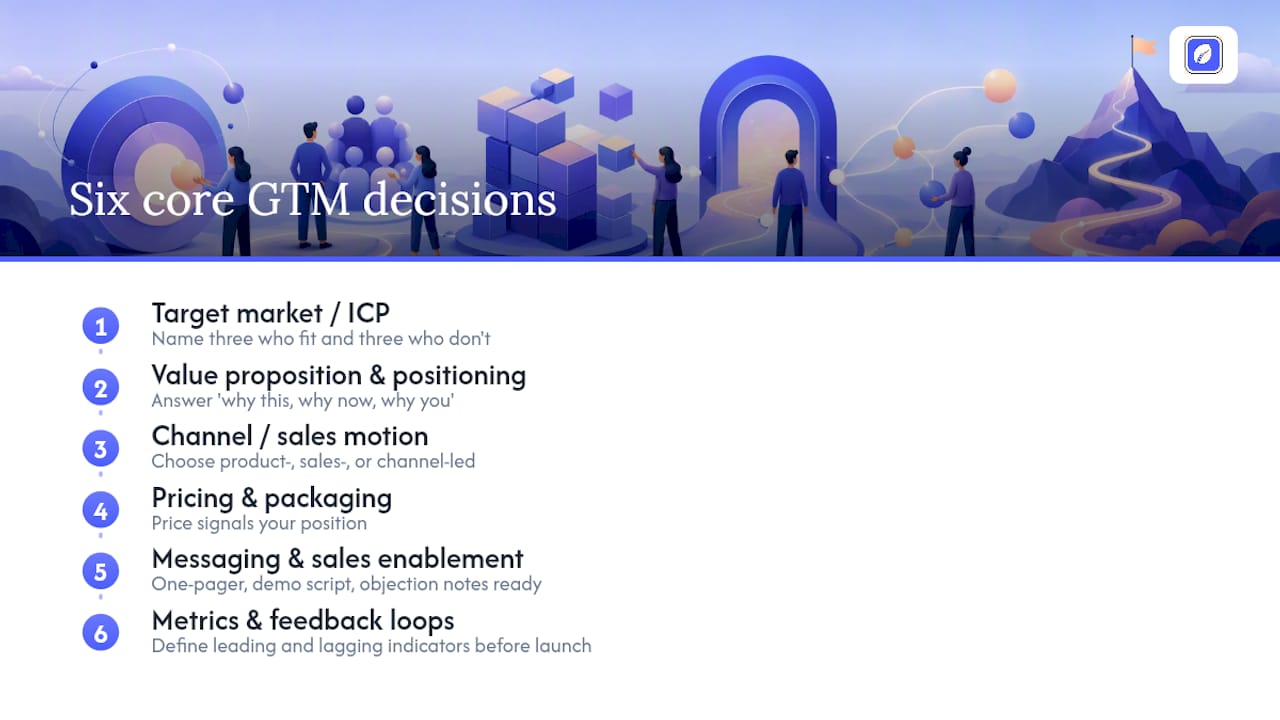
Target market and ICP. Your ideal customer profile needs to be precise enough that you can name three companies or people who fit it and three who don't. "Small businesses" is not an ICP. "Solo consultants billing $150K+ who lose 5+ hours a week to manual invoicing" is.
Value proposition and positioning. State the outcome you deliver, not the feature you built. A clear value proposition answers "why this, why now, why you" in one sentence a prospect can repeat back to a colleague.
Channel and sales motion. Decide whether you're product-led (self-serve trial), sales-led (demos and contracts), or channel-led (partners and resellers). This choice shapes everything downstream, from pricing to hiring.
Pricing and packaging. Your price signals your position. A $19/month tool and a $19,000/year platform tell buyers different stories about who you serve and how seriously to take you.
Messaging and sales enablement. You need a one-pager, a demo script, and objection-handling notes ready before your first real prospect conversation, not after.
Metrics and feedback loops. Define leading indicators (pilot conversion, activation) and lagging ones (retention, CAC) before launch, so week one data means something.
Pro Tip: Write your ICP disqualifiers before your qualifiers. Knowing who you're NOT for keeps your messaging sharp and your sales team from chasing bad-fit leads.
How Do You Build a Go to Market Plan Step by Step?
A practical GTM build sequence follows a dependency chain: you can't choose channels before you know who you're targeting, and you can't write messaging before you've nailed positioning. Here's the nine-step version, with an output and a cheap experiment for each step.
- Define your ICP. Deliverable: a one-paragraph profile with 3 disqualifiers. Experiment: interview 5 people who match the profile and 2 who don't; see if the pitch lands differently.
- Run a competitive scan. Deliverable: a simple grid of 4 to 6 competitors by price, positioning, and channel. Experiment: sign up for a competitor's trial or demo yourself.
- Craft your value proposition. Deliverable: one sentence, tested on 5 strangers who aren't your friends. Experiment: A/B test two headline variants on a landing page.
- Pick your motion and channels. Deliverable: one primary motion, two candidate channels. Experiment: run a $200 test campaign on each channel and compare cost-per-signal.
- Set pricing and packaging. Deliverable: a price list with one tier you'd actually charge a friend. Experiment: quote 5 prospects the price out loud and gauge the flinch.
- Build messaging and sales assets. Deliverable: a one-pager, a 3-slide deck, an email template. Experiment: send the one-pager cold to 10 prospects and track reply rate.
- Plan the sales motion and enablement. Deliverable: a scripted demo flow and an objection list. Experiment: role-play the demo with a non-technical friend and note where they get confused.
- Pilot and measure. Deliverable: 10 to 20 pilot users or customers with defined success criteria. Experiment: track time-to-first-value for each pilot user, not just signup.
- Iterate and scale. Deliverable: a revised plan based on pilot data. Experiment: kill the weaker of your two channels before adding a third.
Each step should be time-boxed. Give yourself a week per step for a solo founder, less for steps that reuse existing research. Assign a single owner per deliverable even if you're a team of two; shared ownership on a GTM step usually means nobody finishes it. Pause and revisit a step if your pilot data contradicts an assumption baked into it. Scale only after you've validated, not before.
Score each channel on ICP fit, speed to signal, and unit economics, then commit to the two highest scorers. Adding a third channel before the first two are proven is the single most common way founders burn a launch budget without learning anything.
B2B vs. B2C: How Does Your GTM Approach Change?
The same product can need a completely different GTM plan depending on who's buying it. A project management tool sold to enterprise IT departments and the same tool sold to freelancers are, in GTM terms, two different businesses.
- Buyer complexity: B2B often means multiple stakeholders and a procurement process; B2C usually means one decision-maker who is also the user.
- Sales cycle: B2B cycles run weeks to months; B2C purchases often close in minutes.
- Channels: B2B leans on outbound sales, LinkedIn, and referrals; B2C leans on paid social, app stores, and influencer or content channels.
- Pricing structure: B2B favors tiered or seat-based pricing with contracts; B2C favors flat subscriptions or one-time purchases.
- Success metrics: B2B tracks pipeline velocity and deal size; B2C tracks activation rate and viral coefficient.
If your buyer needs to justify the purchase to someone else, lean sales-led. If they can decide and pay in one sitting, lean product-led or marketing-led and put your energy into the signup flow instead of a sales deck.
What KPIs Prove Your GTM Plan Is Working?
Track leading indicators weekly and lagging indicators monthly. Confusing the two is how founders celebrate a vanity metric while the business quietly stalls.
Leading indicators tell you early whether the plan is on track: pilot conversion rate (pilots that convert to paying customers, divided by total pilots), time-to-value (days from signup to the user's first meaningful outcome), activation rate (percent of signups who complete a core action), and qualified pipeline growth week over week.
Lagging indicators confirm the plan worked: customer acquisition cost (total sales and marketing spend divided by new customers), lifetime value, monthly revenue ramp, churn rate, and market penetration relative to your defined SAM.
GTM metrics should track adoption and time-to-value, not just awareness, and early-stage teams should adjust channels or messaging based on weekly pilot tracking rather than waiting for a monthly report to confirm what's already gone wrong.
Review pilot metrics weekly for the first 90 days; shift to monthly funnel reviews once you have a repeatable motion.
How Long Does a Go to Market Launch Take, and What Does It Cost?
Most early-stage GTM launches follow a rough arc: 2 to 4 weeks of pre-launch pilots, days 0 to 30 for initial paid or public launch, 30 to 90 days for channel validation, and 90 to 180 days for scaling the winning channel. Compress this if your pilot data is unambiguous; extend it if your first cohort gives mixed signals.
Budget typically splits across five buckets:
- Marketing spend: paid channel tests, content production, landing pages
- Sales enablement: decks, demo environments, CRM setup
- Tooling: analytics, CRM, outreach software
- Customer onboarding: support during the pilot phase, documentation
- Experiments: the smallest bucket, but the one you cut last
A workable rule of thumb: spend more on speed to signal early (cheap tests across two channels) and shift spend toward the winning channel once you have real conversion data. Startups that front-load spend into a single unproven channel tend to run out of runway before they learn whether it works.
How Do You Build a One-Page GTM Template You Can Use Today?
A one-page GTM plan works because it forces decisions instead of descriptions. Fill in these fields:
- ICP: who exactly you're targeting, including disqualifiers
- Core value proposition: one sentence, outcome-focused
- Primary channel: the single channel you're testing first
- Primary KPI: the one number that tells you if it's working
- Pricing signal: your starting price and packaging tier
- 30/60/90 targets: what success looks like at each milestone
Here's a filled-in example row for a fictional invoicing tool: ICP: "solo consultants billing $150K+"; value prop: "get paid 10 days faster without chasing clients"; primary channel: LinkedIn outbound; primary KPI: pilot-to-paid conversion; pricing signal: $29/month; 30-day target: 15 pilot signups.
Pair the one-pager with a launch checklist that assigns a name and a date to each task: ICP validated (founder, day 3), competitor scan complete (founder, day 5), landing page live (founder or contractor, day 10), pilot cohort recruited (founder, day 14), pricing tested with 5 prospects (founder, day 18), sales one-pager finalized (founder, day 20). Copy these rows directly into a spreadsheet and adjust the dates to your own calendar. If you need help sizing your addressable market for the template, a TAM/SAM/SOM breakdown fills that field faster than guessing.
What Are the Most Common GTM Mistakes Founders Make?
The same five mistakes show up again and again: a fuzzy ICP that tries to serve everyone, chasing too many channels at once, skipping the pilot entirely, ignoring time-to-value in favor of vanity signups, and sales compensation that rewards closing deals instead of closing the right deals.
Recovery is usually fast if you catch it early. Within one to two weeks, you can rerun ICP interviews with a narrower profile, kill the weakest channel and reallocate its budget, or add a mid-onboarding check-in to fix a time-to-value problem. Common GTM pitfalls compound as companies scale, which is why fixing process and definitions early costs far less than fixing them after you've hired a sales team around a broken motion. Decide to pivot only when multiple pilot cohorts show the same negative signal; double down when one cohort underperforms but the underlying interest is clearly there.
How Do You Validate a GTM Plan Before You Build the Product?
Phase zero validation happens before a single line of code gets written, and it's where most of the wasted spend in early-stage startups actually starts. A phase zero tool typically produces a clarity scorecard, a modeled ICP, a competitor map, and a one-page GTM output you can act on immediately, instead of a deck full of assumptions nobody tested.
Klaritea builds exactly this kind of connected model from a single one-line idea: it structures your ICP, sizes your TAM/SAM/SOM, scans competitors, and maps the features and requirements your build spec needs, all before you commit engineering time. Founders can use these outputs directly in steps 1 through 3 of the nine-step GTM workflow: ICP definition, competitive scanning, and value proposition drafting.
The business case is straightforward. If your product idea has a fundamental ICP or positioning problem, finding that out in a phase zero exercise costs a few hours. Finding it out after building an app costs the roughly $15,000 many vibe coders spend before realizing the market wasn't there.
Pro Tip: Run your competitor scan before you finalize your value proposition, not after. It's much cheaper to differentiate on paper than to rebrand a shipped product three months in.
What Should You Do in Your First 30 Days?
- Week 1: Run 5 to 8 customer interviews and draft your ICP and disqualifiers. Founder owns this.
- Week 2: Draft your value proposition and run one channel experiment with a small test budget. Founder or marketing owns the experiment; product weighs in on messaging accuracy.
- Week 3: Test your pricing hypothesis with 5 real prospects and draft your sales one-pager. Founder owns pricing; sales (or founder, if solo) drafts the one-pager.
- Week 4: Launch your pilot cohort and set a weekly review cadence. Ops or the founder tracks metrics; escalate to a product decision if two consecutive weeks show the same red flag.
Keep the handoffs simple: product owns the ICP and value prop, marketing owns channel experiments, sales owns pricing conversations, and ops owns the metrics dashboard. In a two-person team, one person just wears two hats, but the ownership split still matters for accountability.
What Actually Determines GTM Success
Most GTM failures aren't strategy failures, they're alignment failures. The founders who win aren't the ones with the cleverest channel; they're the ones who measure honestly and change course within a week of bad data. Chase learning velocity over vanity metrics, every time.

Get a Phase-Zero GTM Plan Before You Spend on Development
Most GTM guides hand you a template and leave you to fill in the ICP, market sizing, and competitor scan by hand, which usually takes weeks of scattered research. Klaritea turns your one-line idea into a connected model instead: a structured ICP, TAM/SAM/SOM sizing, a competitor map, and a one-page GTM output, built with input from three AI advisors covering marketing, business strategy, and operations.
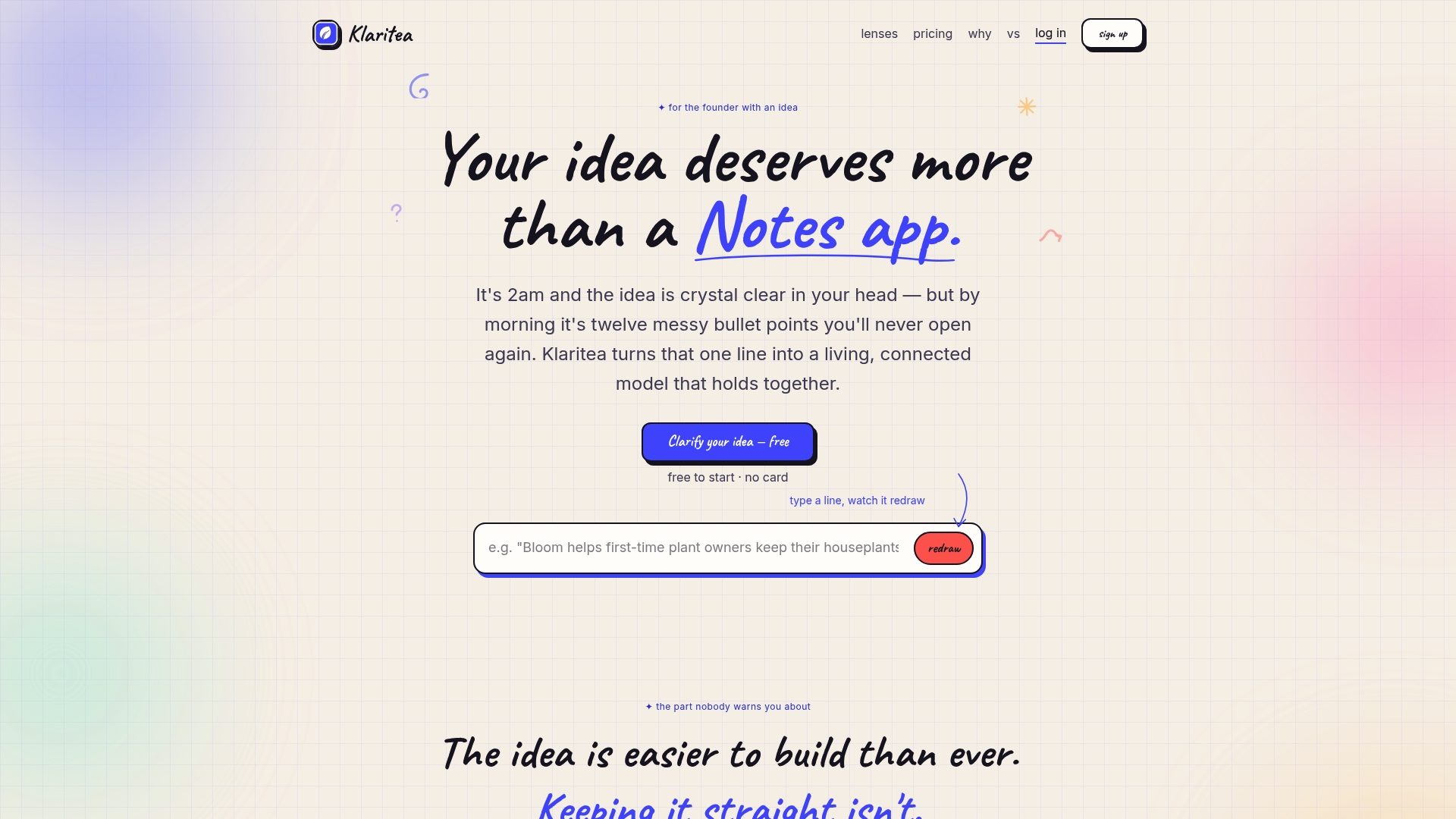
That means you walk into step one of your nine-step GTM workflow with real answers instead of guesses, before you've committed a dollar to engineering. If you're deciding between a few product directions, the clarity scorecards show you where each idea is strong and where it's still fuzzy. Start with your one-line idea and see your GTM foundation take shape in minutes, not weeks.
Sources
- Go-to-Market Strategy Template: The Complete GTM Planning Framework | GTM Playbook
FAQ
What Should Be Included in a Go to Market Plan?
A go to market plan needs six elements: your target ICP, value proposition, channel and sales motion, pricing and packaging, messaging and sales enablement assets, and the metrics you'll use to measure adoption.
What Does a GTM Role Typically Pay?
GTM-focused roles vary widely by title, seniority, and company stage, and public salary data on GTM-specific positions isn't consistent enough across sources to state a reliable figure here.
Is GTM the Same as Sales?
No. Sales is one motion inside a GTM plan, alongside marketing, pricing, and customer success; a GTM plan coordinates all of them around a single launch objective rather than focusing on selling alone.
What Are the Best Go-to-Market Strategies for Startups?
The strongest approach for most early-stage founders is validating ICP and value proposition through pilots before committing to a channel, then scoring and testing only the top two channels rather than spreading across many at once.
How Is a GTM Plan Different From a Marketing Plan?
A GTM plan is a bounded project tied to a specific launch, measured by adoption and activation, while a marketing plan runs continuously and is measured by reach and demand generation over time.