Phase 0, done right, turns a one-line idea into a GitHub-ready build spec: prioritized epics, user stories with acceptance criteria, and a repo scaffold engineers can act on immediately. The next step is not writing code. It's naming your customer segment and value proposition, then mapping the features that serve them into epics before anyone touches a keyboard.
TL;DR:
- Executing Phase 0 effectively ensures clear prioritization, acceptance criteria, and a scaffolded repo, preventing costly rework later.
- Locking in fixed scope and prices for Sprint 0, usually costing $5,000 to $15,000 and lasting 2 to 4 weeks, helps avoid scope creep and surprises.
- Taking time to validate demand with small, inexpensive tests before engineering a full architecture reduces unnecessary infrastructure investment.
- Connecting planning tools and maintaining traceability across the business model, build spec, and development reduces mismatched requirements and scope drift.
- Using a structured approach with real customer data and acceptance criteria improves handoff clarity and minimizes questions during the first development sprints.
Table of Contents
- What Phase 0 Planning Covers and Why Engineers Care
- How Do You Get a One-Line Idea Ready for Engineers?
- Turning Your Phase 0 Model Into a GitHub-Ready Build Spec
- How Long Does Sprint 0 Take and What Should It Cost?
- Handoff Best Practices for Working With Engineers
- Why Connected Planning Beats a Pile of Loose Documents
- Klaritea Turns a One-Line Idea Into a GitHub-Ready Spec
- Sources
- FAQ
What Phase 0 Planning Covers and Why Engineers Care
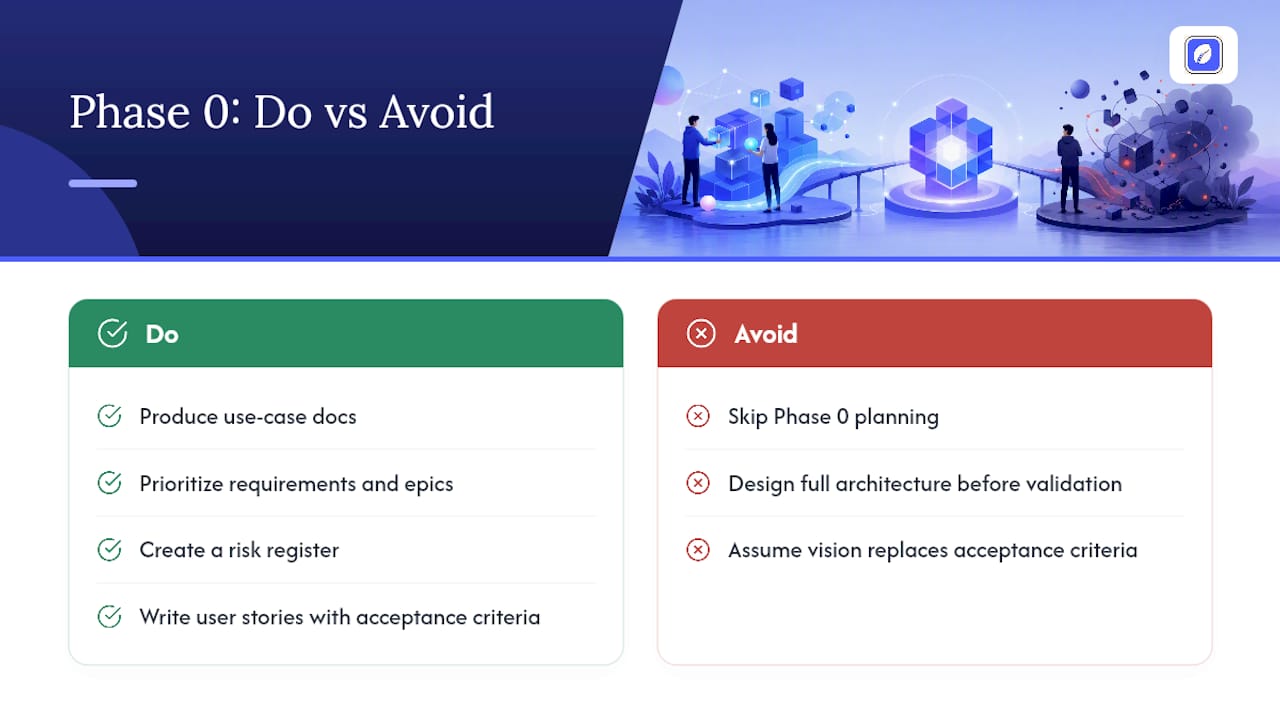
Phase 0 is the work that happens before the first commit: clarifying who the product is for, what it does, and what "done" looks like for each piece of it. Skipping it doesn't save time. It just moves the confusion to week six, when it costs ten times more to fix. Phase 0 planning produces use case documentation, prioritized requirements, and a risk register, which is exactly the material that keeps rework from piling up later.
Engineers don't want a vision statement. They want three things: prioritized epics that tell them what to build first, user stories with acceptance criteria that tell them when a piece is finished, and a repo scaffold that tells them where things live. A milestone plan ties those together with dates and deliverables attached.
One mistake shows up constantly with first-time founders: designing the full technical architecture before anyone has confirmed the business works. It's usually smarter to test demand with a small prototype or an existing managed service before committing engineering hours to infrastructure nobody has asked for yet.
How Do You Get a One-Line Idea Ready for Engineers?
Getting from "I have an idea" to "here's a spec my engineer can build from" follows a fairly predictable sequence. Skip a step and you'll usually pay for it during handoff, when the engineer starts asking questions nobody thought to answer.
- Name your customer segment and value proposition first. Write down three real people (not personas, actual humans you could call) who fit your target segment, and describe the specific value your product gives each of them. This pair anchors every decision that follows, including which features matter and which architecture choices are premature.
- Choose your canvas based on certainty, not habit. A Lean Canvas suits an idea still full of open questions. A Business Model Canvas fits better once you've confirmed real demand and want to formalize revenue streams, channels, and partnerships.
- Define your minimum viable business loop. Steve Blank's framing is useful here: a startup is a search for a repeatable business model, not a search for a feature set. Connect customer, problem, value, revenue, and delivery into one loop before expanding scope.
- Run small, cheap tests for willingness to pay. A landing page, a pre-order, or a manual concierge version of your service tells you more in a week than a finished app tells you in three months.
- Lock in Sprint 0 deliverables and a fixed fee. Before any code gets written, agree on exactly what you'll receive and what it costs.
Pro Tip: Keep your first canvas messy. Sticky notes, a whiteboard, a shared doc, it doesn't matter. The tool matters less than repeating the loop until the model stops changing every time you talk to a customer.
Turning Your Phase 0 Model Into a GitHub-Ready Build Spec
Once the business model holds still, the conversion work is mechanical, but it's the step most founders rush or skip. Every feature on your roadmap needs to become an epic. Every epic breaks into user stories. Every story needs exactly one acceptance criterion that's binary: it either passes or it doesn't. "The login screen looks good" is not an acceptance criterion. "A user can log in with email and password and reach the dashboard within two seconds" is.
Before syncing anything to GitHub, prepare a repo scaffold that includes:
- A README describing the product, its users, and its core loop in plain language
- Architecture notes covering the stack, integrations, and known technical constraints
- Design tokens or a basic style reference if the UI has any custom branding
- Seed issues for your first milestone, already tagged and prioritized
- Issue and pull request templates so contributors follow a consistent format
Group your stories into a milestone plan, with each milestone tied to a deliverable and a clear acceptance bar. Sync to GitHub after a technical advisor or engineer has reviewed the epics for feasibility. Syncing too early means engineers inherit stories that quietly assume a database schema or a third-party integration that doesn't exist yet, and unwinding that after the fact costs more than a second look would have.
How Long Does Sprint 0 Take and What Should It Cost?
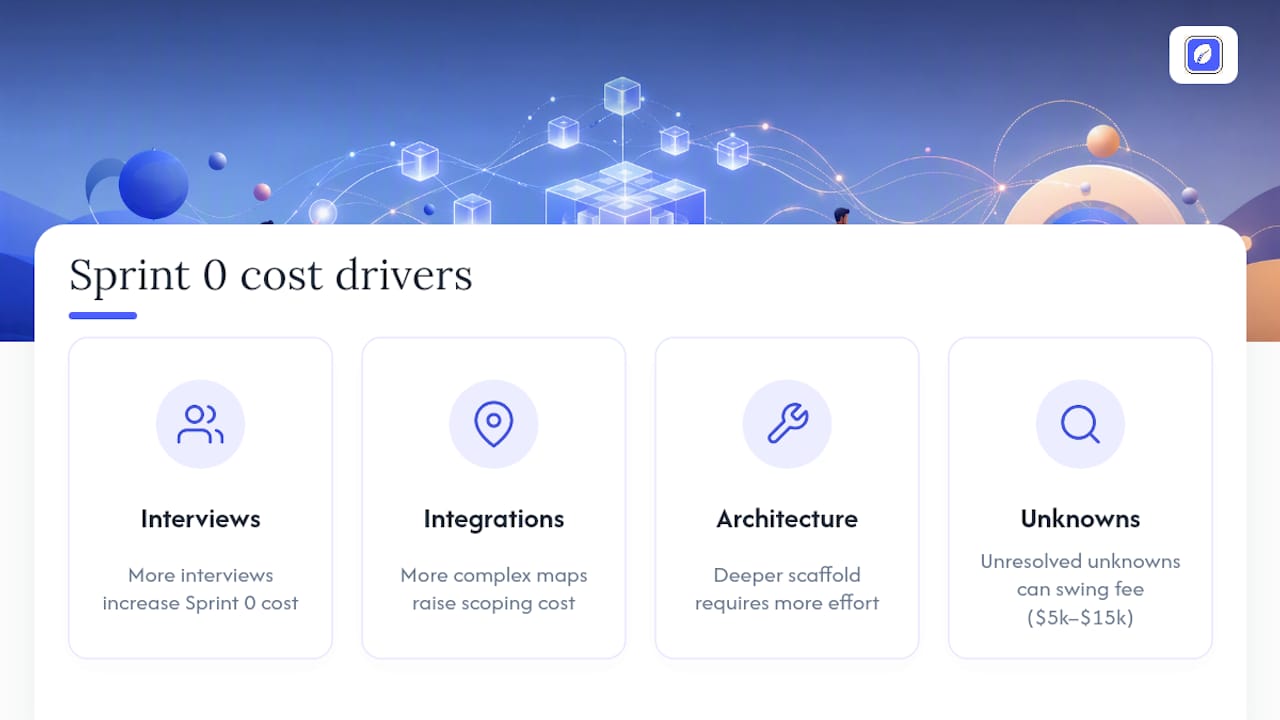
Sprint 0 (the discovery and scoping phase that operationalizes your Phase 0 model) typically runs 2 to 4 weeks and commonly costs $5,000 to $15,000 as a fixed fee, depending on scope and how many unknowns still exist in the plan.
Cost swings mostly on four things: how many stakeholder interviews are needed, how complex your integration map is, how deep the architecture scaffold has to go, and how many genuine technical unknowns remain unresolved. A simple internal tool with one integration costs far less to scope than a marketplace with payments, two-sided onboarding, and a mobile app.
Ask for a fixed-fee Sprint 0 explicitly. A vendor or freelancer who won't commit to a price for scoped epics, stories, a milestone plan, and a scaffolded repo is signaling that scope creep is coming.
Handoff Best Practices for Working With Engineers
The handoff is where most Phase 0 work either pays off or quietly falls apart. Loose acceptance criteria and unclear ownership are the two most common causes of rework after the first sprint starts.
- Write acceptance criteria that are testable and binary, and include at least one edge case per story (what happens when the input is empty, when the network fails, when two users act at once).
- Spell out repo ownership, branching conventions, and who reviews pull requests before the first commit lands, not after a merge conflict forces the conversation.
- Deliver a scaffolded repo or a runbook detailed enough that an engineer who has never spoken to you, can clone it and run it locally within an hour.
- Set go/no-go criteria for each milestone review so "done" isn't a judgment call made in a Slack message.
Pro Tip: Sprint 0 that ends in code scaffolding and a priced milestone plan instead of a narrative document is far less likely to hide extra work that surfaces as a surprise invoice in week three.
Why Connected Planning Beats a Pile of Loose Documents
Most Phase 0 failures aren't caused by bad ideas. They're caused by documents that drift out of sync: the pitch deck says one customer segment, the feature list serves a different one, and nobody notices until an engineer asks why the build spec doesn't match either.
A connected model solves that by forcing every change (a new competitor insight, a repriced feature, a shift in your ICP) to ripple through scope, requirements, and the build spec automatically. Running that model against an AI advisory board that pressure-tests marketing, business logic, and operational gaps catches contradictions faster than a solo founder staring at five open tabs at midnight. Different lenses on the same model (Clarity, Build, Run & Scale) surface different risks without forcing you to rebuild the plan for each audience.
— Karl
Klaritea Turns a One-Line Idea Into a GitHub-Ready Spec
An advantage of connected planning tools is traceability: every plan, roadmap, and AI-generated recommendation ties back to one connected model, so when your value proposition changes, your build spec updates with it instead of quietly going stale.
You type your idea in one line. Klaritea's AI advisory board (marketing, business, and operations perspectives) challenges and fact-checks it, then builds a structured view covering your ICP, TAM/SAM/SOM, competitors, features, and requirements. From there it generates a build spec, clarity scorecards, and a GitHub sync so your epics and stories land in your repo instead of a document nobody opens again. It's worth considering if you want plan-to-handoff traceability without burning through the roughly $15,000 that most vibe-coded builds spend before ever confirming demand.
Check the Klaritea pricing page to see the Free plan, the $19/month Klaritea plan, and the $99/month Pro plan (which includes GitHub sync and exports to Notion and Confluence).
Sources
- Business Model Canvas: A First-Time Founder's Guide - DEV Community
- What Is Sprint Zero (Sprint 0) and What Should It Actually Cost? - Leanware
- Why Phase 0 matters in product development - SGW Designworks
FAQ
What Is Phase 0 in Product Development?
Phase 0 is the planning stage before any code gets written, where founders define their customer segment, value proposition, and feature scope. It produces use case documentation, prioritized requirements, and a risk register that inform every later phase.
How Do I Turn a Business Canvas Into GitHub Issues?
Break each canvas feature into an epic, then split each epic into user stories with one testable acceptance criterion apiece. Sync those stories to GitHub issues once a technical reviewer has confirmed feasibility, ideally alongside a scaffolded repo with a README and architecture notes.
How Much Does a Sprint 0 Cost?
Sprint 0 typically runs $5,000 to $15,000 over 2 to 4 weeks, depending on scope, integration complexity, and how many technical unknowns remain. Ask for a fixed fee tied to specific deliverables before starting.
Should I Use a Lean Canvas or a Business Model Canvas?
Use a Lean Canvas when your idea still has open questions about customers or demand, since it's faster to iterate. Switch to a full Business Model Canvas once you've validated demand and need to formalize revenue and channel details.
Does Klaritea Support GitHub Sync?
Yes. Klaritea's Pro plan, priced at $99 per month on the pricing page, includes GitHub sync so your build spec, epics, and stories move directly into a repo instead of staying locked in a planning document.