Treat every AI answer as a first draft, not a finished fact. Break the response into individual claims, ask the model for its sources, then leave the chat window entirely and verify those claims against independent evidence. Run suspect material through an automated hallucination checker to see what deserves the closest look with tools like BabyLoveGrowth's AI Citation Audit, and send anything with real stakes, medical, legal, or financial, to a human expert before you act on it.
TL;DR:
- Automated tools can flag unsupported claims, but lateral reading across authoritative sources remains essential for verifying AI-generated information.
- High-stakes claims related to health, law, or finance require expert review to avoid dangerous errors that automated tools alone cannot catch.
- Nearly half of medical references used by AI are fabricated, making independent source verification crucial for accurate fact-checking.
- Breaking responses into discrete claims and checking each against primary documents helps prevent oversight and ensures thorough validation.
- Building repeatable verification routines with tools and human review turns fact-checking from a burden into a quick, reliable step.
Table of Contents
- 7 Steps to Fact Check AI Outputs
- Lateral Reading: The Core Skill Behind Manual Verification
- Tools That Help You Triage What to Check First
- When You Need a Human Expert, Not Just a Tool
- What Human-in-the-Loop Review Actually Looks Like
- Karl's Take: Speed and Verification Aren't Opposites
- Sources
- FAQ
7 Steps to Fact Check AI Outputs
Most people read an AI answer top to bottom and either accept it whole or reject it whole. Neither works. The fix is to slice the response apart and check the pieces separately.
- Fractionate the response. Split the answer into discrete, checkable claims instead of judging it as one block.
- Ask the model for citations. Request sources for each claim and copy the exact titles, names, and numbers it gives you.
- Open new tabs and read laterally. Leave the AI interface and check the claim against independent, authoritative sources rather than asking the same tool to grade itself.
- Verify dates, quotes, and originals. Trace quotes back to full documents, not just the snippet the AI surfaced.
- Run a hallucination checker. Use an automated tool to triage which claims need the most scrutiny before you spend time on manual review.
- Flag, correct, or cut unsupported claims. Mark anything you cannot confirm rather than letting it slide into your final draft.
- Escalate high-impact items. Send anything with legal, medical, or financial consequences to someone qualified to sign off on it.
Pro Tip: Keep a running log of claims you have verified and where you found the confirmation. It turns fact-checking into a five-minute habit instead of a fresh investigation every time.
Lateral Reading: The Core Skill Behind Manual Verification
Lateral reading means leaving the AI's answer on screen and opening new tabs to check the claim elsewhere. It is the most effective manual method for verifying AI-generated claims, and it beats asking the same chatbot to double-check itself, because a model that got a fact wrong has no built-in way to notice its own error.
Fractionation is what makes lateral reading manageable. A single AI paragraph often buries three or four separate claims, a statistic, a causal statement, a date, an attribution. Pull each one out and search it on its own.
Where to check depends on the claim type:
- Official government or institutional sites for regulations, statistics, and policy
- Peer-reviewed journals for scientific or medical claims
- Archive scans or primary documents for historical facts
- Reputable news outlets with named reporters for current events
University library guides from schools like UMD and VCU teach this exact process to students evaluating AI-generated research.
Here is a mini walk-through. Say an AI tool tells you "the FDA approved semaglutide for weight loss in 2021." Fractionate it: (1) semaglutide, (2) FDA approval, (3) weight loss indication, (4) year 2021. Search "semaglutide FDA approval weight loss" directly on the FDA's own database rather than a summary article. You will find the actual approval was for Wegovy in 2021, a specific brand and dose, not a blanket approval of the drug for every use. That nuance is exactly what lateral reading catches and a single AI answer often flattens.
| Claim type | Best place to check | What you're confirming |
|---|---|---|
| Statistic or study finding | Peer-reviewed journal or original study | Number, sample, and context match |
| Historical fact | Archive or primary document | Date and sequence of events |
| News event | Named reporter at a reputable outlet | Timing and attribution |
| Regulatory or legal claim | Government or agency site | Current status, not outdated rule |
Tools That Help You Triage What to Check First
Not every claim deserves the same amount of scrutiny, and this is where automated tools earn their place. They do not replace lateral reading. They tell you where to spend your lateral reading time.

Two different tool categories get confused constantly. AI detectors try to answer "did a machine write this text?" Hallucination checkers ask a completely different question: "are the claims in this text actually true?" You want the second category for fact-checking.
A few tools worth knowing:
- Verfai scans a document or output and flags claims that look unsupported or inconsistent, giving you a starting shortlist rather than a full research report.
- ASURIQ produces color-coded badges, green, amber, red, as a quick triage signal, though its own guidance stresses combining that with human checks against primary records like PubMed or EDGAR filings for domain-specific claims.
- TrueStandard leans on multi-model agreement as a reliability signal, since independent models rarely invent the same wrong fact in the same way.
- Lenz structures the full pipeline: extract claims, triage by impact, run automated flags, then route the highest-risk items to lateral reading and expert review.
Pro Tip: Run the same claim through two different checkers if the stakes are high. Agreement between independently built tools is a stronger signal than any single tool's confidence score.
All of these share the same limit: false positives happen, coverage gaps exist for niche topics, and none of them replace a human reading the primary source.
When You Need a Human Expert, Not Just a Tool
Some categories of claim are too risky to clear with tools and lateral reading alone. Medical dosing, legal thresholds, financial guidance, and safety-critical instructions fall into this group because a wrong answer has real, immediate consequences, not just an embarrassing correction later.
Ask these questions before you publish or act on an AI claim:
- How severe is the impact if this claim turns out to be wrong?
- Is this a novel situation with no established precedent to check against?
- Does this touch a regulated area, healthcare, law, or finance, where AI lacks the contextual judgment a specialist has?
- Who downstream relies on this being correct?
If any answer points toward high stakes, package your work for an expert: the original claims, the sources you found, and any tool output you ran. A concise packet gets you a faster, better review than handing someone a raw AI transcript. Teams building pitch materials or investor-facing documents run into this constantly, since a single unverified market figure can undercut an entire deck's credibility.
What Human-in-the-Loop Review Actually Looks Like
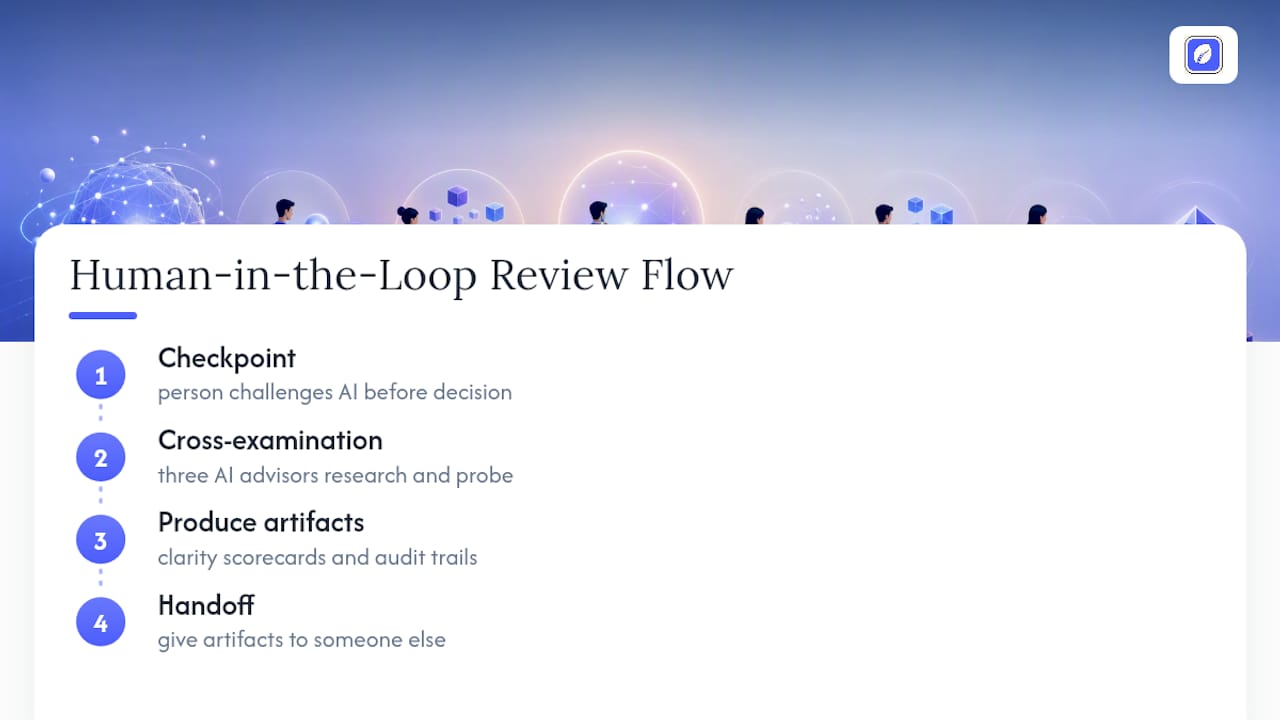
The fastest way to cut hallucinations is to build checkpoints where a person, or several, challenges the AI's output before it becomes a decision. Klaritea's advisory board model does this by design: three AI advisors research and cross-examine a startup idea, and the resulting clarity scorecards and audit trails give founders a traceable record of what was checked and why. Adopting that same habit, checkpoints plus artifacts you can hand to someone else, is the single most transferable practice in this entire article.
Karl's Take: Speed and Verification Aren't Opposites
Most people treat fact-checking as friction that slows AI down. It doesn't have to. Build a triage checkpoint into your workflow once, using a claim template you reuse every time, and verification becomes a five-minute habit rather than a chore. The tools help you prioritize. They don't replace your judgment, and they never will.
— Karl
Sources
AI-generated citations look real right up until you try to find them. That is the danger: a fabricated reference is formatted exactly like a real one, complete with a plausible journal name and page range.
Check every citation with the same short routine. Search the exact title in quotation marks. Look up the DOI or PMID if one is given. Then open the original source and read the actual passage the AI claims supports its point, not just the abstract.
Watch for these red flags:
- Lateral reading research (PMC)
- Artificial Intelligence (AI) and Information Literacy: Fact-checking AI with Lateral Reading — UMD Libraries
The scale of the problem is worth knowing. A review of medical content generated by ChatGPT found that 47% of its references did not exist at all. Nearly half.
That statistic also explains why "faithfulness" checks fall short. A faithfulness check confirms an AI's output matches whatever document you fed it. It says nothing about whether that document was accurate in the first place. Genuine verification means checking claims against independent sources, not just tracing them back to input material that could itself be wrong. For quotes, statistics, and legal or medical claims specifically, search the exact phrase in quotation marks alongside the source's name. If nothing surfaces outside the AI's own answer, treat the claim as unconfirmed.
FAQ
Is AI Accurate for Fact-Checking?
AI can help surface claims worth checking, but it is not reliably accurate on its own. Treat any AI-generated fact as a lead, then confirm it through lateral reading and independent sources before trusting it.
What Is the 30% Rule in AI?
There is no single, widely recognized "30% rule" in AI fact-checking with a fixed definition. If you've seen the term used elsewhere, treat it as informal shorthand rather than an established standard, and rely on documented methods like fractionation and lateral reading instead.
How Do You Fact Check AI Responses?
Break the response into individual claims, ask the AI for citations, then verify those citations and claims against independent sources outside the chat window. Run the claims through an automated hallucination checker for triage, and send anything high-stakes to a qualified expert.
What Did Stephen Hawking Warn Us About AI?
Stephen Hawking warned that artificial intelligence, if developed without careful oversight, could eventually outpace human control and pose risks to humanity's long-term future. His comments focused on advanced, general AI systems rather than the everyday chatbot outputs this article covers, but the underlying caution, don't assume a system understands consequences the way a person does, still applies to daily fact-checking habits.