The fastest way to write an elevator pitch is to fill in one sentence: [Target customer] uses [company] to [specific outcome] by [unique mechanism]. Say that in about 15 seconds, and if you have a second sentence, use it for traction and keep the whole thing under 30 seconds. The goal isn't to explain your company. It's to earn a follow-up question. Y Combinator pushes founders toward exactly this kind of predigested sentence, and it's the same discipline behind Klaritea's approach to phase zero planning: get the one-liner right before you build anything on top of it.
TL;DR:
- A one-liner pitch should clearly identify the target customer, the outcome they will experience, the mechanism that delivers it, and at least one proof point.
- Pitches that include vague buyer segments or feature dumps are weak; specify your customers and focus on measurable results with proof.
- Delivery should be conversational, ending with a question, and practicing on non-technical listeners helps eliminate jargon and refine clarity.
- When lacking traction, emphasize founder-market fit and early signals like pilots or survey responses instead of unverified market size claims.
- Tools like Klaritea can transform a one-liner into a detailed model with market sizing and competitive insights, preventing costly building before validation.
Table of Contents
- Six Elevator Pitch Examples for Different Startup Types
- The Anatomy of a Pitch That Actually Lands
- How to Tailor Your Pitch for the Room You're In
- Common Mistakes and a Pre-Pitch Checklist
- Why a One-Liner Is Just the Starting Point
- Turn Your One-Liner Into a Pitch-Ready One-Pager
- Sources
- FAQ
Six Elevator Pitch Examples for Different Startup Types
Every one of these follows the same skeleton: name the buyer, name the outcome, name the mechanism, then back it with one number. Swap in your own details, but keep the shape.
1. B2B SaaS
"Regional accounting firms use Ledgerly to close monthly books three days faster by auto-matching bank feeds to invoices without manual reconciliation." Add the proof: "We're live with 14 firms, and the average client cut close time from nine days to six." This works because it names a specific buyer (regional firms, not "businesses") and a number an investor can picture.
2. Two-sided marketplace
"Freelance welders use MetalMatch to book fabrication shop time within 48 hours, while shop owners fill idle equipment hours they'd otherwise write off." Marketplace pitches fail when they describe only one side. Naming both sides in one breath signals you understand the harder problem, which is liquidity, not just demand.
3. Consumer AI product
"Busy parents use Snapmeal to plan a week of dinners in under two minutes by turning a fridge photo into a grocery list and recipe set." Consumer pitches live or die on the time or money saved. "Under two minutes" beats "quickly" every time, because a judge or angel can test that claim in their head immediately.
4. Fintech
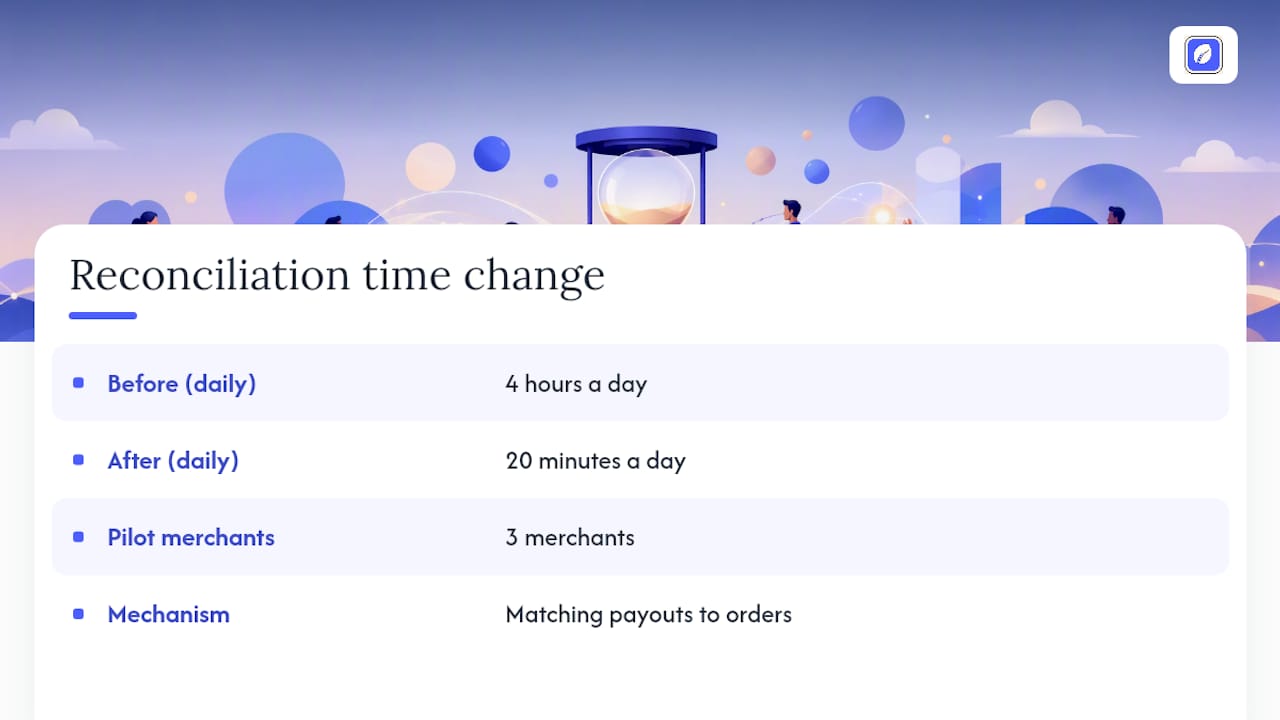
"Mid-size e-commerce brands use Recon to close their daily payment reconciliation in minutes instead of hours by matching Stripe payouts against orders automatically." Add: "Three pilot merchants cut reconciliation time from four hours a day to twenty minutes." Fintech pitches need a mechanism that sounds boring and specific. Vague words like "streamlined" read as filler; "matching payouts against orders" reads as a real product.
5. Hardware or IoT
"Commercial greenhouse operators use SoilSense to cut water use by 20% by pairing soil moisture sensors with automated drip valves." Hardware pitches often drown in specs. Skip the sensor model number and lead with the outcome a grower actually cares about, then use the pilot number as your one proof point.
6. Pre-seed idea with no traction yet
I spent six years running clinic operations and watched this exact problem drain revenue every week. I'm looking for five clinics willing to pilot this for free." When you have no traction, the Bract Agency's 60-second framework suggests leaning on "why you" instead of inflating a market-size number nobody in the room can verify.
The Anatomy of a Pitch That Actually Lands
A pitch has five working parts, and each one answers a specific question in the listener's head before they ask it out loud.
- Target customer answers "Who exactly buys this?" Name a segment, not a category. "Small businesses" answers nothing; "10-person dental practices" answers everything.
- Outcome answers "So what?" It's the measurable change your customer experiences, stated as a number or a clear before/after.
- Mechanism answers "How will this happen?" This is the one sentence investors actually lean forward for, because it's where they judge whether you understand your own product.
- Traction answers "Does anyone care yet?" One pilot number beats a paragraph of adjectives.
- The ask answers "What do you want from me?" Without it, the conversation just stops.
Here's a before and after from a real pattern founders fall into:
Before: "We're building an innovative platform that leverages AI to help businesses optimize their workflow and drive growth."
After: "Boutique law firms use ClauseCheck to cut contract review time in half by flagging non-standard clauses automatically. We're in pilots with six firms."
The rewrite drops every adjective and replaces it with a name, a number, or a verb. Y Combinator is blunt about this: if a non-expert can't follow your pitch, it's too complicated, not too simple.
If you have limited traction, don't paper over it with a giant total addressable market claim. Lean on founder-market fit instead, the specific reason you're the right person to solve this, plus whatever early signal you do have, even if it's just survey responses showing willingness to pay.
How to Tailor Your Pitch for the Room You're In
The same one-liner needs different framing depending on who's listening, and pacing matters as much as wording.
- For investors, lead with market size implicitly through your buyer segment, and be ready with one-line answers to the three questions that always follow a good pitch: why you, how big, and how you'll get customers. That's documented investor behavior, not a guess, so script those three answers before you walk into the room.
- For partners, swap the outcome for something that benefits their business specifically, like new customer volume or reduced support load, rather than your own growth metric.
- For customers, cut the mechanism down to almost nothing and spend your words on the outcome. They don't care how it works; they care what changes for them.
Delivery matters more than most founders admit. Speak at a conversational pace, not a rehearsed one, and end on a question, not a period. "Can I send you the two-page version?" gets a yes far more often than a pitch that just trails off.
Pro Tip: Run two drills before any real pitch. First, say your one-liner out loud with a timer and cut it until it's under 15 seconds without losing the mechanism. Second, record a 60-second expansion on your phone and play it for someone outside your industry. If they can't repeat back what you do, the pitch still has jargon hiding in it.
Practicing on a non-technical listener is the fastest way to find the words that need to go, according to Y Combinator's own pitch guidance.
Common Mistakes and a Pre-Pitch Checklist
Most weak pitches share the same five habits, and each has a one-line fix.
- Jargon without a plain-English backup. Fix: replace any word a smart 12-year-old wouldn't know with a number or a verb.
- A vague buyer like "businesses" or "consumers." Fix: name the actual segment, down to size or role.
- No ask at the end. Fix: always close with a specific request, like intros, a pilot, or a meeting.
- A feature dump instead of one outcome. Fix: pick the single change your customer feels most, and cut the rest.
- Weak or missing proof. Fix: one pilot number or one customer quote beats a paragraph of claims.
Run this checklist before any pitch opportunity:
| Checklist item | What it prevents |
|---|---|
| Named a specific buyer segment | Vague, forgettable pitches |
| Stated one measurable outcome | Feature dumps with no clear payoff |
| Explained the mechanism in one clause | Confusion about how it actually works |
| Included one proof point | A pitch that sounds like speculation |
| Ended with a specific ask | Conversations that just fizzle out |
Say your pitch to a friend outside your industry. If they can't repeat the outcome back to you in their own words, revise it again before your next real conversation.
Why a One-Liner Is Just the Starting Point
The one-liner is a compression exercise, and that's exactly its value: if you can't fit your business into one sentence, you probably haven't finished thinking it through yet. But investors who ask a follow-up question want the layer underneath the sentence, the market sizing, the competitor landscape, the actual build plan, and most founders haven't done that work before they're standing in the room.
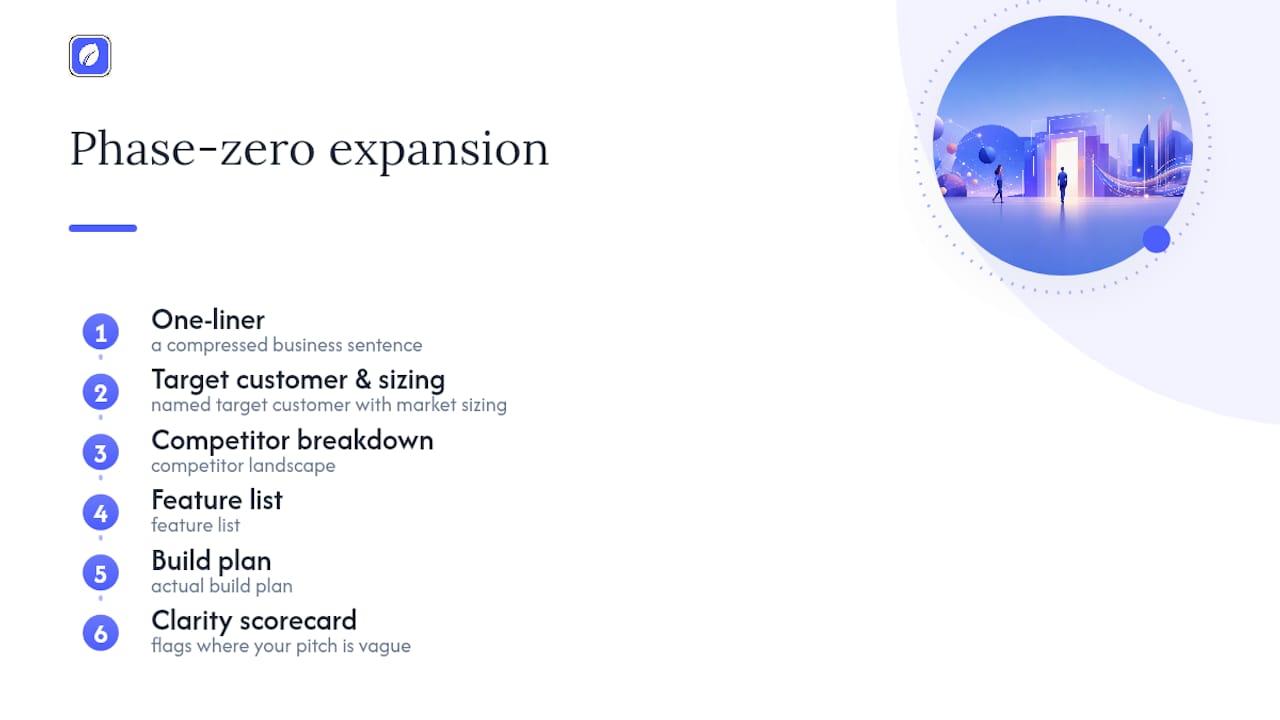
That's the gap a phase zero process is built to close. You start with the same one-liner covered in this article, and it is expanded into a connected model: a named target customer with market sizing, a competitor breakdown, a feature list, and a clarity scorecard that flags where your pitch is still vague. The output isn't just talking points; it's a structured basis for a pre-seed pitch deck you can actually hand someone.
The bigger cost this prevents is downstream, not upstream. Founders routinely sink thousands into building before they've validated the one-liner that was supposed to guide them, and most of that spending never returns anything. Getting clarity before you write code, not after, is the entire premise of the phase zero approach.
Turn Your One-Liner Into a Pitch-Ready One-Pager
This tool takes the exact sentence you just built and turns it into something you can actually hand to an investor or partner, or to get early traction by submitting to directories through StartupSubmit. Type your one-liner in, and an AI advisory board, with advisors covering marketing, business strategy, and operations, pressure-tests it against market data, then builds out a connected model: your target segment, a market size estimate, competitor positioning, and a clarity score that shows exactly where your pitch is still soft.
From there you get a printable one-pager and a build spec you can sync to GitHub or export to Notion, so the same clarity work that sharpened your pitch also becomes the plan your team builds from. The free tier lets you run your own one-liner through this process today and see your clarity score before you spend a dollar on development. Head to Klaritea's product page to see how the connected model works, or start directly with your one-line idea and watch it turn into a structured plan you can actually pitch from.
Sources
- How to Pitch Your Company | Y Combinator
- How to craft your pitch elevator: The 60-second framework that gets you the room • The Bract Agency
- Founder elevator pitch: the Mad Libs formula (2026) | Causo Hub
FAQ
What is the fastest way to write an elevator pitch?
Fill in this formula: [Target customer] uses [company] to [specific outcome] by [unique mechanism], then add one proof point. That's the Mad Libs pattern most practitioner guides converge on.
How long should a startup elevator pitch be?
One sentence should take about 15 seconds to say, and a two-sentence version with traction should stay under 30 seconds. Investopedia defines the broader format as a 30 to 60 second summary that ends in a call to action.
What if my startup has no traction yet?
Lead with founder-market fit and a specific early signal, like a pilot conversion or survey data, rather than a speculative market-size number. That trade-off is standard advice for pre-seed founders.
What three questions should I be ready to answer after my pitch?
Investors typically follow up with "Why you?", "How big is this?", and "How will you get customers?" Have a one-line answer ready for each before you pitch.
Can Klaritea help me expand a one-liner into a full pitch deck?
Yes. Klaritea turns a single-line idea into a connected model covering market sizing, competitors, and a clarity score, which then feeds into a pre-seed pitch deck or a printable one-pager.