Run small, fast usability tests on lead-like early adopters, not average users, and measure what people actually do instead of what they say. Mix guerrilla sessions with moderated remote calls, following the approach Jakob Nielsen built his reputation on, and layer in the lead-user screening method Eric von Hippel pioneered. A phase-0 planning tool helps you frame the hypotheses before you recruit anyone.
TL;DR:
- Testing should focus on early adopters who have faced the problem recently and are willing to co-create, rather than average users or those without genuine engagement.
- Recruiting channels should prioritize existing users, niche communities, trusted partners, and targeted outreach, with screener filters for problem experience, innovation behavior, and budget authority.
- Use quick guerrilla or moderated remote testing in early stages, ensuring each round addresses the most critical friction points before progressing to larger-scale validation.
- Track behavioral signals such as task success, retention at 30 and 90 days, and feature adoption, rather than relying solely on satisfaction scores or testimonials.
- Pair iterative fixes with transparent updates to testers, and develop a phase-0 hypothesis-driven plan to align testing questions directly with product hypotheses and avoid building features nobody asked for.
Table of Contents
- Who Are Early Adopters, and Why Do They Matter Most?
- How Do You Find and Recruit Early Adopters for Testing?
- Which Usability Testing Method Fits Your Stage?
- What Should You Measure, and For How Long?
- How Do You Turn Testers Into Long-Term Advocates?
- How Does Phase-0 Planning Sharpen Your Test Design?
- A Practitioner's Quick-Start Checklist
- A Faster Way to Design Your Test Plan Before You Recruit
- Sources
- FAQ
Who Are Early Adopters, and Why Do They Matter Most?
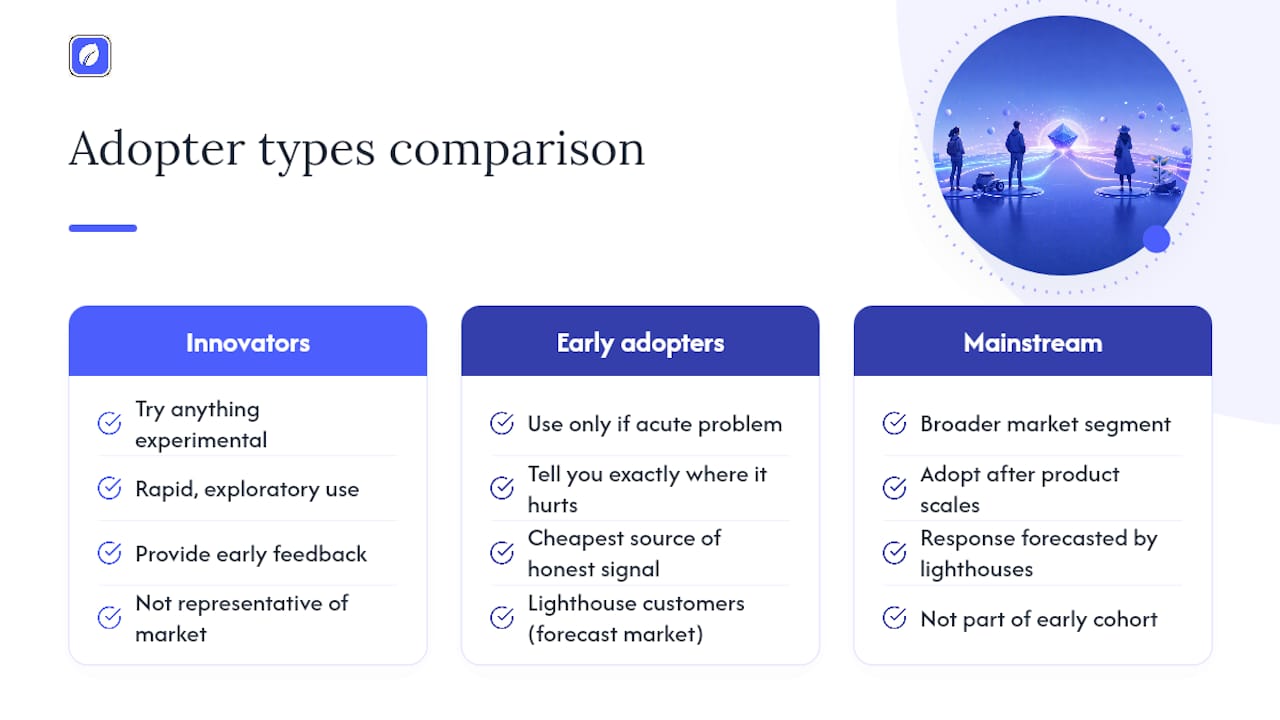
Early adopters sit between innovators and the mainstream market. Innovators will try anything experimental; early adopters won't touch a product unless it solves a problem they already feel acutely, but once they commit, they tell you exactly where it hurts. That combination makes them the cheapest source of honest signal a startup will ever get.
They're often called lighthouse customers, because their behavior in the first weeks tends to forecast how the broader market will respond once you scale. Treating them as a distinct cohort in your analytics, rather than blending them into your general user pool, keeps that signal from getting diluted.
Prioritize early-adopter testing in early product stages when validation of real workflows and retention issues need investigation before significant build investment.
How Do You Find and Recruit Early Adopters for Testing?
Recruitment is where most usability testing plans die. Founders either post a generic call for feedback and get responses from people who have no stake in the problem, or they wait for "enough users" before testing anything, which means testing never happens.
Work these channels in order of signal quality:
- Existing users and waitlist sign-ups who've already shown intent by giving you an email or trying a prototype.
- Niche communities tied to the problem, whether that's a subreddit, a Slack group, or a Discord server where the target job-to-be-done gets discussed daily.
- Partner and referral channels, where someone you trust vouches for a participant's relevance.
- Targeted outreach on LinkedIn or industry forums, filtered hard by a screener before anyone gets a calendar invite.
Your screener should filter for problem involvement (have they actually felt this pain in the last month?), past innovation behavior (do they try new tools without being asked?), willingness to co-create, and whether they can actually make a purchase decision. A tester who loves your idea but has zero budget authority gives you weaker signal than one who's mildly skeptical but controls the check.
On incentives: small honoraria work, but exclusive early access often matters more to this group than cash. Be explicit about consent and how you'll store their feedback. This audience talks to other potential customers, and a sloppy privacy approach travels fast in tight-knit communities.
Pro Tip: Ask every screener candidate one blunt question: "What have you already tried to fix this problem?" People who've cobbled together a spreadsheet or hired a freelancer to patch the gap are your best testers. They've already paid a cost you can measure against.
Which Usability Testing Method Fits Your Stage?
There's no single right method. The right one depends on how confident you are in the concept and how much time you have before you need an answer.
- Guerrilla testing is the fastest option: grab someone at a coworking space, a conference, or a quick video call, show them a low-fidelity prototype, and watch where they hesitate. Nielsen Norman Group's research shows that a few users per round surface most glaring usability problems, though the sample skews toward whoever's available, not necessarily your target segment.
- Moderated remote testing is the workhorse for early-stage teams whose users are geographically scattered. It lets you probe follow-up questions in real time, which matters when you're testing a workflow rather than a single screen. NN/g's guidance on remote testing notes this format supports deeper investigation than unmoderated sessions allow.
- Unmoderated remote testing works once you have a specific, repeatable task to validate at scale, like a checkout flow or onboarding sequence. It needs airtight task instructions since nobody's there to clarify confusion mid-session.
- Small lab or pilot beta tests suit high-fidelity products where you need to watch interaction detail closely, or where you want a longer observation window to catch behavior that only shows up after repeated use.
For sample size, run a few participants per round for problem discovery, and recruit some extras to cover no-shows and unusable sessions. Run three or four short rounds instead of one large study. Each round should fix the highest-friction issue before the next begins.
What Should You Measure, and For How Long?
Satisfaction scores tell you almost nothing about whether a product will survive contact with the mainstream market. Behavioral signals do. Track task success rate, time on task, and where people drop off in your onboarding funnel during the sessions themselves. After launch, watch feature adoption depth (how much of the product people actually use, not just log into) and retention at the 7, 30, and 90-day marks.
Signal to watch: History Tools' research on lighthouse customers warns explicitly against what it calls the "testimonial trap." Praise doesn't predict retention; churn, session length, and feature adoption depth do.
Pair the analytics with qualitative signals, like think-aloud commentary during sessions and open-ended feedback afterward, and segment everything by when each cohort adopted. A workable timeline: capture immediate task metrics during testing, run a retention check at 30 to 60 days, and do a full value-realization review at 90 days to see if early usage actually turned into a habit.
How Do You Turn Testers Into Long-Term Advocates?
The fastest way to lose a good tester is to collect their feedback and never mention it again. Ship the fix tied to whatever caused the most friction in your last round, then tell the tester directly what changed and why.
- Offer staged incentives as commitment deepens: early exclusive onboarding first, a look at your roadmap next, then a paid beta slot or referral bonus once they're clearly invested.
- Build a small invite-only channel, even something as simple as a private Slack group, where testers can see each other's suggestions and feel part of shaping the product rather than just reporting bugs into a void.
- Run occasional co-creation sessions instead of pure feedback interviews. Herstatt and von Hippel's lead-user research found that participants engaged this way frequently value the influence itself over cash rewards, which cuts your incentive costs while raising retention.
Pro Tip: Don't wait until the product is "ready" to loop testers back in. Send a two-line update after every shipped fix, even a small one. That drip of visible progress is what turns a one-time tester into someone who recommends you to their network.
How Does Phase-0 Planning Sharpen Your Test Design?
Most teams jump straight to recruiting testers before deciding what question each session is supposed to answer. That's backward. Mapping your idea to an ICP, then to specific testable hypotheses, then to a recruitment plan, means every session ties to a keep, pivot, or fix decision instead of generating vague impressions.
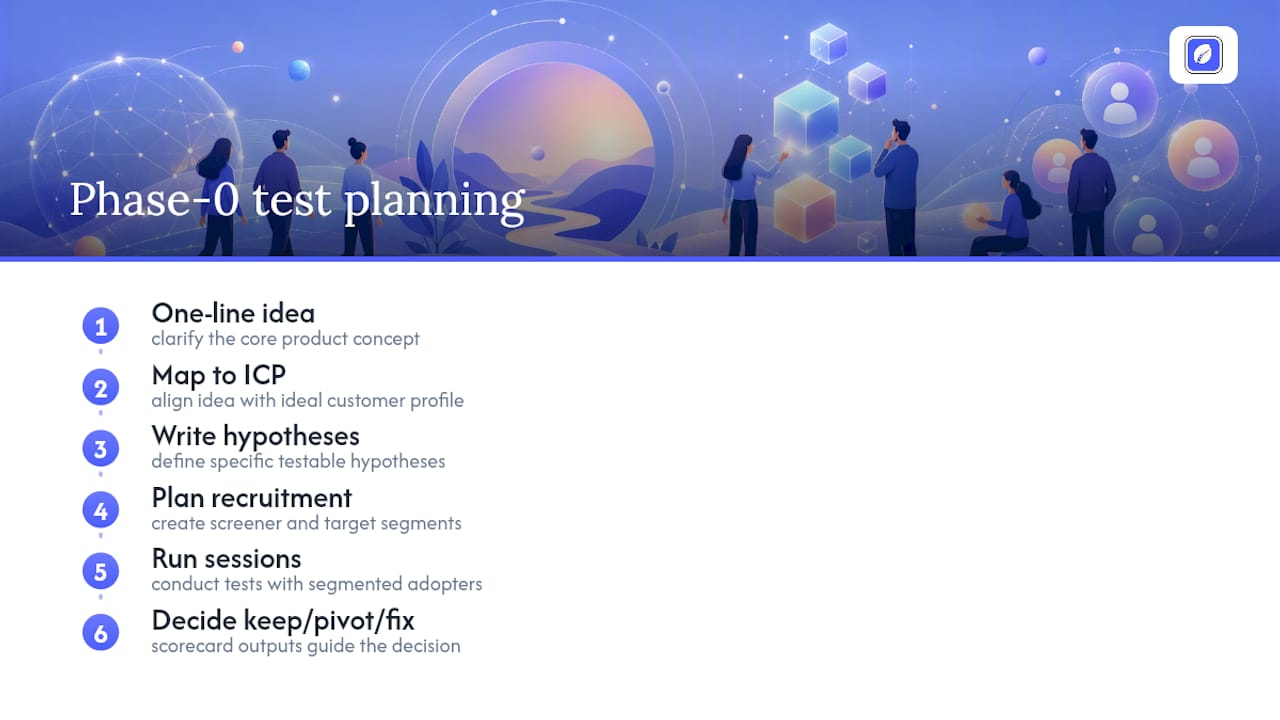
A lean, hypothesis-driven approach works best when it's structured before you write a single screener question. Clarity scorecards and simple outputs, like screener templates and a build spec, keep product, research, and engineering aligned on what "success" for a given round actually looks like. And segmenting your first-adopter cohort separately in analytics from day one prevents that lighthouse signal from getting buried once your user base grows.
A Practitioner's Quick-Start Checklist
Recruit a small group of lead-like users and run multiple rounds of moderated sessions. Ship exactly one meaningful fix per round before testing again. Track 30 and 60-day retention, not just how enthusiastic people sounded on the call. Skip the testimonial trap entirely: a glowing quote means nothing if the same person stops opening the product two weeks later.
— Karl
A Faster Way to Design Your Test Plan Before You Recruit
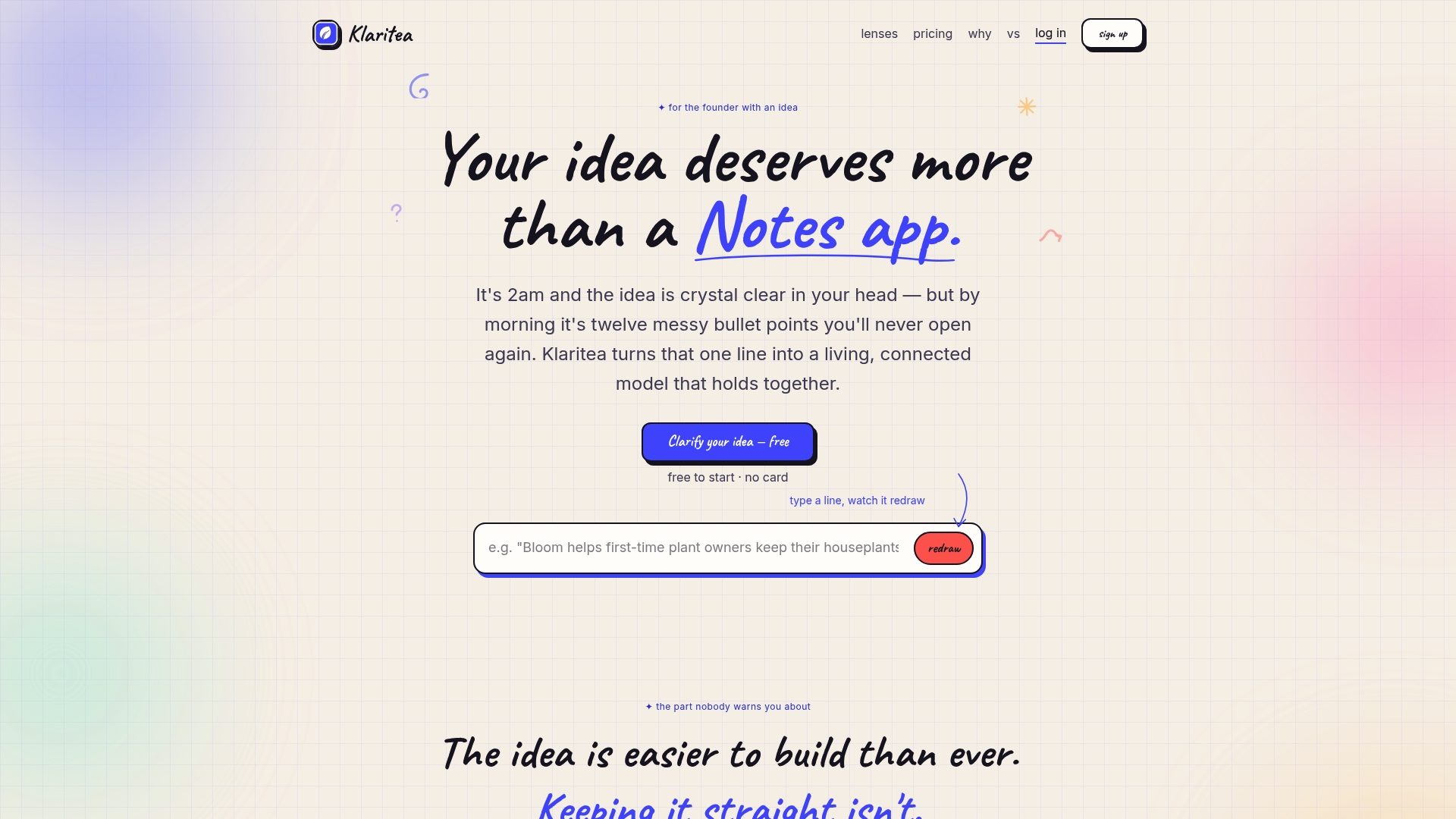
This kind of phase-0 planning tool addresses the gap this article covers: the space between "I have an idea" and "I know who to test it with." Instead of guessing at a screener or writing hypotheses on a whiteboard, you can type a one-line description of your idea and get back a structured model covering your ICP, market sizing, competitor landscape, and a feature and requirements map.
That structure matters because most founders lose money building features nobody asked to test in the first place. AI advisors can challenge your assumptions before you spend on development, and the resulting clarity scorecards and screener-ready outputs give you a recruitment plan and a build spec grounded in the same hypotheses your usability rounds are meant to check. If you're staring at a fuzzy idea and need a testable plan before your next recruiting push, start structuring it on such a platform.
Sources
- Guerrilla HCI | Nielsen Norman Group
- Remote usability testing: moderated and unmoderated | Nielsen Norman Group
- Lead-user method case study (Herstatt / von Hippel)
- Lighthouse customers: how early adopters reveal product outcomes | History Tools
FAQ
What Are the Five Categories of Technology Adopters?
Everett Rogers' diffusion-of-innovations model groups adopters into innovators, early adopters, early majority, late majority, and laggards, each defined by how quickly they accept a new product relative to their peers.
How Do You Conduct a Usability Test With Early Adopters?
Recruit 3 to 5 lead-like users per round, run a moderated or guerrilla session focused on a specific task, watch for where they hesitate or fail, then ship one fix before the next round.
What Is Early Adopter Syndrome?
It's the tendency for early adopters to tolerate rough edges, missing features, and bugs because they're driven by an unmet need, which makes their feedback about friction more reliable than their satisfaction scores.
Can You Give an Example of an Early Adopter?
A small agency that adopts a brand-new project management tool before it has a mobile app or a full integration suite, because the core workflow already solves a problem they feel every week, is a classic early adopter.
How Many Users Do You Need for Early-Stage Usability Testing?
Three to five participants per round is enough to catch most surface-level usability problems; recruit one or two extras beyond that to cover no-shows and unusable sessions.