An early adopter persona is a profile of the specific person most likely to try your unfinished product, tolerate its rough edges, and tell you exactly what to fix. Founders and product managers who target this group first, instead of a broad "target audience," validate product-market fit faster and burn far less runway proving it.
TL;DR:
- Early adopters are motivated by a specific pain point and existing workaround, making them more predictive for product-market fit than innovators.
- Building a detailed persona involves listening in niche communities, validating through short interviews, and offering direct founder influence to attract committed users.
- Small cohorts of 10 to 30 users, tracked against clear thresholds like activation and detailed feedback, provide reliable signals of persona accuracy.
- Focus on problem urgency and real workflow impact rather than demographics or broad outreach to find the most valuable early users.
- Using connected planning tools can transform early adopter hypotheses into actionable product features and validated roadmaps.
Table of Contents
- What Is an Early Adopter Persona in the Diffusion Curve?
- What Traits and Behaviors Signal a True Early Adopter?
- How Do You Build and Validate an Early Adopter Persona?
- Where Do You Find and Recruit Early Adopters?
- How Do You Measure Whether Your Early Adopter Persona Is Working?
- How a Phase-0 Planning Workflow Formalizes Persona Work
- When Should Founders Prioritize Early Adopters Over Broad Traction?
- Turn Your Early Adopter Hypothesis Into a Tested Plan With Klaritea
- Sources
- FAQ
What Is an Early Adopter Persona in the Diffusion Curve?
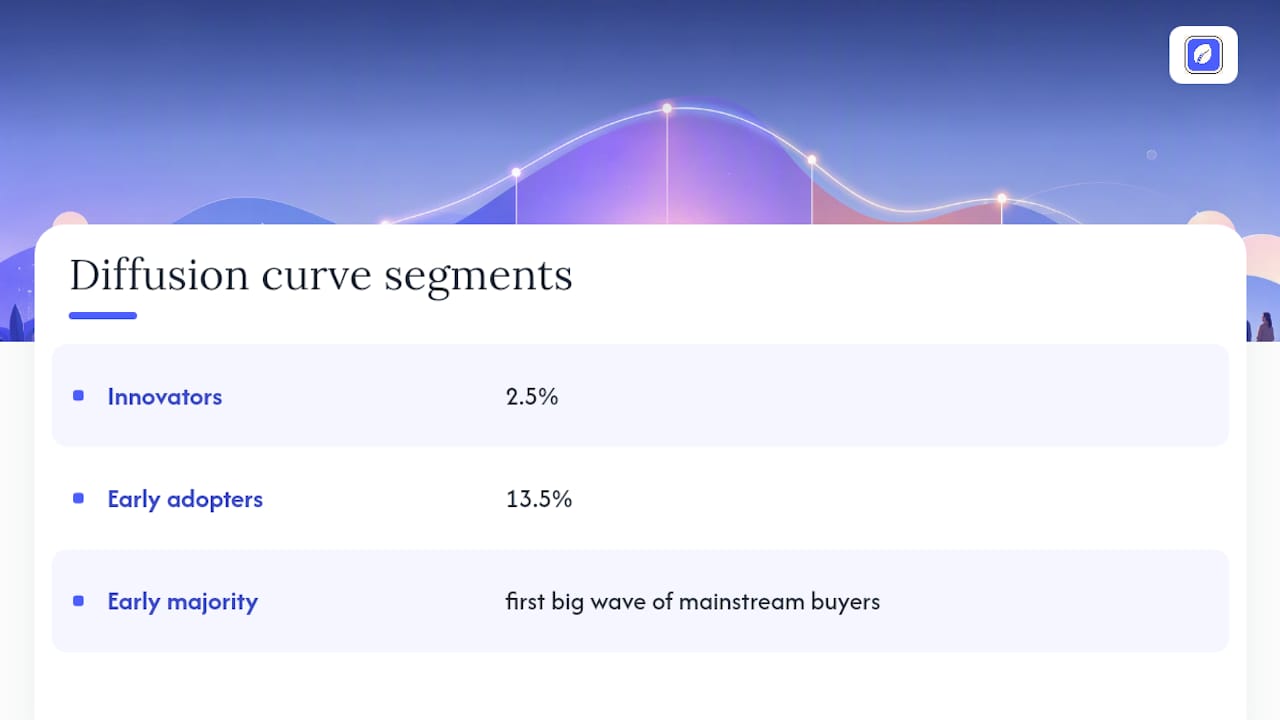
Early adopters make up roughly 13.5% of any market, according to diffusion-of-innovations research. They sit right after innovators, who represent only 2.5%, and right before the early majority, which is the first big wave of mainstream buyers.
Innovators try things because they love novelty for its own sake. Early adopters try things because they have a specific, nagging problem and enough curiosity to bet that your unfinished product might solve it. That distinction is why they matter more to a founder than innovators do: innovators will play with anything, but early adopters need a real reason, which is precisely what a startup needs to hear.
A useful illustration: the first developers who paid for a beta project-management tool weren't hobbyists. They were team leads already juggling three spreadsheets to track sprints, desperate enough to hand a stranger their workflow.
What Traits and Behaviors Signal a True Early Adopter?
Demographics tell you almost nothing about whether someone will adopt early. Psychographics and behavior tell you almost everything. The Cambridge Dictionary defines an early adopter simply as someone who buys or uses a new product before most people do, often paying a premium for the privilege. That premium tolerance is the tell.
Look for these traits when building your profile:
- Problem intensity: they feel the pain daily, not occasionally, and can describe it in specific terms.
- Existing workaround: they've already hacked together a spreadsheet, a script, or a manual process to cope.
- Curiosity over caution: they'll click "join beta" before reading the fine print.
- Peer influence: colleagues or followers ask them for recommendations on tools and trends.
- Feedback fluency: they can explain not just what's broken, but why it matters to their workflow.
Pro Tip: Ask a candidate to describe their current workaround in detail. If they can walk you through it step by step, they're a real early adopter. If they shrug and say "it's fine," they're not.
One archetype worth naming: the "spreadsheet refugee." This is the operations person running a growing team on a tangle of Google Sheets and Slack threads, who adopts new software the moment it promises to kill even one manual step. They're not chasing hype. They're chasing relief.
Motivation matters more than title. A SaaS founder's playbook on early adopter marketing found the strongest early adopters combine urgency, curiosity, and visibility, meaning they have the problem, will actually test a fix, and can influence peers once they find one that works. Chasing any single trait in isolation, like just "tech enthusiasts," tends to produce testers who play with your product and never depend on it.
How Do You Build and Validate an Early Adopter Persona?
Treat persona-building as a six-step loop, not a one-time worksheet you fill out and file away.
- Discover. Spend two weeks listening in the channels where your problem gets discussed: subreddits, trade forums, niche Slack or Discord groups, Indie Hackers threads. Collect the exact phrases people use to describe their pain.
- Define. Write the persona with fields that matter for testing, not vanity fields: job context, current workaround, trigger event that makes them search for a fix, and the outcome they'd pay for. Skip age and location unless your product genuinely depends on them.
- Validate. Run 10 to 15 short interviews using a simple guide: "Walk me through the last time this problem cost you time," "What have you tried?," and "What would make you switch tools tomorrow?" Set a screening bar, such as requiring a documented workaround, before anyone enters your beta cohort.
- Onboard. Design a first-value flow that gets a real result inside one session, not a tour of features. Concierge-style onboarding, where you personally walk the first ten users through setup, catches friction points a self-serve flow will hide.
- Activate. Give early cohorts founder access and visible influence over the roadmap. A SaaS marketing analysis found direct founder contact often matters more to early adopters than a discount ever will.
- Refer. Once a user reports a concrete change to their workflow because of your product, ask them to say so publicly, on a review site, a case study, or their own social feed.
Pro Tip: Run this loop in cohorts of 10 to 30 people rather than one sprawling open beta. Smaller cohorts make it obvious, fast, whether your persona guess was right.
Where Do You Find and Recruit Early Adopters?
Early adopters cluster in specific places, and generic ad spend rarely reaches them. Go to the communities where the problem already gets discussed daily, because that is where you'll also find the sharpest screening criteria for who deserves an invite.
- Prioritize niche Reddit threads, Discord servers, Indie Hackers, and trade-specific forums over broad social platforms.
- Use an invite-only beta or waitlist instead of an open signup page. Scarcity filters out casual browsers.
- Run live founder demos and answer questions in real time. Watching someone hesitate over a feature tells you more than any survey.
- Screen applicants for problem urgency and an existing workaround, not job title or company size.
- Offer founding access, direct founder contact, and a visible say in the roadmap. These incentives beat discounts because early adopters care more about influence than price.
Skip the coupon-code approach. A 20% discount attracts bargain hunters. Early access to a founder's Slack channel attracts people who actually want the product to succeed.
How Do You Measure Whether Your Early Adopter Persona Is Working?
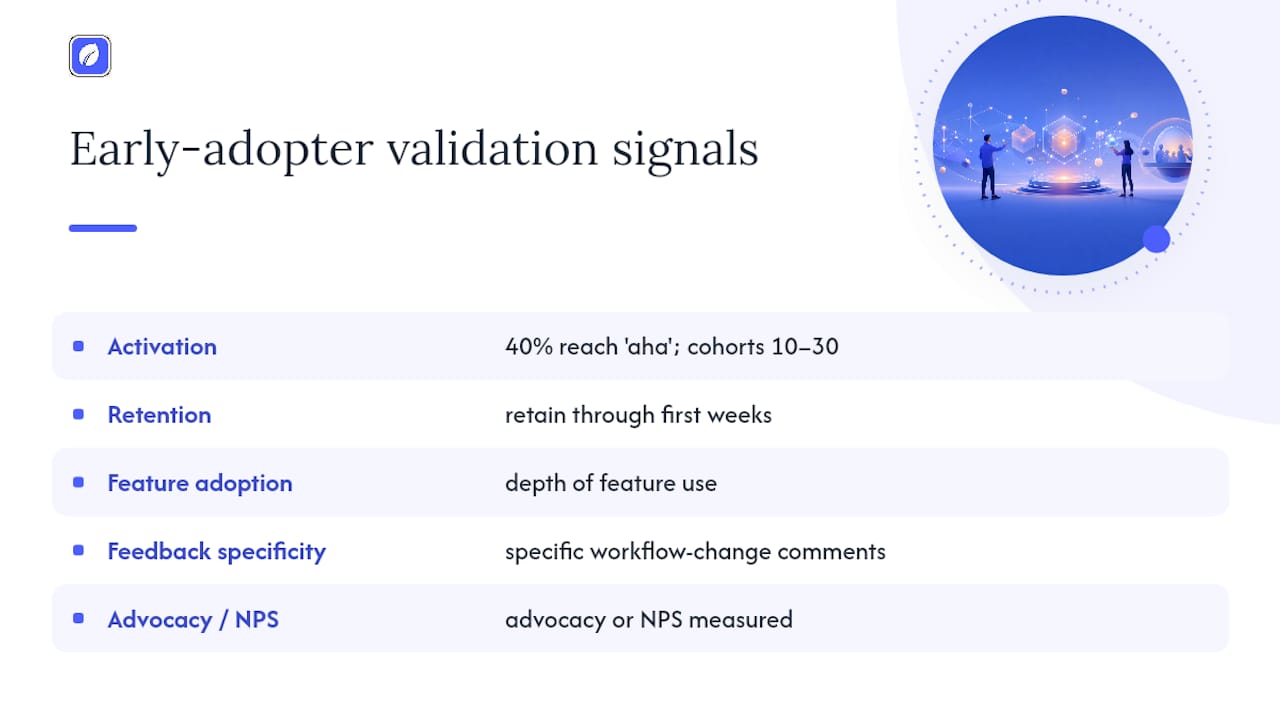
Five signals tell you whether the persona is real: activation rate to a first meaningful outcome, retention through the first few weeks, feature adoption depth, feedback specificity, and advocacy or NPS.
Feedback specificity deserves more attention than most teams give it. Vague praise like "I love it" tells you nothing. A comment describing exactly what someone changed in their workflow because of your product is the kind of signal that should actually move your roadmap. Set a success threshold before you launch a cohort, such as 40% of testers reaching a defined "aha" outcome within their first session, and revisit the persona's language if you consistently miss it. Small cohorts of 10 to 30 users, tracked against clear thresholds, make that read far clearer than one sprawling open beta ever will. If a cohort blows past your thresholds and starts referring people outside your target profile, that's often the moment to widen toward the early majority.
How a Phase-0 Planning Workflow Formalizes Persona Work
Most founders sketch a persona on a sticky note, then lose the thread once building starts. A structured phase-0 workflow keeps the persona connected to everything downstream: the features you build, the requirements you write, and the pitch you eventually give investors.
Klaritea builds that connected model from a single one-line idea, then routes it through an AI advisory board covering marketing, business strategy, and operations to stress-test the persona's assumptions and sharpen interview questions before you ever contact a real user. The outputs include a clarity scorecard, a build spec tied directly to the persona's stated problem, and a printable experiment plan you can hand to a designer or co-founder. Pair that with early adopter usability testing once you have real users, and you get a straight line from hypothesis to validated feature.
When Should Founders Prioritize Early Adopters Over Broad Traction?
Chase early adopters when your product still has rough edges and unproven assumptions, not once you already have paying customers demanding scale. The most common mistake I see is founders treating early-adopter outreach like a marketing funnel, blasting cold messages instead of screening for real problem urgency. Early adopters reward founders who show up personally, not founders who show up loudest.
— Karl
Turn Your Early Adopter Hypothesis Into a Tested Plan With Klaritea
Guessing at who your early adopters are and building for a year to find out is exactly the trap Klaritea exists to prevent. Klaritea turns a one-line idea into a connected model covering your ideal customer profile, market sizing, competitors, and features, so the persona work in this article becomes a build spec instead of a sticky note. Every plan and roadmap traces back to a visible model that updates as you learn, with custom brand voice built into outputs and no revenue share or lock-in.

Start on the Free plan to draft your first early adopter persona and see how the model connects it to features and requirements, or explore the Klaritea plan at $19 per month if you're ready to export a full experiment plan. If you want the reasoning behind the approach first, read why Klaritea builds one connected model instead of scattered documents.
Sources
FAQ
What Are the Five Types of Adopters?
Rogers' diffusion model names five categories: innovators, early adopters, early majority, late majority, and laggards, each adopting new products at a different point along the curve. Early adopters follow innovators and make up about 13.5% of the market.
What Is Early Adopter Syndrome?
It's an informal term for the frustration of using a new product before it's fully polished, meaning bugs, missing features, and limited support. Early adopters accept this trade-off because they value early access and influence over the roadmap more than a smooth experience.
Who Are the First 2.5% of People in the Diffusion Curve?
That 2.5% are innovators, the small group who adopt a new product purely out of fascination with novelty, often before there's clear proof it works. Early adopters are the next group in, motivated by a specific problem rather than novelty alone.
Can You Give an Example of an Early Adopter?
A team lead who already tracks sprints in a messy spreadsheet and jumps at a beta invite for project software is a classic early adopter. They have a documented workaround, feel the pain daily, and will give specific feedback because the outcome matters to their own workflow.
Does Klaritea Help With Early Adopter Persona Work?
Klaritea builds a connected model from a one-line idea that includes your early adopter persona, market sizing, and features, so persona hypotheses turn into a testable build spec. Pricing starts with a free plan, with paid tiers at $19 and $99 per month for founders who want deeper AI advisory support and exports.