Investors expect a tight pitch deck paired with a well-organized data room: a clean cap table, signed core legal documents, over a year of monthly financials, IP assignments and material contracts. Prepare these first, then stage them in a secure virtual data room with one clear owner before you take a single investor meeting.
TL;DR:
- A well-organized data room should include comprehensive legal, financial, IP, material contracts, and governance documents, staged with layered access controls.
- Critical legal documents include a matching certificate of incorporation, signed stock purchase and rights agreements, and current board and governance records.
- Financial statements should cover at least 12 to 18 months of historical data and include three to five-year projections with assumptions and sensitivity analyses.
- Founders must gather all IP assignments, patent and trademark filings, and key commercial agreements, ensuring no gaps, especially from early contractors.
- Regularly update and securely manage access to the data room, with a dedicated owner, to ensure diligence readiness and avoid delays caused by missing or outdated documents.
Table of Contents
- Investor Data Room Checklist: Folders and Exact Documents to Include
- Core Legal Documents Investors Read and What to Check in Each
- Financial Documents Investors Expect and How to Present Them
- IP, Technical Evidence, and Material Commercial Contracts Investors Will Review
- Disclosure Schedules and Regulatory Filings Founders Must Know
- How to Organize and Control Access to Your Data Room: VDR Operations Checklist
- Practitioner Workflow: Drafting the Disclosure Schedule and Fixing Common Red Flags
- Author Perspective: A Short Checklist Founders Should Run Before Investor Meetings
- Optional Alternative: How Klaritea Helps Founders Prepare Investor-Ready Materials Faster
- Sources
- FAQ
Investor Data Room Checklist: Folders and Exact Documents to Include
A data room works like a filing cabinet an investor can navigate in minutes, not hours. Organize it into folders that mirror how diligence teams actually think, so a reviewer finds the certificate of incorporation without emailing you to ask where it lives.
Structure your top-level folders this way:
- Deck: current pitch deck, one-pager, and any product demo links.
- Core: certificate of incorporation, bylaws, board consents, and cap table.
- Legal: signed stock purchase agreements, investors' rights agreements, and prior financing documents.
- Financial: monthly P&L, balance sheet, cash flow, budget, and projections.
- IP: assignment agreements, trademark and patent filings, open-source disclosures.
- Material agreements: customer, vendor, hosting, and partnership contracts.
- HR and team: employment agreements, option grants, contractor agreements.
- Regulatory: Form D filings, state blue-sky notices, licenses.
- Prior financings: SAFEs, convertible notes, and related board approvals.
Within each folder, separate executed documents from drafts so no one mistakes an unsigned agreement for a binding one. Use consistent file names with dates (for example, "SPA_Signed_2026-01-15") and stage access in layers: a general layer for early conversations, a deeper layer unlocked after a term sheet or signed NDA. Keep PDFs watermarked with the viewer's name, disable bulk downloads where your VDR allows it, and review the audit log weekly to see who opened what.
Pro Tip: Build your data room before you need it. A founder who sends a complete room on day one looks more credible than one who trickles documents out over three weeks.
Core Legal Documents Investors Read and What to Check in Each
The term sheet sets the terms everything else will reflect, so read it line by line before you sign anything. Pay attention to the economics (valuation, option pool size, liquidation preference), control provisions (board seats, protective provisions), exclusivity periods, and any conditions precedent to closing.
Your certificate of incorporation (or articles of incorporation, depending on your entity type) should match your actual capitalization exactly: preferred stock classes, authorized shares, and any amendments filed since your last round. A mismatch between what the certificate says and what your cap table shows is one of the fastest ways to stall diligence.
The stock purchase agreement and investors' rights agreement carry the substance of the deal:
- Reps and warranties confirm what you're promising is true about the company.
- Information rights define what investors can request after closing.
- Registration rights cover future public offering participation.
- Board and voting rights, ROFR, and co-sale provisions govern control and share transfers.
Store every signed copy, board consent, and side letter in your Legal folder, and keep a single index listing which investors hold which rights. Investors on a diligence list, including Cooley GO's sample VC due diligence checklist, commonly ask for board and shareholder minutes alongside these agreements, so keep governance records current rather than reconstructing them under deadline pressure.
Financial Documents Investors Expect and How to Present Them
Financial documentation does more than report history: it proves you understand your own business. Investors expect monthly profit and loss statements, balance sheets, and cash flow statements covering over a year, along with a budget and a clear runway calculation, according to founder-focused guidance on data room preparation.

Pair your historicals with three to five year projections that show your assumptions explicitly, not just the output numbers. A sensitivity note (what happens if churn doubles, or growth halves) tells investors you've stress-tested your own model rather than optimized a spreadsheet to look good.
Include these items in your financial folder:
- Monthly P&L, balance sheet, and cash flow for the trailing 12 to 18 months.
- Three- to five-year projections with stated assumptions and a sensitivity case.
- KPI tracking covering ARR or MRR, month-over-month growth, churn, CAC, and payback period.
- Bank reconciliations and recent tax filings.
- A single cap table file that includes fully diluted ownership, SAFEs, and convertible notes.
Seed-stage investors weigh traction and unit economics heavily when evaluating a round, which means your KPI definitions need to be consistent and your assumptions need to be visible, not buried in a locked formula. A cap table that disagrees with your certificate of incorporation, or a SAFE that never made it into the fully diluted count, is one of the fastest ways to lose an investor's confidence before the first call even ends. If your financial story needs more structure before you build these files, a startup readiness checklist can help you map what evidence belongs where.
IP, Technical Evidence, and Material Commercial Contracts Investors Will Review
Investors need proof that the company, not an individual, owns what it's selling. Founder and contractor IP assignment agreements come first: every person who ever touched the codebase or product design should have a signed assignment on file, with no gaps between founding and today.
Beyond assignments, gather:
- Patent, trademark, and copyright filings, including application numbers and status.
- Open-source license inventories, listing every dependency and its license type.
- Material customer, vendor, and hosting agreements, with SLA summaries where relevant.
- Employment agreements, option grant records, and contractor agreements.
- Immigration documents, when a founder or key employee's work authorization is tied to the company.
A missing assignment from an early contractor is one of the most common gaps investors find, and it's far easier to fix before diligence starts than during it. Keep a one-page index that maps each contract to its counterparty, term, and renewal date so reviewers aren't hunting through PDFs to find an expiration.
Disclosure Schedules and Regulatory Filings Founders Must Know
A disclosure schedule lists the exceptions to the reps and warranties you make in your stock purchase agreement: pending litigation, undisclosed contracts, third-party consents required for the deal to close, and any indemnities you owe or are owed. Cooley GO's guidance on disclosure schedules notes that the company typically drafts the first version, because only your team has the operational detail to identify what needs disclosing.
On the regulatory side, most exempt offerings require a Form D filing with the SEC, due no later than 15 calendar days after the date of first sale when the exemption applies. Form D covers issuer identity, principal place of business, related persons, and offering amounts, and many states layer their own blue-sky notice requirements on top of it.
Keep this in your Regulatory and Legal folders:
- The disclosure schedule, mapped line by line to each representation it qualifies.
- Form D filings and confirmation of the filing date relative to first sale.
- State blue-sky notices, where your offering requires them.
- Notes on unresolved items, flagged for counsel rather than left silent.
Involve counsel early rather than at the signature stage. An unresolved item noted honestly in the data room reads as diligence maturity; one discovered by the investor reads as a red flag.
How to Organize and Control Access to Your Data Room: VDR Operations Checklist
Running a data room well is an ongoing job, not a one-time setup. Follow a simple operational rhythm:
- Pick a VDR that supports staged access layers, so you can separate a general view from a deep-diligence view.
- Name files consistently and date-stamp every folder so version history is obvious at a glance.
- Archive old drafts into a separate folder rather than deleting them, in case a prior version needs reference.
- Apply security controls: watermark PDFs, set per-user permissions, restrict bulk downloads, and check the audit log regularly.
- Refresh monthly, updating financials and KPIs on a fixed schedule rather than only before a raise.
- Assign one owner who updates the room after every board meeting, so nothing goes stale between rounds.
Pro Tip: Treat your data room like a second product. The version you show in month one shouldn't look different in structure from the one you show in month twelve, only more current.
Practitioner Workflow: Drafting the Disclosure Schedule and Fixing Common Red Flags
Draft your disclosure schedule yourself before counsel ever touches it. Walk through each representation in your stock purchase agreement and map it to a source document: a contract, a cap table entry, a board resolution.
Common red flags surface here:
- Missing IP assignments from early contractors or co-founders who left.
- Inconsistent cap table counts that don't match the certificate of incorporation.
- Unsigned prior financing documents, like a SAFE that was agreed verbally but never executed.
Run a pre-diligence workflow: assign an owner for each document category, source the evidence, flag anything uncertain for a counsel checkpoint, and keep a remediation log of what's fixed and what's pending. Clarity-first planning tools that link your assumptions, evidence, and exportable reports in one connected model can cut down on the kind of gaps that only surface under investor scrutiny.
Author Perspective: A Short Checklist Founders Should Run Before Investor Meetings
At a first meeting, show your deck, your topline metrics, and a cap table summary. Save customer contracts, source code excerpts, and anything granular for NDA'd access inside the data room.
Before you open that room to anyone, fix your cap table errors first. Reconcile your financials second, and lock down IP assignments third. Those three gaps cause more lost deals than a mediocre pitch ever does.
— Karl
Optional Alternative: How Klaritea Helps Founders Prepare Investor-Ready Materials Faster
Building a data room is easier when your underlying business model is already structured, not scattered across a dozen half-finished documents. Klaritea turns a one-line idea into a connected model covering your market, features, requirements, and build spec, then exports clarity scorecards and reports that give investors a traceable view of your assumptions.
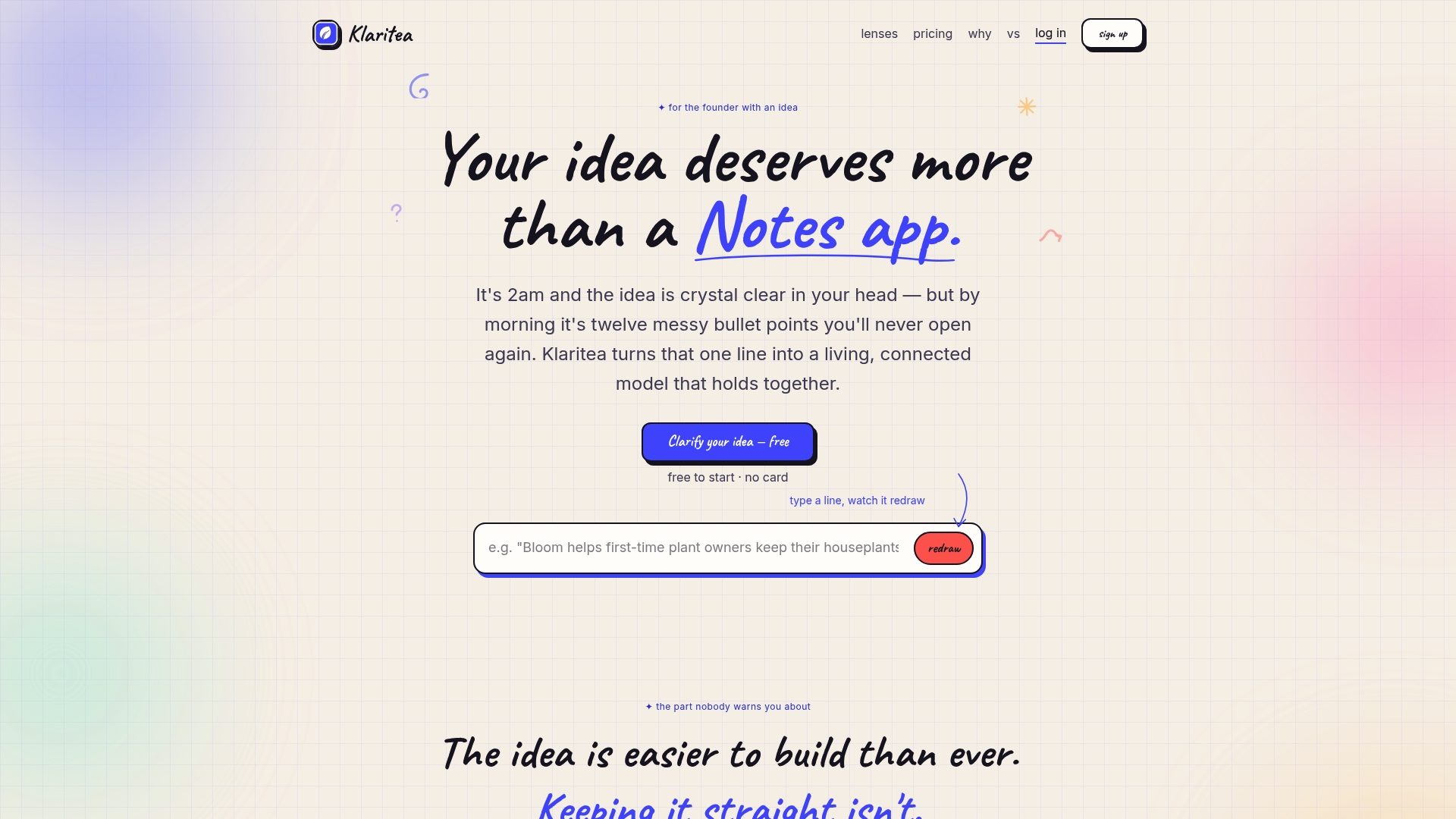
- A connected business model that updates vision, market, and features together instead of as disconnected files.
- Clarity scorecards and printable reports that show the reasoning behind your plan, not just the conclusions.
- Export options to Notion or Confluence on the Pro plan, useful for keeping evidence organized alongside your data room.
Klaritea doesn't replace counsel or your VDR. It sits earlier, in the planning stage, so the numbers and assumptions you eventually put in front of investors hold together. Plans start at the Free tier, with Klaritea at $19 per month and Pro at $99 per month.
Sources
- SAMPLE VC DUE DILIGENCE REQUEST LIST | Cooley GO
- Startup Evolution: Due-Diligence Ready – Building a data room that wins investor confidence | Klehr
- What Seed Investors Look for in 2026 | CRV
- Form D | SEC
This article is general information, not a substitute for advice from a qualified lawyer. Consult a qualified legal professional about your own circumstances before acting on anything here.
FAQ
What documents do investors need?
Investors typically need a pitch deck, a clean cap table, signed core legal documents like the stock purchase agreement and investors' rights agreement, over a year of monthly financials, IP assignments, and material customer or vendor contracts. These should live in an organized data room with staged access levels.
What is the 7-5-3-1 rule in investing?
This term isn't a recognized standard in startup fundraising or securities regulation, and no primary source defines it consistently. Founders are better served focusing on documented requirements like Form D timing and disclosure schedule accuracy rather than informal rules of thumb.
What are common mistakes founders make when preparing investor documents?
The most frequent issues are a cap table that doesn't match the certificate of incorporation, missing IP assignments from early contractors, and unsigned prior financing documents like SAFEs. Reconciling these before opening a data room avoids the most common cause of stalled diligence.
What should founders avoid telling investors?
Avoid making claims in a pitch that your documentation can't back up, since diligence exists specifically to test those claims against evidence. Overstating traction, projections, or IP ownership tends to surface quickly once an investor compares your deck to your data room.
Do all startups need to file Form D with the SEC?
Companies relying on a federal securities exemption for their offering generally need to file Form D, due no later than 15 calendar days after the first sale of securities. Many states also require a separate blue-sky notice, so founders should confirm requirements for each state where investors are located.