A definition of ready for founders is the minimum bar an idea must clear before you spend engineering hours or pitch investors: at least 10 real customer conversations, 3 written commitments or paid pilots, a one-page spec, and explicit scope boundaries. If you have all four, build. If not, keep validating. Author Karl's own scorecard framework (also used inside Klaritea) treats these as important gates to consider, not mere suggestions.
TL;DR:
- Validating at least 10 customer conversations and obtaining three signed commitments or paid pilots is essential before starting development or pitching investors.
- A one-page MVP spec, clear scope boundaries, and explicit acceptance criteria are necessary to ensure disciplined, narrow scope and avoid scope creep.
- Complete readiness includes detailed validation evidence, a well-defined scope, documented specifications, and operational basics like error tracking and support contacts.
- Launch decisions should be based on activation, retention, revenue, and feedback metrics collected within the first 30 days, with clear go/no-go signals for further investment.
- Tools like Klaritea can automatically generate comprehensive readiness artifacts from a single idea, ensuring founders follow a rigorous, reproducible process.
Table of Contents
- The Founder's Checklist: What Actually Counts as "Ready"
- How Do You Apply the Definition of Ready in Practice?
- What Do Complete Definition of Ready Examples Look Like?
- What Are the Go/No-Go Signals After Launch?
- Who Owns the Definition of Ready When You Have No Team Yet?
- What Mistakes Wreck a Founder's Definition of Ready?
- Incomplete vs. Complete Definition of Ready Checklists
- How Does Definition of Ready Differ From Definition of Done?
- What Founders Get Wrong About Readiness
- How Klaritea Turns This Checklist Into a Real Artifact
- Sources
- FAQ
The Founder's Checklist: What Actually Counts as "Ready"
Most founders think they're ready because they're excited. Excitement is not evidence. A real definition of ready rests on four categories of proof, and skipping any one of them is how a founder ends up six months and thousands of dollars into a product nobody asked for.
Validation evidence. You need a minimum of 10 customer conversations and at least 3 written commitments, ideally a signed letter of intent or a paid pilot, before you move into scoping. This threshold comes from practitioner guidance on the idea-to-MVP process, and it exists because verbal enthusiasm ("I'd totally use that") almost never survives contact with a price tag or a calendar invite.
Scope. Every ready idea answers one primary question and maps the smallest end-to-end path a user can take to get value. That means writing down what's explicitly out of scope for version one, not just what's in.
Specification. A one-page MVP spec, acceptance criteria for each feature, and a documented list of dependencies and integrations. If you can't fit your spec on one page, your scope is too wide.
Operational basics. Error tracking, a support plan, and a named list of who responds when something breaks on day one.
- 10+ customer conversations logged with dates and takeaways
- 3+ written commitments or paid pilot agreements
- One-page spec with a single core promise
- Explicit v1 out-of-scope list
- Acceptance criteria per feature
- Error tracking and support contact assigned before launch
Klaritea's own thesis is blunt about the cost of skipping this: most early "vibe coded" builds run roughly $15,000, and more than 80% never produce a return. That's not a rounding error. That's a founder's entire runway spent on a product built before anyone confirmed the problem was real.
Expect a tight, well-scoped MVP to take 6 to 12 weeks from idea to a paying-customer-ready product when validation and scope are both disciplined. Cost ranges vary wildly depending on complexity, but the pattern holds: narrow scope compresses both time and spend, while vague scope inflates both.
Pro Tip: Log every validation conversation in a shared doc the moment it happens. Founders who wait until "later" to write it up consistently round their own optimism upward, and the notes get softer with every week that passes.
How Do You Apply the Definition of Ready in Practice?
Treat readiness as a four-step process, not a mood. Each step has a timebox and a gate you either pass or don't.
- Validate (1 to 2 weeks). Run structured conversations, not casual chats. Ask directly: "Would you pay for this today?" A commitment only counts if it changes behavior, a calendar invite for a pilot, a signed LOI, a deposit. Enthusiasm that doesn't produce a commitment isn't validation, it's a compliment.
- Scope (2 to 4 days). Write your single primary question on one line. Then map the critical path: the minimum sequence of screens or actions a user needs to get value once. Everything else goes on the out-of-scope list. Ruthless scoping to one testable question is what separates a two-week build from a two-month one.
- Spec (1 to 3 days). Write the one-page spec: core promise, primary user, success metric, happy path, acceptance criteria, dependencies, and your go/no-go rule. Use Given/When/Then format for acceptance criteria: "Given a new user signs up, when they complete onboarding, then they see their first result within 60 seconds."
- Soft launch rehearsal (1 day). Before opening to real users, rehearse it. Assign who watches usage in real time, who responds to support requests, and how you'll collect signal in the first 30 days. The minimum bar for launch is that a user can complete the core loop end-to-end and your team can act on feedback quickly, not that the product is polished.
Pro Tip: Run your soft launch with a cohort small enough that you can personally read every piece of feedback. A watched cohort with a fast-fix plan beats a broad, polished release almost every time.
What Do Complete Definition of Ready Examples Look Like?
Templates beat theory here. Copy these directly.
One-page MVP spec fields: core promise (one sentence), primary user, core success metric, minimal happy path, must-have acceptance criteria, known dependencies, and your go/no-go rule. This structure comes straight from practitioner MVP-shipping guidance, and it forces you to commit to specifics instead of hiding behind vague ambition. For a deeper walkthrough of building out these fields, see this feature requirements list guide.
A concrete acceptance-criteria example: "Given a returning user, when they open the app, then their last session's data loads within 2 seconds, and if it fails, an error state with a retry button appears." Pair every criterion like this with a dependency note, whether that's a third-party API, a payment processor, or an internal service that doesn't exist yet.
Klaritea generates these same artifacts automatically once you type in a one-line idea. The platform's connected model produces a clarity scorecard, a build spec, and per-feature acceptance criteria, then syncs the spec to GitHub for paid plans or exports it to Notion and Confluence on Pro. Three AI advisors, covering marketing, business strategy, and operations, challenge and fact-check the idea before it ever reaches a checklist.
| Checklist Item | Klaritea Output |
|---|---|
| Validation evidence | Clarity scorecard with advisor-flagged gaps |
| One-page spec | Auto-generated build spec |
| Acceptance criteria | Per-feature criteria in the Build lens |
| Dependency list | Structured requirements with integration notes |
| Export for team | GitHub sync (paid), Notion/Confluence export (Pro) |
What Are the Go/No-Go Signals After Launch?
Readiness doesn't end at launch. The same discipline that got you to build now tells you whether to keep going.
Before you commit further spend, you need the baseline: 10+ validation conversations and 3+ written commitments logged before day one. That's your starting evidence, not your finish line.
In the first 30 days, track four things:
- Activation rate for the core loop (what percentage of new users actually complete the primary action you built)
- Retention of your first cohort at day 7 and day 30
- Revenue or pilot commitments converted from prospects to paying or committed users
- Qualitative feedback volume, specifically complaints or requests that repeat across multiple users
If activation is strong and retention holds, double down. If activation is weak but users who do activate stick around, iterate on onboarding before touching the core product. If both activation and retention are weak after a full 30-day window, pause and go back to validation. Founders considering a raise should also know that investors generally expect 6 to 9 months of runway in hand and stage-appropriate evidence before a pitch makes sense, not just a working product.
Who Owns the Definition of Ready When You Have No Team Yet?
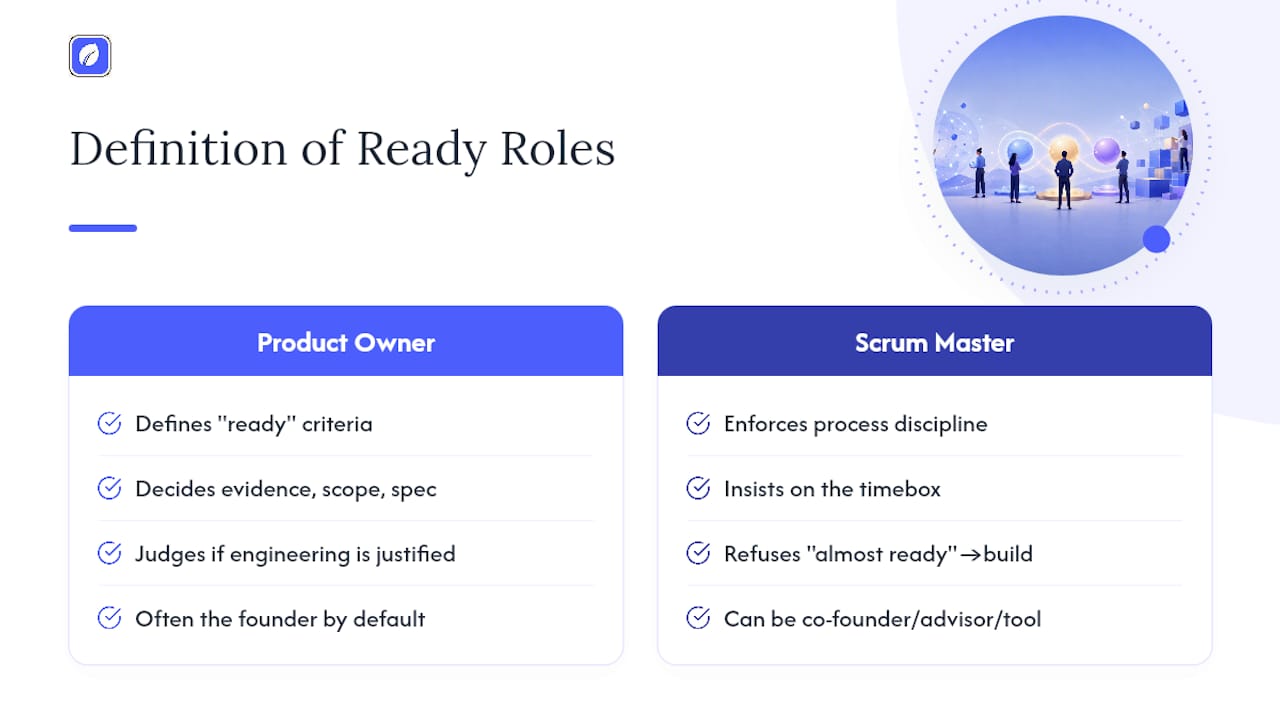
In a traditional software team, the Product Owner defines what "ready" means for a backlog item, and a Scrum Master enforces the process discipline that keeps the team from skipping it. Most early-stage founders don't have either title, but the roles still exist. You are the Product Owner by default: the person who decides whether an idea has enough evidence, scope clarity, and specification detail to justify engineering time. Somebody, even if it's you wearing a second hat, needs to play Scrum Master: the person who insists on the timebox, refuses to let "almost ready" slide into "building," and calls the go/no-go moment out loud instead of letting momentum decide it.
This split matters more than it looks. Founders who blend both roles into one unexamined gut feeling tend to talk themselves into building before validation is real, because the same person who wants to build is also the person deciding whether it's time. Bringing in a co-founder, an advisor, or even a structured tool to play devil's advocate closes that gap. The point isn't hierarchy, it's separation of judgment: one voice pushing to build, another voice checking the evidence before it agrees. Klaritea's AI advisory board exists partly for this reason, giving a solo founder a second opinion that isn't just an echo of their own optimism.
What Mistakes Wreck a Founder's Definition of Ready?
The most common anti-pattern is treating opinions as commitments. A friend saying "that's a great idea" is not evidence. A stranger saying "I'd pay for that" in a hallway conversation is not evidence either, not until it turns into a calendar invite, a deposit, or a signature.
The second anti-pattern is scope creep disguised as thoroughness. Founders convince themselves that adding "just one more feature" makes the MVP more credible, when it actually delays the moment you get real evidence. Every feature added before launch is a hypothesis you haven't tested yet, stacked on top of hypotheses you also haven't tested.
The third anti-pattern is skipping the out-of-scope list entirely. Teams that only write what they're building, and never write what they're explicitly not building, end up relitigating scope decisions every week because nothing was ever decided in writing.
The fourth, and probably the sneakiest, is confusing "ready to demo" with "ready to build." A slide deck or clickable prototype can look convincing without a single line of the real product existing. That's fine for validation conversations. It's not evidence you're ready to spend engineering budget, because it hasn't tested whether a user can complete the actual core loop end-to-end.
Incomplete vs. Complete Definition of Ready Checklists
An incomplete checklist looks reassuring on paper and falls apart under scrutiny. It might say: "Talked to some potential users, they seemed interested. Have a rough idea of features. Ready to start building." Notice what's missing: no conversation count, no written commitments, no scope boundaries, no acceptance criteria. This is the checklist that leads to the $15,000 build with no return that Klaritea's own product thesis was built to prevent.
A complete checklist reads differently: "12 customer conversations logged with dates. 4 written pilot commitments, 2 with deposits paid. Out-of-scope for v1: mobile app, multi-currency support, team accounts. One-page spec written with 8 acceptance criteria. Dependencies: Stripe for payments, Plaid for bank sync. Support contact assigned. Error tracking configured." Every line is checkable by someone who wasn't in the room.
The difference isn't effort, it's specificity. A founder can spend just as many hours on the incomplete version and feel just as busy. What separates the two is whether each line names a number, a date, a name, or a boundary instead of a feeling. If you can't point to who said yes and what they committed to, you don't have a complete checklist yet, you have a hope with formatting.
How Does Definition of Ready Differ From Definition of Done?
Definition of ready governs the start line. Definition of done governs the finish line. They answer different questions, and confusing them is how founders end up either building too early or shipping something that technically works but never gets evaluated against real criteria.
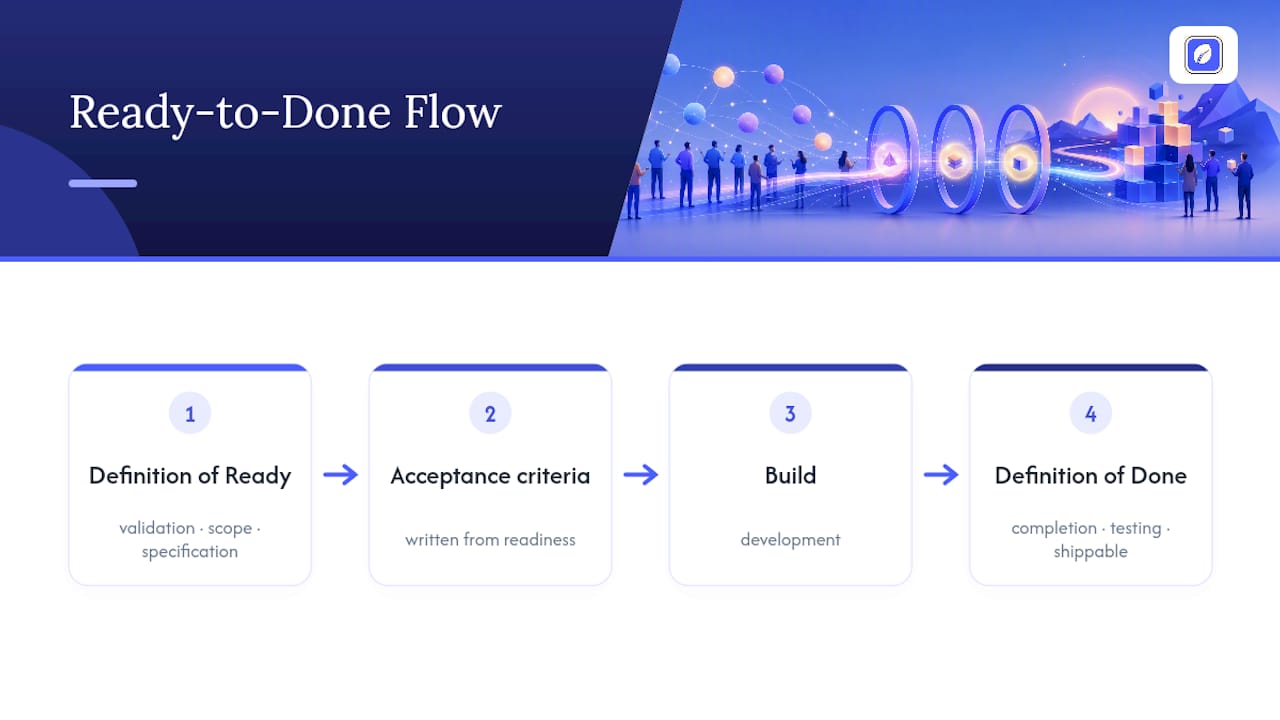
Definition of ready asks: do we have enough validation, scope clarity, and specification to justify starting? Definition of done asks: does this specific feature or release meet the bar we set to call it complete, tested, and shippable? You need both, and they connect directly, the acceptance criteria you write during your readiness spec become the exact criteria you check against when you declare a feature done. For a full breakdown of what belongs in that second checklist, see this guide to definition of done.
This connects to backlog refinement too, even for a two-person startup. Every time you revisit your one-page spec, whether that's weekly or after a validation conversation shifts your thinking, you're doing a lightweight version of backlog refinement: reordering what matters, cutting what doesn't, and making sure acceptance criteria still match reality. Founders who skip this refinement step tend to build against a spec that was accurate three weeks ago and stale today. The discipline isn't about ceremony, it's about keeping your definition of ready and your definition of done pointed at the same, current target.
What Founders Get Wrong About Readiness
The biggest mistake I see is over-scoping dressed up as ambition. Founders add features to feel more "serious," when every addition is really a hypothesis they haven't tested. The second mistake is mistaking polite enthusiasm for commitment. If a conversation doesn't end in a calendar invite, a deposit, or a signature, it's not evidence, it's a compliment. The third is delaying the go/no-go decision indefinitely because nobody wants to say "not yet" out loud.
The fix is simple, even if it isn't easy: pick one testable question, set a hard timebox for validation, and refuse to count anything short of a real commitment. Treat readiness as a ritual you run every time, not a one-off judgment call. Do that consistently, and you'll waste far less time and money finding out an idea doesn't work.
*— Karl
How Klaritea Turns This Checklist Into a Real Artifact
Klaritea is the fastest way to turn everything in this checklist into an actual document instead of a mental note. You've read what a one-page spec needs, what acceptance criteria should look like, and why an out-of-scope list matters. Klaritea builds all of it from a single line of input.
Type your idea in, and Klaritea's connected model produces a clarity scorecard, a full build spec, and feature-level acceptance criteria in its Build lens, while its Clarity lens flags gaps in your validation evidence before you waste a token on code. The Run & Scale lens then tracks the early metrics that decide whether you double down or pivot. Three AI advisors covering marketing, business strategy, and operations, stress-test the idea the way a skeptical co-founder would, instead of letting your own optimism write the checklist for you. Everything exports to GitHub, Notion, or Confluence, so the artifact travels with you into the actual build.
If you want to see what a complete readiness package looks like before you commit a single hour of engineering time, see why founders use Klaritea and generate your first clarity report today.
Sources
- Idea to MVP: The Complete Founder's Roadmap (2026) | Idea to MVP
- Launch strategy: when is your MVP ready for the public? | The Founders' Hub
- How to Ship an MVP Fast: The 2026 Founder's Playbook | Jean-Baptiste Bolh
FAQ
What Is a Definition of Ready for a Startup?
It's the minimum set of validation, scope, and specification criteria, typically 10+ customer conversations, 3+ written commitments, a one-page spec, and defined acceptance criteria, that an idea must meet before a founder invests engineering time or money.
How Many Customer Conversations Count as Validation?
At least 10 structured conversations, paired with a minimum of 3 written commitments such as signed letters of intent or paid pilots, is the practical threshold before moving to scoping.
What's the Difference Between Definition of Ready and Definition of Done?
Definition of ready governs whether you should start building; definition of done governs whether a specific feature or release meets the bar to call it complete. See this definition of done breakdown for the full checklist.
How Long Should an MVP Take to Build Once It's Ready?
A tightly scoped MVP with disciplined validation typically takes 6 to 12 weeks from idea to a paying-customer-ready product, though complexity shifts that window.
Can a Tool Help Generate a Definition of Ready Checklist?
Yes. Klaritea converts a one-line idea into a clarity scorecard, build spec, and acceptance criteria automatically, giving founders a reproducible readiness artifact instead of a mental checklist.