This page gives you seven copy-ready persona examples, a reusable template, and the exact interview questions to fill it with real data instead of guesses. Copy the card closest to your business, swap in your own research, and you have a working persona in under an hour.
TL;DR:
- Personas must directly influence decisions, focusing on decision triggers and actions rather than hobbies or generic details.
- Building personas from actual data and interviews ensures relevance and usefulness, avoiding stale or overly broad profiles.
- Qualifying potential customers with an ICP first prevents wasting efforts on accounts unlikely to buy, then customizing personas for decision-making inside those accounts.
- Adding too many fields or decoration leads to unused personas; focus on key decision-changing information for better adoption.
- Tools like Klaritea facilitate rapid persona creation by synthesizing research and testing assumptions, reducing the time from idea to actionable profile.
Table of Contents
- Customer Persona Examples for B2B and B2C Teams
- A Customer Persona Template You Can Paste and Fill In
- How to Write a Customer Persona That Holds Up
- ICP vs Persona: Which One Do You Need First?
- Common Persona Mistakes and How to Fix Them Fast
- How Klaritea Turns One-Line Ideas Into Working Personas
- What Actually Separates a Useful Persona From a Wasted One
- Try Klaritea to Skip the Blank-Page Problem
- Sources
- FAQ
Customer Persona Examples for B2B and B2C Teams
A persona only earns its keep when it changes a decision. Not a mood board, not a stock photo with a made-up name. Each card below follows that rule: every field ties to something a marketing, product, or sales team actually does differently because of it.
Here are seven persona examples covering the situations most teams face, from enterprise buyers to the customer you should stop chasing.
1. B2B Buyer Persona: "Budget-Owner Bruce"
- Role: VP of Operations at a 200 to 500 employee logistics company
- Demographics: Age 42, manages a $1.2 million tools budget, reports to the COO
- Goals: Cut manual reporting time, prove ROI within two quarters
- Pain points: Burned twice by vendors who overpromised implementation timelines
- Buying triggers: A board mandate to reduce operational overhead by Q3
- Channels: LinkedIn, industry newsletters, peer referrals at trade shows
- Quote: "I don't need more dashboards. I need one number I can defend in a board meeting."
- Team action: Sales should lead every demo with time-to-ROI math, not feature lists.
2. B2B User Persona: "Day-to-Day Dana"
- Role: Operations analyst who actually logs into the software daily
- Demographics: Age 28, two years in the role, not the buyer but the heaviest user
- Goals: Finish reporting tasks faster than the spreadsheet she replaced
- Pain points: Tools bought by executives that ignore how the work actually gets done
- Buying triggers: None. Dana has no purchasing power, only veto power through complaints
- Channels: Internal Slack, onboarding docs, YouTube tutorials
- Quote: "If it takes longer than Excel, nobody on my team will touch it."
- Team action: Product should test onboarding flows against Dana's patience, not Bruce's budget.
3. B2C Frequent Buyer: "Repeat Rachel"
- Role: Marketing coordinator, shops the category three to four times a year
- Demographics: Age 31, urban, disposable income around $3,000 a month
- Goals: Save time by not re-researching the same purchase decision every cycle
- Pain points: Loyalty programs that feel like busywork instead of a real reward
- Buying triggers: A restock email or a limited-time bundle discount
- Channels: Instagram, email, retargeted ads
- Quote: "Just tell me what changed since last time and I'll buy it."
- Team action: Retention emails should lead with "what's new," not a generic discount code.
4. Early Adopter: "First-In Felix"
- Role: Freelance designer, follows product launches for a living
- Demographics: Age 26, active on Product Hunt and niche Discord communities
- Goals: Be the person who found the tool before it got popular
- Pain points: Beta products that break trust with buggy releases
- Buying triggers: A waitlist invite or founder-led launch post
- Channels: X, Product Hunt, founder newsletters
- Quote: "I'll forgive bugs. I won't forgive a founder who goes silent."
- Team action: Founders should personally respond to Felix's first three support tickets.
5. Cautious Buyer: "Slow-Yes Sam"
- Role: Small business owner, decides alone, answers to nobody but the bank account
- Demographics: Age 51, runs a 12-person accounting firm
- Goals: Avoid a purchase he will regret explaining to his business partner
- Pain points: Sales pressure, unclear cancellation terms, vague pricing pages
- Buying triggers: A case study from a business his own size, not an enterprise logo
- Channels: Google search, referrals from other owners, industry Facebook groups
- Quote: "Show me someone my size who didn't regret this."
- Team action: Marketing should publish case studies segmented by company size, not just logos.
6. Product User Persona: "Power-User Priya"
- Role: Customer success lead who uses every advanced feature you ship
- Demographics: Age 35, three years tenure, unofficial internal trainer for the tool
- Goals: Get deeper functionality without filing a support ticket every time
- Pain points: Feature requests that vanish into a roadmap nobody shares
- Buying triggers: Renewal season, when she has leverage to ask for a roadmap update
- Channels: In-app feedback widget, quarterly business reviews
- Quote: "I've found five workarounds for things that should just be buttons."
- Team action: Product should interview Priya before finalizing any roadmap, not after.
7. Negative Persona: "Bargain-Hunter Ben"
- Role: Signs up for every free trial, never converts, drains support resources
- Demographics: Age unknown, likely a student or hobbyist, price-sensitive to the point of churn
- Goals: Get maximum functionality for zero dollars
- Pain points: Not a real customer problem. Ben's "pain" is that free tiers have limits
- Buying triggers: None. Ben churns the day a paywall appears
- Channels: Wherever free trials are advertised
- Quote: "I'll use it until it asks for a credit card."
- Team action: Stop optimizing onboarding flows around Ben's behavior. He was never going to pay.
A negative persona matters as much as the other six. It tells your team who to stop designing for, which frees budget and attention for the accounts that actually convert. Research on effective persona design backs this up: cards that tie every field to one specific decision get used far more than cards padded with decorative detail like hobbies or favorite podcasts, according to Userforge's analysis of working persona examples.
Pro Tip: Add a "decision trigger" line to every persona: one sentence capturing the exact moment this person decides to buy, upgrade, or churn. That single line does more for your roadmap than three paragraphs of demographic filler.

A Customer Persona Template You Can Paste and Fill In
A good customer persona template forces you to answer a question, not decorate a slide. Below is a field-by-field structure you can drop into a doc, a Notion page, or a spreadsheet row, based on template guidance from Cognism's ICP and persona framework.
- Name and role: A memorable name plus their actual job title. Answers: who is this, in one glance?
- Demographic data: Age range, company size or household income, location. Answers: what context shapes their decisions?
- Psychographic traits: Risk tolerance, values, how they define success. Answers: what mindset drives them?
- Primary goal: One sentence, no more. Answers: what are they hiring your product to do?
- Pain points: The specific frustration your product removes. Answers: what's currently broken for them?
- Buying triggers and timeline: The event that pushes them from browsing to buying. Answers: when do they act?
- Main channels: Where they actually spend attention, not every platform that exists. Answers: where do we reach them?
- Decision criteria: The two or three factors they weigh before saying yes. Answers: what do we need to prove?
- Quote: An eight to twelve word line in their voice. Answers: how do they talk about the problem?
- Team action: The one decision this persona should change. Answers: what do we do differently now?
Populated example row for the "decision criteria" and "team action" fields: Decision criteria: implementation time under two weeks, transparent pricing, a named support contact. Team action: sales removes any pricing page that requires a demo call to see a number.
Choose your format based on how the team will use it. A one-page card works for quick reference during sprint planning. A narrative paragraph works better when you're presenting to executives who need context, not bullet points. A spreadsheet row works when you're tracking multiple personas against the same set of fields for comparison.
How to Write a Customer Persona That Holds Up
Building a persona from a guess is how most personas end up unused by month two. Building one from evidence takes a repeatable process.
- Pull quantitative data first. Start with CRM records, product usage analytics, and support ticket logs. These show you what people actually do, not what they say they'll do.
- Run five to eight customer interviews. Ask questions adapted from Harvard Business School's guide to customer interview questions: What triggered you to start looking for a solution? What did you try before this? What almost stopped you from buying? What would make you switch away? Who else was involved in the decision? What does success look like six months from now? What's the biggest risk you were worried about?
- Group recurring language into themes. If four out of six interviews mention "I don't trust vendors who hide pricing," that's a pain point, not an anecdote.
- Write the quote from real words, not a paraphrase that sounds like marketing copy.
- Map the persona to one decision. If it doesn't change a call script, a feature priority, or an onboarding step, cut it.
- Validate against three checks: does sales recognize this person, does support see these tickets, does the quote sound like a real customer said it.
- Set a review cadence. A quarterly check tied to major product launches or market shifts keeps personas from going stale, a pattern confirmed by ZoomInfo's guidance on ideal customer profiles.
Pro Tip: Record every interview and pull the exact sentence a customer uses to describe their frustration. Paraphrasing kills the specificity that makes a persona quote useful.
ICP vs Persona: Which One Do You Need First?
An ideal customer profile (ICP) describes which companies are worth pursuing. A persona describes which person inside that company you're writing to and building for. Confuse the two and you'll build gorgeous personas for accounts that were never going to buy.
An ICP typically covers firmographics (company size, revenue, industry), technographics (existing tools, tech stack maturity), and behavioral signals (growth stage, hiring patterns), according to ZoomInfo's ICP framework. A persona covers the individual: their goals, frustrations, and how they buy.
Sequence matters. Qualify the account with your ICP first, then apply the right persona inside it.
- ICP example: B2B SaaS companies, 50 to 300 employees, using at least two disconnected project tools, growing headcount 20% year over year.
- Persona inside that ICP: "Budget-Owner Bruce" (the buyer) and "Day-to-Day Dana" (the user) both live inside this ICP, but they need different messaging entirely.
Common Persona Mistakes and How to Fix Them Fast
Most personas fail for four repeatable reasons, and each has a same-sprint fix.
- Decoration over decision: A persona lists hobbies and favorite coffee orders but no purchasing trigger. Fix: delete any field that doesn't map to a marketing, sales, or product action.
- Stale personas: Nobody has touched the doc in eighteen months. Fix: set a quarterly review tied to product launches or CRM shifts, not a calendar reminder nobody honors.
- Too many personas: Twelve personas means no one uses any of them. Fix: prioritize the top three that drive the most revenue or usage, archive the rest.
- Confusing ICP with persona: Building rich personas for companies that fail your ICP criteria wastes the effort entirely. Fix: qualify the account against your ICP before you write a single persona field.
Pro Tip: If a persona field hasn't changed a decision in the last quarter, it's decoration. Cut it before your next review, not after.
How Klaritea Turns One-Line Ideas Into Working Personas
Klaritea takes a one-line business idea and builds out ICP, TAM/SAM/SOM, and persona-ready outputs as part of its connected model, so you're not starting persona work from a blank page. Its AI advisory board pressure-tests assumptions before you write a single interview question. For deeper practical steps, see Klaritea's guides on running customer discovery interviews and choosing market research tools.
What Actually Separates a Useful Persona From a Wasted One
Most persona guides tell you to add more fields: hobbies, favorite brands, a stock photo. That's backwards. The personas that survive past month one are the ones stripped down to what changes a decision, which is why I'd rather see a team ship three thin, accurate personas than one elaborate, decorative one nobody opens again.
If you take one thing from this page, run three customer interviews this week using the questions above, then rewrite one existing persona around the quote you actually hear back. That single update will do more for your roadmap than a fresh round of persona templates.
— Karl
Try Klaritea to Skip the Blank-Page Problem
Building personas from scratch usually means a slow loop of spreadsheets, guesswork, and interview notes nobody synthesizes. Klaritea replaces that loop with a phase 0 planning tool: type your one-line idea, and its connected model generates ICP, market sizing, and persona-ready inputs alongside your feature and build spec, backed by an AI advisory board that challenges assumptions before you write a line of code.
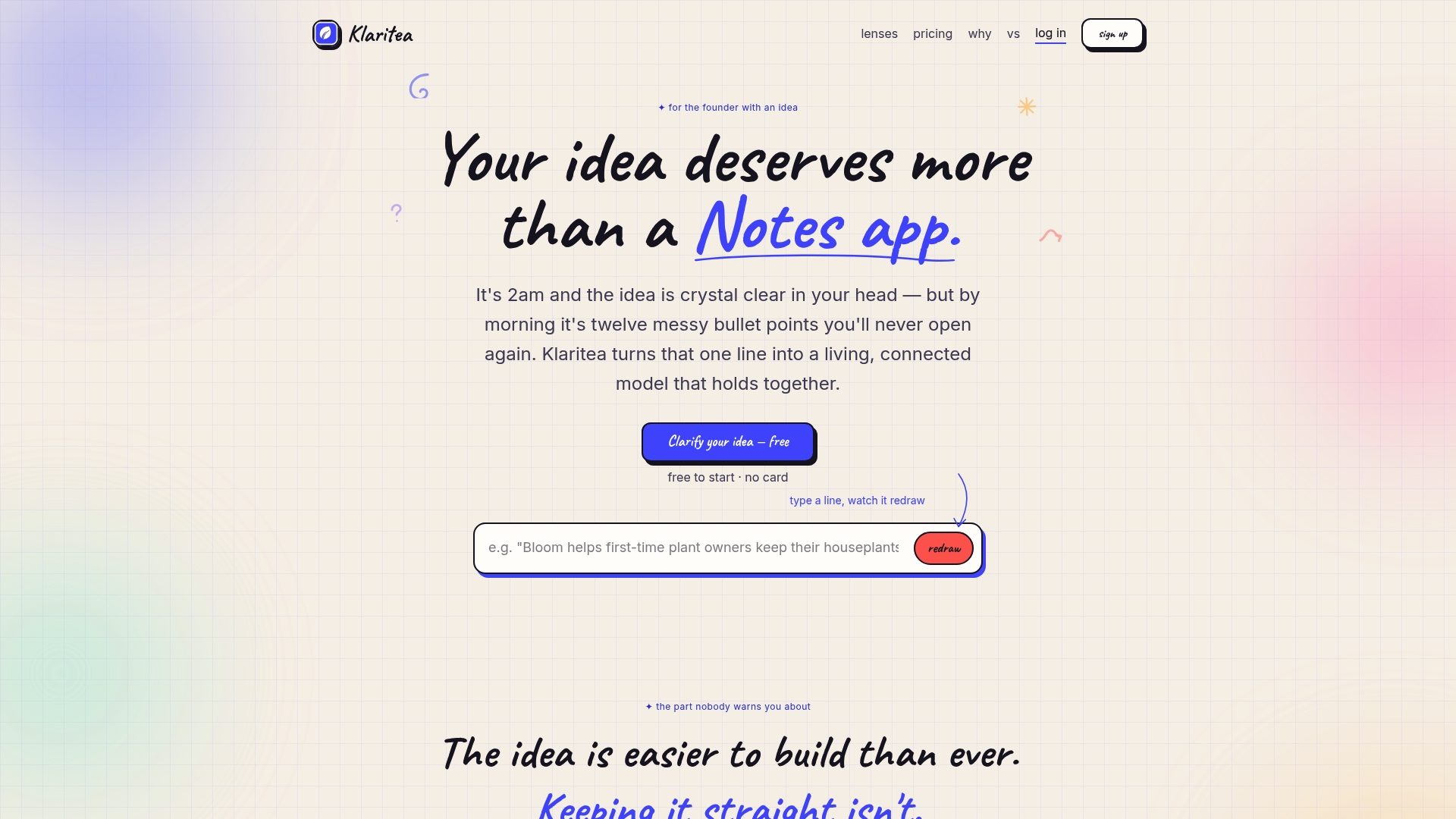
It speeds up the two slowest parts of persona work: turning raw research into synthesized attributes, and generating interview questions worth asking in the first place. If you're staring at a one-line idea and no data yet, that's exactly the gap Klaritea fills. For a deeper look at translating personas into build priorities, Klaritea's guide on defining MVP scope and its breakdown of the jobs to be done framework both walk through the next steps. Visit the Klaritea landing page to try the connected model on your own idea.
Sources
For deeper reading beyond this page: Harvard Business School Online's customer interview question guide for recruitment and question design, ZoomInfo's ideal customer profile breakdown for ICP attributes, Userforge's persona example library for decision-focused card structure, and Cognism's ICP and template guidance for field-by-field template design. For buyer persona alignment with campaigns, see Babylovegrowth's guide to buyer personas.
- Customer interview questions to ask — Harvard Business School Online
- Ideal customer profile — ZoomInfo / Pipeline
- User Persona Examples That Actually Work — Userforge
FAQ
What are the four types of customer personas?
The four most common types are B2B buyer personas (who approves budget), B2B user personas (who uses the product daily), B2C buyer personas (individual consumers), and negative personas (customers you should stop targeting).
How do I write a customer persona?
Pull data from CRM records, product usage, and support logs, then run five to eight customer interviews using questions like those in the Harvard Business School guide, and group recurring language into goals, pain points, and a decision trigger.
What is a persona, with an example?
A persona is a research-based profile of one buyer or user type, built to change a specific team decision. "Budget-Owner Bruce," the VP who needs ROI proof within two quarters, is a working example above.
What are the best examples of user personas?
The strongest user persona examples tie every field, from goals to quotes, to one action a product or marketing team takes differently, rather than listing decorative demographic details with no connection to a decision.
How is an ICP different from a buyer persona?
An ICP qualifies which companies are worth pursuing based on firmographics and technographics, while a persona describes the individual buyer or user inside a qualified company. Use the ICP first, then apply personas within it.