TL;DR:
- Customer discovery interviews are hypothesis-driven conversations that reveal whether a real customer problem exists through behavioral evidence. They involve speaking with target strangers, focusing on past actions like money spent or workarounds, and stopping when no new insights emerge. Klaritea helps founders synthesize interview findings into a clear product plan after validation.
Customer discovery interviews are structured, hypothesis-driven conversations that surface real customer behavior — not polite opinions, not feature requests, not guesses. The goal is simple: find out whether the problem you think exists actually exists, for real people, badly enough that they've already spent money or time trying to fix it.
Here's how to start today:
- Recruit several strangers who match your target customer profile (not friends, not family, not your network).
- Open with: "Tell me about the last time you dealt with [the problem you're investigating]."
- Trust only behavioral receipts: money spent, time lost, or a workaround they built themselves.
- Run 5–8 interviews to spot patterns, 10–15 for high confidence in your top three pain points, and 20 or more only for complex markets or conflicting signals. Stop when three consecutive interviews produce no new surprises.
The validated signal you're looking for isn't "that sounds interesting." It's a specific story, a dollar amount, or a cobbled-together workaround that proves the pain is real.
Table of Contents
- What are customer discovery interviews?
- Why discovery interviews are different from product feedback
- Who should you interview and how do you find them?
- How to structure a discovery interview
- Concrete question banks and scripts to use
- Practical logistics: scheduling, recording, and note-taking
- How many interviews do you need and when should you stop?
- How to analyze interviews and turn them into outputs
- Practical tips, red flags, and common mistakes
- When does a structured tool help with discovery?
- Key Takeaways
- The tradeoffs founders actually face in discovery
- Klaritea helps you go from validated problem to clear plan
- Useful sources and further reading
- FAQ
What are customer discovery interviews?
Customer discovery interviews are one-on-one conversations designed to test falsifiable hypotheses about a customer segment, a problem, and the demand for a solution. The term comes from Steve Blank's customer development framework, laid out in The Four Steps to the Epiphany, which argues that startups fail not from poor execution but from building something nobody wants.
A discovery interview has three defining characteristics:
- Hypothesis-driven: You enter with a specific, testable belief ("Small logistics managers spend more than four hours a week reconciling delivery exceptions manually").
- Past-behavior focused: Every question anchors to what the person actually did, not what they might do.
- Falsifiable: A good interview can prove your hypothesis wrong, not just confirm it.
| Interview type | Primary goal | Timing | Key output |
|---|---|---|---|
| Discovery interview | Test whether the problem exists | Pre-product | Updated hypothesis |
| Product feedback interview | Improve an existing feature | Post-launch | Feature priorities |
| Usability interview | Identify UX friction | During/after build | UI fixes |
| Sales call | Qualify and close a deal | Any stage | Revenue |
Discovery interviews happen before you build anything. Product feedback interviews happen after. Mixing the two is one of the most common mistakes early founders make — you end up optimizing a product for a problem that was never validated in the first place.
Why discovery interviews are different from product feedback
The difference isn't just timing. It's the entire goal.
Product feedback interviews start with an assumption: the product exists, the problem is real, and the job is to make the experience better. Discovery interviews start with the opposite assumption: nothing is proven yet, and the job is to find out whether you're even solving the right problem.
That shift changes everything about how you run the conversation.
Do:
- Ask about the last time the problem happened ("Walk me through the last time you dealt with this").
- Let silence sit. Uncomfortable pauses often produce the most honest answers.
- Ask what they tried before ("What did you do to fix it?").
- Probe for receipts: money, time, or a workaround.
Don't:
- Pitch your idea or describe your product.
- Ask hypothetical questions ("Would you use a tool that...?").
- Ask for feature preferences ("Which of these would be most useful?").
- Treat enthusiasm as validation ("That sounds great!" means nothing).
The Mom Test principle captures this well: ask about specifics and concrete past actions, because compliments and hypotheticals are poor signals. A customer who says "I'd definitely pay for that" has given you nothing. A customer who shows you the spreadsheet they built to manage the problem has given you everything.
Who should you interview and how do you find them?
Start by writing a falsifiable customer hypothesis. It should name a role, a trigger, and a context:
"Operations managers at e-commerce companies with 10–50 employees who have experienced at least one missed delivery SLA in the past 30 days."

That specificity lets you screen participants and reject people who don't fit. Without it, you end up interviewing everyone and learning nothing.
Building a screener
A screener is a short filter you apply before booking an interview. Four behavioral questions are enough:
- What is your job title and primary responsibility?
- How often do you deal with [the problem area]?
- Have you tried to solve this in the past six months? How?
- Are you currently using any tools or workarounds to manage this?
Anyone who answers "rarely" to question 2 or "no" to question 3 is probably not your customer yet.
Where to find participants
- LinkedIn title search: Filter by job title, company size, and industry. Send a short, honest outreach note (see below).
- Niche communities: Subreddits, Slack groups, Discord servers, and industry forums where your target customer hangs out.
- One-star reviews of adjacent tools: People who left angry reviews of a competitor's product are experiencing the problem right now.
- Conference speaker lists: Speakers are often willing to talk and tend to be experienced practitioners.
- Second-degree introductions: Ask a contact to introduce you, not to vouch for your idea.
Talk to ten strangers before you talk to anyone you know. Your network will be polite. Strangers will tell you the truth.
Sample outreach message (LinkedIn or email):
Keep it short. Lead with curiosity, not your idea.
How to structure a discovery interview
A well-run discovery interview takes 20–30 minutes and follows a consistent flow. Here's a timeboxed structure:
- 0–2 min: Opening and consent
- 2–5 min: Role and context ("How do you describe your role? What does success look like for you?")
- 5–18 min: Core problem exploration (story, workaround, receipts)
- 18–25 min: Probing follow-ups and commitment signals
- 25–30 min: Referrals and close
Opening script
Start by removing any product cues and setting expectations:
That last sentence matters. Always ask for recording consent explicitly before you start.
How to probe follow-ups
The four follow-up probes that convert a polite first answer into a usable insight:
- Sequence: "What happened next?"
- Expansion: "Tell me more about that."
- Specificity: "When was the last time that happened?"
- Why-now: "What made you do it that way?"
Closing the interview
Referrals from a good interview are often your best next participants.
Pro Tip: For B2B interviews, open with "How do you describe your role?" and "What does success look like for you?" before diving into the problem. This gives you the language and context you'll need when you eventually run solution interviews.
Concrete question banks and scripts to use
Problem interview script
Use this sequence for a standard discovery conversation:
- "Tell me about the last time you dealt with [problem area]."
- "Walk me through exactly what happened."
- "What did you try to fix it?"
- "How much time did that take?"
- "Did you spend any money trying to solve it?"
- "What was the worst part of that experience?"
- "How often does this happen?"
- "What would a perfect outcome look like for you?"
Questions 3–5 are your receipt questions. If someone can't answer them, the problem may not be painful enough to build around.
Follow-up probes that get receipts
- "Can you show me what that looks like?" (Ask to see the spreadsheet, the workaround, the process.)
- "What did you Google when you were trying to fix this?"
- "How much did that cost you, roughly?"
- "Who else on your team felt this?"
Solution interview questions (use only after discovery)
Solution interviews are a separate conversation. Run them only after you've validated the problem exists. Sample questions:
- "I've been thinking about [approach]. Does that match how you'd want to solve this?"
- "What would make you trust a new tool enough to try it?"
- "What would have to be true for you to switch from what you're doing now?"
Questions to avoid
- "Would you use a product that...?" (hypothetical)
- "Don't you think it's frustrating when...?" (leading)
- "What features would you want?" (prescriptive)
- "How much would you pay for this?" (too early, too abstract)
The Mom Test discipline is clear: questions that ask about concrete past actions produce usable evidence. Hypotheticals produce polite fiction.
Practical logistics: scheduling, recording, and note-taking
Scheduling cadence
Aim for two to three interviews per day, maximum. More than that and your synthesis quality drops. Book a 30-minute buffer after each call to write up your notes while the conversation is fresh.
A simple outreach follow-up cadence: send the initial message, follow up once after three days, then move on. Don't chase.
Incentives
For consumer interviews, a $25–$50 Amazon gift card is standard and usually sufficient. For B2B professionals, a donation to a charity of their choice often works better than cash. For early-stage founders with no budget, offering to share your research findings is a legitimate exchange.
Consent and recording
Read this (or paste it into your opening message):
If they decline, take verbatim notes instead. Never record without explicit consent.
Note-taking setup
The optimal interview team has two people: one interviewer who holds rapport and probes, and one dedicated note-taker who captures verbatim quotes. If you're solo, record the call and transcribe key quotes immediately after.
Your note template for each interview:
- Participant: role, company size, context
- Key quotes: verbatim, timestamped
- Receipts: money, time, workarounds mentioned
- Surprises: anything you didn't expect
- Hypothesis impact: which hypothesis does this update, and how?
How many interviews do you need and when should you stop?
Run 5–8 interviews to spot initial patterns, 10–15 to gain high confidence in your top three pain points, and 20 or more only for complex markets or when early interviews produce conflicting signals. Stop when three consecutive interviews produce no new surprises, no new workarounds, and no new language. That's your signal to synthesize, not to book more calls.
A two-week stopping-rule checklist
- Have you interviewed at least five strangers (not your network)?
- Are you hearing the same core story without new variations?
- Have at least three participants mentioned the same workaround?
- Can you write a one-paragraph problem summary without hedging?
- Has your original hypothesis been updated at least once?
If you can check all five, you have enough to move to synthesis.
How to analyze interviews and turn them into outputs
Step-by-step affinity mapping
For 5–15 interviews, this process takes about two hours with two people:
- Transcribe or review notes and pull out every distinct observation as a sticky note (physical or digital, using a tool like FigJam or Miro).
- Sort silently: each person groups stickies without talking. Silence prevents anchoring bias.
- Name the clusters: write a one-sentence label for each group that describes the pattern, not just the topic.
- Vote on severity: rank clusters by how many participants mentioned them and how strong the receipts were.
- Write hypothesis cards: one card per cluster.
Recommended deliverables
| Deliverable | What it contains | Time to produce |
|---|---|---|
| Hypothesis card | Problem statement, evidence, confidence level | 30 min per card |
| Persona stub | Role, trigger, workaround, quote | 20 min per persona |
| Prioritized problem list | Top 3 problems ranked by receipt strength | 45 min |
| Interview summary | Key quotes, surprises, hypothesis updates | 15 min per interview |
The artifact of discovery is an updated, falsifiable hypothesis — not a feature wishlist. That shift in mindset keeps interviews diagnostic instead of prescriptive.
Who does what: the interviewer writes the hypothesis update. The note-taker writes the interview summary. Both participate in affinity mapping together.
Practical tips, red flags, and common mistakes
Dos and don'ts
- Do ask for the story before you ask for the opinion.
- Do take notes on what they did, not what they said they would do.
- Don't rescue the conversation when it gets uncomfortable — silence is productive.
- Don't interview only people who already like your idea.
- Don't count enthusiasm as a receipt.
Red flags that mean the idea isn't validated
- No one can name a specific dollar amount or time cost.
- No one has a workaround (if the problem were real, they'd have tried to fix it).
- Triggers are vague ("sometimes," "occasionally," "when it comes up").
- Every participant says "that's interesting" but no one asks how to get access.
A common mistake and how to correct it
A founder building a project management tool for freelancers ran eight interviews and heard consistent enthusiasm. She interpreted "I'd love something like that" as validation and started building. Three months later, she had a product and no users.
What she missed: not one participant had spent money on the problem, and every workaround they described was a free tool they'd already stopped using. The problem existed, but the pain wasn't strong enough to pay for a solution.
The correction: go back and ask the receipt questions. If no one has spent money or time, test a lower-friction version of the solution first — a spreadsheet, a Notion template, a manual service — before writing a line of code.
When does a structured tool help with discovery?
Manual interviews plus a shared spreadsheet are enough for your first 5–8 conversations. You don't need software to run good discovery. A Google Doc with a consistent note template and a shared Miro board for affinity mapping will take most founders through their first validation sprint without friction.
A structured tool becomes worth adopting when:
- You're running more than 15 interviews and synthesis is taking longer than the interviews themselves.
- Multiple team members are conducting interviews and notes are inconsistent.
- You need to export hypothesis cards or persona stubs into a planning or build workflow.
- You want to track how hypotheses change across interview rounds over time.
Klaritea sits at exactly this junction. After you've run your interviews, you can bring your findings into Klaritea's connected planning workspace, where your ICP, problem hypotheses, and market context live in one structured model rather than scattered across docs. The AI advisory board (Maya, Devon, and Priya) can challenge your hypothesis updates, flag gaps in your evidence, and help you translate interview language into a build spec or pitch. For founders who are close to moving from discovery into planning and build, that structure prevents the common mistake of jumping straight from "validated problem" to "let's code."
Pro Tip: If you're running async studies to scale volume, use a tool that fires clarifying follow-ups when answers are vague. Async studies with adaptive probing can preserve comparable depth to live calls — but treat live interviews as the gold standard for your highest-value conversations.
For founders who want to see how startup management tools fit into a broader validation workflow, the tradeoffs between manual and structured approaches are worth understanding before you commit to a stack.
Key Takeaways
Behavioral receipts — money spent, time lost, or a workaround built — are the only reliable signal that a problem is worth building around.
| Point | Details |
|---|---|
| Focus on past behavior | Ask "Tell me about the last time..." — hypothetical questions produce polite fiction, not evidence. |
| Interview strangers first | Talk to ten strangers before anyone in your network; your network will be polite, strangers won't. |
| Know your stopping point | Run 5–8 interviews to spot patterns, 10–15 for high confidence in your top three pain points, and 20 or more for complex markets or conflicting signals. Stop when three consecutive interviews produce no new surprises. |
| The output is a hypothesis | Discovery produces an updated, falsifiable hypothesis card — not a feature list or a persona deck. |
| Klaritea speeds synthesis | After interviews, Klaritea's connected workspace structures your ICP, hypotheses, and build spec in one place. |
The tradeoffs founders actually face in discovery
Discovery is uncomfortable in a specific way: you're trying to prove yourself wrong, and most people aren't wired for that. The instinct to pitch, to steer the conversation toward confirmation, to interpret "that's interesting" as a green light — all of it is natural, and all of it will mislead you.
The speed-versus-depth tradeoff is real. Five live interviews in a week will teach you more than twenty async surveys, but twenty async responses will surface language patterns you'd never find in five calls. The practical answer is to run live interviews first, then use async methods to pressure-test the patterns you found.
Embedding discovery as an ongoing habit — folding short conversations into support calls, onboarding sessions, and community interactions — is what separates founders who stay calibrated from those who drift. A single two-week sprint is a start. Treating every customer touchpoint as a low-stakes discovery opportunity is what keeps your hypotheses current six months after launch.
The founders who do this well share one trait: they're genuinely more curious about being wrong than about being right. That's not a personality type — it's a discipline you can practice, one interview at a time.
Klaritea helps you go from validated problem to clear plan
Most founders finish their discovery sprint with a pile of notes, a rough hypothesis, and no clear path to a build spec. That gap — between "we validated the problem" and "here's what we're building and why" — is where most early-stage momentum dies.
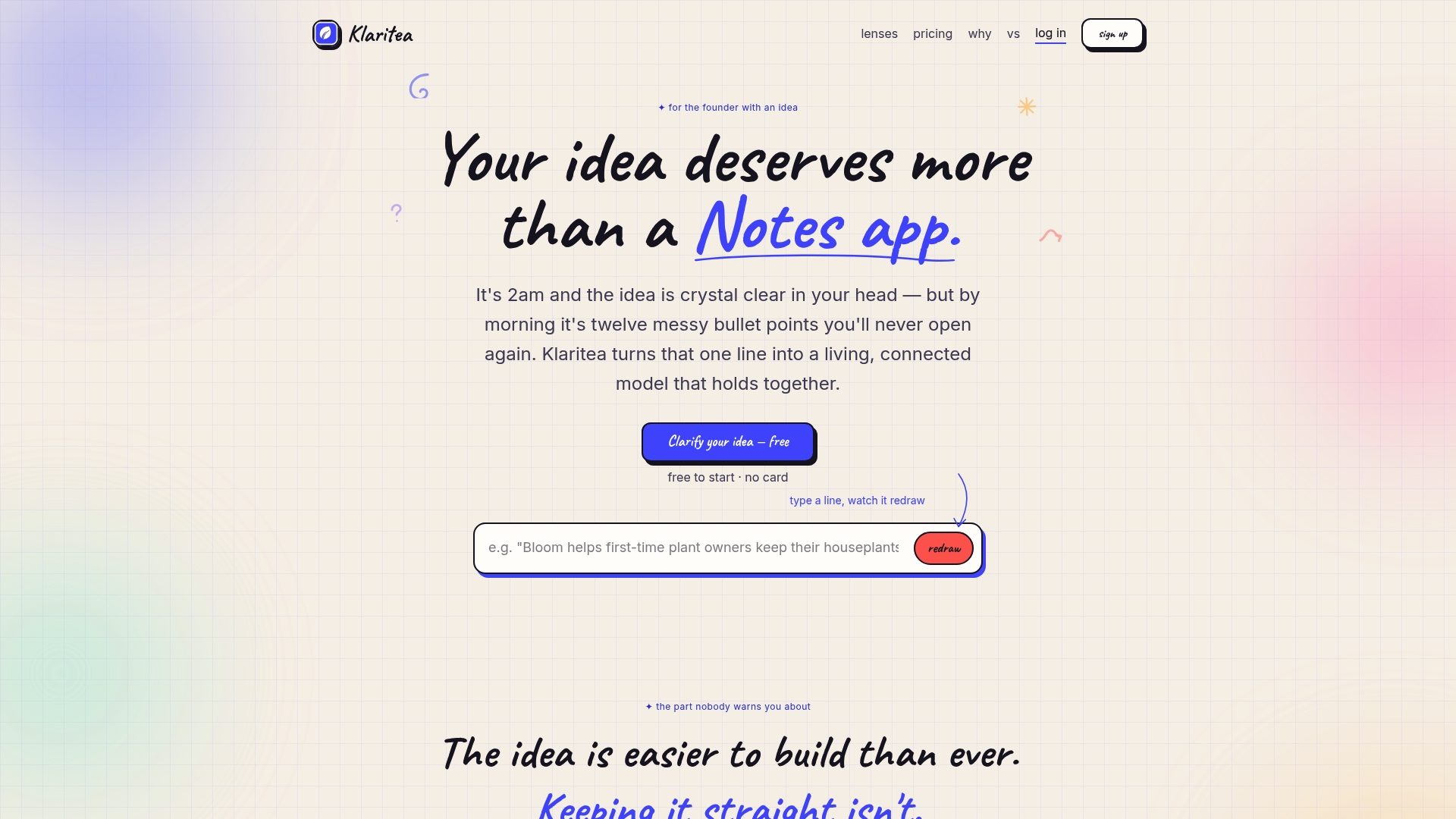
Klaritea is built for exactly that moment. You bring your validated problem statement, your ICP, and your key interview findings, and Klaritea structures them into a connected business model: market sizing, competitor context, feature priorities, requirements, and a pitch-ready summary. The AI advisory board challenges your assumptions the same way a good co-founder would — before you spend a dollar on development.
If you've just finished your first round of discovery interviews and you're ready to turn your findings into a plan, start with Klaritea and see how fast a fuzzy hypothesis becomes a clear product direction.
Useful sources and further reading
These are the primary sources used in this article, selected for authority, specificity, and practical usefulness for founders running discovery for the first time.
- Steve Blank, The Four Steps to the Epiphany — the foundational text on customer development and falsifiable hypothesis testing. Stanford course materials include excerpts and frameworks.
- Michael Batko — Customer Discovery Interviews: Complete Guide for First-Time Founders — practical, opinionated guide covering interview counts, saturation rules, and ongoing discovery habits.
- No BS Startup Coach — Customer Discovery Interviews That Get Receipts — strong on the Mom Test discipline, politeness bias, and behavioral receipt signals.
- Talkful — How to Run Customer Discovery Interviews — covers hypothesis classes, async studies, and the artifact-of-discovery framing.
- Customer Dev Labs — B2B Customer Discovery Problem Interview Script — the most practical B2B-specific script available, with role and success-criteria openers.
- Board of Innovation — Problem Validation Script — covers two-person interview team setup and verbatim note-taking.
- Perspective AI — Customer Interview Questions That Get Honest Answers — detailed breakdown of follow-up probe types (sequence, expansion, specificity, why-now).
- Desert Pacific iCorps — Tips and Best Practices for Conducting Customer Discovery Interviews — practical field guidance from an NSF I-Corps program perspective.
These sources were chosen because they either originate the frameworks (Blank, Mom Test) or provide reproducible, practitioner-tested scripts and templates — not because they rank well on Google.
FAQ
What is a customer discovery interview?
A customer discovery interview is a structured, hypothesis-driven conversation designed to test whether a specific problem exists for a defined customer segment, using past-behavior questions rather than hypothetical ones. The output is an updated, falsifiable hypothesis — not a feature list.
What questions do you ask in a customer discovery interview?
Start with "Tell me about the last time you dealt with [problem area]," then follow up with receipt questions: what did you try, how much time did it cost, did you spend money on it? Avoid hypothetical questions like "would you use a product that...?"
What are the four steps of customer discovery?
Steve Blank's customer development framework organizes discovery into four phases: state your hypotheses, test the customer problem, test the product concept, and verify the business model. Discovery interviews primarily serve the first two phases.
How many interviews do you need before you stop?
Run 5–8 interviews to spot initial patterns, 10–15 to reach high confidence in your top three pain points, and 20 or more only for complex markets or conflicting signals. Stop when three consecutive interviews produce no new surprises.
How does Klaritea fit into the discovery process?
Klaritea is most useful after your interviews are done. You bring your validated problem statement and ICP into Klaritea's workspace, and it structures your findings into a connected business model — market sizing, feature priorities, and a build spec — so you move from discovery to planning without losing momentum.