Start with Porter's Five Forces. That's the verdict. Map industry structure first, then zoom to competitor-level positioning with a Strategic Group map or perceptual map, then build your operational artifacts: a weighted Feature Matrix and Battle Cards. Those four frameworks, run in that sequence, cover every strategic question a product team or founder needs to answer before making a roadmap, pricing, or positioning decision.
Two things you can do this week: (1) Write the strategic question your analysis must answer in one sentence. Not "understand the market" but something like "Should we price below the category leader or position as a premium alternative?" (2) Name three direct competitors using CRM deal data or customer interview notes. That scoping decision shapes everything downstream.
According to Fairview's competitive analysis guide, teams that run frameworks out of sequence or skip buyer-weighted scoring consistently produce analysis that never influences a decision. The sequence matters as much as the frameworks themselves.
Key Takeaways
A competitor analysis framework only produces value when it is tied to a specific strategic question, run in the right sequence, and connected to a named decision owner with a deadline.
| Point | Details |
|---|---|
| Start with structure | Run Porter's Five Forces before any competitor-level framework to avoid chasing the wrong signals. |
| Define the question first | Write the strategic question in one sentence before selecting a framework; mismatched selection is the leading cause of unusable outputs. |
| Weight by buyer research | Feature matrix scores must use buyer-derived weights; buyers often value features quite differently than founders assume. |
| Assign owners and cadence | Teams that formalize ownership and schedule annual, quarterly, and event-triggered reviews are significantly more likely to act on their findings. |
| Klaritea for founders | Klaritea automates competitor scoping, feature mapping, and decision outputs so founders can run a structured analysis before they build. |
Table of Contents
- What is a competitor analysis framework and why does it matter?
- How do you identify direct, indirect, and substitute competitors?
- Which frameworks actually work, and when should you use each?
- How to run a competitor analysis in 1–6 weeks
- Ready-to-use templates you can populate today
- What tool categories support competitor analysis?
- How do you turn analysis outputs into actual decisions?
- What are the most common pitfalls in competitor analysis?
- Why run Five Forces first? The case for structural sequencing
- What does a final verdict and immediate action plan look like?
- How do you evaluate competitor financial performance and market share trends?
- How do you incorporate competitor customer feedback and sentiment analysis?
- What are the legal and ethical rules for competitor data collection?
- How do you connect competitor analysis to ongoing competitive intelligence?
- How do you keep competitor analysis current as markets shift?
- The part most guides get wrong about competitor analysis
- Klaritea maps the full framework sequence for founders
- Sources
- FAQ
What is a competitor analysis framework and why does it matter?
A competitor analysis framework is a repeatable, decision-first system for studying rivals and converting those findings into specific strategic choices. It is not a spreadsheet of features. It is not a one-time research project. Rework's competitive analysis template defines it as the structured process of studying rivals to inform pricing, positioning, product, and messaging decisions, and draws a clear line between this periodic, decision-ready deliverable and continuous competitive intelligence, which is the ongoing monitoring work that feeds it.
That distinction matters in practice. Competitive intelligence is a stream; competitor analysis is a snapshot you take when a decision is pending. Conflating the two leads teams to either over-invest in monitoring with no output, or run a one-time analysis and never update it.
What a well-run analysis should deliver:
- Roadmap signals: which features competitors are building, abandoning, or pricing out of reach
- Positioning decisions: where gaps exist in the market that your product can credibly own
- Pricing inputs: how the category is segmented and where your price point lands relative to perceived value
- Sales battle cards: the objections your reps will face and the specific rebuttals that work
Three misconceptions trip up most teams. First, analysis is not a feature checklist. A table of checkboxes tells you what competitors have; it tells you nothing about whether buyers care. Second, running it once is not enough. Markets shift, new entrants appear, and a 12-month-old analysis is often worse than no analysis because it creates false confidence. Third, raw data is not insight. Pulling traffic numbers, pricing pages, and G2 reviews is data collection. The insight is the interpretation: what does this signal mean for our next decision?
HBR's research on competitive intelligence usage found that only about half of companies actually use the competitive intelligence they collect, which points directly to the real failure mode: analysis that is not tied to a decision cadence or an owner never gets used.
How do you identify direct, indirect, and substitute competitors?
Scoping the competitor set is the step most teams rush, and the one that most often breaks the analysis. Tracking the wrong rivals wastes weeks; missing an indirect threat leaves a strategic blind spot.
Direct competitors solve the same problem for the same customer segment using a similar approach. If you sell project management software to marketing teams, another project management tool targeting marketing teams is a direct competitor. Indirect competitors solve the same problem differently. A shared spreadsheet template is an indirect competitor to project management software. Substitute competitors solve a different problem that eliminates the need for yours entirely. An agency that handles the work your software automates is a substitute.
The job-to-be-done lens is more reliable than category labels. Ask: what is the customer hiring this product to do? Any product that gets hired for the same job is a competitor, regardless of how it is categorized.
Selection rules for scoping your set:
- Pull CRM deal data to find the names that appear in "lost to" fields most often. Those are your highest-priority direct competitors.
- Run customer interviews and ask: "What else did you consider?" You will surface indirect competitors your CRM never captures.
- Use SEO overlap tools. Moz's competitive research tools identify "true search competitors" by measuring keyword overlap and rivalry scores, which often reveals indirect competitors you would not find through category research alone.
Aim for 3–5 direct competitors in your active analysis and a watch list of 5–10 indirect or substitute entrants you review quarterly.
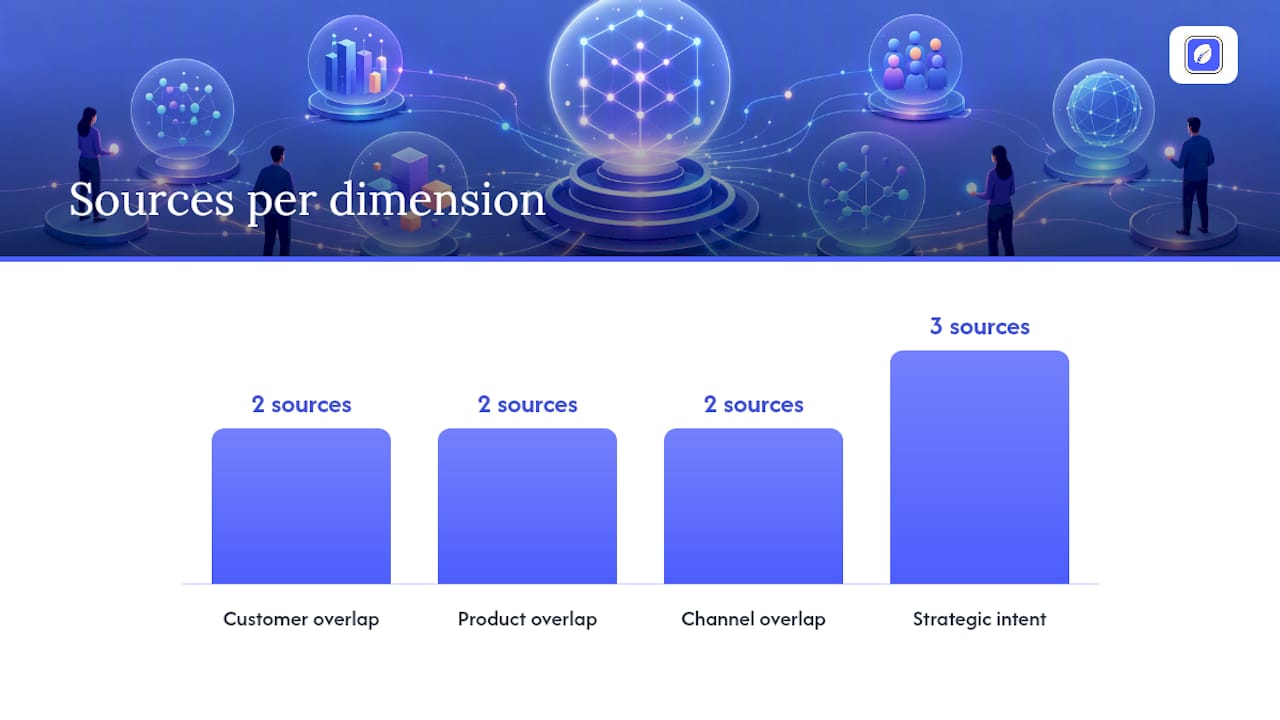
Competitor identification matrix
| Dimension | What to capture | Data source |
|---|---|---|
| Customer overlap | % of shared target segment | CRM, customer interviews |
| Product overlap | Core jobs-to-be-done in common | Product pages, G2/Capterra reviews |
| Channel overlap | Shared acquisition channels | SEO tools, ad libraries |
| Strategic intent | Funding stage, hiring signals, roadmap hints | LinkedIn, press releases, job postings |
Store this matrix in a shared workspace, not a personal spreadsheet. Notion, Confluence, or a dedicated competitive intelligence tool all work. The format matters less than the ownership: one person should be accountable for keeping it current.
Pro Tip: Run a quick search overlap check before finalizing your competitor list. A brand you have never heard of may be outranking you for your three highest-intent keywords. That is a competitor.

Which frameworks actually work, and when should you use each?
The goal is not to run every framework. It is to pick the one that answers your current strategic question. Infomineo's practitioner guide is direct on this: mismatched framework selection is the leading cause of CI outputs that never influence decisions.
Porter's Five Forces
What it answers: Is this industry structurally attractive? Where does power sit?
When to use it: At the start of any analysis cycle, before you look at individual competitors. It maps the forces shaping every player in the market: supplier power, buyer power, threat of new entrants, threat of substitutes, and competitive rivalry.
- Strengths: Forces you to think about structural dynamics, not just current rivals; surfaces threats from substitutes and new entrants that feature matrices miss
- Limits: Industry-level only; does not tell you how to beat a specific competitor; can feel abstract without a follow-on framework
SWOT analysis
What it answers: Where are we strong, weak, exposed, and positioned to move?
When to use it: After structural analysis, as a synthesis tool. SWOT is most useful when you cross-analyze the quadrants: SO moves (use strengths to capture opportunities), ST moves (use strengths to counter threats), WO moves (address weaknesses to unlock opportunities), WT moves (minimize exposure).
- Strengths: Fast to run; creates shared language across teams; works at company or product level
- Limits: Frequently misused as a brainstorm dump with no prioritization; outputs are only as good as the buyer research behind them
Strategic group mapping
What it answers: Which competitors are actually playing the same game we are?
When to use it: After Five Forces, to cluster competitors by strategic dimensions (price point, distribution channel, product breadth). Groups reveal which rivals you are most directly competing with and which you are not.
- Strengths: Reveals white space; shows where a strategic move would face the least resistance
- Limits: Axis selection is subjective; requires iteration to find the dimensions that actually matter
Perceptual mapping
What it answers: How do buyers perceive us relative to competitors on dimensions they care about?
When to use it: When positioning decisions are on the table. HBR's work on mapping competitive position shows that visual positioning tools help leaders identify differentiation opportunities and interpret competitor moves in context.
- Strengths: Buyer-grounded; reveals gaps in perceived positioning that internal teams miss.
- Limits: Only as accurate as the buyer research behind it; two-axis maps oversimplify complex positioning
Weighted feature matrix
What it answers: Where do we win and lose on the features buyers actually value?
When to use it: After structural and positioning analysis, when you need product-level specifics. The key word is weighted. Buyers often value features two to three times differently than founders assume, so weights must come from buyer research, not internal assumptions.
- Strengths: Quantifies gaps; directly feeds roadmap prioritization
- Limits: Becomes a checkbox exercise without buyer-derived weights; can create feature-comparison fatigue if run before structural analysis
Battle cards
What it answers: How does our sales team handle this competitor in a live deal?
When to use it: As the final operational artifact, after you have completed structural, positioning, and product analysis. A battle card without that upstream context is just a list of talking points with no strategic grounding.
- Strengths: Directly improves win rates in competitive deals; gives reps confidence
- Limits: Goes stale fast; requires a quarterly refresh cadence
BCG growth-share matrix
What it answers: How should we allocate resources across a portfolio of products or business units?
When to use it: When managing multiple products or evaluating a competitor's portfolio strategy. Less useful for single-product startups.
Marketing mix (7Ps)
What it answers: How is a competitor going to market across product, price, place, promotion, people, process, and physical evidence?
When to use it: When you need a full go-to-market picture of a specific competitor, particularly useful in B2B and service businesses.
Practical pairing rule: Use no more than two frameworks per analysis cycle. The most effective sequence is Porter's Five Forces followed by a perceptual map or strategic group map, then a weighted Feature Matrix, then Battle Cards. Each framework builds on the last.
How to run a competitor analysis in 1–6 weeks
The process has six steps. The depth of each step scales with your timeline and team size.
Step 1: Define the strategic question. One sentence. "Should we enter the enterprise segment or double down on SMB?" is a strategic question. "Understand competitors" is not.
Step 2: Scope the competitor set. Apply the identification matrix from the previous section. Confirm 3–5 direct competitors and a watch list.
Step 3: Select frameworks. Pick two maximum. Match them to your strategic question using the catalog above.
Step 4: Collect tiered data. Tier 1 is public data: pricing pages, product documentation, job postings, press releases, G2/Capterra reviews. Tier 2 is derived data: SEO overlap, traffic estimates, ad spend signals. Tier 3 is primary research: win/loss interviews, customer interviews, mystery shopping.
Step 5: Synthesize findings. Convert data into signals. Convert signals into implications. Convert implications into decisions.
Step 6: Produce decision outputs. A one-page summary with a strategic conclusion, three implications, a weighted feature gap, and a battle card.
Timing and effort by analysis depth
A practical workflow from Coursera's competitor analysis guide recommends running a full refresh every 6–12 months, with lighter quarterly updates triggered by market events such as a competitor funding round, a major product launch, or a pricing change.
Minimum viable analysis template (one page):
- Strategic conclusion: one sentence stating the single most important finding
- Top 3 implications: what this means for roadmap, positioning, and pricing
- Weighted feature gap: the two or three features where you are most exposed, with buyer-derived weights
- Battle card: one competitor, one page, ready for the sales team
Ready-to-use templates you can populate today
SWOT template
Run SWOT after your structural analysis, not before. The quadrants only mean something when you have context on industry forces and competitor positioning.
- Strengths: List 3–5 internal capabilities that are genuinely differentiated. Not "great team" or "good product." Specific: "lowest implementation time in category," "only player with native Salesforce integration."
- Weaknesses: List 3–5 honest gaps. Pull from customer churn interviews and lost-deal data, not internal opinion.
- Opportunities: List 3–5 external conditions you can exploit. Tie each to a specific competitor gap or market shift.
- Threats: List 3–5 external risks. Include substitute competitors and regulatory shifts, not just direct rivals.
Cross-analysis moves: Once the quadrants are filled, force yourself to generate at least one SO move (a strength that captures an opportunity) and one WT move (a weakness that a threat could exploit). Those two moves are the strategic output of a SWOT. Everything else is setup.
For a worked example using SWOT in a technology context, the SWOT analysis of artificial intelligence guide walks through the cross-analysis method in detail.
Weighted feature matrix template
- List the features buyers evaluate in your category across the top row. Pull these from customer interviews and review sites, not your product roadmap.
- Assign a weight to each feature (weights must sum to 100). These weights come from buyer research: ask customers to allocate 100 points across features by importance.
- Score each competitor on each feature using a 1–5 rubric (1 = absent or poor, 5 = best in class).
- Multiply each score by its weight. Sum the weighted scores per competitor.
Example calculation (simplified):
A gap of 5 points here is not meaningful. A gap of 50+ points on a high-weight feature is a roadmap priority.
Perceptual map
Pick two axes that buyers actually use to evaluate options in your category. Price vs. ease of use is a common starting point, but "enterprise-grade vs. SMB-friendly" and "broad vs. specialized" often reveal more useful positioning gaps. Plot each competitor and your own product. Look for clusters (where competition is dense) and white space (where no one is positioned). HBR's competitive positioning research shows that white space on a perceptual map is not always an opportunity: sometimes it is empty because buyers do not value that combination. Validate before you move.
Battle card template
- Competitor one-liner: What they do, who they serve, their core claim.
- Where they win: Two or three scenarios where a buyer would legitimately choose them.
- Where we win: Two or three scenarios where our product is the stronger choice, with proof points.
- Top objections: The three objections reps hear most often when this competitor is in the deal.
- Rebuttals: One or two sentences per objection. Specific, not generic.
- Proof points: Customer quotes, case study references, or benchmark data that support each rebuttal.
For reps handling competitive deals, OffBook's guide to competitive deal strategies covers how to use battle cards in live deal situations, including how to handle objections when the competitor has a feature advantage.
What tool categories support competitor analysis?
Tools do not run the analysis. They collect and organize the signals your frameworks interpret. Zapier's breakdown of competitor analysis tools segments the tooling into five categories, each delivering distinct signals.
SEO and traffic tools reveal share of voice, organic keyword overlap, estimated traffic, and backlink profiles. They are the fastest way to identify true search competitors and measure content gaps. Use these during competitor scoping and for quarterly monitoring.
Social listening tools track brand mentions, sentiment trends, and share of voice across social platforms and review sites. They surface how buyers talk about competitors in their own words, which is the raw material for battle card objections and rebuttals.
Tech-stack scanners (tools that detect the technologies a competitor's website runs) reveal their infrastructure choices, the tools they use for marketing automation, analytics, and customer support. This is useful for understanding their operational sophistication and identifying integration opportunities.
Market panels and survey tools provide primary research data: buyer preferences, willingness to pay, and feature importance rankings. These are the source of the buyer-derived weights your feature matrix needs.
Win/loss and CRM tools capture deal-level competitive data directly from your sales process. This is often the highest-signal data source because it reflects actual buying decisions, not stated preferences.
Selection criteria checklist:
- Job-first: pick the tool that answers your specific question, not the one with the most features
- Data freshness: check how often the tool's index updates; stale traffic data is worse than no data
- Exportability: you need to get data out and into your analysis workspace
- CRM integration: win/loss data is only useful if it flows into the system your sales team already uses
Sample stacks by budget:
- Bootstrapped (under $200/month): Free tier of an SEO tool for keyword overlap, G2/Capterra for review mining, LinkedIn for job posting signals, and a shared Notion workspace for outputs.
- Growth-stage ($200–$1,000/month): A paid SEO platform, a social listening tool, a market survey tool for buyer-weight research, and a win/loss tracking integration with your CRM.
- Enterprise ($1,000+/month): Full competitive intelligence platform, dedicated market panel access, primary win/loss interview program, and a CI tool that pushes updates to Slack and your CRM automatically.
For a broader view of tools that support the full founder workflow, the best startup tools guide covers tooling across planning, research, and execution.
How do you turn analysis outputs into actual decisions?
The analysis is not done when the frameworks are filled in. It is done when a specific person has committed to a specific action with a specific deadline. Most analysis dies in the gap between "here are the findings" and "here is what we are changing."
Decision-mapping table
| Analysis output | Recommended action | Owner | Experiment to test assumption |
|---|---|---|---|
| Feature gap (high-weight feature you are losing on) | Add to roadmap with buyer-weight justification | Product lead | Ship MVP version; measure adoption vs. churn impact |
| Sentiment signal (competitor losing on support quality) | Reposition on service quality; update messaging | Marketing lead | A/B test landing page headline; measure conversion lift |
| Market structure change (new entrant with lower price) | Run pricing test at current vs. 15% lower price point | Pricing lead | 30-day cohort test; measure conversion and LTV impact |
| Battle card gap (reps losing deals to a specific competitor) | Publish updated battle card; run 30-minute sales training | Sales enablement | Track win rate against that competitor over next quarter |
Roadmap reprioritization: A feature gap finding only justifies a roadmap change if the weight comes from buyer research. An internal opinion that "we need feature X" is not a competitor signal.
Positioning experiments: When a perceptual map reveals white space, test a repositioning claim before committing to it. Change one headline on your highest-traffic landing page and measure conversion for 30 days. That is a positioning experiment. Rewriting your entire website is a commitment.
Pricing tests: Competitor pricing data tells you where the category is priced, not what your buyers will pay. Run a willingness-to-pay survey or a pricing page test before changing your price point based on competitive data alone.
Sales battle card rollouts: A battle card that lives in a shared drive and is never trained on is not a sales asset. For practical techniques on getting reps to actually use competitive materials in live deals, OffBook's deal advancement guide covers the workflow from card creation to rep adoption.
What are the most common pitfalls in competitor analysis?
Most analysis fails not because the frameworks are wrong but because the process breaks down in predictable ways.
- Confirmation bias: Teams find evidence that confirms their existing beliefs and stop looking. Mitigation: assign one team member to argue the opposite interpretation of every major finding before it is finalized.
- Feature-comparison fatigue: Running a feature matrix before structural analysis produces a list of gaps with no strategic context. You end up chasing features that do not move the needle. Mitigation: always run Five Forces or strategic group mapping first.
- Tracking the wrong competitors: Focusing exclusively on the market leader while ignoring the fast-growing challenger that is eating your segment. Mitigation: review your watch list quarterly; use job posting signals and funding announcements as early warning indicators.
- Mistaking activity for insight: Collecting 200 data points and calling it analysis. Mitigation: tie every data point to the strategic question before collecting it. If it does not answer the question, do not collect it.
- No decision owner: Analysis that produces a report with no assigned owner and no deadline never changes anything. Mitigation: every finding must have a named owner and a decision deadline before the analysis is considered complete.
- Stale battle cards: A battle card written 18 months ago for a competitor that has since launched three new features actively harms your sales team. Mitigation: schedule a quarterly battle card review as a standing calendar item.
- Over-relying on public data: Pricing pages, feature lists, and marketing copy are what competitors want you to see. Mitigation: balance public data with primary research: win/loss interviews, customer interviews, and review site mining.
- Skipping the synthesis step: Handing raw data to a decision-maker and expecting them to draw conclusions. Mitigation: the analyst's job is to convert data into a one-sentence strategic conclusion before presenting findings.
Data quality checklist before acting on a finding:
- Is the data source current (within 6 months for fast-moving markets)?
- Is the finding based on at least two independent data sources?
- Has the opposite interpretation been considered and ruled out?
- Is there a named owner and a decision deadline attached to this finding?
The SCIP (Society of Competitive Intelligence Professionals) provides ethical guidelines for CI collection that are worth reviewing before you build out your data collection process, particularly around primary research methods.
Why run Five Forces first? The case for structural sequencing
The sequencing recommendation is not arbitrary. It reflects how strategic decisions actually get made and where analysis most often breaks down.
Structural analysis first (Porter's Five Forces): This tells you whether the industry is worth competing in at all, where power sits, and which forces are most likely to reshape the competitive environment. Without this, every subsequent framework is missing context. A feature matrix built without knowing that buyer power is extremely high (meaning buyers can easily switch) will lead you to over-invest in features when the real problem is switching costs.
Positioning analysis second (strategic group mapping, perceptual map): Once you understand the structural forces, you can identify which competitive positions are defensible and which are crowded. This is where you find the white space that your product strategy should target.
Operational artifacts third (weighted feature matrix, battle cards): These are the execution layer. They are only useful after you know what position you are trying to defend or capture. A battle card written without a positioning strategy is a list of talking points. A battle card written after structural and positioning analysis is a strategic weapon.
Fairview's competitive analysis framework guide makes the same point: practitioners advise running Porter's Five Forces first to map structural dynamics, then zooming to competitor-level frameworks to avoid feature-comparison fatigue. The Infomineo enterprise strategy guide reinforces this: defining the strategic question before selecting a framework is the single most critical step, and it prevents the analysis from producing irrelevant outputs.
Recommended cadence:
- Annual deep refresh: Full framework sequence, all six steps, 6+ weeks. Triggered by annual planning or a major market shift.
- Quarterly update: Refresh the watch list, update battle cards, check for new entrants. 1–2 days of effort.
- Event-triggered scan: A competitor raises a funding round, launches a new product, or changes pricing. Run a targeted one-week analysis focused on that specific event.
Pro Tip: Assign a single owner to the quarterly update. Teams that formalize cadence and ownership are significantly more likely to have their competitive intelligence actually influence strategic decisions, per Rework's competitive analysis research. Without an owner, the quarterly update never happens.
What does a final verdict and immediate action plan look like?
The recommended starting point is Porter's Five Forces, followed by a perceptual map or strategic group map, then a weighted Feature Matrix, then Battle Cards. That sequence works because it moves from structure to positioning to execution, and each framework builds on the last. Skipping steps or running them out of order produces analysis that is technically complete but strategically useless.
One-page checklist:
- Strategic question defined in one sentence: yes/no
- Competitor set scoped (3–5 direct, 5–10 watch list): yes/no
- Frameworks selected (maximum two per cycle): yes/no
- Data collection plan with tiered sources: yes/no
- Named owner for each decision output: yes/no
- Cadence scheduled (annual deep, quarterly update, event-triggered): yes/no
- Outputs stored in a shared workspace with access for all stakeholders: yes/no
Three immediate next steps:
- Write the strategic question your analysis must answer. One sentence. Do it before you open a single competitor's website.
- Name three direct competitors using CRM lost-deal data or customer interview notes. Not the market leaders you admire. The ones you actually lose deals to.
- Schedule a 60–90 minute kickoff with the people who will own the decision outputs: the product lead, the marketing lead, and a sales rep who handles competitive deals.
How do you evaluate competitor financial performance and market share trends?
Financial signals tell you where a competitor is placing its bets and how much runway it has to sustain them. For private companies, direct financials are rarely available, but proxy signals are.
Funding and valuation data from Crunchbase or PitchBook reveal how much capital a competitor has raised, at what stage, and from which investors. A Series B competitor with $40M raised and a 24-month burn rate is a different threat than a bootstrapped competitor with 10 years of profitability.
Hiring signals are one of the most reliable leading indicators of strategic direction. A competitor posting 15 enterprise sales roles and 8 security engineering roles is signaling an enterprise push before any press release confirms it. LinkedIn job postings, filtered by department and seniority, give you a 3–6 month preview of a competitor's strategic priorities.
Market share proxies for private companies include web traffic trends (SEO tools), app store download estimates, review volume growth on G2 or Capterra, and social follower growth rates. None of these is a direct market share figure, but directional trends across multiple proxies are meaningful.
For TAM/SAM/SOM analysis that puts competitor market share in the context of total addressable market, that framework helps you assess whether a competitor's apparent growth is taking share from you or expanding the overall market.
Revenue signals for public competitors are straightforward: 10-K and 10-Q filings, earnings call transcripts, and analyst reports. For private competitors, revenue estimates from data providers like PitchBook or industry analyst reports give directional guidance, though with significant uncertainty bands.
How do you incorporate competitor customer feedback and sentiment analysis?
The most honest signal about a competitor's product is what their customers say when they are not being sold to. Review sites, community forums, and social media are where buyers describe the actual experience of using a product, not the marketed version.
Review site mining on G2, Capterra, and Trustpilot is the fastest way to extract competitor weaknesses. Filter reviews by one and two stars. Read the specific complaints. You will find patterns: "the onboarding takes three weeks," "support takes 48 hours to respond," "the reporting module hasn't been updated in two years." Each of these is a potential positioning claim for your product if you can credibly address it.
Sentiment trend analysis using social listening tools tracks how the volume and tone of competitor mentions change over time. A competitor that was receiving positive sentiment 12 months ago and is now trending negative has likely shipped a bad update, raised prices, or had a support failure. That is a window.
Community forums and Reddit threads often surface the most unfiltered buyer opinions. Search for your competitor's product name on Reddit, Hacker News, and relevant Slack communities. The complaints in these threads are the objections your sales team will face when competing against them.
Win/loss interview data is the highest-quality sentiment source because it captures the decision-making process directly. Ask lost customers: "What did [competitor] do better than us?" Ask won customers: "What almost made you choose [competitor] instead?" The answers to those two questions are the raw material for your battle cards.
What are the legal and ethical rules for competitor data collection?
Most competitor data collection is legal and straightforward. Public websites, pricing pages, press releases, job postings, and review sites are all fair game. The line is crossed when collection methods involve deception, unauthorized access, or misrepresentation.
What is clearly permitted: Visiting public websites, reading published pricing, analyzing public job postings, reviewing public financial filings, reading customer reviews, using SEO tools to analyze public search data, and attending public industry events.
What requires care: Mystery shopping (posing as a buyer to evaluate a competitor's sales process) is generally legal but should be disclosed internally and documented. Purchasing a competitor's product to evaluate it is legal. Reverse-engineering a competitor's product may implicate intellectual property law depending on the method and jurisdiction.
What is not permitted: Accessing systems without authorization, misrepresenting your identity to obtain confidential information, inducing a competitor's employees to share trade secrets, and using data obtained through a breach or leak.
The SCIP publishes a code of ethics for competitive intelligence professionals that covers these boundaries in detail. The core principle is straightforward: collect only information that would be available to any member of the public using legal means.
How do you connect competitor analysis to ongoing competitive intelligence?
Competitor analysis and competitive intelligence are not the same process, but they should feed each other. Analysis is the periodic deep dive that produces decision-ready outputs. Intelligence is the continuous monitoring that detects signals between analysis cycles.
The connection point is the watch list. The competitors you identify and scope during an analysis cycle become the subjects of your ongoing monitoring. The signals you monitor (pricing changes, product launches, hiring patterns, funding announcements) become the triggers for your next event-triggered analysis.
Practical integration steps:
- Set up Google Alerts or a social listening tool for each competitor on your active list and watch list.
- Create a shared Slack channel or Notion page where anyone on the team can log a competitive signal. One sentence: what happened, which competitor, what it might mean.
- Review the signal log at the start of every quarterly update. Signals that appear multiple times or across multiple competitors are the ones worth analyzing.
- Connect win/loss data from your CRM to your competitive intelligence workflow. Every lost deal is a data point. Aggregate them monthly.
The strategic planning software overview covers tools that can host both your analysis outputs and your ongoing intelligence workflow in a single workspace, which reduces the friction of keeping both processes active.
How do you keep competitor analysis current as markets shift?
An analysis that is not maintained becomes a liability. Teams make decisions based on outdated findings, miss new entrants, and fail to notice when a competitor has fundamentally changed its strategy.
Annual deep refresh: Run the full framework sequence once a year, aligned with your annual planning cycle. This is the moment to revisit your competitor identification matrix, update your strategic group map, and rebuild your weighted feature matrix with fresh buyer research.
Quarterly update: A lighter pass focused on the watch list. Check for new entrants, update battle cards for any competitor that has shipped a major product change, and review the signal log from the past 90 days. Budget one to two days of effort.
Event-triggered scan: A competitor raises a funding round, acquires a company, launches a new pricing tier, or loses a major customer publicly. Run a targeted one-week analysis focused on that event and its implications for your strategic question.
New entrant detection: The most common blind spot is the competitor that does not exist yet when you run your annual analysis but is taking deals from you 18 months later. Job posting monitoring, accelerator demo day coverage, and Product Hunt launches are the earliest signals of new entrants in most B2B software categories.
Version control for outputs: Store each analysis cycle's outputs with a date stamp. When you update a battle card or a feature matrix, keep the previous version. The delta between versions is often more informative than the current version alone: it shows you the direction a competitor is moving, not just where they are today.
The part most guides get wrong about competitor analysis
Most competitor analysis guides treat the frameworks as the hard part. They are not. The hard part is the decision linkage.
The frameworks are well-documented. Porter's Five Forces has been taught in business schools for 40 years. SWOT is on every strategy consultant's slide deck. The reason only about half of companies actually use the competitive intelligence they collect is not that they ran the wrong framework. It is that the analysis was never connected to a specific decision, a specific owner, and a specific deadline.
The founders and product teams I have seen get the most value from competitor analysis share one habit: they write the strategic question before they open a single competitor's website. Not "let's understand the market" but "we are deciding whether to add an enterprise tier in Q3, and we need to know whether the two competitors already in enterprise are winning on features or on brand." That question shapes every subsequent choice: which competitors to scope, which frameworks to run, which data to collect, and what the output needs to say.
The sequencing recommendation in this guide (structural first, then positioning, then operational) is not a theoretical preference. It is the order that prevents the most common failure mode: teams that build feature matrices before they understand industry structure end up chasing features that do not address the actual competitive threat. They optimize for the wrong thing with great precision.
One pattern that appears repeatedly with first-time founders: they scope their competitor set based on who they admire rather than who they lose deals to. The result is an analysis of the market leader that tells them nothing about the mid-market challenger that is actually taking their customers. CRM data and customer interviews fix this. The market leader is a reference point. The competitor in your lost deals is the one you need to understand.
Klaritea maps the full framework sequence for founders
Running a structured competitor analysis from scratch takes time most early-stage founders do not have. Klaritea compresses the scoping, research, and synthesis steps into a single connected workflow. You describe your idea in one line, and Klaritea builds a structured model that covers your competitor set, market sizing, feature mapping, and positioning, with three AI advisors (Maya for marketing, Devon for business strategy, and Priya for ops and QA) that research, challenge, and fact-check the analysis as it builds.
The outputs map directly to the framework sequence in this guide: competitor scoping and market structure analysis feed into a clarity scorecard, weighted feature gaps surface in the feature mapping lens, and the build spec and pitch outputs give you the decision artifacts you need before you write a line of code. For founders who want a structured starting point rather than a blank spreadsheet, see how Klaritea works and what a connected business model looks like before you build.
Sources
- Competitive Analysis Framework Template: A Guide — Fairview
- Competitive Analysis Framework — A Practitioner's Guide for Enterprise Strategy Teams
- Competitive Analysis: How to Analyze Your Competitors (Template)
- Moz competitive research
FAQ
What is a competitor analysis framework?
A competitor analysis framework is a repeatable process for studying rivals and converting findings into specific strategic decisions on pricing, positioning, product, and sales. It differs from ongoing competitive intelligence, which is continuous monitoring rather than a periodic, decision-ready deliverable.
What are the 5 steps of a competitive analysis?
Define the strategic question, scope 3–5 direct competitors, select up to two frameworks matched to that question, collect tiered data (public, derived, and primary), then synthesize findings into a one-page output with a strategic conclusion, three implications, and a weighted feature gap.
What is Michael Porter's framework for competitor analysis?
Porter's Five Forces analyzes industry structure across five dimensions: competitive rivalry, threat of new entrants, threat of substitutes, supplier power, and buyer power. It is most useful at the start of an analysis cycle to establish structural context before zooming to competitor-level frameworks.
What are the 4 Ps of competitor analysis?
The 4 Ps (product, price, place, promotion) come from the marketing mix framework and describe how a competitor goes to market. They are one lens within a broader analysis, most useful for mapping a specific competitor's go-to-market approach rather than for structural or positioning analysis.
How often should you update a competitor analysis?
Run a full refresh annually, a lighter quarterly update focused on the watch list and battle cards, and an event-triggered scan whenever a competitor raises funding, launches a major product, or changes pricing. Teams that formalize this cadence with a named owner are significantly more likely to act on their findings.