Yes — early-stage founders should be using ChatGPT and OpenAI tools right now. A Wharton-linked study found AI-human collaboration produced higher volumes and better-rated startup ideas than human-only brainstorming. GPT-4o and the GPT-5 model family handle everything from TAM estimates to investor pitch drafts. The gains are real and immediate when you pair the right model with the right prompt.
Three things to do in the next 72 hours:
- Apply for OpenAI startup credits at OpenAI for Startups — free API credits, Build Hours, and VC partner perks are available if you qualify.
- Pick your account plan — ChatGPT Free works for exploration; ChatGPT Plus ($20/month) unlocks GPT-4o and file uploads; the API gives you programmatic control for building features.
- Run a 7-day validation sprint using the prompt templates in this guide to test your core hypothesis before writing a single line of code.
Quick wins you can capture this week: draft your landing page copy, build a customer support triage bot, scaffold a product spec, and generate 50 interview questions for user research.
Key Takeaways
ChatGPT delivers immediate, measurable value for early-stage founders when paired with structured validation, the right model selection, and honest risk controls.
| Point | Details |
|---|---|
| Apply for credits first | OpenAI for Startups offers API credits, Build Hours, and VC partner perks — apply before spending on subscriptions. |
| Match model to task | Use lightweight models for volume drafts; reserve GPT-4o or GPT-5 for reasoning, code, and investor materials. |
| Run a 7–21 day sprint | Validate your core hypothesis with ChatGPT-generated assets before writing any production code. |
| Mitigate vendor risk | Abstract LLM calls behind a wrapper, maintain a prompt regression suite, and never skip human review for public-facing output. |
| Use Klaritea before you build | Klaritea structures your idea into a validated model so ChatGPT generates assets for the right problem, not just polished output for the wrong one. |
Table of Contents
- What OpenAI programs and tools actually matter for your startup
- High-impact use cases you can copy right now
- A 7–21 day validation sprint you can run this week
- Which models to choose, what they cost, and what U.S. founders need to know about privacy
- Key risks of building on ChatGPT and how to contain them
- How Klaritea and ChatGPT work better together
- Where most founders get this wrong
- Klaritea gives your ChatGPT workflow a foundation worth building on
- Useful sources for founders
- FAQ
What OpenAI programs and tools actually matter for your startup
OpenAI has built a surprisingly deep stack for founders. Here is what each piece does and who it is for.
OpenAI for Startups
The OpenAI for Startups program offers API credits, starter repositories, Build Hours (structured working sessions with OpenAI engineers), and access to VC partner networks. To apply, you typically need proof of incorporation, a brief product description, and a VC partner referral if you have one. Credits are tiered by stage, so pre-seed founders still qualify.
ChatGPT for small business and ChatGPT Work
The ChatGPT for small business program includes virtual training, in-person AI academies, and pre-built agent templates. It integrates with Dropbox, Shopify, Intuit, Slack, Atlassian, and Wix. At earlier small-business events, 78% of participants built a functional AI workflow in a single day and 42% saved more than five hours per week after implementation. ChatGPT Work (the team-oriented workspace) adds shared memory, custom GPTs, and admin controls that matter once you have two or more people on a founding team.
Model families: GPT-4o and GPT-5
GPT-4o is the current workhorse: fast, multimodal, and strong enough for most startup tasks. The GPT-5 model family pushes further on reasoning and code generation, which matters when you are generating a product spec or debugging a prototype. For high-volume tasks like drafting social copy or summarizing research, lighter models cost a fraction of GPT-4o and perform well enough.
DALL·E and Whisper
DALL·E generates product mockup images, pitch deck visuals, and brand concept art from a text prompt. Whisper transcribes user interviews, sales calls, and customer support recordings with strong accuracy across accents. Both are available through the OpenAI API and worth adding to your research and content workflows early.
Stat to know: At OpenAI's small-business AI jams, 78% of attendees shipped a working workflow in one day — a strong signal that structured, short sprints produce real output fast.
High-impact use cases you can copy right now
MIT research confirms that ChatGPT measurably improves productivity on writing tasks. That finding extends well beyond copywriting. Here are the use cases that move the needle most for early-stage teams, along with what to measure:
- Marketing copy and ad creative — Draft landing page headlines, email sequences, and ad variants. HubSpot Startups research shows ChatGPT is among the most widely adopted tools for copywriting tasks, with measurable reductions in content creation time.
Example input → output: Prompt: "My startup idea is: a scheduling tool for independent physical therapists. Give me a one-paragraph TAM estimate and three discovery interview questions for my ICP." Output in under 60 seconds: a rough TAM framing based on U.S. PT practice counts, average billing rates, and software adoption curves — plus three sharp interview questions. That is a usable research artifact, not a finished answer, but it cuts two hours of desk research to five minutes.
Pair each output with a quick experiment. Landing page copy goes straight into a Carrd or Webflow page for an ad test. Interview questions go into a Calendly booking flow. The goal is to move from ChatGPT output to real-world signal within 48 hours.
A 7–21 day validation sprint you can run this week
This sprint costs roughly $20–$50 in ChatGPT Plus or API credits for a solo founder. Run it before spending anything on development.
- Days 8–14: Paid test or qualitative interviews — Run $50–$100 in Meta or Google ads to the landing page, or book five user interviews using the ChatGPT-generated script. Success signal: at least two interviewees describe the problem unprompted in their own words.
MIT's productivity research supports the time savings here. Writing tasks that typically take hours compress to minutes, which means the sprint's bottleneck shifts from content creation to real-world data collection — exactly where it should be.
Pro Tip: Use GPT-4o mini or a lighter model for high-volume drafts (ad copy variants, email sequences) and reserve GPT-4o or GPT-5 for reasoning-heavy tasks like hypothesis scoring, spec writing, and investor Q&A prep. The cost difference is significant at volume.
Which models to choose, what they cost, and what U.S. founders need to know about privacy
Zapier's model selection guidance aligns with what most practitioners find in practice: match model strength to task complexity, not to what sounds most impressive.
| Model / Tier | Best for | Cost shape | Latency |
|---|---|---|---|
| GPT-4o mini (API) | High-volume drafts, classification, triage | Per-token, low | Fast |
| GPT-4o (API / Plus) | Reasoning, code, spec writing, pitch drafts | Per-token, moderate | Moderate |
| GPT-5 family (API) | Complex reasoning, multi-step agents, investor Q&A | Per-token, higher | Moderate |
| ChatGPT Free | Exploration, one-off prompts | Free (rate-limited) | Variable |
| ChatGPT Plus ($20/mo) | Daily founder workflows, file uploads, custom GPTs | Flat subscription | Fast |
On privacy: OpenAI offers a zero-data-retention (ZDR) option through the API for enterprise customers, meaning inputs and outputs are not stored or used for training. For early-stage startups on the standard API, conversations are retained for a limited period per OpenAI's data usage policies. Check the current terms at OpenAI's privacy center before sending customer PII, proprietary financial data, or unreleased product details through any ChatGPT interface.
Pro Tip: Strip or anonymize sensitive data before it enters a prompt. Replace real customer names with tokens ("Customer_A"), swap revenue figures with ranges, and never paste raw database exports. This habit costs nothing and prevents a compliance headache later.
Key risks of building on ChatGPT and how to contain them
Building a startup feature on a single LLM provider is a real concentration risk. Here is the honest list and what to do about each:
- API availability and pricing changes — OpenAI has changed model availability and pricing multiple times. Mitigation: abstract your LLM calls behind a thin wrapper so you can swap providers (Anthropic, Google Gemini, open-source models) without rewriting application logic.
Before shipping an LLM-powered feature: run a security review on data flows, build a rule-based fallback for when the API is unavailable, and get a legal review for any content that touches licensing, medical advice, or financial guidance.
How Klaritea and ChatGPT work better together
ChatGPT generates artifacts fast. What it does not do is tell you which artifacts matter, in what order, or whether your underlying business logic holds together. That is the gap Klaritea fills.
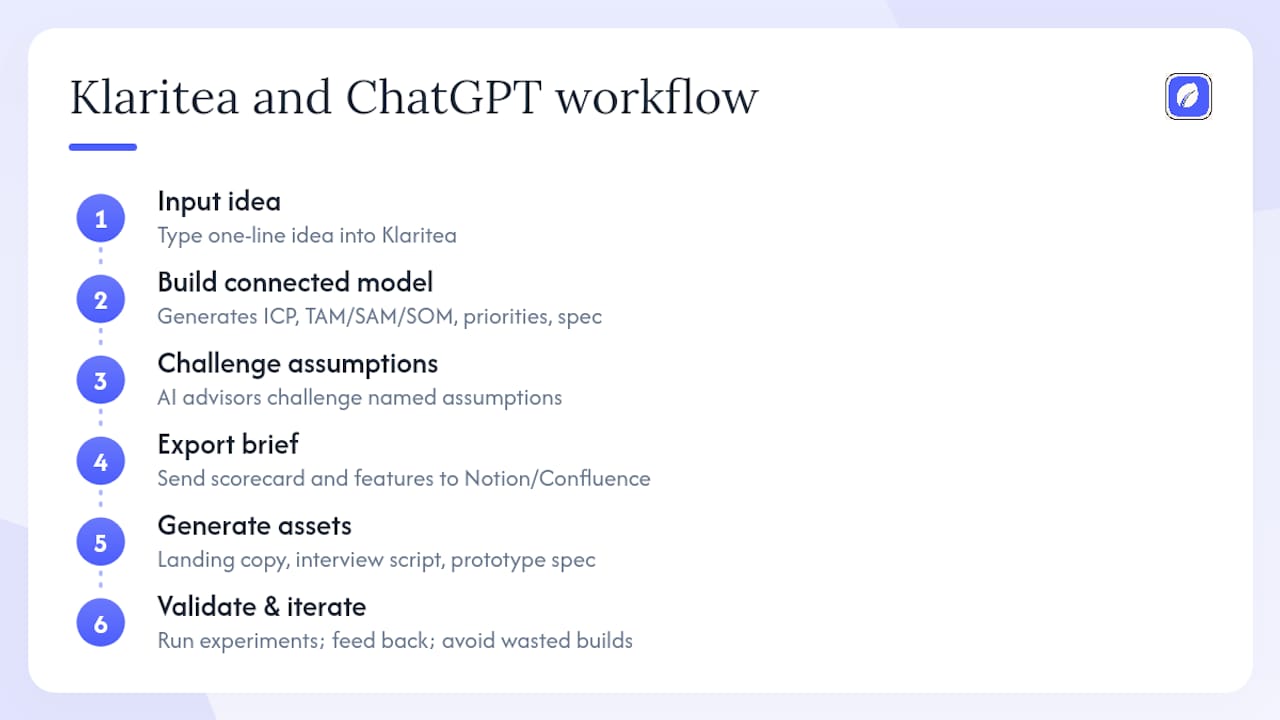
The pattern works like this: type your one-line idea into Klaritea, and it builds a connected model covering ICP, TAM/SAM/SOM, competitor positioning, feature priorities, and a build spec. That structured output becomes the brief you hand to ChatGPT. Instead of prompting from a blank page, you are prompting against a validated hypothesis with named assumptions.
Why this matters in practice: Most founders using ChatGPT alone generate polished artifacts for the wrong problem. Klaritea's AI advisors (Maya on marketing, Devon on business strategy, Priya on ops and QA) challenge your assumptions before you invest time generating assets. The result is that ChatGPT's output goes toward experiments that are already scoped and prioritized, not toward ideas that feel good but have not been stress-tested.
A concrete workflow: Klaritea produces a clarity scorecard and a prioritized feature list. You export that to Notion or Confluence, then use ChatGPT to generate the landing page copy, interview script, and prototype spec for the top-priority feature. Validation results feed back into Klaritea's model. The loop closes without wasted builds.
For founders who want to go deeper on validating startup ideas before committing to a build, Klaritea's structured approach prevents the most common failure mode: spending $10,000–$15,000 building an app that solves a problem nobody has confirmed they will pay to fix.
Where most founders get this wrong
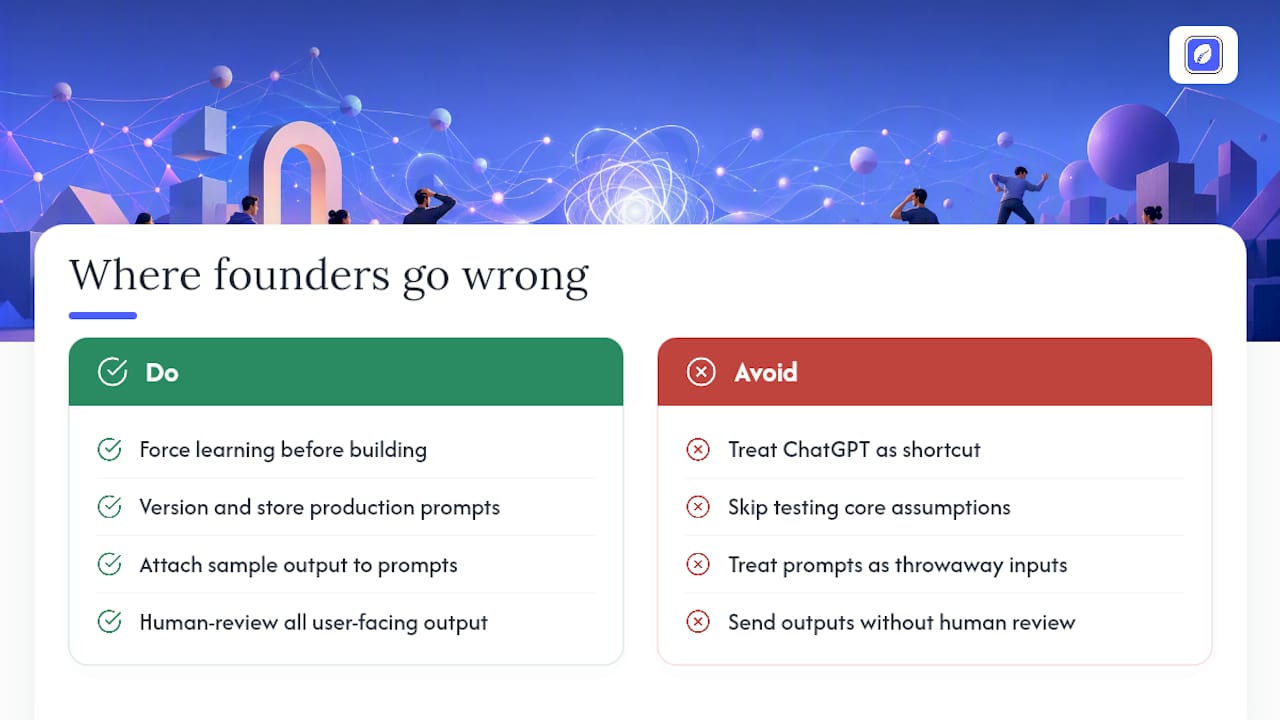
The biggest mistake I see is treating ChatGPT as a shortcut to a finished product rather than a tool for accelerating learning. Founders generate a beautiful pitch deck, a detailed spec, and a polished landing page — and then discover, three months later, that the core assumption was never tested. The artifacts were real. The validation was not.
ChatGPT is genuinely good at compressing the time between "I have an idea" and "I have something to show." What it cannot do is tell you whether the idea is worth pursuing. That requires real signal: a user who paid, a prospect who said no and explained why, a metric that moved. The sprint framework in this guide is designed to force that signal before the artifacts multiply.
The other underappreciated risk is prompt drift. A prompt that worked reliably in January may produce subtly different output after a model update in March. Teams that treat prompts as throwaway inputs rather than versioned assets get burned by this. A shared prompt library with version notes is a 30-minute setup that saves hours of debugging later.
Set a simple rule for your team: any prompt that runs in production gets a file, a version number, and a sample output. Any output that reaches a user gets a human eye on it first. Those two guardrails cover most of the failure modes.
Klaritea gives your ChatGPT workflow a foundation worth building on
Most founders using AI tools for startups hit the same wall: great outputs, unclear direction. Klaritea solves that by turning a one-line idea into a structured business model before you generate a single asset. You get a connected view of your ICP, market sizing, competitive gaps, feature priorities, and a build spec — all stress-tested by three AI advisors before you write a prompt.
That structure is what makes ChatGPT genuinely useful at the validation stage. Instead of prompting from intuition, you prompt from a prioritized hypothesis. Landing pages, interview scripts, and pitch drafts all map back to assumptions you have already examined. When validation results come in, they update the model, not just a folder of disconnected documents.
Klaritea has a free tier to get started. For founders ready to move from fuzzy idea to execution-ready plan, start your first project at Klaritea and see how much faster the sprint runs when the brief is already built.
Useful sources for founders
- Introducing the ChatGPT for small business program | OpenAI
- Startups | OpenAI
- Ideation and AI — UX Magazine
- I asked ChatGPT for 100 ideas. The best ones came later — PCWorld
- Study finds ChatGPT boosts worker productivity for writing — MIT News
- AI tools for startups — HubSpot Startups
- ChatGPT for brainstorming — Zapier
- 7 ChatGPT Prompts To Start A Business — Forbes
FAQ
Is ChatGPT good for starting a business?
Yes, with one caveat: it accelerates research, drafting, and ideation, but it cannot replace real customer validation. Use it to generate hypotheses and assets fast, then test those assets with actual users before committing to a build.
Does OpenAI have a startup program?
OpenAI runs a dedicated startup program offering API credits, Build Hours, technical guides, and VC partner introductions. Applications are open to incorporated startups at most stages.
Which AI tools are most useful for early-stage startups?
ChatGPT (GPT-4o or GPT-5 via API) handles the widest range of founder tasks: ideation, spec writing, copywriting, and support triage. DALL·E adds visual prototyping; Whisper handles interview transcription. For startup tool recommendations beyond the OpenAI stack, a curated guide covers integrations and workflow patterns.
Why do most startups fail, and can ChatGPT help?
Most early-stage failures trace back to building something before validating that anyone will pay for it. ChatGPT helps by compressing the time to a testable artifact, but the validation itself still requires real signal from real users. A structured phase-0 tool like Klaritea adds the hypothesis framework that keeps ChatGPT output pointed at the right problem.
How do I use ChatGPT for startup ideation without getting generic results?
Use the two-stage method: ask for 100 unfiltered ideas first, then run a second prompt to filter for diversity and attack the top three assumptions. Research confirms the strongest ideas appear later in a long list, after the obvious answers are exhausted.