You can validate a business plan in weeks by testing your riskiest assumption with one cheap experiment. Pick the single hypothesis most likely to kill your idea, run a landing page or concierge MVP, and set a 1–3 week window to collect real signals. That's the whole game.
Three things worth knowing before you start:
- Most founders who skip this step pay for it. Klaritea's core thesis: the average vibe coder spends a significant amount building an app, and a large majority never see a return on that investment.
- Market sizing matters early. Estimating TAM/SAM/SOM tells you whether a validated idea can actually scale to a viable business, not just a clever side project.
- Klaritea is built specifically for this phase. Type a one-line idea and it generates a connected model covering your ideal customer profile, market sizing, competitor analysis, features, and a clarity scorecard before you write a single line of code.
Table of Contents
- What does business plan validation actually mean?
- How to validate a business plan step by step
- What fast experiments can you run this week?
- What metrics should you track, and what counts as a pass?
- What does a realistic validation timeline and budget look like?
- Which tools actually speed up validation?
- How do you turn validation results into a business plan?
- Klaritea's phase-0 method: what it does and how it fits
- What legal and regulatory issues come up during validation?
- How does financial feasibility fit into validation?
- How do you iterate the business plan based on what you learn?
- Key Takeaways
- The validation trap most founders fall into
- Klaritea gives you a phase-0 foundation before you build anything
- Authoritative sources and further reading
- FAQ
What does business plan validation actually mean?
Business plan validation is the process of turning your plan's assumptions into testable hypotheses and collecting real-world evidence to confirm or disprove them. It's not about polishing a document. It's about finding out whether your plan reflects reality before you spend serious money on it.
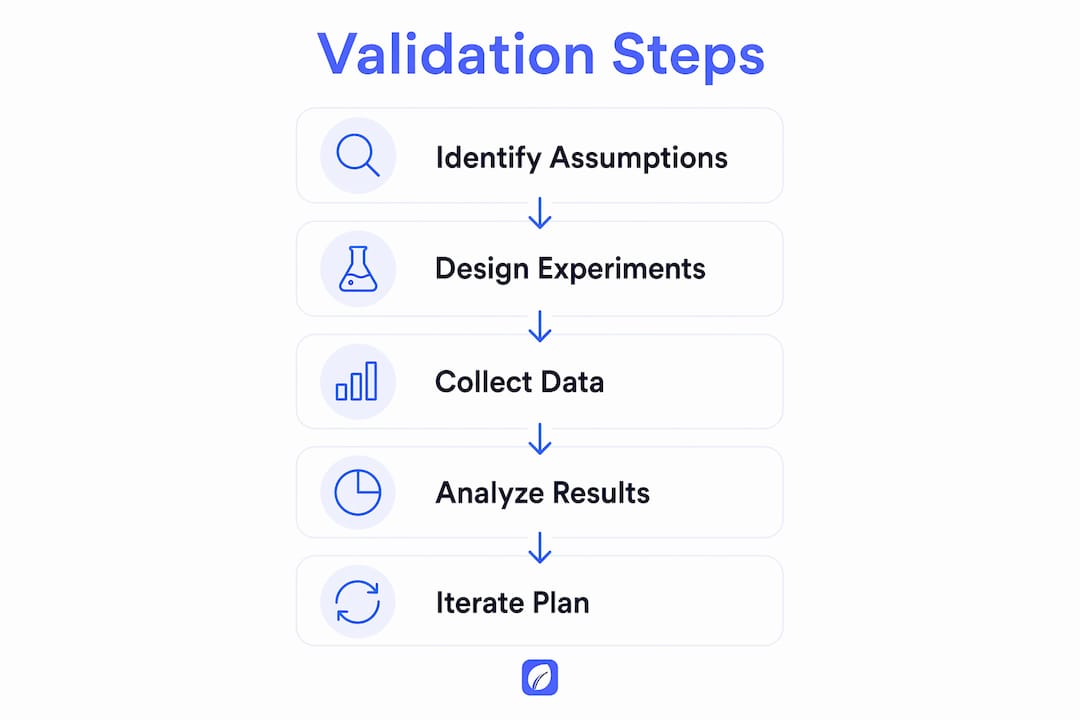
HBS Online describes a five-step market validation process that starts with documenting assumptions and ends with testing the product with real users. The logic is simple: a business plan is a theory. Every section, from the customer segment to the pricing model, rests on assumptions you haven't proven yet.
Why does this matter in practice? Three reasons:
- Reduces wasted build costs. Catching a flawed assumption before development saves far more than it costs to run a $200 ad test.
- Improves investor credibility. Investors fund evidence, not enthusiasm. A plan backed by real conversion data or customer interviews is a different conversation entirely.
- Short-circuits false-positive intuition. Founders are naturally optimistic about their own ideas. Structured validation forces you to confront disconfirming signals instead of explaining them away.
The core elements that need validation: the customer problem and pain intensity, your value proposition, demand and willingness to pay, delivery cost structure, and whether your acquisition channel assumptions hold at scale.
How to validate a business plan step by step
The workflow below is repeatable. Use it for any idea, at any stage before you build.
- Define your goals. What decision does this validation need to support? "Should I build this?" is a goal. "Will 5% of visitors sign up?" is a testable goal.
- List every assumption. Write down everything your plan assumes to be true: who the customer is, what problem they have, how much they'll pay, how you'll reach them, and what it costs to deliver.
- Prioritize killer assumptions. SAP AppHaus recommends plotting assumptions on a 2x2 risk-vs-effort matrix. High risk, low validation effort goes first. These are the assumptions that, if wrong, collapse the entire model.
- Write a hypothesis for each. Use this format: If [target user] has [problem], then [solution] will cause [measurable behavior or metric]. Example: "If freelance designers struggle to invoice clients, then a one-click invoice tool will cause 10% of landing-page visitors to enter their email."
- Design one experiment per hypothesis. Match the experiment to what you're testing. Demand? Run a landing page. Willingness to pay? Run a pre-sale. Delivery feasibility? Run a concierge MVP.
- Run the test and set a time limit. Two weeks is usually enough to get a signal. Longer tests drift into rationalization.
- Analyze and decide. Did the result meet your threshold? Go, iterate, or stop. Document what you learned regardless.
Interview script basics
Customer interviews are your fastest source of qualitative evidence, but First Round Review warns that leading questions destroy the signal. Avoid "Would you use this?" entirely.
Use open discovery prompts instead:
- "Walk me through the last time you dealt with [problem]."
- "What do you do today to solve that?"
- "How much time or money does that cost you?"
- "What have you already tried?"
The goal is to hear about real behavior and existing workarounds, not hypothetical interest. Hypothetical interest is worthless. Real workarounds tell you whether the pain is acute enough to change behavior.
Pro Tip: Record interviews and review them after, not during. When you're listening for confirmation, you'll unconsciously emphasize agreeable responses. The transcript reveals what you actually heard.

What fast experiments can you run this week?
Small, atomic tests produce decisive signals faster and cheaper than broad MVPs. Design each test to confirm a single behavior or willingness to pay.
- Landing page + email signup (2–4 days, $0–$50 for a domain and builder). Tests demand. An email capture rate on cold traffic above a low threshold is considered a meaningful signal for many B2C ideas.
- Paid ad test (3–5 days, $100–$300 in ad spend). Drive traffic to a landing page via Google Ads or Meta. Tests channel efficiency and demand simultaneously. Use cohort tagging to separate ad-channel performance from conversion quality.
- Wizard-of-Oz / concierge MVP (1–2 weeks, near-zero build cost). You manually deliver the service while the customer thinks it's automated. Tests whether you can actually deliver the value, and whether customers will pay for it.
- Pre-sale or paid pilot (1–3 weeks, minimal overhead). Ask customers to pay before the product exists. Real money is the strongest demand signal available. Even $50 from five strangers beats 500 survey responses.
- Explainer video + CTA (3–5 days, $0–$100). A 90-second screen recording or animated explainer with a "Join the waitlist" button. Tests whether your value proposition is clear enough to generate interest without a live demo.
- One-on-one paid interviews (1 week, $25–$75 per participant via platforms like Respondent). Tests pain intensity and willingness to pay. Paying for interviews filters out people who aren't genuinely affected by the problem.
Each experiment maps to a specific assumption type. Landing pages test demand. Pre-sales test willingness to pay. Concierge MVPs test delivery feasibility. Ad tests reveal channel efficiency. Run the experiment that matches your highest-risk assumption, not the one that's easiest to build.
What metrics should you track, and what counts as a pass?
| Metric | What it measures | Example threshold | Pass/fail implication |
|---|---|---|---|
| Landing-page conversion rate | Demand signal | 5–10% email capture (cold traffic) | Below 3%: weak demand or unclear messaging |
| Click-through rate (ad to page) | Channel efficiency | 1–3% CTR on cold audience | Below 1%: wrong channel or weak hook |
| Trial-to-paid conversion | Willingness to pay | 15% for B2B SaaS | Below 10%: pricing or value-prop mismatch |
| Demo-to-paid rate | Sales efficiency | 20% for B2B | Below 20%: qualification or pitch problem |
| Customer acquisition cost (CAC) | Channel economics | CAC < 1/3 of LTV | CAC approaching LTV: unsustainable unit economics |
| Retention after initial use | Product stickiness | 30% for B2C apps | Below 20%: core value not landing |
| Pre-sale conversion | Strongest demand proof | Any paying customer | Zero paying customers: revisit problem or segment |
InnovationManagement notes that LTV must be meaningfully greater than CAC for a model to be sustainable. Track both from your first paid experiment, not after launch.
These thresholds are starting points, not universal rules. A B2B enterprise product with a $50,000 contract value has very different conversion benchmarks than a $9/month consumer app. Calibrate to your price point and sales cycle.
What does a realistic validation timeline and budget look like?
Most founders underestimate how fast a useful signal arrives and overestimate how much it costs to get one.
- Week 0 (prep). Write your assumption list, build your hypothesis sheet, and set up a simple landing page. Budget: $0–$50 for tools.
- Weeks 1–2 (rapid experiments). Run your first 1–2 experiments. A landing page with a small ad budget is the standard starting point. Budget: $100–$300 in ad spend.
- Weeks 3–4 (iterate or second test). If the first test produced a weak signal, adjust the messaging or segment and rerun. If it produced a strong signal, move to a deeper test (concierge MVP or pre-sale). Budget: $0–$200.
- Weeks 5–8 (pilot or pre-sale). Run a paid pilot with 3–10 real customers. This is where you test delivery, pricing, and retention simultaneously. Budget: $200–$1,000 depending on what you're delivering.
Decision checkpoints:
- After Week 2: if conversion is below your threshold and you've tested two different messages, the problem or segment may be wrong. Pause before spending more.
- After Week 4: if you have paying customers or strong pre-sale interest, scale the experiment. If not, pivot the segment or value proposition.
- After Week 8: if you have retention data and positive unit economics, you have enough evidence to write a credible plan and approach investors.
Deloitte's business-plan assessment framework emphasizes reviewing cash-flow forecasts and stress scenarios before presenting to stakeholders. Build that review into your Week 8 checkpoint.
Which tools actually speed up validation?
The right tool depends on your stage, not your preference.
- AI-structured validators (phase 0). Tools like Klaritea build a connected business model from a one-line idea, covering TAM/SAM/SOM, competitor analysis, feature mapping, and a clarity scorecard before you run a single experiment. Best for: first-time founders who need structure before they know what to test.
- Landing-page builders. Carrd, Webflow, and Framer let you publish a test page in under an hour. Pair with Mailchimp or ConvertKit for email capture. Best for: demand and messaging tests.
- Ad networks. Google Ads and Meta Ads are the standard for driving cold traffic to a test page. Budget $100–$300 for a meaningful sample. Best for: channel efficiency and demand tests.
- Interview and survey platforms. Respondent, UserInterviews, and Typeform give you access to screened participants and structured data collection. Best for: qualitative pain validation and willingness-to-pay research.
- Analytics and heatmap tools. Google Analytics 4, Hotjar, and Microsoft Clarity reveal where visitors drop off and what they actually read. Best for: diagnosing why a landing page isn't converting.
One important caveat: SAP AppHaus recommends completing a Business Model Canvas and validation templates before running experiments. An AI scorecard alone is not validation. It's a starting point. Always tie any tool output to at least one real-world experiment with real people.
For a broader view of startup tools for founders, the options across categories have expanded significantly in 2026, but the principle hasn't changed: pick the simplest tool that answers your specific question.

How do you turn validation results into a business plan?
Test results map directly to business plan sections. The translation is straightforward once you know what each experiment proved.
From experiment evidence to plan sections:
- Customer interview data → refine your target segment and ICP description
- Landing-page conversion rate → supports (or challenges) your demand assumption in the market analysis section
- Pre-sale results → grounds your revenue model in real pricing data
- Concierge MVP delivery cost → informs your cost structure and gross margin estimates
- CAC from ad tests → feeds your customer acquisition strategy and financial projections
Decision outcomes and next steps:
- Iterate. Signal was weak but not zero. Adjust the segment, message, or price point and rerun the experiment. Document what changed and why.
- Pivot. Signal was consistently negative across two or more experiments. The problem, segment, or solution needs a fundamental change. Go back to the assumption list.
- Scale. Signal was strong. Run a larger pilot, increase ad spend, or recruit more pre-sale customers. Start building the investor-ready narrative.
- Stop. No signal after multiple iterations. The market may not exist at the size you assumed, or the pain isn't acute enough to drive behavior change. Cut losses now.
For investors or partners, document results in a concise evidence log: what you tested, how many people participated, what the conversion or response rate was, and what decision it supports. A one-page metrics snapshot with three to five experiments is more persuasive than a 40-page plan with no real-world data behind it.
Klaritea's phase-0 method: what it does and how it fits
Klaritea is designed for the moment before you run any experiment. You type a one-line idea and it builds a structured, connected model of your entire business: ideal customer profile, TAM/SAM/SOM, competitor analysis, feature mapping, requirements, and a build spec.
Three AI advisors work through the model with you: Maya covers marketing, Devon handles business strategy, and Priya focuses on operations and QA. They research, challenge, and fact-check your assumptions before you've spent a dollar on ads or development.
What you get out of Klaritea:
- A clarity scorecard that surfaces your highest-risk assumptions
- A prioritized assumption list ready for experiment design
- TAM/SAM/SOM outputs that ground your market-size claims
- A validation checklist tied to your specific business model
- Export to Notion or Confluence (Pro), and GitHub sync (paid) for teams moving into build
What legal and regulatory issues come up during validation?
Validation isn't purely a market exercise. Depending on your industry, legal and regulatory constraints can invalidate a business model just as thoroughly as weak demand signals.
Before running experiments, check three things. First, confirm whether your product or service requires a license, permit, or regulatory approval in your target market. Healthcare, financial services, food and beverage, and education all carry specific federal and state requirements that affect whether you can legally offer what you're testing. The U.S. Small Business Administration's business model validation resources include guidance on regulatory considerations as part of pre-launch planning.
Second, if your validation involves collecting customer data, even just email addresses, you need a basic privacy policy and must comply with applicable data protection rules. CAN-SPAM governs email collection and outreach in the United States. If you're testing with users in California, the CCPA applies.
Third, if you're running a pre-sale or paid pilot, you're entering a commercial relationship. Make sure your terms of service or pilot agreement are clear about what customers are paying for, what they'll receive, and what happens if the product doesn't launch. A simple one-page agreement protects both sides.
This article is general information, not legal advice. Confirm the specific requirements for your industry and state with a qualified attorney or the relevant regulatory body.
How does financial feasibility fit into validation?
A validated demand signal is not the same as a viable business. You can confirm that people want your product and still build something that can't sustain itself financially.
Run a break-even estimate early, before you scale any experiment. The calculation is simple: fixed monthly costs divided by your gross margin per unit equals the number of units you need to sell each month to break even. If that number is implausible given your market size or acquisition cost, the model needs revision before you invest further.
InnovationManagement identifies CAC, LTV, churn, and retention as the core metrics for validating whether a revenue model is sustainable. LTV needs to be meaningfully greater than CAC. A ratio below 3:1 for a SaaS model is a warning sign worth addressing during validation, not after launch.
Two practical steps to incorporate financial feasibility into your validation phase: first, cost out your concierge MVP delivery manually. What does it actually cost you to serve one customer? That number becomes your cost-of-goods-sold baseline. Second, test pricing at two points. Offer your pre-sale at a higher price to a smaller segment and a lower price to a broader one. The conversion difference tells you where your pricing power actually sits.
How do you iterate the business plan based on what you learn?
Validation feedback rarely tells you to do nothing. It almost always tells you to change something. The question is how to translate that signal into a revised plan without losing momentum.
Treat each validation round as a version update. After every experiment, update three things in your plan: the customer segment description (based on who actually responded), the value proposition (based on what language converted), and the revenue model (based on what people actually paid or refused to pay). These three elements are the most assumption-dense parts of any early-stage plan, and they're the ones most likely to shift.
Avoid the trap of making large structural pivots after a single weak experiment. One low-converting landing page is a messaging problem until proven otherwise. Run the same test with different copy before you change the product. If two or three variations all fail, then the problem or segment assumption is worth revisiting.
The define, test, correct loop is the operating rhythm here. Each iteration should be faster than the last because you're narrowing the hypothesis, not broadening it. By the third or fourth round, you should be testing very specific claims about price, channel, or feature priority, not the fundamental question of whether the problem exists.
Document every iteration. A one-paragraph summary of what you tested, what you changed, and why is enough. That log becomes the evidence base for your investor narrative and the foundation for a credible, data-backed business plan.
Key Takeaways
Validation works when you test your highest-risk assumption first, set a clear metric threshold, and make a go/no-go decision within two to four weeks.
| Point | Details |
|---|---|
| Start with killer assumptions | Plot assumptions on a risk-vs-effort 2x2 and test the highest-risk, lowest-effort one first. |
| Run time-boxed experiments | Set a 1–3 week window per experiment; landing pages and pre-sales produce signals within days. |
| Set metric thresholds before you test | Define pass/fail criteria upfront: e.g., 5% email capture or at least one paying pre-sale customer. |
| Map results to your plan | Customer data updates your ICP; pre-sale pricing grounds your revenue model; delivery cost informs your cost structure. |
| Use Klaritea for phase-0 structure | Klaritea builds your connected business model, TAM/SAM/SOM, and clarity scorecard before you run a single experiment. |
The validation trap most founders fall into
The most common mistake in founder-led validation isn't running bad experiments. It's running the right experiment on the wrong assumption.
Confirmation bias is the real enemy here. First Round Review is direct about this: founders conducting their own interviews unconsciously steer conversations toward agreement. They ask "Would you use this?" instead of "What do you do today when this problem comes up?" The first question gets you a polite yes. The second gets you the truth.
The second trap is overbuilding the MVP. An MVP is not a beta product. It's the smallest possible test of a single behavior. If you're spending more than two weeks building something before you've collected a real-world signal, you've already overbuilt. A Wizard-of-Oz test, where you manually deliver the service while the customer thinks it's automated, will tell you more in three days than a polished prototype will in three months.
Vanity metrics are the third trap. Signups, page views, and social media followers feel like traction. They're not. The only metrics that matter during validation are ones that require the customer to give up something: money, time, or a real commitment. A pre-sale converts a curious visitor into evidence. A signup converts them into a number on a spreadsheet.
The practical fix for all three: write your hypothesis before you run the experiment, define your success threshold before you see the results, and ask someone outside your team to review your interview questions for leading language. That last step alone catches most confirmation bias before it corrupts your data.
Klaritea gives you a phase-0 foundation before you build anything
Most founders go from idea to build without ever writing down what they're assuming to be true. That's the gap Klaritea fills. You type a one-line idea and Klaritea builds a structured business model covering your ICP, TAM/SAM/SOM, competitor landscape, feature requirements, and a clarity scorecard that surfaces your highest-risk assumptions before you spend a dollar on development.
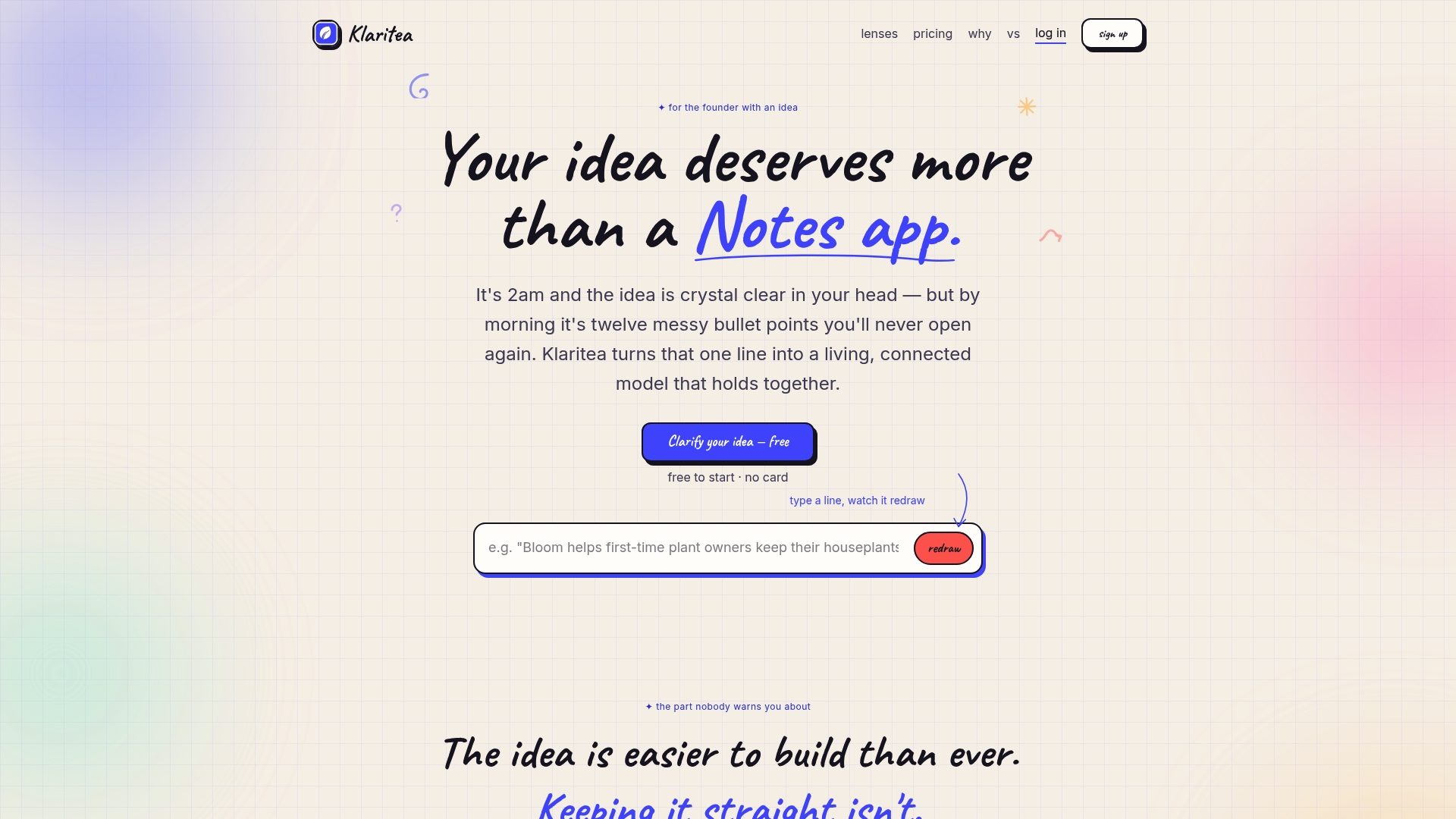
The AI advisory board, Maya, Devon, and Priya, challenges your assumptions from three angles: marketing, business strategy, and operations. You get a prioritized assumption list, a validation checklist, and export-ready outputs for Notion, Confluence, or GitHub. It's the structured phase-0 workflow this guide describes, built into a single platform.
Klaritea runs on a subscription model with tiered monthly plans and usage-based credits, plus a free introductory tier so you can test the workflow before committing. Start your phase-0 plan at Klaritea and know what you're building before you build it.
Authoritative sources and further reading
These sources ground the methods described throughout this guide. Each one is worth bookmarking for templates, deeper frameworks, and case studies.
- U.S. Small Business Administration — Practical framework for validating a business model before launch, including value proposition testing and MVP concept testing.
- HBS Online: 5 Steps to Validate Your Business Idea — Five-step market validation process covering hypothesis definition, market sizing, customer interviews, and product testing.
- First Round Review: How to Test a Business Idea — Detailed guidance on atomic-unit testing, confirmation bias in interviews, and moving from pitching to discovering.
- SAP AppHaus: Validate Your Business Model — Workshop-style templates including the Business Model Canvas, assumption prioritization matrix, and validation plan.
- InnovationManagement: Critical Steps to Validate Your Startup's Business Model — Financial feasibility validation covering CAC, LTV, churn, and cost structure.
- Deloitte: Business Plan Assessment and Analysis — Professional-grade framework for reviewing cash-flow forecasts, liquidity, and stress scenarios before presenting to investors.
FAQ
How do you validate a business plan?
Start by listing your plan's core assumptions, then design one small experiment to test the riskiest one. A landing page, a pre-sale, or a concierge MVP can produce a real signal within one to two weeks.
What is the first thing you should do when validating a strategy?
Write down every assumption your strategy depends on, then identify the single assumption that, if wrong, would collapse the entire model. That's your starting point.
How do you quickly validate a business idea?
Run an atomic test: build a one-page landing page, drive $100–$200 in paid traffic to it, and measure whether people take a meaningful action like entering an email or clicking a pre-order button. Klaritea can structure your assumptions and market sizing before you run that first test.
What are the five stages of a business plan?
Definitions vary, but a common sequence is: define the opportunity, validate the market and customer, build the financial model, develop the operational plan, and present the investor narrative. Validation sits at stage two and feeds every section that follows.