This article gives you six filled-out business model canvases, drawn from companies you already know, plus a short process for turning any of them into a working draft of your own. Each example shows how its nine blocks connect rather than sitting as isolated notes. Use them as starting points: copy the structure, swap in your assumptions, then test before you build anything.
TL;DR:
- Filling out a business model canvas requires testing assumptions, especially the connection between revenue streams and cost structure, to ensure internal consistency.
- Using an example that resembles your idea helps identify divergences and risky hypotheses that need validation through targeted tests.
- Focus on linking each block and performing clash tests to discover internal contradictions rather than striving for a perfect first draft.
- Turning a filled canvas into a detailed build spec involves expanding assumptions into a market-sized ICP, competitor analysis, feature map, and a validated financial model.
- The real value comes from iterative revision and linking blocks, not from completing a perfect canvas or relying solely on the template.
Table of Contents
- What a Business Model Canvas Actually Is
- Turning an Example Into Your Own Draft
- Six Business Model Canvas Examples Worth Studying
- Getting Started: Templates, Boards, and Starter Metrics
- Where Canvases Go Wrong
- From Canvas to Build Spec: A Phase-0 Workflow
- What the Research Actually Supports
- Sources
- FAQ
What a Business Model Canvas Actually Is
The Business Model Canvas is a one-page framework created by Alexander Osterwalder to describe, design, and pivot a business model without writing a 40-page plan first. It works because every block forces a decision, and every decision has to match the eight others on the page.
The nine blocks are:
- Customer segments: who you're building for, split into distinct groups if their needs differ
- Value proposition: the specific problem you solve or gain you create for each segment
- Channels: how you reach, sell to, and deliver to customers
- Customer relationships: the type of interaction each segment expects (self-service, personal, community)
- Revenue streams: how and how often money comes in
- Key resources: the assets you need to make the model run (people, tech, brand, data)
- Key activities: the handful of things you must do well, not everything you do
- Key partnerships: outside relationships that supply resources or reduce risk
- Cost structure: what it actually costs to run the model at scale, not just to launch it
A canvas filled block by block with no cross-checking is close to useless. The real work is in the connections: does the revenue stream actually cover the cost structure? Does the channel match how the customer segment prefers to buy? A strong canvas reads like a single argument, not nine separate index cards.
Turning an Example Into Your Own Draft
Start with a canvas that resembles your idea, not the most famous one. A subscription meal kit has more in common with Nespresso's model than with Uber's, even though Uber gets cited more often.
- Pick one or two analogous examples and list where your idea genuinely differs, block by block. Don't skip blocks that look identical. That's often where a hidden assumption is hiding.
- Turn each risky block into a hypothesis. "Customers will pay $15 a month" is a hypothesis. "Value proposition" is not. Aim for three to five hypotheses total; more than that and you'll test nothing well.
- Run a one-hour workshop to draft the first canvas version with your co-founders or team, using the example as a scaffold. The deliverable is a rough canvas and a ranked list of the riskiest assumptions.
- Run a one-day workshop a week later to design the actual tests: customer interviews, a landing page, a pricing survey. The deliverable is a test plan with a metric and a deadline attached to each hypothesis.
- Define pass/fail thresholds before you run the test, not after you see the results. If fewer than 10% of interviewed prospects would pay your target price, that's a fail, and you revise the revenue stream block.
Pro Tip: Write your pass/fail number down before you talk to a single customer. It's much easier to convince yourself a mediocre result is “promising” after the fact than before.
Practitioners who work with the canvas regularly warn against treating it as a form to complete once. The value comes from linking blocks explicitly and revising the whole page every time one assumption changes.
Six Business Model Canvas Examples Worth Studying
Each of these examples pairs a customer segment and value proposition with the revenue stream that actually funds the business, plus one insight that explains why the model holds together.
Amazon serves two distinct segments on one canvas: shoppers who want selection and speed, and third-party sellers who want reach without building their own storefront. The value proposition is different for each, but the revenue streams reinforce each other: retail margin, seller fees, and Amazon Web Services all draw on the same logistics and cloud infrastructure. The cross-block insight is that Amazon's key resource isn't its warehouses. It's the data and fulfillment network that makes both customer segments more valuable to serve at once.
Airbnb matches hosts with guests, and its key resource is the trust system, not the properties themselves. Reviews, verified IDs, and payment protection are what make strangers comfortable transacting, and platform examples like this show that matching infrastructure and trust systems can outweigh physical assets on the canvas entirely. Revenue comes from service fees charged to both sides, which only works because the channel (the app) and the relationship (mostly self-service, with support for disputes) are cheap to run at scale. The tactical takeaway: if your model depends on strangers trusting each other, put the trust mechanism in key resources, not as an afterthought in customer relationships.
Uber runs on the same matching logic as Airbnb but with a tighter time constraint. Riders need a car in minutes, not a place for a weekend, so the key activity shifts from listing management to real-time dispatch algorithms. Revenue is a percentage of each fare, and the cost structure is dominated by driver incentives and regulatory compliance rather than physical infrastructure. The lesson for founders building anything time-sensitive: your channel and key activities need to be built around latency, because that's the value proposition, not a delivery detail.
Spotify splits its customer segments into free and paid listeners, and the canvas only makes sense once you see that free users aren't a separate business. They're the acquisition funnel and the ad inventory that subsidizes the licensing costs behind the paid tier. Key partnerships (record labels) dominate the cost structure in a way that's unusual for a tech company. If your model has a freemium layer, map exactly how the free segment pays for itself before you assume it's "just marketing."
Nespresso is the clearest example of a company rebuilding its canvas around a single insight: sell the machine near cost, then build recurring revenue on pods sold directly to customers. That shift from wholesale commodity coffee to a product-plus-recurring model changed which channel mattered (owned boutiques and direct online orders instead of grocery shelves), and which customer relationship mattered (direct, data-rich, and loyalty-driven instead of anonymous retail). If you're building anything with a durable-plus-consumable structure, this is the canvas to study block by block.
A generic B2B SaaS company shows the pattern most software founders actually need. Customer segments split by company size or role; the value proposition centers on a specific workflow fixed, not a feature list; and revenue streams are tiered subscriptions with usage-based add-ons. The cross-block insight worth stealing: worked SaaS examples that specify the trial-to-conversion path, average revenue per account, and churn rate as one linked mini-model, rather than treating "revenue streams" and "customer relationships" as separate topics, make the canvas testable instead of aspirational.
Getting Started: Templates, Boards, and Starter Metrics
Start with the official Strategyzer template, which is free to download and licensed for use as a working document, not a static deliverable. For collaborative work, digital boards like Miro or Canva let a team edit a canvas live, and Confluence works well if you're already tracking specs there; printable PDFs are fine for a solo first draft.
Whatever tool you pick, track your hypotheses against real thresholds:
| Hypothesis | Metric | Method | Pass Threshold |
|---|---|---|---|
| Customers will pay EX/month | Willingness-to-pay rate | Pricing survey or landing page test | 15%+ of qualified visitors convert |
| Channel Y drives signups | Cost per acquired user | Paid ad test | Below target CAC for 2 weeks |
| Segment prefers self-service | Support ticket rate | Beta usage tracking | Under 1 ticket per 10 active users |
Name and version your files clearly (v1_explore, v2_pivot) so you're never guessing which assumptions a given canvas was built on.
Where Canvases Go Wrong
The most common failure is block-filling: writing a plausible-sounding sentence in each of the nine boxes without checking whether they agree. A canvas can claim a low-cost channel and a high-touch customer relationship in the same breath, and nobody notices until the cost structure blows up.
Run a clash test: pick one block, change it, and ask whether that forces a change somewhere else. If a new value proposition doesn't ripple into cost structure or revenue, the canvas isn't wired together yet. It's worth keeping separate Explore and Exploit versions of your canvas, since the assumptions you're testing early look very different from the ones you're scaling later, and mixing them muddies both.
Pro Tip: Give every hypothesis exactly one metric. Two metrics per hypothesis usually means you haven't decided what "pass" actually looks like.
- Treat the canvas as a living hypothesis, not a report you file once
- Test with interviews before you test with a build
- Update every connected block when one assumption changes
From Canvas to Build Spec: A Phase-0 Workflow
A filled canvas is a starting point, not a launch decision. The gap most founders hit is turning nine boxes of assumptions into an actual ICP, a realistic TAM/SAM/SOM estimate, and a feature list that isn't just a wish list.
A phase-0 workflow takes the one-line version of your idea and expands it into a connected model that mirrors what the canvas already forces you to think about, then goes further:
- Customer segments and value proposition become a structured ICP with market sizing
- Key partnerships and competitors become a mapped competitor analysis instead of a bullet list
- Key activities and resources become a feature and requirements breakdown you can hand to a developer
- Revenue streams and cost structure feed into a build spec and pitch draft, checked by three AI advisors covering marketing, business strategy, and operations
| Canvas Block | Klaritea Output |
|---|---|
| Customer segments | ICP and TAM/SAM/SOM sizing |
| Key partnerships/competitors | Competitor analysis |
| Key activities/resources | Feature and requirements map |
| Revenue/cost structure | Build spec and pitch |
If you're deciding whether an idea is worth the build cost before you spend on it, Klaritea's connected model is built for exactly that gap between a filled canvas and a real spec.
What the Research Actually Supports
The advice to "just fill out a canvas" undersells how much the format punishes vague thinking. Every example in this article holds together because someone forced the revenue stream to answer for the cost structure, not because the template has magic in it. That's the part conventional guides gloss over: a canvas with nine confident-sounding sentences and zero internal tension is not a strong canvas. It's an unchecked one.
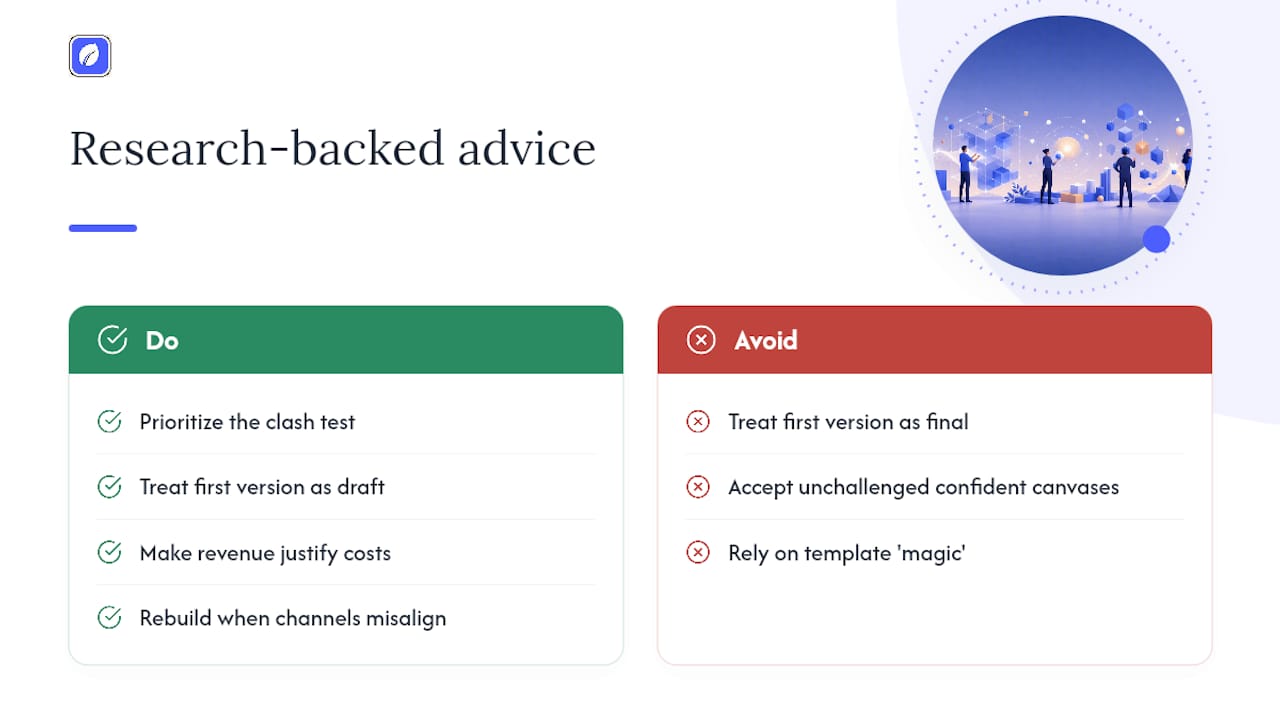
Where most founders go wrong isn't skipping the canvas. It's treating the first version as the answer instead of the first draft of a testable claim. Nespresso's pivot from wholesale coffee to direct recurring sales didn't come from a cleaner canvas. It came from someone asking whether the existing channel matched the value they wanted to capture, and rebuilding the model when the answer was no.
If you take one thing from this article, prioritize the clash test over polish. A rough canvas that survives a hard question about its own internal consistency will serve you better than a beautiful one that's never been challenged.
— Karl
Sources
- Business Model Canvas – Download the Official Template
- Business model canvas (TTU research park)
- Business Model Canvas: What It Is, How It Works, and Real-World Examples | TSI
- Business Model Canvas Examples: 4 Worked Models With All 9 Blocks | Deckary
FAQ
What is an example of a business model canvas?
Airbnb's canvas is a common example: customer segments split into hosts and guests, a value proposition built on trust and access rather than ownership, and revenue from service fees charged on both sides of each booking.
How do you write a business model canvas?
Start with customer segments and value proposition, then work through channels, relationships, and revenue streams before filling in the resources, activities, partnerships, and cost structure needed to deliver on it, checking that each block agrees with the others as you go.
What are the 9 building blocks of the Business Model Canvas?
They are customer segments, value proposition, channels, customer relationships, revenue streams, key resources, key activities, key partnerships, and cost structure, all arranged on a single page so their connections stay visible.
How many components does a business model have?
The Business Model Canvas itself is built around nine components rather than seven; some older business planning frameworks used different counts, but the nine-block canvas is the standard version in current use.
Do I need special software to build a canvas?
No. The official Strategyzer template works as a printable PDF, and tools like Miro or Canva just make it easier to edit with a team in real time.