
The fastest, most reliable way to handle beta tester recruitment is a mix of six channels, each suited to a different need:
- Existing users/email lists — highest quality, fastest to launch, near-zero cost
- Niche communities (Reddit, Discord, Indie Hackers) — good for early-stage products with no user base yet
- Beta directories (BetaList, Betabound) — steady trickle of volunteer testers
- Paid panel services (BetaTesting) — when you need scale or specific demographics fast
- App store distribution (TestFlight, Google Play) — mandatory once you're mobile and need real device coverage
- Referrals — cheapest and often the highest-converting source
Free channels tend to convert at a 10 to 20 percent feedback completion rate, so recruit five to ten times your target tester count if you're relying on Reddit or Product Hunt alone.
Key Takeaways
Successful beta tester recruitment matches testers to your ICP first, then picks the channel mix that fits your speed, quality, and budget constraints.
| Point | Details |
|---|---|
| Start with existing users | Your email list and active users convert better than any cold channel and cost nothing extra. |
| Size for a 10 to 20% yield | Free channels like Reddit and Product Hunt need 5 to 10 times your target tester count in applicants. |
| Screen for use case, not demographics | A 6 to 8 question screener with a pre-test micro-task filters for motivation and technical fit. |
| Stage incentives around milestones | Partial payment at onboarding, full payment at completed feedback, keeps low-effort testers out. |
| Use Klaritea to build the screener fast | Klaritea converts a one-line idea into an ICP, feature list, and exportable screener before recruiting starts. |
Table of Contents
- Beta Tester Recruitment Starts With Knowing Who Qualifies
- Which Channels Actually Deliver Qualified Testers?
- How Do You Get Builds Into Testers' Hands?
- Choosing Incentives That Don't Wreck Your Feedback Quality
- Building a Screening and Onboarding Flow That Doesn't Leak Testers
- How Many Testers Do You Actually Need?
- Turning Feedback Into Roadmap Decisions
- Turning an ICP Into a Screener in Minutes
- Sources
- FAQ
Beta Tester Recruitment Starts With Knowing Who Qualifies
"Qualified" doesn't mean "willing." It means the tester matches your ideal customer profile closely enough that their feedback tells you something about your actual market, not just about people who like trying new apps. For B2B tools, that means matching job function, company size, and current workflow tools, not just enthusiasm.
A useful screener runs 6 to 8 questions across four categories:
- Fit — job role, industry, or use case that mirrors your ICP
- Access — device, OS version, or software environment required to run the beta
- Behavior — frequency of using similar tools, and which ones
- Motivation — why they want in, screened with an open-text field rather than a checkbox
Add one attention check, like asking testers to type a specific word into a field, to filter out testers who click through without reading. ProductPlan's recruitment framework recommends segmenting by these attributes before you even open applications, not after.
Pro Tip: Put your hardest screener question first. Testers who abandon the form at question one save you the trouble of reviewing a low-effort application later.
Which Channels Actually Deliver Qualified Testers?
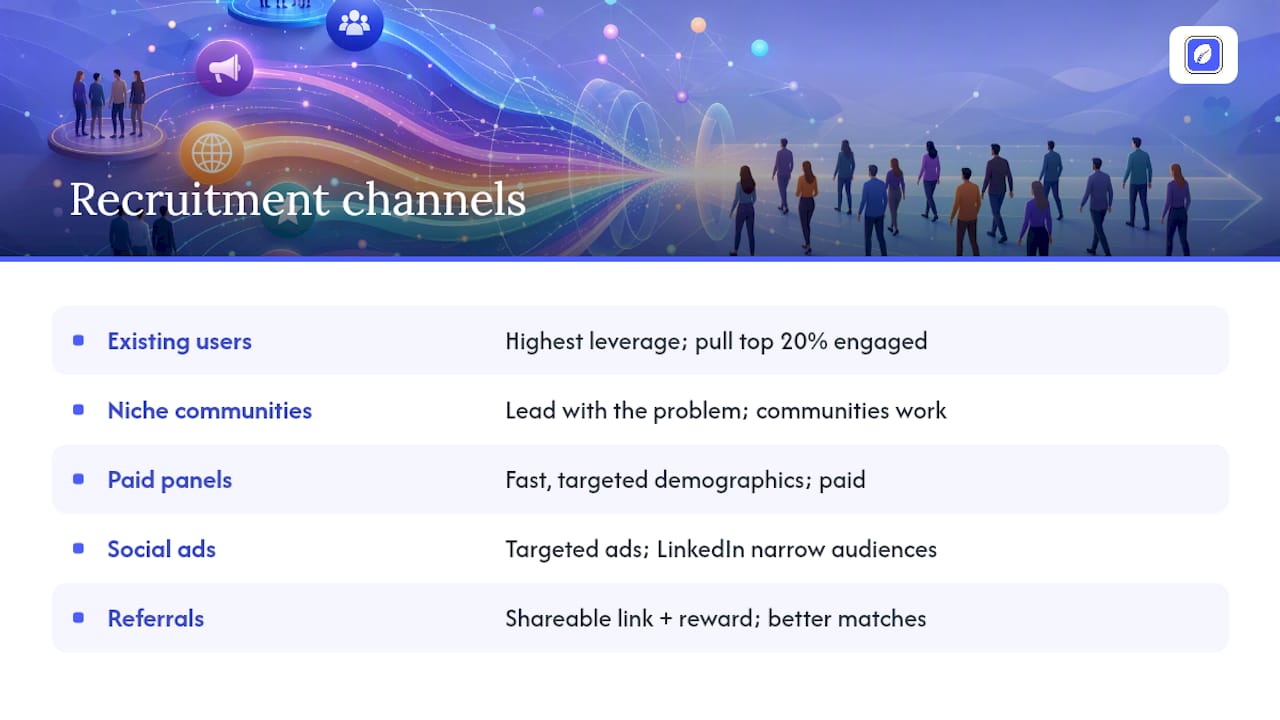
Your existing users and email list are the highest-leverage channel you have, because they've already opted into your product category. Segment your list by activity level, pull your most engaged 20%, and send a direct ask: "You've been one of our most active users. We're opening a private beta for [feature] and want your take before anyone else sees it." That framing outperforms generic "join our beta" blasts because it flatters the reader's actual behavior instead of guessing at it.
For products with no existing users, niche communities are next. A Reddit post in a relevant subreddit or a Discord drop in an active server works only if you lead with the problem you solve, not your product name. Indie Hackers and Product Hunt's Ship feature reward the same honesty. Curated directories like BetaList and Betabound reach people who signed up specifically to test new products, and they cost nothing beyond your listing time.
Paid panels like BetaTesting's 450,000-person pool with over 100 targeting filters make sense when you need a specific demographic fast, or when your internal network simply can't hit your sample size on deadline. Targeted social ads work similarly, but budget carefully. A few hundred dollars targeting a narrow job title on LinkedIn usually outperforms a broader, cheaper Facebook audience.
Referral mechanics are simple: give existing testers a shareable link and a small reward for each qualified referral who completes onboarding. Recruitment exchanges that promise a dozen testers overnight solve app-store minimums, but they rarely produce testers who match your ICP.
How Do You Get Builds Into Testers' Hands?
Recruitment only pays off if testers can actually install and run your build. TestFlight allows up to 10,000 external testers per app via a public link or direct email invite, though testers still need a compatible iOS version and enough device storage. Google Play's testing tracks (internal, closed, open) each carry different minimum tester counts and review timelines, and closed tracks require you to manage tester lists manually rather than relying on a public link.
- Public links are fast but recruit anyone; email invites let you segment by cohort and device
- Google Play's closed track needs a defined list before it will accept your build
- Device filters matter: don't invite Android-only testers to an iOS-only build
Your onboarding message should cover four things in under 100 words: what to install, what the first task is, how long it should take, and where to report bugs.
Choosing Incentives That Don't Wreck Your Feedback Quality
The wrong incentive attracts the wrong tester. A $50 gift card for a 20-minute survey pulls in people optimizing for the reward, not people who care about your product.
Match the incentive to the ask:
- Early access or founding-member status — best for products testers genuinely want, low cost
- Small gift cards ($10 to $25) — appropriate for a single structured session under an hour
- Discounts on the paid product — works well when testers are already close to your ICP and likely to convert
- Swag or public recognition — cheap, effective for community-sourced testers who value status over cash
Pair any incentive with a milestone structure: partial reward for onboarding, full reward for completing the test cycle and submitting usable feedback. That single change filters out drive-by sign-ups better than any screener question.
Pro Tip: Never pay the full incentive upfront. Testers who know a second payment is coming after the final report stay engaged through week three, when most beta fatigue sets in.

Building a Screening and Onboarding Flow That Doesn't Leak Testers
A repeatable process beats an improvised one every time. Centercode's tester recruitment framework breaks the flow into announcing, qualifying, onboarding, and managing, and each stage catches a different kind of drop-off.
- Landing page explains the product and time commitment in under 100 words
- Qualification form applies your screener and attention check
- A small pre-test micro-task (installing a beta build, submitting one screenshot) filters out testers who won't follow through
- Acceptance email includes the first task, install steps, and expected time commitment
- Onboarding checklist covers bug-report format and feedback channel
Micro-tasks work as a filter because completing one requires both the technical ability and the motivation you're screening for, not just a willingness to check a box. Score testers after each cycle so your best performers become a reusable pool for future rounds.
How Many Testers Do You Actually Need?
The right number depends on what you're testing, not a fixed rule.
- Qualitative usability testing: 10 to 30 testers, run over 1 to 2 weeks
- Consumer-scale betas: 50 to 200 testers, run over 2 to 6 weeks
- Store-driven minimums (Google Play open testing): whatever the platform requires, treated as a floor, not a target
Because free channels convert applicants to active feedback at roughly 10 to 20 percent, recruit accordingly. If you need 30 active testers from Reddit alone, expect to accept 150 to 300 applicants. Ship a build update roughly every one to two weeks to keep momentum, and flag your top 10% of testers early. They're your future advocates and your first reference customers.
Turning Feedback Into Roadmap Decisions
Collect feedback through a dedicated channel, not scattered emails or DMs. A Discord server or Slack Connect channel works better than email threads because testers can see each other's reports and stop duplicating them.
- Tag every report by severity (blocks core task vs. minor annoyance) and frequency (one tester vs. a pattern)
- Prioritize anything high-severity and high-frequency first, regardless of how it was reported
- Track three metrics weekly: completion rate, number of actionable reports, and top three recurring UX blockers
- Hand off a weekly digest to engineering with reproduction steps attached, not raw quotes
A beta that generates 200 messages but only five actionable bug reports isn't succeeding. One that generates 40 messages and twelve clear, reproducible issues is.
Turning an ICP Into a Screener in Minutes
Recruiting well starts before you write a single outreach post. If your ICP definition is fuzzy, your screener will be too, and you'll approve testers who waste your test window.
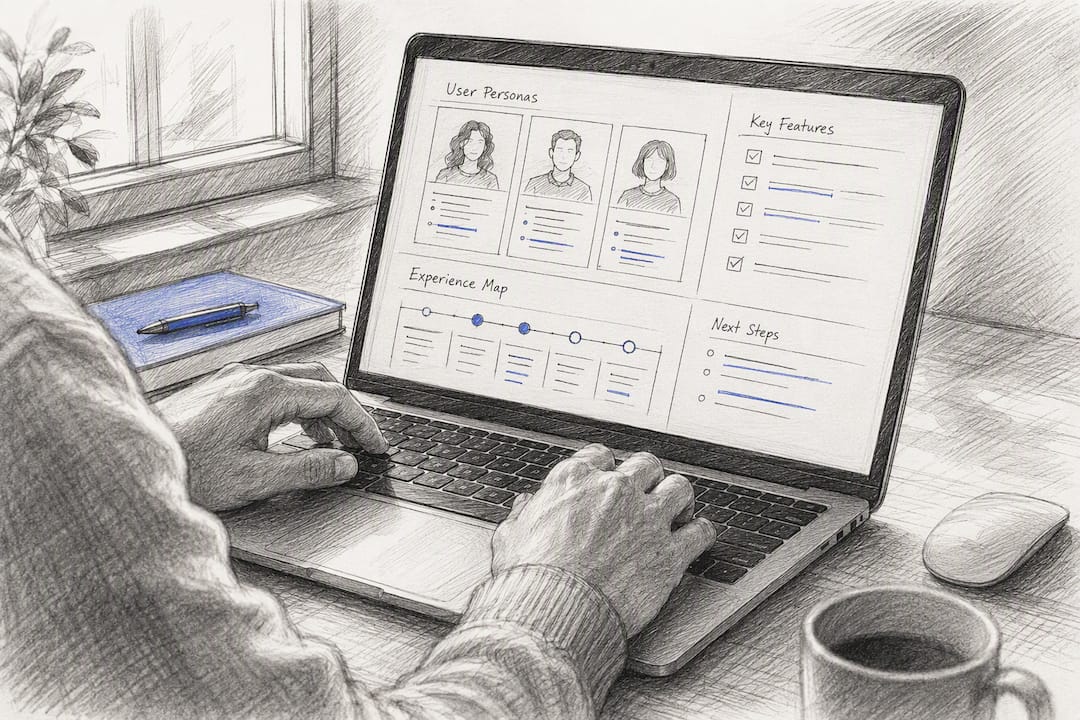
Klaritea's phase-0 model takes a one-line product idea and builds out the connected pieces, ICP, feature list, and requirements, so you can pull your top screener criteria straight from the model instead of guessing. The QA advisor lens converts feature acceptance criteria directly into first-test tasks, and the outputs export as a ready screener and tester brief, cutting the setup time most teams spend reinventing this from scratch.
What I've Seen Go Wrong (and How to Fix It)
Teams over-index on demographics and under-index on use case. A 35-year-old marketer isn't a qualified tester just because they fit a persona slide. Stage your incentives, always. And answer tester questions within a day. Silence is the single biggest reason engaged testers go quiet by week two.
— Karl
Klaritea: Skip the Guesswork Before You Recruit a Single Tester
Klaritea turns your one-line idea into a structured ICP, feature list, and requirements set, the exact inputs your screener and tester brief need, before you spend a weekend building one from scratch in a spreadsheet.
Teams that recruit testers without a clear ICP tend to approve people who are enthusiastic but off-target, then spend weeks sorting signal from noise. Klaritea's advisory lenses (marketing, business, and QA) stress-test your idea and generate the criteria a screener actually needs, plus a build spec your team can hand straight to QA. If you're planning a beta and want the ICP and screener questions built for you instead of drafted by hand, see why Klaritea works or start on the free tier to map your first screener today.
Sources
- Recruit Beta Testers and User Research Participants
- 9 Ways to Recruit Beta Testers
- TestFlight - Join a beta
- Getfree
- Tester recruitment
FAQ
Is BetaTesting a Legitimate Company?
Yes. BetaTesting operates a vetted panel of roughly 450,000 participants with over 100 targeting criteria, and it's widely used by product teams needing paid, scaled recruitment.
How Much Do Beta Testers Get Paid?
Pay varies by test complexity and channel, ranging from small gift cards for short sessions to structured payouts on paid panels; unpaid early access or discounts are also common for volunteer-sourced testers.
How Do I Become a Beta Tester?
Sign up through directories like Betabound or BetaList, join niche communities relevant to the product category, or apply directly through a paid panel like BetaTesting.
Is Being a Beta Tester Worth It?
It depends on your goal: testers get early access and sometimes payment, while product teams get real usage feedback, but the exchange only works well when the tester's use case genuinely matches the product being tested.