TL;DR:
- Klaritea is the best product roadmap tool in 2026 for validating ideas before building, especially for early-stage founders. It offers AI advisors, clarity scorecards, and exports that connect directly to development tools to prevent costly mistakes. Using it early can save founders from spending thousands on prototypes that lack market support.
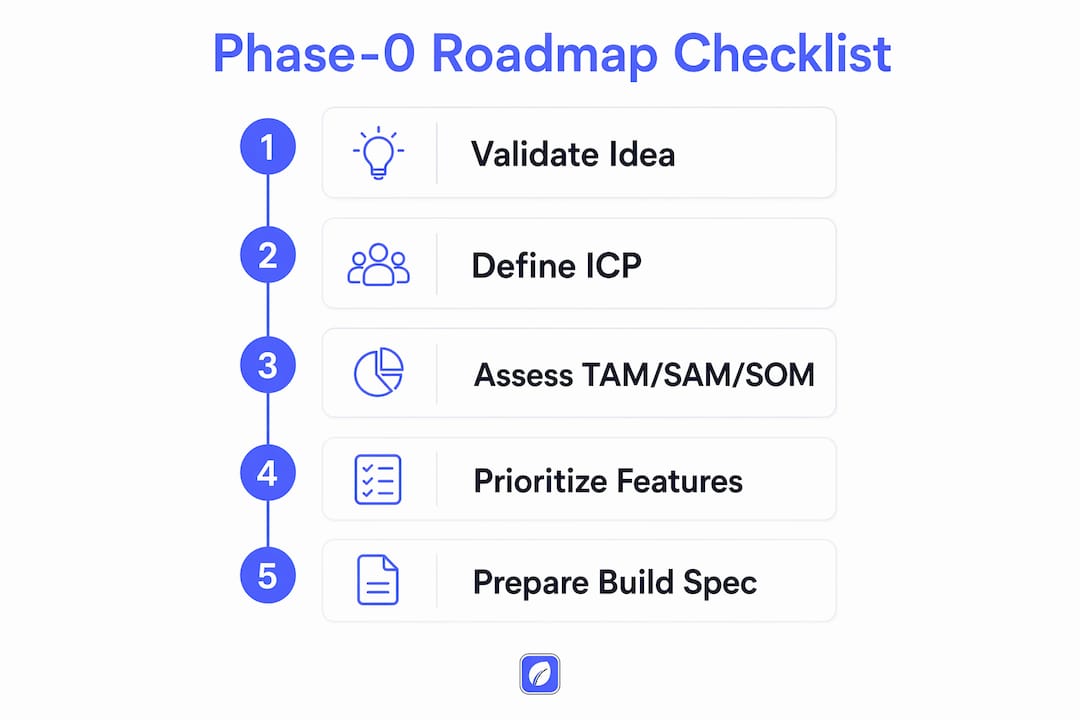
For early-stage founders who need to validate before building, Klaritea is the strongest choice among product roadmap tools in 2026. It is the only platform built specifically for phase‑0 planning: you type one line, and it generates a connected business model covering ICP, TAM/SAM/SOM, competitor signals, features, and a build spec, before a single line of code gets written.
Three reasons it stands out for founders at this stage:
- AI advisory board: Three distinct advisors (Maya for marketing, Devon for business strategy, Priya for ops and QA) research, challenge, and fact-check your idea from different angles.
- Clarity scorecards: Every initiative ties back to market-size calculations and business metrics, so prioritization has evidence behind it, not gut feel.
- Dev-ready exports: GitHub sync (paid), Notion and Confluence export (Pro), so the plan travels directly into your build workflow.
Who this fits:
- Solo founders at the idea or pre-seed stage
- Founding teams of 2–8 people preparing for a seed raise
- Anyone who has ever started building before validating the market
Pro Tip: Before you open any roadmap tool, write your idea in one sentence. If you cannot do that, the tool will not save you. Klaritea forces this discipline from the first screen, which is exactly where roadmap bloat starts.
Table of Contents
- Why the right roadmap tool can save you $15K before you write a line of code
- How do you choose the right roadmap tool for a phase‑0 workflow?
- How Klaritea delivers on every phase‑0 criterion
- Your 30/60/90-day plan from idea to build-ready
- Key Takeaways
- Phase‑0 planning changes more than your roadmap
- What you get when you start with Klaritea
- Useful sources and further reading
- FAQ
Why the right roadmap tool can save you $15K before you write a line of code
Most founders treat roadmap tools as task trackers. That framing costs them money. The real job of a roadmap is to communicate the why to stakeholders, investors, and your own future self, and to force the hard prioritization decisions before dev budget gets committed.
The $15K problem: Many developers spend a significant amount building apps, yet a large portion never see a return on that investment. Phase‑0 validation, done before engineering starts, is the single most effective way to avoid joining that majority.
Connecting roadmap items to business metrics like TAM/SAM/SOM and ICP reduces roadmap bloat and strengthens prioritization. That is not a nice process improvement. It is the difference between a product that finds customers and one that does not.
Tool categories matter here. Enterprise lifecycle suites (broad platforms requiring months of configuration) are built for teams that already have a product, customers, and an engineering org. Purpose-built roadmapping platforms can produce a shareable roadmap in days rather than the months needed for those full lifecycle suites. Most founders get a structured output, including ICP, TAM/SAM/SOM, and an initial clarity scorecard, in under an hour from a single one-line input. Phase‑0 AI workspaces like Klaritea go further: they generate the business model and validation layer before the roadmap even exists.
Core tradeoffs founders should expect by category:
- Enterprise suites: Deep integrations, steep learning curve, built for post-revenue teams
- Purpose-built roadmap tools: Fast to a shareable plan, strong stakeholder views, limited pre-build validation
- Phase‑0 AI workspaces: Validation-first, AI-driven, exports into dev tools, built for pre-revenue founders
A founder who ran a four-week validation cycle using evidence-backed prioritization avoided committing to a $15K prototype after the TAM analysis revealed the serviceable market was too small to support the unit economics. That is the outcome phase‑0 planning is designed to produce.

How do you choose the right roadmap tool for a phase‑0 workflow?
Prioritize tools that deliver validation outputs, clarity scorecards, build specs, and an investor-ready pitch, faster than they deliver task tracking. If a tool's homepage leads with Gantt charts and sprint boards, it was built for a different problem.
The evaluation checklist
- Time to first plan: Can you get a structured output in under an hour without professional services?
- AI advisory capability: Does the tool challenge your assumptions, or just format them?
- Evidence connection: Are priorities tied to TAM/SAM/SOM, ICP, or customer signals?
- Export and sync: Can you push a build spec to GitHub, Notion, or Confluence without manual copy-paste?
- Pricing transparency: Are credit or usage costs clearly listed before you commit?
- Data portability: Can you export everything if you leave?
AI-assisted templates remove the blank-canvas problem by generating a roadmap structure from a brief in seconds. That matters most at phase‑0, when you have nothing yet.
Red flags to watch for:
- Tool marketed primarily for engineering delivery tracking
- Long onboarding requiring professional services or a dedicated admin
- No two-way sync or data export option
- Opaque credit pricing that only appears at checkout
Questions to ask during any trial:
- Show me a sample clarity scorecard from a real plan
- How long does it take to get from a one-line idea to a build spec?
- What do the AI advisors actually do, and can I see an example session?
- Can I export to Notion and GitHub from the free tier?
For a broader look at how business planning tools compare when you are deciding between a strategic workspace and a roadmap-first tool, that comparison is worth reading before you commit.
How Klaritea delivers on every phase‑0 criterion
Klaritea was built for pre-revenue founders who need validation before engineering. Every feature maps to a decision a founder has to make before writing a spec.
| Phase‑0 criterion | How Klaritea delivers |
|---|---|
| Clarity scorecards | Auto-generated after each AI advisor session; tied to business metrics |
| TAM/SAM/SOM | Built into the connected model from the first one-liner input |
| AI advisory board | Maya (marketing), Devon (business), Priya (ops & QA) — three distinct lenses |
| Build spec output | Generated from the connected model; exportable as a structured document |
| GitHub sync | Available on paid plans; two-way sync keeps plan and code aligned |
| Notion/Confluence export | Available on Pro; one-click export of the full plan |
| Time to first plan | Structured output from a single sentence in under an hour |
| Security and data ownership | Founders retain data ownership; full export available on all tiers |
Governance from day one: Linking initiatives to financial outcomes early avoids rework when investors ask about the Run/Grow/Transform balance. Klaritea builds this connection structurally, not as a tag added after the fact.
The user flow is straightforward. You paste a one-line idea, Klaritea builds the connected model, you run sessions with the three AI advisors, review the clarity scorecard, and export the build spec to GitHub or Notion. From fuzzy idea to a document an engineer can act on, without a single planning meeting.
Strategic planning AI tools cover a wider category, but for phase‑0 specifically, the combination of advisory sessions, scorecards, and dev-ready exports is what separates Klaritea from general-purpose options.
Your 30/60/90-day plan from idea to build-ready
Follow this cadence to validate before committing any dev budget.
Days 1–30: Validate the idea
- Write your idea in one sentence and enter it into Klaritea
- Review the auto-generated ICP and TAM/SAM/SOM model
- Run your first AI advisor session (start with Devon for business viability)
- Pull your first clarity scorecard and note the lowest-scoring areas
- Checkpoint: You should have a structured business model and a prioritized list of assumptions to test
Days 31–60: Pressure-test the plan
- Conduct five to ten market interviews using the ICP as your targeting guide
- Revise the clarity scorecard based on what you heard
- Prioritize features against the updated TAM/SAM/SOM
- Generate the build spec draft inside Klaritea
- Export to Notion and share with an advisor or potential technical co-founder
- Checkpoint: A revised scorecard with evidence behind each priority, and a build spec ready for review
Days 61–90: Move toward engineering
- Run a smoke test or landing page against your ICP
- Collect early signal (signups, waitlist, interviews)
- Finalize MVP scope using the evidence from the smoke test
- Connect GitHub sync to hand off the build spec to engineering
- Checkpoint: An evidence-backed MVP scope, a GitHub-connected plan, and a pitch-ready clarity report
Lean startup principles pair well with this cadence. Running experiments alongside the scorecard revision in days 31–60 sharpens the evidence before you finalize scope.
Key Takeaways
For early-stage founders, the best product roadmap tools are the ones that force validation before engineering, not after.
| Point | Details |
|---|---|
| Phase‑0 first | Validate ICP, TAM/SAM/SOM, and assumptions before writing a build spec or committing dev budget. |
| AI advisory board | Three distinct AI advisors (marketing, business, ops/QA) challenge your plan from different angles. |
| Red flags | Avoid tools built primarily for engineering delivery, with no data export or opaque credit pricing. |
| 30/60/90 cadence | Use the structured plan: validate in 30 days, pressure-test in 60, move to engineering at 90. |
| Klaritea | Klaritea delivers clarity scorecards, TAM/SAM/SOM, build specs, and GitHub/Notion exports from a single one-line input. |
Phase‑0 planning changes more than your roadmap
The founders who get the most from phase‑0 tools are not the ones who use them to build prettier slides. They are the ones who use the outputs to change a decision they would otherwise have made too late.
A clarity scorecard shared before a first investor meeting does something specific: it shows you already know where your plan is weak. That is a more credible signal than a polished deck that never acknowledges risk. Investors notice the difference immediately.
The same logic applies to technical hires. Sharing a build spec and scorecard with an engineer before you make an offer aligns expectations on scope, complexity, and timeline before anyone signs anything. Mid-build pivots are expensive. Most of them are avoidable with a single honest conversation backed by a structured plan.
Pro Tip: Share your clarity scorecard with your first technical hire before the offer stage. It surfaces scope disagreements early, when they are cheap to resolve.
What you get when you start with Klaritea
Skip the $15K mistake. Klaritea gives you a structured business model, a clarity scorecard, and a build spec from a single sentence, before you spend a dollar on development.
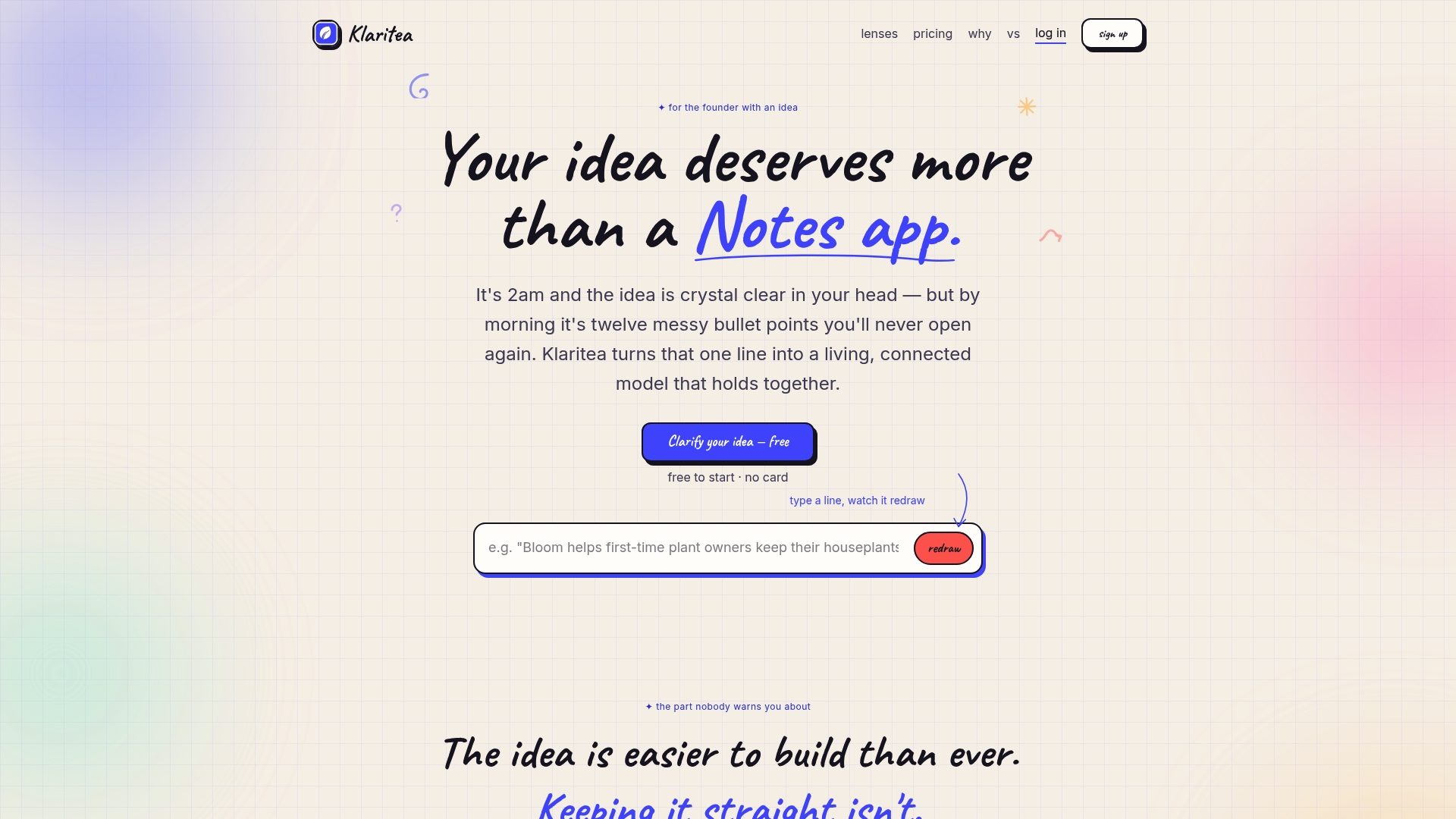
On the free tier, you get your first connected model, one AI advisor session, and a clarity scorecard you can export to Notion. That is enough to know whether your idea is worth building.
Getting started takes four steps:
- Sign up and paste your one-line product brief
- Run an AI advisory session with Devon, Maya, or Priya
- Review your clarity scorecard and identify the weakest assumptions
- Export your build spec and share it with a co-founder or advisor
Founders who complete the 30-day plan inside Klaritea consistently report a clearer MVP scope, stronger investor conversations, and fewer mid-build surprises. Start your free plan at klaritea.app and run the first advisory session today.
Useful sources and further reading
- ProductPlan — Product Roadmaps: Strong reference on roadmaps as communication tools and connecting initiatives to OKRs; useful for understanding what enterprise roadmap tools do well.
- Miro — Roadmap Planning: Good on AI templates and dependency mapping; relevant if you want a visual canvas alongside a phase‑0 workspace.
- Roadmap.one: Practical guidance on linking initiatives to financial outcomes and governance; worth reading before your first investor Q&A.
- Canny — Best Product Roadmap Tools: Broad category roundup covering feedback-centric and roadmap-centric platforms; useful for understanding the full tool landscape.
- Best Startup Tools for Founders: Klaritea's own roundup of tools founders commonly adopt early, with guidance on prioritizing roadmap objectives using financial metrics.
- Top 4 AI Business Plan Generator Alternatives: Covers when to generate investor-ready pitch materials directly from a clarity workspace.
- Startup Management Software for First-Time Founders: Practical recommendations on using roadmaps as strategic communication tools and aligning early hires with plan outputs.
- Value Proposition Generator: AI Tools for Startups: Useful for shaping the ICP and messaging that feed into a clarity scorecard.
Run the 30/60/90 plan from the article against one of these resources. The lean startup principles post pairs especially well with the days 31–60 pressure-test phase.
FAQ
What makes Klaritea different from other roadmap tools?
Klaritea operates at phase‑0, before engineering starts. It generates a connected business model, clarity scorecards, and a build spec from a one-line idea, rather than tracking tasks or managing sprints.
How long does it take to get a usable plan from Klaritea?
Most founders get a structured output, including ICP, TAM/SAM/SOM, and an initial clarity scorecard, in under an hour from a single one-line input.
What are the biggest red flags when evaluating roadmap planning tools?
Watch for tools built primarily for engineering delivery, no data export option, and opaque credit pricing. Purpose-built platforms reach a shareable plan far faster than broad lifecycle suites that require extensive configuration.
Do I need a technical background to use phase‑0 roadmap software?
No. Klaritea is designed for first-time founders with no engineering background. The AI advisory board handles research and fact-checking; you make the decisions.
Can I export my Klaritea plan to tools my developer already uses?
Yes. GitHub sync is available on paid plans, and Notion and Confluence export are available on Pro, so the build spec moves directly into your development workflow without manual copying.