TL;DR:
- Starting with AI-native platforms helps founders quickly refine their hypotheses before moving to specialized survey tools for validation. Proper methodology transparency and matching research questions to appropriate tools ensure reliable, actionable insights. Klaritea structures phase-0 research, translating ideas into clear briefs that accelerate decision-making and product development.
For founders and product teams, the fastest path to reliable market insight runs through AI-native platforms first, then specialized survey and panel tools as you move from hypothesis to confirmation. Start with a phase-0 clarity workspace like Klaritea to structure your research questions and business model, then layer in purpose-built tools for surveys, social listening, or pricing studies as your questions sharpen.
The reason this order matters: most teams waste weeks designing studies around the wrong questions. Klaritea forces you to define your ICP, TAM/SAM/SOM, and core assumptions before you spend a dollar on fielding, which means every downstream study is faster and more focused. Speed-to-insight and methodology transparency are the two metrics that separate useful market research from expensive noise.
Table of Contents
- What do market research tools actually do for your business?
- What are the main types of market research tools?
- What features separate a reliable tool from a risky one?
- How do you choose the right tool for your specific situation?
- How AI and continuous measurement are changing speed-to-insight
- A founder's playbook for phase-0 research
- How different startup types use these tools in practice
- Free vs. paid market research tools: what you actually get
- How to connect research insights to your product development process
- Key Takeaways
- Why method discipline matters more than tool selection
- Klaritea turns your research brief into a product plan
- Useful sources
- FAQ
What do market research tools actually do for your business?
Market research tools turn raw signals — survey responses, social conversations, behavioral data, purchase records — into stakeholder-ready insights your team can act on.

The flow looks like this:
Inputs (panels, surveys, social streams, behavioral data, syndicated datasets) → Processing (AI analysis, statistical weighting, thematic coding) → Outputs (audience segments, concept test scores, brand health metrics, willingness-to-pay estimates, reports)
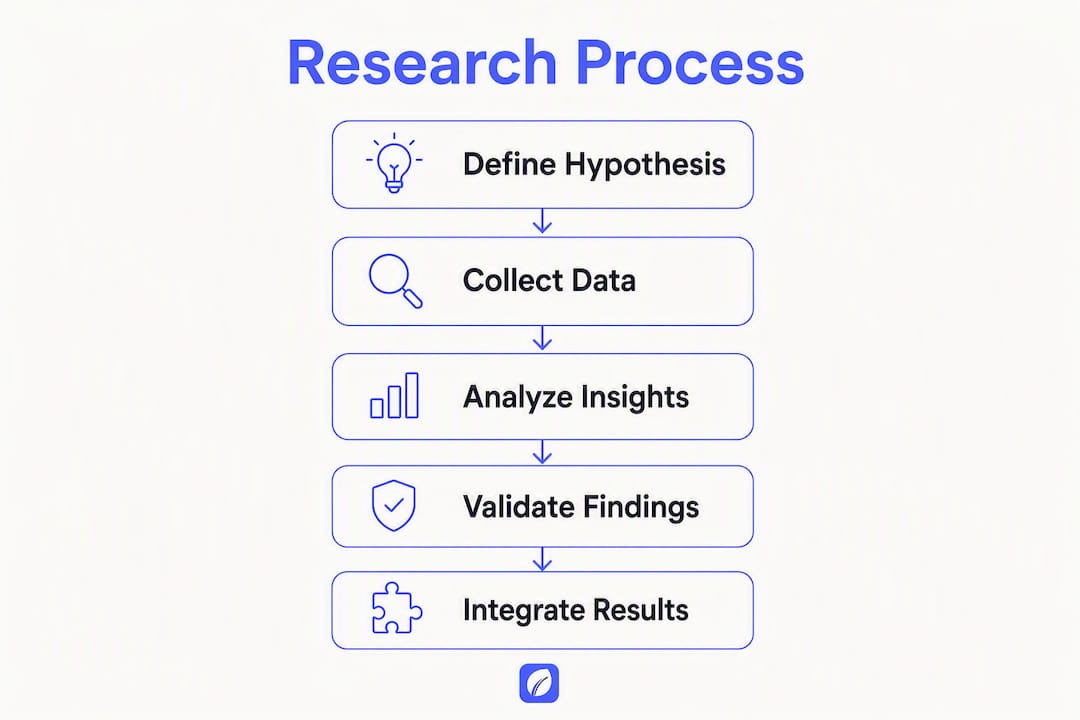
Core outcomes these tools deliver: audience segmentation, concept and messaging testing, brand tracking, competitive benchmarking, and willingness-to-pay measurement. Each of those outcomes maps to a different tool class, which is why picking the right one starts with knowing your question, not your budget.
Klaritea sits at the front of this workflow. Before you design a single survey question, Klaritea's AI advisory board (Maya for marketing, Devon for business strategy, Priya for ops and QA) challenges your assumptions and maps your idea into a structured business model. That structured model becomes the brief your market research tools execute against.
What are the main types of market research tools?
Six tool classes cover most research needs. Each answers a different question, operates at a different speed, and carries a different cost profile.
- Syndicated datasets: — Pre-collected, standardized data sold to multiple buyers. Best for market sizing, category benchmarks, and competitive share. Slow to update (monthly to quarterly). Expensive at the enterprise tier; some public datasets (U.S. Census Bureau, Statista) are free or low-cost.
- AI-native platforms: Combine synthetic persona generation, conversational AI agents, and continuous data collection. Best for rapid hypothesis testing, always-on brand intelligence, and non-analyst-friendly querying. Speed: hours to days. Pricing varies widely.
| Tool class | Best question type | Typical time-to-insight | Cost profile |
|---|---|---|---|
| Surveys and panels | Concept testing, pricing, segmentation | 24–72 hours | Free to $5,000+ per study |
| Social listening | Sentiment, trends, brand health | Real-time | $50–$500/month |
| Syndicated datasets | Market sizing, category benchmarks | Days to weeks | Free (public) to subscription-based pricing |
| Analytics/dashboards | Behavioral patterns, funnel analysis | Real-time | Varies by data volume |
| UX testing | Usability, friction, feature validation | 1–5 days | $50–$300/session |
| AI-native platforms | Rapid validation, continuous intelligence | Hours to days | Subscription, usage-based |
Representative tools by category (listed as examples for further investigation, not endorsements): surveys and panels — Qualtrics, OpinionX; social listening — Brandwatch, Sprout Social; syndicated data — Statista, U.S. Census Bureau; analytics — Google Analytics, Mixpanel; UX testing — UserTesting, Maze; AI-native — Morning Consult Intelligence, YouGov Profiles AI Agent, Remesh.
What features separate a reliable tool from a risky one?
Data quality lives or dies on methodology transparency. Before signing any contract, verify these eight features:
- Weighting methodology: — Is the sample weighted to census benchmarks or a proprietary standard? Ask for the weighting variables and their source.
- Integration and APIs: Can the platform push data to your BI tools, CRM, or data warehouse? Many continuous-intelligence platforms include API access and connectors for BI platforms and major LLM integrations.
Red flags to watch for: opaque sampling with no methodology documentation; no ability to export raw data; fielding times quoted in weeks rather than days; AI features that are clearly wrappers on general-purpose LLMs rather than models trained on validated research datasets.
Pro Tip: During a vendor demo, ask the rep to run a live query on a specific demographic segment and show you the unweighted vs. weighted n. If they can't do it in real time, the platform's transparency claims are marketing, not infrastructure.
How do you choose the right tool for your specific situation?
Match your business question to the right tool class before you evaluate vendors. Three question types drive most research decisions:
- Explore (you don't know what you don't know): Use social listening, qualitative interviews, or AI-native conversational platforms. Sample sizes of 20–50 for qualitative; 200–500 for exploratory quantitative. Time-to-insight: 1–5 days.
- Validate (you have a hypothesis and need a signal): Use surveys with purpose-built formats. For pricing and feature prioritization, MaxDiff and conjoint analysis produce far more reliable signals than standard Likert scales. Sample sizes of 150–400. Time-to-insight: 2–5 days.
- Benchmark (you need to track change over time): Use continuous panels or syndicated data. Morning Consult Intelligence, for example, collects 30,000+ consumer interviews daily across 45+ countries, covering 4,000+ brands. Sample sizes are set by the vendor's panel design. Time-to-insight: daily or weekly.
| Research goal | Tool class | Minimum sample | Typical timeline | Budget range |
|---|---|---|---|---|
| Explore a new market | Social listening, qualitative AI | 20–50 (qual) | 1–3 days | $0–$500 |
| Validate a concept or price | Survey with MaxDiff/conjoint | 150–400 | 2–5 days | $500–$3,000 |
| Track brand or category health | Continuous panel | Vendor-set | Daily/weekly | $2,000+/month |
| Benchmark competitive position | Syndicated dataset | N/A | Days | $500–several thousand dollars |
Vendor questions worth asking on every demo:
- What is your panel recruitment source, and how do you screen for quality?
- How do you handle speeders and straight-liners in survey data?
- Can you show me a methodology report from a comparable study?
- What is the typical fielding time for a 15-minute survey to n=300 in my target segment?
- How does pricing scale with sample size, and are there overage fees?
- What integrations do you support natively, and what requires a custom API build?
How AI and continuous measurement are changing speed-to-insight
Generative AI is reshaping market research by enabling rapid creation of synthetic personas, faster analysis pipelines, and continuous-insight workflows that were operationally impossible three years ago. The practical implication for founders: you no longer have to choose between speed and rigor if you sequence your methods correctly.

The recommended workflow combines three layers:
Layer 1: Synthetic and AI-native exploration. Use AI-generated personas and conversational agents for initial hypothesis testing. YouGov's Profiles AI Agent, for instance, provides conversational access to validated audience data, letting non-analysts query representative statistics on demand. This layer takes hours, not days, and costs a fraction of a fielded study.
Layer 2: Targeted human-validated confirmation. Synthetic results are directionally useful but not a full replacement for human-validated samples for high-stakes decisions. Before committing to a pricing strategy or a major feature investment, run a focused study with a real panel using MaxDiff or conjoint formats.
Layer 3: Continuous monitoring. Once you have a baseline, wire in an always-on signal. Platforms with API and BI integrations let teams pipe daily signals into internal dashboards, so you catch shifts in sentiment or competitive position without commissioning a new study each time.
| Research layer | Method | Speed | Confidence level |
|---|---|---|---|
| Synthetic exploration | AI personas, conversational agents | Hours | Directional |
| Human-validated confirmation | MaxDiff, conjoint, targeted panel | 2–5 days | High |
| Continuous monitoring | Always-on panel, API feeds | Daily | Trend-level |
Quantified-qualitative techniques add a fourth option worth knowing: large-scale open-ended conversations analyzed by AI in near real-time. Platforms using this approach reduce thematic analysis from days to hours while preserving the nuance that closed-ended surveys miss. For early-stage founders trying to understand why a concept resonates, this method sits between a focus group and a survey in both cost and confidence.
Statistic callout: Morning Consult Intelligence fields consumer interviews daily across a broad set of countries, covering thousands of brands. That cadence is what "always-on" brand intelligence actually looks like at scale.
A founder's playbook for phase-0 research
Phase-0 research happens before you write a line of code or commission a formal study. Its job is to sharpen your hypotheses so every subsequent dollar of research budget lands on a real question.
- Step 1: Define your hypotheses. Write down three falsifiable claims about your customer, their problem, and their willingness to pay. Klaritea's AI advisory board challenges these claims and surfaces gaps in your reasoning before you invest in fielding.
- Step 2: Map your ICP and market size. Use Klaritea to generate a structured ICP and a TAM/SAM/SOM snapshot. This gives you the segmentation frame your survey needs and a market sizing baseline to test against secondary data.
- Step 3: Design a focused study. Keep it to one primary question per study. A 10-minute survey with a MaxDiff block for feature prioritization and a Van Westendorp price sensitivity section covers most early-stage validation needs.
- Step 4: Run fast tests. Field to 150–300 respondents in your target segment. AI-native platforms can return results in 24–48 hours. Resist the urge to over-sample at this stage.
- Step 5: Analyze for decisions, not reports. The output you need is a decision: build this feature, price at this point, target this segment. Klaritea exports clarity scorecards, build specs, and structured reports you can push to Notion, Confluence, or GitHub, so insights connect directly to your product workflow.
- Step 6: Iterate. Each study should answer one question and generate two new ones. That cadence, run weekly or bi-weekly, is what lean startup methodology calls a build-measure-learn loop applied to research itself.
Concrete outputs phase-0 research should produce: a validated ICP with demographic and psychographic attributes, a TAM/SAM/SOM estimate grounded in real data, a willingness-to-pay signal (even a directional one), and a prioritized feature list ranked by customer preference rather than founder intuition.
How different startup types use these tools in practice
B2C consumer app (food delivery niche): A two-person team used social listening to identify a recurring complaint about delivery windows in a specific metro area. They ran a MaxDiff survey with a sample size within the recommended 150–400 respondent range to rank five potential features by importance. Total cost: under $800. Time from idea to decision: four days. The MaxDiff results directly shaped their MVP feature list.
B2B SaaS (HR tech): A solo founder used Klaritea to structure her ICP and competitive analysis, then fielded a 15-minute conjoint study to 150 HR managers to test three pricing configurations. The conjoint data showed her original pricing was 30% above the acceptable range for her target segment. She repriced before building, saving months of post-launch iteration.
Multi-market fintech startup: The team needed consistent data across the U.S., UK, and Germany without running three separate studies. They used an AI-powered platform with built-in multilingual support to run a single study with real-time translation, then used the API to pipe results into their internal dashboard. Cross-market comparison took hours instead of weeks.
Each of these examples follows the same pattern: start with a structured hypothesis (phase-0), pick the tool class that matches the question, and connect outputs to a product decision rather than a slide deck.
Free vs. paid market research tools: what you actually get
Free tools are genuinely useful for early exploration. The ceiling is real, but so is the value.
Free tools worth using: U.S. Census Bureau data for demographic and market sizing baselines, Google Trends for search demand signals, Statista's free tier for category-level benchmarks, Google Forms for internal or network surveys, and Reddit/social platforms for unmoderated qualitative listening.
Where free tools fall short: sample quality and representativeness. A Google Form sent to your LinkedIn network is a convenience sample, not a market signal. It tells you what your network thinks, which is almost never the same as what your target customer thinks. Free social listening is also limited to public data, missing private communities and gated forums where real customer frustration often lives.
Paid tools earn their cost when: you need a representative sample, a validated methodology, statistical significance, or data you can defend to investors and stakeholders. A $500 MaxDiff study with a vetted panel is worth more than ten free surveys with uncontrolled samples for any decision that involves real money.
The practical rule: use free tools to explore and generate hypotheses. Use paid tools to confirm and defend decisions.
How to connect research insights to your product development process
Research that doesn't change a decision is just expensive documentation. Three habits separate teams that use research well from those that collect it and move on.
Tie every study to a decision gate. Before fielding, write down the decision the study will inform and the threshold that would change your direction. If your willingness-to-pay study shows median acceptable price below $X, you pivot the pricing model. If it shows above $X, you proceed. Without a pre-defined threshold, teams rationalize whatever the data shows.
Export insights into your existing workflow. Klaritea's exports to Notion and Confluence, and its GitHub sync, mean research outputs live where your team already works. A clarity scorecard sitting in Notion next to your sprint backlog gets used. A PDF in someone's downloads folder does not. For broader strategic planning integration, connecting research outputs to your planning tools is the step most teams skip.
Run a research retrospective after each product sprint. Ask: which assumptions did we validate, which did we invalidate, and what did we not test that we should have? This habit surfaces research gaps before they become expensive surprises and keeps the team calibrated on what they actually know versus what they believe.
Key Takeaways
AI-native platforms combined with targeted human-validated studies give founders the fastest, most defensible path from raw idea to product decision.
| Point | Details |
|---|---|
| Start with phase-0 clarity | Define hypotheses and ICP in Klaritea before designing any survey or fielding study. |
| Match tool to question type | Exploratory questions need social listening or AI agents; validation needs MaxDiff or conjoint with a real panel. |
| Verify methodology before buying | Ask every vendor for a sample methodology report; opaque sampling is the top data-quality red flag. |
| Free tools explore, paid tools confirm | Use Census Bureau and Google Trends for early signals; invest in vetted panels for decisions that involve real money. |
| Klaritea accelerates the whole loop | Klaritea structures your research brief, generates ICP and TAM/SAM/SOM outputs, and exports directly to Notion, Confluence, or GitHub. |
Why method discipline matters more than tool selection
The conventional wisdom in market research is that the platform you pick determines the quality of your insights. After working through dozens of founder research projects, that framing gets it backwards. The platform is the last decision, not the first.
What actually determines insight quality is question discipline: knowing precisely what decision you're trying to make, what evidence would change your mind, and what sample is genuinely representative of your customer. A well-designed MaxDiff study run on a mid-tier panel beats a poorly scoped study run on the most expensive platform in the market.
The trap founders fall into most often isn't picking the wrong tool. It's starting with a vague question and hoping the data will clarify it. It won't. AI-native platforms make this trap easier to fall into, not harder, because they return results so quickly that it feels like progress even when the question was wrong from the start.
The second trap is over-relying on small qualitative samples. Five customer interviews are useful for generating hypotheses. They are not useful for validating pricing, estimating market size, or prioritizing a feature roadmap. The teams that use research well run qualitative and quantitative methods in sequence, not as substitutes for each other.
The recommended approach in this article, starting with Klaritea for phase-0 structure and then layering in specialized tools, works because it forces question discipline before you spend on fielding. That sequence is what separates founders who validate before they build from those who discover their assumptions were wrong after they've already shipped.
Klaritea turns your research brief into a product plan
Most founders spend more time choosing a survey platform than defining what they actually need to learn. Klaritea flips that. You type a one-line idea, and the platform builds a structured business model covering your ICP, TAM/SAM/SOM, competitive landscape, and feature requirements before you write a single survey question. That structured output becomes the brief every downstream research tool executes against.
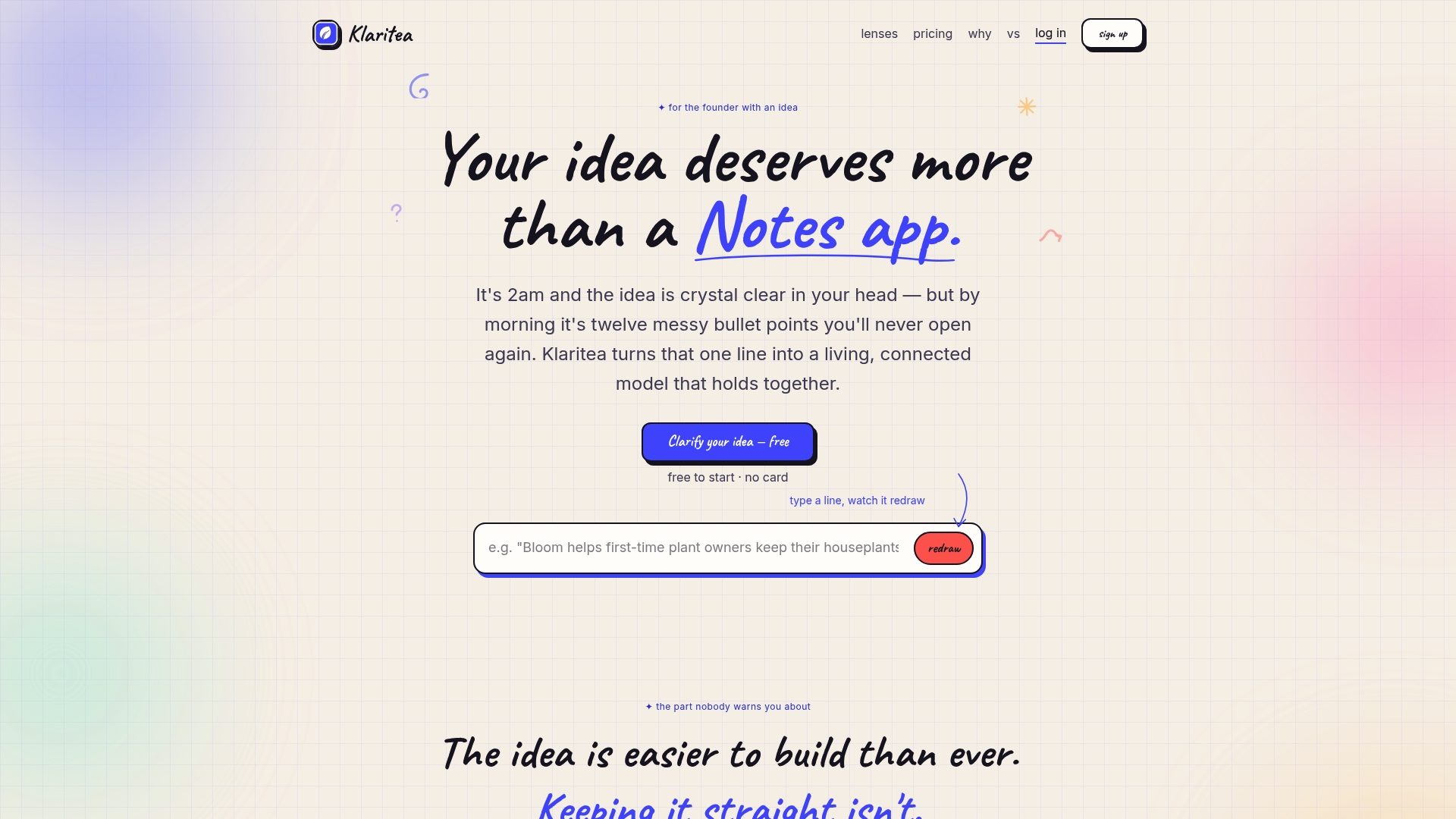
The AI advisory board (Maya, Devon, and Priya) challenges your assumptions, flags gaps in your reasoning, and surfaces the questions worth testing. Clarity scorecards show you where your idea is solid and where it needs validation. Outputs export directly to Notion, Confluence, or GitHub, so your research findings live inside your product workflow rather than in a separate document no one reads.
For founders ready to stop guessing about their market and start building with evidence, start your phase-0 session at Klaritea and have a structured research brief in under an hour.
Useful sources
The sources below back the claims in this article and are worth bookmarking for deeper methodology work or vendor evaluation.
- The AI Tools That Are Transforming Market Research — Harvard Business Review's analysis of how generative AI is reshaping research workflows, synthetic personas, and continuous-insight pipelines. Best for understanding the strategic implications of AI-native platforms.
- Morning Consult Intelligence — Product page covering their continuous consumer interview methodology, API integrations, and brand tracking capabilities. Best for evaluating always-on panel options.
- YouGov AI Agent — Details on the Profiles AI Agent, including how it surfaces validated audience statistics through conversational queries. Best for non-analyst teams needing fast audience benchmarks.
- Remesh AI-Powered Market Research Platform — Covers quantified-qualitative methodology, multilingual support, and real-time AI analysis. Best for teams running large-scale open-ended research.
- Qualtrics Market Research Overview — Methodology documentation covering quantified-qualitative workflows and advanced survey formats. Best for methodology deep dives and enterprise vendor evaluation.
- OpinionX Advanced Market Research Surveys — Platform documentation on MaxDiff, conjoint, and pairwise formats. Best for founders evaluating specialized pricing and prioritization study formats.
| Source | Best for | Type |
|---|---|---|
| Harvard Business Review (AI research) | Strategic AI implications | Methodology deep dive |
| Morning Consult Intelligence | Always-on panel evaluation | Vendor capability |
| YouGov AI Agent | Non-analyst audience queries | Vendor capability |
| Remesh | Quantified-qualitative, multilingual | Vendor capability |
| Qualtrics | Advanced survey methodology | Methodology deep dive |
| OpinionX | MaxDiff and conjoint formats | Vendor capability |
FAQ
Can ChatGPT do market research?
ChatGPT can assist with hypothesis generation, survey design, and qualitative analysis of existing data, but it cannot field studies to real respondents or produce statistically representative samples. For validated consumer insights, pair AI tools like ChatGPT with a panel platform that recruits and screens real respondents.
What are the four types of market research?
The four standard types are primary research (data you collect directly, such as surveys and interviews), secondary research (existing data from reports and databases), qualitative research (exploratory, open-ended methods), and quantitative research (structured, statistically measurable methods). Most founder research projects combine all four in sequence.
Which market research methods work best for startup pricing decisions?
MaxDiff and conjoint analysis consistently outperform standard Likert-scale surveys for pricing and feature prioritization because they force trade-offs rather than allowing respondents to rate everything highly. Van Westendorp price sensitivity questions are a faster alternative for early-stage willingness-to-pay signals.
What is the fastest way to get market research results?
AI-native platforms and conversational agents can return directional insights in hours. For human-validated results, a focused survey fielded to a vetted panel of 150–400 respondents typically returns results in 24–72 hours. Klaritea's phase-0 workspace can generate a structured ICP, TAM/SAM/SOM snapshot, and research brief in under an hour, giving you the foundation to field a targeted study immediately.
How much does market research cost for a startup?
Costs range from free (public datasets, Google Trends, network surveys) to several thousand dollars for a professionally fielded study. A focused MaxDiff or conjoint study with a vetted panel of 150–400 respondents typically runs $500–$3,000 depending on the platform and sample specifications. Ongoing brand tracking through continuous panels starts at roughly $2,000 per month at the entry level.