TL;DR:
- Klaritea is a phase-0 AI planning tool that converts a startup idea into a connected business model, including market analysis and a build spec. It features an AI advisory board that challenges outputs, flexible exports, and cross-linked outputs to prevent costly mistakes. Using it allows founders to validate ideas quickly and cheaply before investing heavily in development.
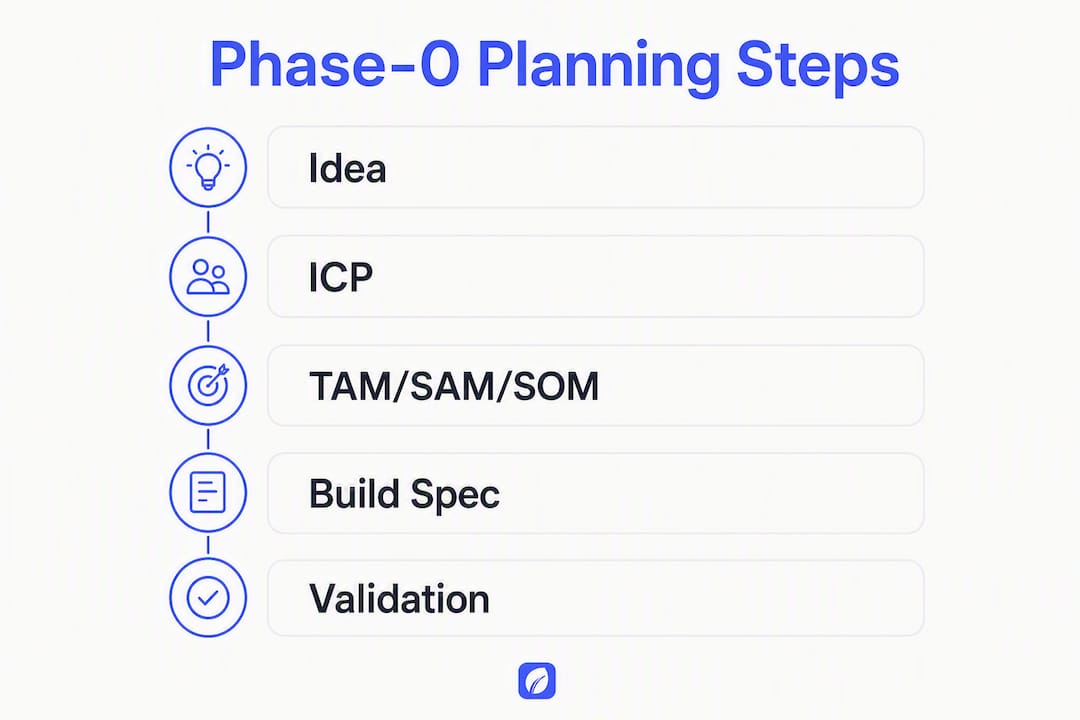
If you're a first-time founder deciding what to build, Klaritea is the phase-0 AI planning tool to start with. It takes a single-line idea and produces a connected business model: ICP, TAM/SAM/SOM, competitor analysis, prioritized features, a build spec, and a pitch, before you write a line of code or spend a dollar on engineering.
Three reasons it stands out:
- Connected outputs, not isolated documents. Every section of your model links to the others. Change your ICP and the feature priorities update.
- AI advisory board built in. Three specialized advisors (Maya for marketing, Devon for business, Priya for ops and QA) challenge and fact-check your outputs before you export anything.
- Export-ready from day one. GitHub sync, Notion and Confluence export, printable clarity scorecards, and investor-ready reports ship with the product.
The stakes are real. Most founders who skip structured validation spend a significant amount on developing an MVP before discovering the market doesn't want it. Phase-0 planning costs a fraction of that and takes days, not months.
Table of Contents
- What do "AI planning tools" actually mean for founders?
- Why phase-0 planning prevents expensive mistakes
- How to evaluate a phase-0 AI planning tool
- Four steps to validate one idea in under a week
- How Klaritea maps to the checklist
- What phase-0 planning costs and how long it takes
- What should you do right now?
- Key Takeaways
- Why I built Klaritea around phase-0 clarity
- Klaritea gives you clarity before you commit
- Further reading and references
- FAQ
What do "AI planning tools" actually mean for founders?
Most search results for "best AI planning tools" return calendar assistants and task schedulers. That is a different product for a different audience. This article covers a specific category: phase-0 startup planning tools that convert a raw idea into a structured, investable business model.
The orientation stage of a startup is where founders assess idea fit, test assumptions, and define constraints before committing to build. Phase-0 AI tools automate and accelerate that entire stage.
Here's what a genuine phase-0 AI planning tool should produce:
| Output | What it tells you |
|---|---|
| Ideal Customer Profile (ICP) | Who you're building for and why they'll pay |
| TAM / SAM / SOM | Market size and your realistic addressable slice |
| Competitor analysis | Who already exists, where the gaps are |
| Feature map + requirements | What to build first and why |
| Build spec | Scope and technical requirements for your dev team |
| Clarity scorecard | A scored view of idea strength across key dimensions |
| Investor pitch | A structured narrative ready for early conversations |
If a tool doesn't produce most of these, it's a note-taking app with AI branding, not a phase-0 planning tool.
Why phase-0 planning prevents expensive mistakes
The core problem isn't that founders build bad products. It's that they build the right product for the wrong customer, or solve a problem nobody pays to fix. Harvard Business School's market validation framework frames validation as determining whether a real need exists in your target market before you invest resources, not after.

Skipping this step is expensive. Engineering an MVP typically runs $5,000–$50,000 depending on complexity. Phase-0 planning, done with an AI tool, costs a fraction of that and takes 48–72 hours for a quick sprint or up to one to two weeks for a fuller cycle.
The outputs matter beyond cost savings. A build spec prevents scope creep. A TAM/SAM/SOM model gives investors something to evaluate. An ICP forces you to stop building for "everyone." Founders who treat idea selection as a structured phase rather than open-ended brainstorming move faster and kill weak ideas before they become expensive ones.
How to evaluate a phase-0 AI planning tool
Not every tool that calls itself an AI planning tool delivers what founders actually need. Run through this checklist before committing to any platform:
Must-have outputs:
- ICP generator with demographic and behavioral detail
- TAM/SAM/SOM calculator with sourced market data
- Competitor scan with gap identification
- Prioritized feature list tied to ICP pain points
- Build spec exportable to your dev team
- Clarity scorecard with scored dimensions
Integration and export requirements:
- GitHub sync (critical if you're moving to a dev team)
- Notion and/or Confluence export for team collaboration
- Printable reports for investor meetings
- Exportable evidence files (not just in-app views)
Trust signals to look for:
- AI advisory or review layer that challenges outputs
- Case examples or documented founder workflows
- Free trial or demo with real feature access (not a locked preview)
- Transparent pricing with usage-based credit options
Pro Tip: In your free trial, run your idea through the tool's ICP and TAM generators, then ask: does the output cite sources, or does it just generate plausible-sounding text? Sourced outputs are the difference between a planning tool and a hallucination engine.
For a broader view of strategic planning AI tools and how evaluation criteria differ by use case, that comparison is worth reading before you finalize your shortlist.
Four steps to validate one idea in under a week
This workflow uses a phase-0 AI planning tool as the engine. It takes 48–72 hours for a quick sprint or up to one to two weeks for a fuller cycle.
-
Write your one-liner and define your ICP. Describe your idea in a single sentence. Then define who has the problem: industry, role, company size, and what they currently pay to solve it. This is your hypothesis, not your answer.
-
Generate your market model and competitor map. Use the AI tool to produce TAM/SAM/SOM estimates, a competitor scan, and a prioritized feature list. AI tools cut competitor research and demand signal collection from days to minutes, letting you run multiple idea cycles in a single week.
-
Run high-signal tests. A 72-hour validation sprint built around commitment signals outperforms surveys every time. Set up a paid waitlist (even a $1 pre-pay), make 10 cold calls to your ICP, and run a small ad test targeting your defined customer. Aim for ≥10% visitor-to-signup as a pass signal. Compliments don't count; payment intent does.
-
Produce your build spec and scorecard, or kill the idea. If your tests pass, export the build spec and clarity scorecard. If they fail, use the competitor gap analysis to pivot the ICP or the problem statement and re-run. A clear fail at step 3 is a win: you save a considerable amount in engineering costs.
For a deeper walkthrough of the validation process before you build, that guide covers the decision points in detail.
How Klaritea maps to the checklist
Klaritea is built specifically for this workflow. Every checklist item above has a direct feature match:
| Checklist item | Klaritea feature |
|---|---|
| ICP generator | Clarity Lens: ICP module with behavioral and demographic detail |
| TAM/SAM/SOM calculator | Clarity Lens: market sizing with sourced estimates |
| Competitor scan | Clarity Lens: competitor gap analysis |
| Prioritized features | Build Lens: feature map tied to ICP pain points |
| Build spec export | Build Lens: exportable spec for dev teams |
| Clarity scorecard | Scored output across idea dimensions, printable |
| GitHub sync | Available on paid plans |
| Notion/Confluence export | Available on Pro plans |
| AI advisory review | Maya (marketing), Devon (business), Priya (ops/QA) challenge every output |
| Free trial | Available; credit-based usage for advanced features |
The AI advisory board is the feature most tools skip. Before Klaritea produces a final report, three specialized advisors review the generated model, flag weak assumptions, and push back on market sizing that looks optimistic. That layer is what separates a structured output from a confident-sounding guess.
For founders also exploring AI business plan generation as a complementary output format, that resource covers the export and narrative side of the planning process.
What phase-0 planning costs and how long it takes
Timeline options:
- 48–72 hour sprint: One idea, one ICP, one set of commitment tests. Enough to get a pass/fail signal and a rough build spec.
- One to two weeks: Full phase-0 cycle with multiple ICP iterations, a polished clarity scorecard, and an investor-ready pitch.
- Two to four weeks: Multiple ideas evaluated in parallel, full competitor analysis, and a prioritized roadmap for the winning concept.
Pricing expectations:
- Most phase-0 AI tools offer a free tier with limited credits, enough to run one or two idea cycles.
- Paid subscription tiers typically unlock full export options, GitHub sync, and advisory features.
- Credit packs let you pay per planning session without committing to a monthly plan, useful if you're validating one idea and not yet running a startup full-time.
The contrast with MVP-first development is stark. A day-zero checklist approach that tracks cost per insight rather than cost per user keeps early spend disciplined. Phase-0 planning tools are the cheapest way to generate those insights.
What should you do right now?
Answer these three questions:
Do you have a specific idea, or are you still exploring? If you have an idea, run a 72-hour sprint with Klaritea's Clarity Lens. If you're still exploring, use the ICP module to define the customer before you define the product.
Do you need investor materials within 30 days? If yes, prioritize tools with exportable pitch outputs and clarity scorecards. Klaritea produces both.
Are you pre-product-market fit or pre-idea? Pre-idea founders benefit most from the competitor gap analysis and ICP generator. Pre-PMF founders should focus on the build spec and run-and-scale lens.
Start with a free Klaritea trial, run your one-liner through the Clarity Lens, and have a clarity scorecard in hand within 48 hours.
Key Takeaways
Phase-0 AI planning tools save founders significant engineering costs by forcing structured validation before a single line of code is written.
| Point | Details |
|---|---|
| Phase-0 planning prevents waste | Skipping validation risks spending substantial costs on an MVP nobody wants. |
| Commitment signals beat surveys | Paid waitlists, $1 pre-pays, and cold calls produce far more reliable signals than feedback from friends. |
| 72-hour sprint is enough to start | A focused sprint produces a pass/fail signal and a rough build spec in under three days. |
| Checklist covers seven must-haves | ICP, TAM/SAM/SOM, competitor scan, feature map, build spec, scorecard, and export options. |
| Klaritea covers the full checklist | Klaritea's Clarity, Build, and Run & Scale lenses plus its AI advisory board map to every must-have item. |
Why I built Klaritea around phase-0 clarity
The pattern I kept seeing was the same: a founder with a genuinely interesting idea would spend three to six months building, then discover the customer they imagined didn't match the customer who showed up. Not because the idea was bad, but because nobody had forced the hard questions early enough.
The AI advisory board inside Klaritea exists for exactly that reason. Maya, Devon, and Priya aren't there to validate your enthusiasm. They're there to find the assumption you haven't tested yet, the competitor you haven't noticed, and the ICP detail that changes your entire pricing model. That friction, applied before you build, is what makes the difference between a shipped product and a sunk cost.
Klaritea's blog analysis and published founder workflows back this up: the founders who move fastest through phase-0 are the ones who treat it as a structured process, not a brainstorming session.
Klaritea gives you clarity before you commit
Most founders know they should validate before building. Few have a tool that makes it fast enough to actually do it. Klaritea closes that gap: type one line, get a connected business model, run your commitment tests, and walk away with a build spec and clarity scorecard in 48–72 hours.
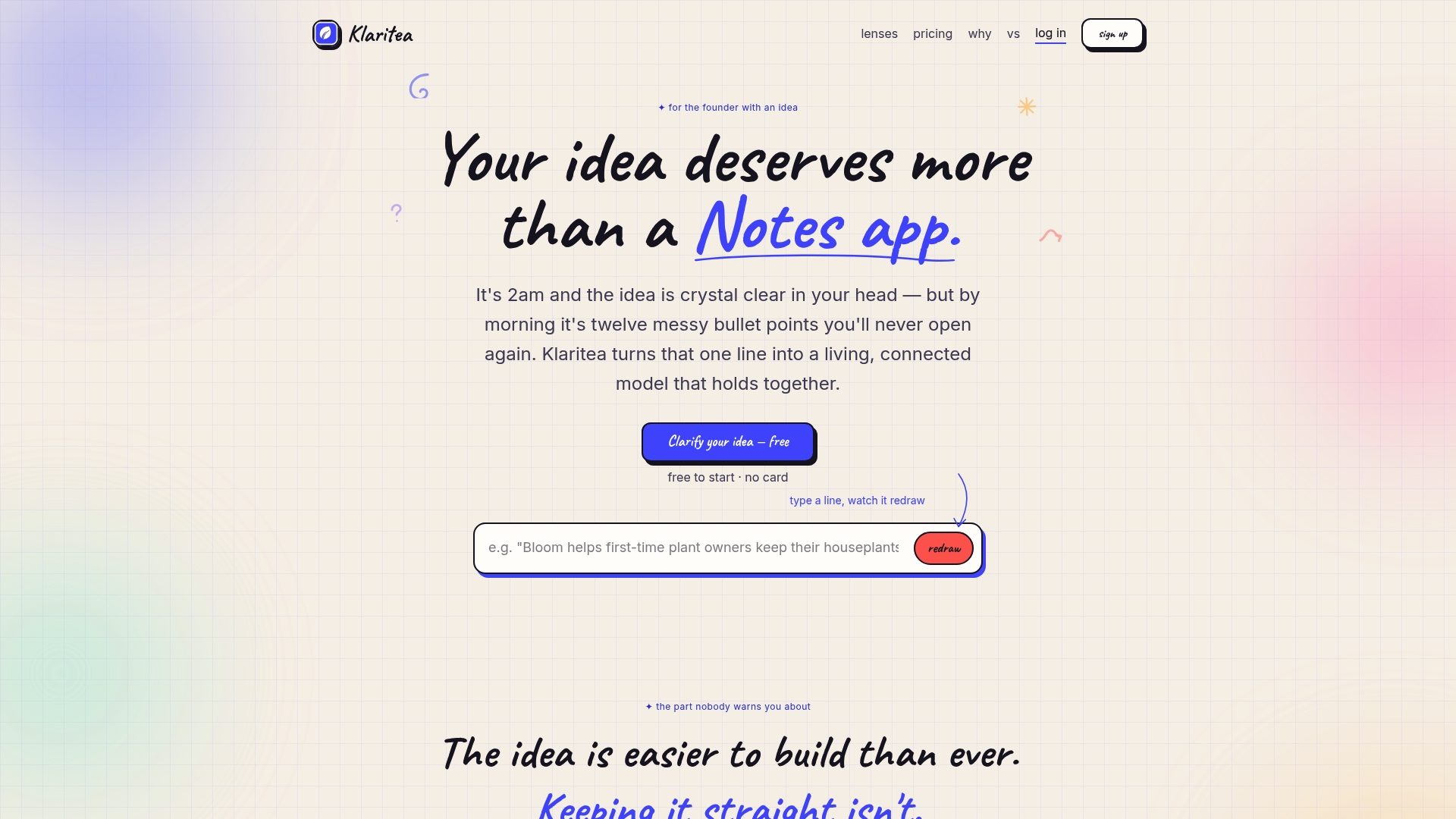
The free tier gets you through a full Clarity Lens cycle. The paid plans unlock GitHub sync, Notion and Confluence export, and full AI advisory sessions. Credit packs are available if you want to run a single validation sprint without a subscription.
Start your first idea sprint at klaritea.app and have your clarity scorecard ready within 48–72 hours or up to one to two weeks for a full cycle.
Further reading and references
- Klaritea: Turn a fuzzy idea into a shipped product — product page, trial signup, and feature documentation
- How to validate a business idea before you build — step-by-step validation process that complements the 72-hour sprint
- AI idea validator: validate your startup in 2026 — focused guide on interpreting AI validation signals
- Best startup tools for founders — broader tooling recommendations beyond phase-0 planning
- 5 Steps to Validate Your Business Idea — HBS Online framework for market validation
- Startup Idea Validation: A Step-by-Step Guide Before Launch — AI-assisted validation tools and landing page test methodology
FAQ
What is a phase-0 AI planning tool?
A phase-0 AI planning tool converts a one-line idea into a structured business model, covering ICP, TAM/SAM/SOM, competitor analysis, features, a build spec, and a pitch, before any engineering work begins.
How is Klaritea different from a business plan generator?
Klaritea produces a connected model where every output links to the others, plus an AI advisory board that challenges assumptions before you export. Most business plan generators produce static documents with no cross-linked logic or advisory review layer.
How long does a phase-0 planning cycle take?
A focused 72-hour sprint produces a pass/fail signal and a rough build spec. A fuller cycle with polished investor materials typically takes one to two weeks.
What commitment signals should I look for during validation?
Paid waitlist signups, $1 pre-pays, and signed letters of intent carry far more predictive weight than survey responses or verbal encouragement. A visitor-to-signup rate of ≥10% in a short ad test is a meaningful pass signal.
Can I use Klaritea for free?
Yes. Klaritea offers a free tier that covers a full Clarity Lens cycle. Paid plans and credit packs unlock GitHub sync, Notion and Confluence export, and full AI advisory sessions.