Most production-ready MVPs cost between $25,000 and $150,000 in 2026, with a median cross-platform build landing around $76,000. Use that median, not the floor or the ceiling, as your negotiation anchor when vendors send quotes. Scope, not hourly rate, is what actually moves the final number. And whatever number you land on, budget another 15% to 25% of it for year one maintenance before you sign anything.
TL;DR:
- Most MVPs in 2026 cost between $25,000 and $150,000, with a median around $76,000; scope, not hourly rates, drives final costs.
- Feature complexity and backend integrations, especially real-time functions and third-party APIs, significantly increase development expenses.
- Cross-platform development typically reduces costs by 30% to 45% compared to native, but complex AR or performance apps may require native builds.
- Accurate quotes depend on detailed scope documentation and fixed-price, feature-specific bids; vague scopes lead to inflated or incomparable estimates.
- Budgeting 15% to 25% of initial development cost annually for maintenance, plus hosting and API fees, is essential for ongoing app sustainability.
Table of Contents
- What Determines App Development Cost in 2026?
- What Drives App Development Expenses the Most?
- Native, Cross-Platform, Web, or No-Code: Which Saves Money?
- How Much Do Developers Charge by Region and Team Type?
- How Long Does Each Development Phase Take and Cost?
- What Does It Cost to Maintain an App After Launch?
- How Do You Get an Accurate App Development Quote?
- Where Can You Estimate Costs Before Talking to Vendors?
- How Phase‑0 Planning Lowers Your Total Delivered Cost
- What Founders Get Wrong About App Budgets
- Turn Your Scope Into a Spec Vendors Can Actually Price
- Sources
- FAQ
What Determines App Development Cost in 2026?
Every quote you get boils down to four cost bands, and knowing which one your idea falls into before you talk to a single vendor changes the entire conversation. Vendors price against a moving target unless you hand them a fixed scope, which is exactly why the same idea can generate a $30,000 quote from one shop and a $180,000 quote from another.
Simple apps ($10,000 to $40,000) cover single-purpose tools: a booking calendar, a basic content app, a simple internal utility. One or two user roles, minimal backend logic, no real-time features. Think a loyalty card app or a static-content reader.
Moderate apps ($40,000 to $90,000) add real functionality: user accounts, a database-backed backend, push notifications, maybe one or two third-party integrations like payments or maps. This is where most funded startups actually land for their first release.
Complex apps ($90,000 to $150,000+) bring in real-time chat or location tracking, multiple user roles with different permissions, custom design systems, and several API integrations working together. Marketplace apps, social platforms, and anything with live matching or dispatch logic sit here.
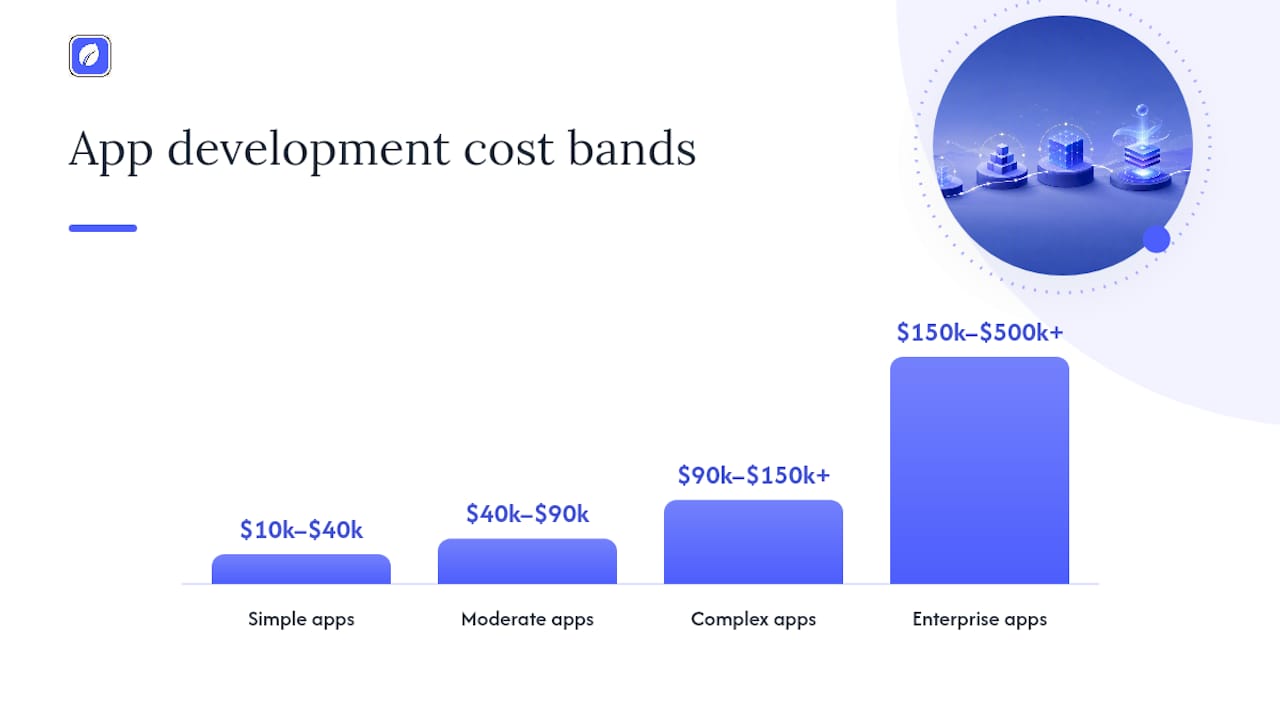
Enterprise apps ($150,000 to $500,000+) mean deep system integrations, custom security architecture, multi-region compliance, and often several parallel workstreams (admin dashboards, customer apps, internal tools) shipping together.
Clutch's pricing data puts the average small-to-medium app project at roughly $90,780, with most projects falling somewhere between $10,000 and $150,000. That average sits closer to the moderate/complex boundary than most first-time founders expect.
Quick benchmark: A cross-platform MVP with accounts, one payment integration, and a moderate feature set typically lands near the $76,000 median that industry teardowns report. If your quote comes in dramatically under that for comparable scope, ask what's being cut. If it comes in dramatically over, ask what's being gold-plated.
Two quick examples make the bands concrete. A single-city delivery app with order tracking, one payment gateway, and push notifications sits solidly in the moderate band, likely $55,000 to $75,000. Add live driver location, in-app chat, and a ratings system, and you've pushed the same idea into the complex band, often $110,000 or more, because now you're paying for real-time infrastructure and more QA cycles.
What Drives App Development Expenses the Most?
Features and backend complexity drive cost far more than which country your developer sits in. A founder who trims scope by 30% often saves more than one who spends weeks negotiating an hourly rate down by $10.
User roles and screens multiply testing effort. An app with a single user type and 10 screens needs a fraction of the QA time of one with three roles (customer, driver, admin) and 40 screens, because every role needs its own permission testing and every screen needs its own device and edge-case coverage.
Backend and integrations usually eat the biggest slice of the budget. Server-side logic, databases, APIs, and the glue connecting them commonly consume 40% to 50% of total build cost, more than design and frontend combined. This is the part founders underestimate most, because a login screen looks simple until you account for the authentication service, session management, and data validation running behind it.
Real-time features and third-party APIs add cost in layers. Live chat, video, or location tracking require persistent connections and more rigorous testing. Payment processors, SMS providers, mapping services, and LLM API calls all carry their own per-transaction or per-request fees on top of the integration work itself.
Design, security, and compliance are cost multipliers, not line items. A fully custom UI system costs more than adapting a component library. Vertical compliance requirements like HIPAA, PCI DSS, or SOC 2 add cost twice over: once to build the controls, and again for the audits and documentation that prove they work. Industry teardowns confirm that retrofitting compliance after launch costs substantially more than designing for it from day one.
Your engagement model changes the math too. Agencies bring process and accountability at a premium. Freelancers cost less but shift project management onto you. Offshore teams can look cheap on an hourly basis but often need more of your own oversight time. No-code platforms cut cost dramatically for simple builds but hit a wall fast once you need custom logic.
Pro Tip: Ask every vendor to itemize their quote by feature, not just by phase. A quote that says "backend development: $35,000" tells you nothing. A quote that breaks out "user authentication: $4,000, payment integration: $6,000, admin dashboard: $12,000" lets you actually negotiate and cut.
Native, Cross-Platform, Web, or No-Code: Which Saves Money?
Cross-platform development is the default cost-saving choice for most founders in 2026, and the math is straightforward: one shared codebase covering iOS and Android typically costs 30% to 45% less than building two separate native apps for products that don't need deep hardware access, according to cross-platform cost analyses. Frameworks like React Native and Flutter make this the standard starting point for MVPs.
Native development earns its premium in specific cases: apps doing heavy AR or VR work, high-performance games, or anything requiring tight integration with device sensors and background processing that cross-platform frameworks handle awkwardly. Couchbase's 2026 breakdown puts production-ready native builds in the $40,000 to $150,000 range, generally above comparable cross-platform builds.
Cross-platform can also backfire on certain projects. If your app leans heavily on custom animations, complex AR features, or console-grade game performance, the extra work to make a shared codebase behave natively on both platforms can erase the savings entirely.
- Native: best for performance-critical apps, AR/VR, or games; commands the highest price
- Cross-platform: best default for most MVPs and business apps; typically 30% to 45% cheaper than dual native builds
- Web apps and PWAs: cheapest validation route, no app store approval needed, but limited access to push notifications, camera, and offline features
- AI/no-code builders: fastest and cheapest for simple MVPs; Bubble's 2026 pricing coverage shows subscription models that undercut custom development for early validation, but they hit real ceilings once you need custom backend logic or regulatory compliance
Web apps and progressive web apps deserve more attention than they get. If your core hypothesis can be tested without native device features, a PWA can validate demand for a fraction of native or cross-platform cost, and you can always rebuild once you have real users and revenue.
How Much Do Developers Charge by Region and Team Type?
Hourly rates vary wildly by region, but the rate on the invoice rarely predicts the final cost of the project. This is the single most common mistake founders make when comparing quotes.
Agency rates in North America and Western Europe generally run $100 to $250 per hour. Freelancers in the same regions tend to fall between $50 and $150 per hour. Offshore teams in Eastern Europe, South Asia, and parts of Latin America often quote $25 to $70 per hour. On paper, offshore looks like it saves 60% or more.
Bolder Apps' analysis points out that offshore engagements typically require significantly more client-side product management time and longer calendar schedules to account for time zone gaps and communication overhead. Add your own hours spent clarifying requirements and reviewing rework, and the effective all-in cost gap between offshore and local talent often shrinks to 20% to 30%, not 60%.
That doesn't make offshore a bad option. It means you need to price in your own time, not just the invoice.
- Agency: best when you need process, accountability, and a single point of contact; highest headline rate but lowest founder-time burden
- Freelancer: good for narrow, well-defined scopes where you can manage the project yourself
- In-house: makes sense once you're past MVP and need continuous iteration, but carries salary, benefits, and hiring overhead
- Hybrid (in-house PM plus contracted developers): often the best balance for funded startups scaling past their first release
Clutch's benchmark data puts average project timelines near 11 months and average total cost near $90,780, a useful sanity check against any quote that promises dramatically faster or cheaper delivery for comparable scope.
How Long Does Each Development Phase Take and Cost?
A typical cross-platform MVP runs four to seven months from kickoff to launch, and the budget splits unevenly across phases.
- Discovery and phase‑0 planning (2 to 4 weeks, roughly 5% to 10% of budget): defining user roles, core flows, technical requirements, and success metrics before any code gets written. This is the phase founders skip most often, and skipping it is what causes the 30% to 50% scope creep that blows budgets later.
- Design (3 to 6 weeks, roughly 15% to 20% of budget): wireframes, user flows, and a visual design system, ideally validated with a handful of target users before development starts.
- Development (2 to 4 months, roughly 45% to 55% of budget): the largest phase by far, covering frontend, backend, and integration work.
- QA and testing (2 to 4 weeks, running in parallel with late development, roughly 10% to 15% of budget): device testing, edge cases, security review, and bug fixes.
- Launch and app store submission (1 to 2 weeks, roughly 5% of budget): store listing prep, submission review (Apple's review alone can take several days), and launch monitoring.
Discovery earns its cost back multiple times over. A tight phase‑0 process produces a build spec, wireframes, and defined acceptance criteria that let you compare vendor quotes apples to apples, instead of hoping every agency interpreted your one-paragraph pitch the same way. Our phase-0 timeline guide walks through what a realistic discovery sprint looks like week by week.
Pro Tip: Ask vendors to price discovery as a standalone, fixed-price deliverable before committing to the full build. A vendor unwilling to scope discovery separately is often one who benefits from you staying vague.
What Does It Cost to Maintain an App After Launch?
Launch is not the finish line, and it's the single most underbudgeted line item in first-time founder plans. Multiple 2026 industry teardowns put annual maintenance at roughly 15% to 25% of your original build cost, covering OS updates, security patches, bug fixes, and small feature additions.
For a $76,000 median MVP, that means budgeting $11,400 to $19,000 for year one maintenance alone, on top of whatever it cost to build.
Hosting and infrastructure add another recurring line. Small apps with modest traffic often start around $50 to $500 per month on cloud infrastructure; media-heavy apps with video, images, or high user volume can run into the thousands. The Azure pricing calculator is a reliable way to model your specific infrastructure cost before committing to a hosting plan, especially since global smartphone user counts keep climbing, and any app built for scale needs to plan for growth, not just launch-day traffic.
- Third-party APIs: payment processors typically take 2.5% to 3.5% per transaction, SMS services charge per message, mapping APIs charge per call once you exceed free tiers, and LLM API usage scales with volume
- App store fees: Apple and Google both charge annual developer fees, plus their standard cut of in-app purchase revenue
- Security and compliance updates: recurring cost for any app handling payment or health data, since compliance isn't a one-time certification
Budget maintenance and hosting as fixed monthly line items from day one, not an afterthought you'll figure out after launch.
How Do You Get an Accurate App Development Quote?
The fastest way to blow your budget is to ask five vendors "how much would this cost?" and expect comparable answers. Vague scope gets vague, inflated quotes designed to cover the vendor's downside risk. Precise scope gets precise, competitive ones.
Here's the process that actually produces comparable quotes:
- Write a one-page scope document before contacting anyone: core user flows, must-have features versus nice-to-haves, target platforms, and rough user volume expectations.
- Run a short discovery or phase‑0 process, even a lightweight one, to turn that one-pager into a real spec with defined user roles and technical requirements. Our MVP scope guide covers how to separate must-haves from feature bloat before you talk pricing.
- Prioritize a genuine MVP, not a wish list. Every feature you cut before the RFP is a feature you don't have to pay a vendor to build and then argue about scope on later.
- Request fixed-scope quotes against your written spec, not open-ended hourly estimates. Fixed scope forces vendors to show their thinking.
- Compare quotes line by line, not just by bottom-line total, using the itemized breakdown you asked for.
Your one-pager or RFP should specify user roles and permissions, defined success metrics (what does "done" look like?), non-functional requirements (expected user load, uptime expectations, data residency needs), and target platforms. Missing any of these is exactly where vendors fill in their own, often expensive, assumptions.
Watch for a few red flags in vendor responses: a quote with no separate maintenance line, milestones described only as "Phase 1" and "Phase 2" with no deliverables attached, or a contract with vague "scope may adjust" clauses that leave change-order pricing entirely up to them. A user story mapping exercise can help you nail down scope in a few hours, which is often enough to expose which vendors are quoting against a real spec and which are guessing.
Structure payments around staged milestones tied to concrete acceptance criteria, not calendar dates. A well-run pilot phase (a small, fixed-price first milestone) also lets you evaluate a vendor's actual work before committing to the full contract. The release planning guide covers how to define these milestones so they're enforceable, not aspirational.
Pro Tip: Never accept "we'll figure out maintenance later" from a vendor at contract signing. Ask for the maintenance retainer number in writing before you sign the build contract, not after launch when you have no leverage left.
Where Can You Estimate Costs Before Talking to Vendors?
A few tools give you a real number before you're negotiating with anyone. The Azure pricing calculator models hosting and infrastructure cost against your expected user volume. Industry teardowns like Clutch's pricing benchmarks and Couchbase's cost guide give you comparable ranges by platform and complexity band.
Two quick worked examples show how line items stack up:
Use this kind of line-by-line build to sanity-check any vendor quote. If a quote skips a feature you know you need, or bundles three of these into one vague number, that's your negotiating opening. Our MVP budget breakdown covers more line items across a wider budget range if your idea sits outside these two examples.
How Phase‑0 Planning Lowers Your Total Delivered Cost
The single biggest cost-saving decision you'll make happens before development starts: whether you scope the project properly or hand a vendor a vague idea and hope. There are tools that take a one-line idea and build it out into a connected model covering your target customer, market sizing, competitor landscape, feature set, and technical requirements, then produce a build spec and clarity scorecards you can hand directly to vendors.
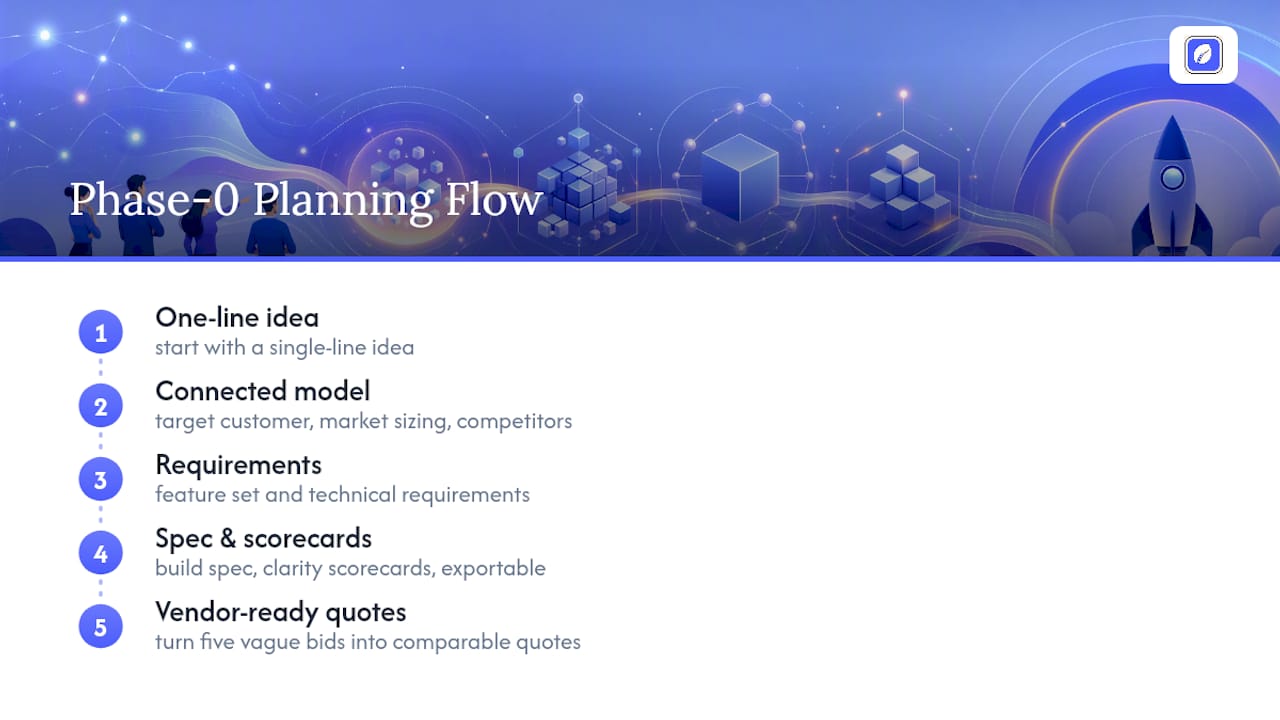
That spec matters because it changes what a vendor is quoting against. Some platforms include AI advisors that cover marketing, business strategy, and operations to stress-test your assumptions before you spend a dollar on development. The output can feed into different views that show your idea from a clarity, build, or scale-and-run perspective, and export to common tools so the spec doesn't live in a document nobody opens again.
Handing vendors a real spec instead of a one-paragraph pitch is what turns five wildly different quotes into five comparable ones.
What Founders Get Wrong About App Budgets
The founders who blow their budget almost never fail because they picked an expensive vendor. They fail because they skipped discovery, added features mid-build because they seemed easy, and forgot maintenance existed until the first invoice arrived. Feature bloat is the quiet budget killer: every "just one more thing" request during development resets QA, retests other features, and pushes the timeline, which pushes the cost.
If you're starting this process in the next two weeks, do five things: write down your core user flow in one sentence, schedule a discovery sprint before contacting vendors, shortlist three vendors across different engagement models, request fixed-scope quotes against the same written spec, and set aside 20% of your build budget for year one maintenance before you sign anything.
The gap between founders who ship on budget and founders who don't isn't talent or luck. It's whether they did the boring scoping work before the fun part started.
— Karl
Turn Your Scope Into a Spec Vendors Can Actually Price
Everything in this guide points to the same conclusion: vague scope produces expensive, incomparable quotes, and tight scope produces fair ones. Some software solutions are built for exactly the step between "I have an idea" and "I'm ready to talk to vendors." You type your idea in one line, and it generates a structured model covering your target customer, competitors, feature list, and a build spec you can hand to any agency, freelancer, or in-house team.
A detailed build spec can turn your next round of vendor conversations from five vague guesses into five comparable, itemized quotes. It's also a tool for keeping mid-build feature creep in check, since your roles, flows, and requirements are already documented before anyone writes a line of code. If your budget planning could use the same rigor as your pitch deck, start with Klaritea before you contact your first developer.
Sources
- Clutch — Mobile application developers: pricing
- Azure pricing calculator
- Statista — Number of smartphone users worldwide
- AIDev — Mobile app development cost (2026 breakdown)
FAQ
Can I build my own app for free?
You can build a very basic app for free using no-code platforms' free tiers, but anything with a real backend, payment processing, or custom design will require paid tools or developer time. Free tools work for prototyping an idea, not for a production-ready launch.
How much can a 1,000-download app make?
Revenue depends entirely on monetization model, not download count. A free app with no ads or in-app purchases makes nothing from a low download number, while a subscription app with strong retention could generate meaningful recurring revenue from the same download number.
Is owning an app profitable?
Profitability depends on whether revenue covers both the initial build cost and ongoing maintenance, which typically runs 15% to 25% of build cost annually. Many apps break even on build cost but underestimate maintenance, hosting, and API fees that erode margin over time.
Do I need an LLC to start an app?
Not to build or launch an app, but forming an LLC or similar entity is common before you start collecting payments, signing vendor contracts, or handling user data, since it separates personal liability from business liability. A tool like Klaritea can help you scope the business model before you decide on legal structure, since your revenue model often determines what entity type makes sense.