The fastest way to an investor-ready pitch deck isn't a prettier template. It's a model-first workflow: AI for pitch decks works best when you feed it a structured business model, not a vague idea, and let it generate slides you can defend in the room.
Done right, you get a full draft in minutes: editable content, market numbers with citations attached, and a slide set matched to your funding stage. Skip that step and you get what most founders get from prompt-and-pray tools, a polished deck built on numbers nobody can trace back to a source.
Before you touch a slide generator, run your one-liner through a clarity pass: define your ideal customer, name your stage, and pick the three metrics that actually matter to the round you're raising.
- Get a stage-aware slide outline, not a generic 12-slide template
- Demand source lines on every market-size claim before you trust the chart
- Export to editable .pptx or Google Slides so you can fix what the AI gets wrong
Quick fact: decks that lead with strategic framing and a defensible narrative, like Anthropic's leaked 2022 deck, tend to outperform ones built around feature lists and slick design alone.
Key Takeaways
The most defensible pitch decks come from a clarity-first AI workflow: structure your business model before you generate slides, and require a source line on every market number.
| Point | Details |
|---|---|
| Model before slides | Build your one-liner, ICP, and stage into a structured model before running any deck generator. |
| Source every market number | Require a citation and date on every TAM/SAM/SOM figure before it goes on a slide. |
| Export editable charts | Choose .pptx or Google Slides output with native charts you can open and verify live. |
| Match slides to stage | Specify funding stage and audience during input so the deck emphasizes what that round expects. |
| Klaritea prepares the model | Klaritea turns a one-line idea into a connected model founders can export as defensible input for any AI deck generator. |
Table of Contents
- What Can AI Pitch Deck Tools Actually Do?
- How Do You Turn an Idea Into a Deck Step by Step?
- Where Should Your Market-Sizing Numbers Come From?
- What Mistakes Do Founders Make With AI-Generated Decks?
- What Should You Look for in an AI Deck Tool?
- How Klaritea Builds the Inputs Investors Actually Trust
- The Overlooked Cost of Skipping the Modeling Step
- Get Your Business Model Investor-Ready Before You Touch a Slide
- Sources
- FAQ
What Can AI Pitch Deck Tools Actually Do?
Most tools in this category fall into two buckets, and the distinction matters more than any feature checklist. There are slide generators, which focus on layout and visual polish, and there are what practitioners call fundraising engines, which combine research, narrative structure, and investor-readiness scoring. If you're raising money, the second category matters far more than the first.
Here's what the better tools handle well:
- Prompt-to-deck and file-to-deck generation. Type a description or upload a business plan, and the tool drafts slide content and layout automatically.
- Stage-aware slide sets. A pre-seed deck and a Series A deck shouldn't look the same, and decent generators adjust the slide count and emphasis based on the round you specify.
- Editable exports. Output lands in .pptx or Google Slides with native shapes, not a flattened image you can't touch.
- Research-first market sizing. The stronger tools pull from industry reports and analyst notes, then log a citation next to the number so you can defend it in a meeting.
- Rehearsal and engagement analytics. Some platforms track how long viewers dwell on each slide, or offer a rehearsal mode that scores your pacing before you send the deck out.
Now here's what these tools genuinely struggle with. Generic AI models will invent market figures when they don't have real data to pull from, a problem researchers and journalists have flagged repeatedly in coverage of AI-native startup decks. A tool with no memory of your actual business model will also default to a templated narrative, the same three-slide arc of "problem, solution, market" that every accelerator alum has seen a thousand times. And no generator, however good, can invent defensible business logic you haven't worked out yourself. If you don't know your own unit economics, the AI won't magically produce them.
Pro Tip: Test any AI deck tool by asking it to source a specific market number for your industry. If it can't show you where the figure came from, don't put that number in front of an investor.
How Do You Turn an Idea Into a Deck Step by Step?
The order of operations matters here. Founders who jump straight to slide generation end up editing a deck that looks finished but says nothing specific about their business. Work backward from clarity instead.
- Build a clarity model first. Write your one-liner, define your ideal customer profile, name your funding stage, and pick three metrics an investor at that stage will actually care about. A pre-seed investor wants to see founder-market fit and a wedge into a market; a Series A investor wants growth curves and unit economics. Conflating the two is the single most common reason decks feel generic.
- Feed the generator structured inputs, not a vague prompt. The more specific your business logic going in, the less the tool has to guess, and the less it hallucinates. Anchor every market claim with a real number and require the tool to attach a source line to it. If it can't, flag that slide for manual research.
- Export as editable .pptx with native charts, then review the data provenance. Open every chart and confirm the underlying numbers match a real report, not a plausible-sounding estimate. This is the step founders skip most often, and it's the one that causes the most embarrassment in a live pitch.
- Rehearse with analytics, then finalize the ask and financials by hand. Some platforms offer engagement tracking or rehearsal scoring that shows where a run-through drags. Use that feedback to tighten pacing, but treat your funding ask and financial projections as something only you should finalize. No AI tool understands your cap table or your actual burn rate.
Practitioners who've studied what separates decks that get follow-up meetings from ones that don't point to the same pattern: a deck built on top of real modeling gets fewer skeptical questions, because the founder already answered them before the investor asked. If you want a head start on that modeling before you ever open a slide tool, a value proposition generator can help you sharpen the one line everything else in the deck has to support.
Pro Tip: Rehearse your pitch out loud, not just in your head. Delivery tools like OffBook's AI call coaching can catch pacing and clarity issues a silent read-through never will.
Where Should Your Market-Sizing Numbers Come From?
Investors care about provenance almost as much as they care about the number itself. A $50 billion TAM slide with no source line invites the exact question you don't want in a fundraising meeting: "Where did that come from?" A slide with a report name, a date, and a methodology note shortens that conversation instead of starting it, according to reporting on how research-first AI tools structure fundraising decks.
Research-first automation looks different from a generic prompt-to-slide tool. Instead of asking a language model to guess at a market size from its training data, these tools query industry reports, regulatory filings, and analyst notes, then attach a citation to the resulting figure. The output should land as an editable chart, not a static image, so you can open it in a live meeting and show exactly where a number derives from.
Before you trust any AI-sourced figure, run four quick checks:
- Confirm the source. Is it a named report or analyst firm, or an unattributed number the tool generated on its own?
- Confirm the date. A market-size figure from three years ago may no longer hold, especially in fast-moving categories.
- Confirm the methodology. Top-down TAM estimates and bottom-up SAM calculations tell very different stories, and investors know the difference.
- Prefer native chart data over flattened images. A chart you can click into and edit proves you understand the number. A screenshot proves nothing.
If market sizing is new territory for you, a practical TAM/SAM/SOM guide walks through how to build each layer before you ever hand the numbers to a generator. Entrepreneurs increasingly lean on AI to spot market trends earlier in the process, which is exactly where that research belongs, before slide generation, not after.
What Mistakes Do Founders Make With AI-Generated Decks?
Three mistakes show up again and again in decks built by founders who skipped the modeling step, and each one has a specific, fixable cause.
Generic template decks. This happens when a founder types a one-line prompt into a slide generator and accepts whatever narrative arc comes back. The fix is sequencing: clarify your business model, your customer, and your differentiation before you generate a single slide. A tool can only reflect the specificity you give it.
Unverified market numbers. This is the costliest mistake because it surfaces in the room, not before. The fix is a hard rule: no market-size slide goes into the deck without a visible source line, and you personally check the original report before the meeting. If the tool can't produce a source, treat the number as a placeholder, not a fact.
Poor stage tailoring. A ten-slide seed deck padded with growth charts you don't have yet reads as confused, not ambitious. Specify your funding stage and your audience explicitly when you generate content, and prune anything that doesn't match what an investor at that stage is actually evaluating.
Run this checklist before you send any AI-assisted deck to an investor:
- Every market number has a named source and a date attached
- The slide count and content match your actual funding stage
- Charts are editable, not flattened screenshots
- Your ask and financials were finalized by you, not left as AI-generated placeholders
- At least one person outside your team has read the deck cold and asked questions
Pro Tip: Read your own deck as if you were a skeptical investor seeing it for the first time. The slide that makes you flinch is the one that needs the most work.
What Should You Look for in an AI Deck Tool?
Not every AI presentation tool deserves the same evaluation. Weigh each option against your funding stage, because what a pre-seed founder needs from a tool looks different from what a Series A team needs.
- Does it accept stage and audience as inputs, or does it produce the same generic output regardless of where you are?
- Are market numbers cited on-slide, with a visible source and date, or does the tool present figures with no way to trace them?
- Can you export native, editable charts in .pptx or Google Slides, or are you stuck with a flattened image you'd need to rebuild from scratch?
- Does it offer rehearsal or engagement analytics to help you iterate before the real pitch, or is the deck a one-shot output with no feedback loop?
Test these in a free trial before committing to anything. Ask the tool to source a market number for your exact niche and see whether it shows you the citation. Ask whether it will adjust slide count and emphasis if you tell it you're raising a pre-seed round versus a Series A.
- If you're early and still validating your business logic, prioritize a planning-first workflow that builds your model before it builds slides.
- If your business model is already solid and you just need speed, a fast template generator with editable exports can get you most of the way there.
- If you're raising serious capital, prioritize research-first market sizing and readiness analytics over pure design polish, since decks focused on defensible narrative over feature lists consistently perform better with investors.
How Klaritea Builds the Inputs Investors Actually Trust
Most AI deck tools fail founders before the founder even opens them, because the founder hands over an idea with no structure behind it. Klaritea exists to close that gap. You start with a one-line description of your idea, and Klaritea turns it into a connected model covering your ideal customer profile, TAM/SAM/SOM, competitor analysis, feature mapping, and a build spec, all linked together instead of scattered across separate documents.

Three AI advisors, Maya on marketing, Devon on business strategy, and Priya on operations and quality assurance, review that model and push back on weak assumptions before they ever reach a slide. That review step is what reduces hallucination risk downstream: a deck generator working from a model that's already been challenged and fact-checked has far less room to invent a number nobody can defend.
Klaritea organizes that model into different "lenses," Clarity, Build, and Run & Scale, so you can view your business through whichever frame the moment calls for. A founder preparing to pitch would typically export from the Clarity lens: a structured pitch outline with your market sizing, competitor positioning, and feature priorities already reasoned through, ready to hand to whichever deck generator or designer takes it from there.
The gap between a deck that gets a follow-up meeting and one that doesn't usually isn't design. It's whether the founder can answer the second question an investor asks, because the modeling was already done before the first slide was built.
If you want to see the broader category this fits into before deciding on a tool, this roundup of AI planning tools for early-stage founders puts Klaritea's approach next to the alternatives.
The Overlooked Cost of Skipping the Modeling Step
Most advice on AI pitch decks treats the tool as the bottleneck: pick the right generator, get the right template, and you're set. That's backward. The bottleneck is almost never the generator. It's the founder handing over a business model that hasn't been stress-tested, and expecting the AI to fill in gaps it has no way of knowing about.
The conventional wisdom, that speed is the main value AI brings to pitch decks, undersells what actually matters. Speed without defensible inputs just gets you to a bad meeting faster. What the research on winning decks consistently shows is that investors reward founders who've already answered the hard questions, not founders who show up with the shiniest slides.
If you take one thing from this, prioritize the modeling over the design. Get your ICP, your market sizing, and your differentiation nailed down before you open a slide tool. The deck is the last five percent of the work, not the first.
Get Your Business Model Investor-Ready Before You Touch a Slide
Klaritea is the fastest way to turn a one-line idea into the structured model an investor-ready deck actually needs, without hiring a strategist or spending weeks in spreadsheets. You describe your idea once, and Klaritea builds a connected view of your ICP, market sizing, competitors, and feature priorities that you can hand straight to any deck tool, or export as a report on its own.
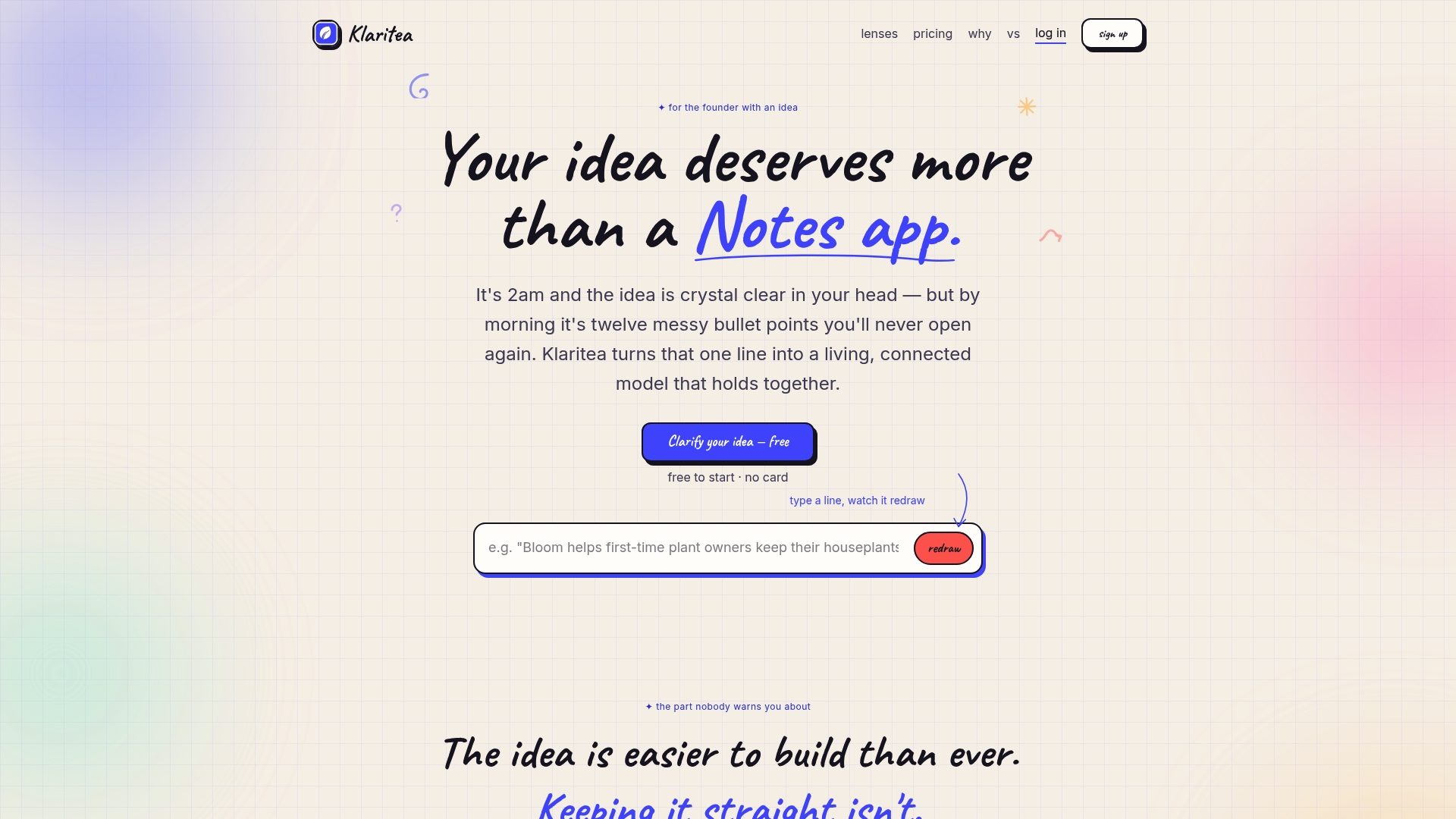
That matters most for founders who've already tried a slide generator and gotten back something generic, because the problem usually wasn't the generator. It was the input. Klaritea's AI advisory board pressure-tests your assumptions before you ever build a slide, so the model you're working from is one you can actually defend to an investor. Start with your one-liner at Klaritea and see the connected model it builds around your idea in minutes.
Sources
- The Exclusive Pitch Deck That AI Agent Startup StackAI Used to Raise Funding - Business Insider
- Anthropic's 2022 Pitch Deck Leaked: 10 Slides to $965B
FAQ
Which AI Is Best for Pitch Decks?
There's no single best tool for every founder. The right choice depends on your stage: a research-first fundraising engine with cited market data and stage-aware slides serves a founder actively raising better than a pure design generator, while a founder still validating their model benefits more from a clarity-first planning tool like Klaritea before they touch slides at all.
Is There an AI That Can Generate a Pitch Deck?
Yes. Several AI tools generate pitch deck content and design from a prompt or uploaded document, exporting to editable .pptx or Google Slides formats, though the quality of the output depends heavily on how structured your input business model is going in.
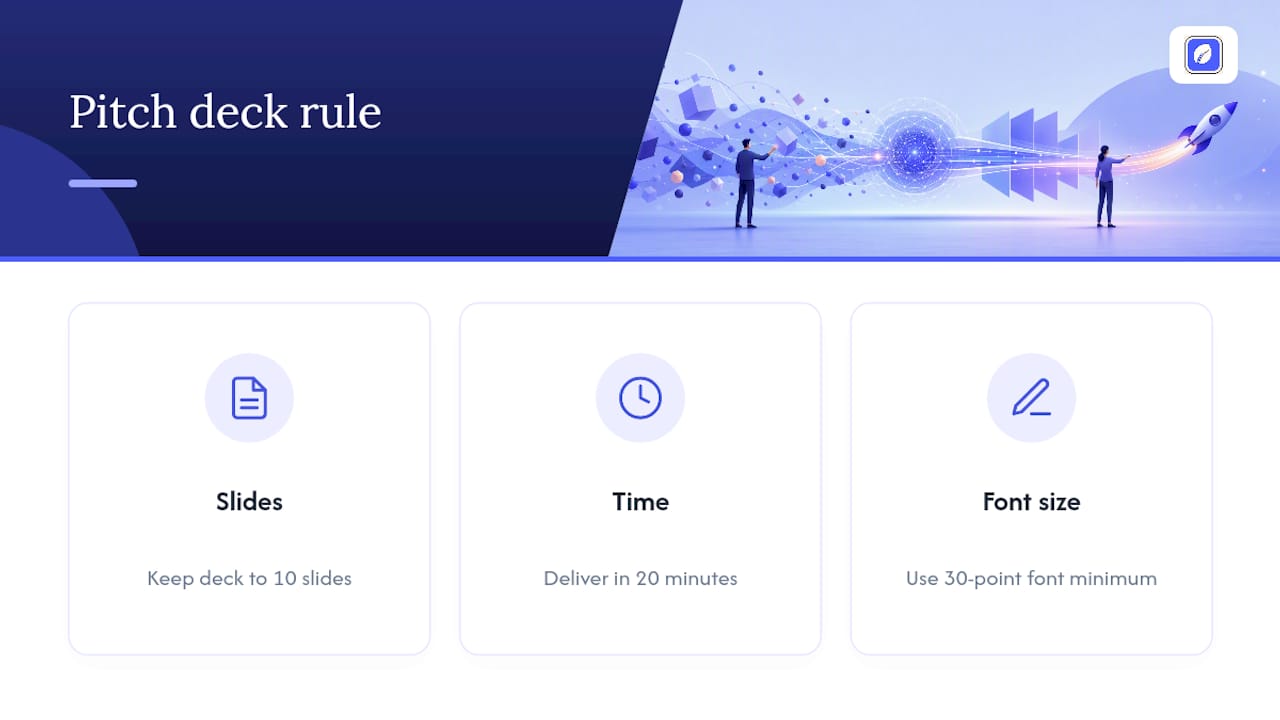
What Is the 10/20/30 Rule for Pitch Decks?
The 10/20/30 rule, popularized by Guy Kawasaki, suggests a pitch deck should be concise and easy to follow, a guideline meant to force concision over cramming detail into every slide.
Which AI Is Best for Decks in General, Not Just Fundraising?
For non-fundraising presentations, template-first AI presentation software optimized for design speed often works fine. For investor decks specifically, prioritize tools that cite market numbers on-slide and offer stage-aware content, since design polish alone doesn't answer the questions investors actually ask.