Choosing startup planning software that delivers traceable recommendations and defensible business models is harder than it should be for founders and early-stage teams. Many tools charge high minimums or restrict exports, so founders cannot test multiple models without steep costs or lock-in. This comparison pairs feature details, pricing, and unique value points so founders can choose the best AI business strategist alternative for their next project.
Table of Contents
Klaritea
At a Glance
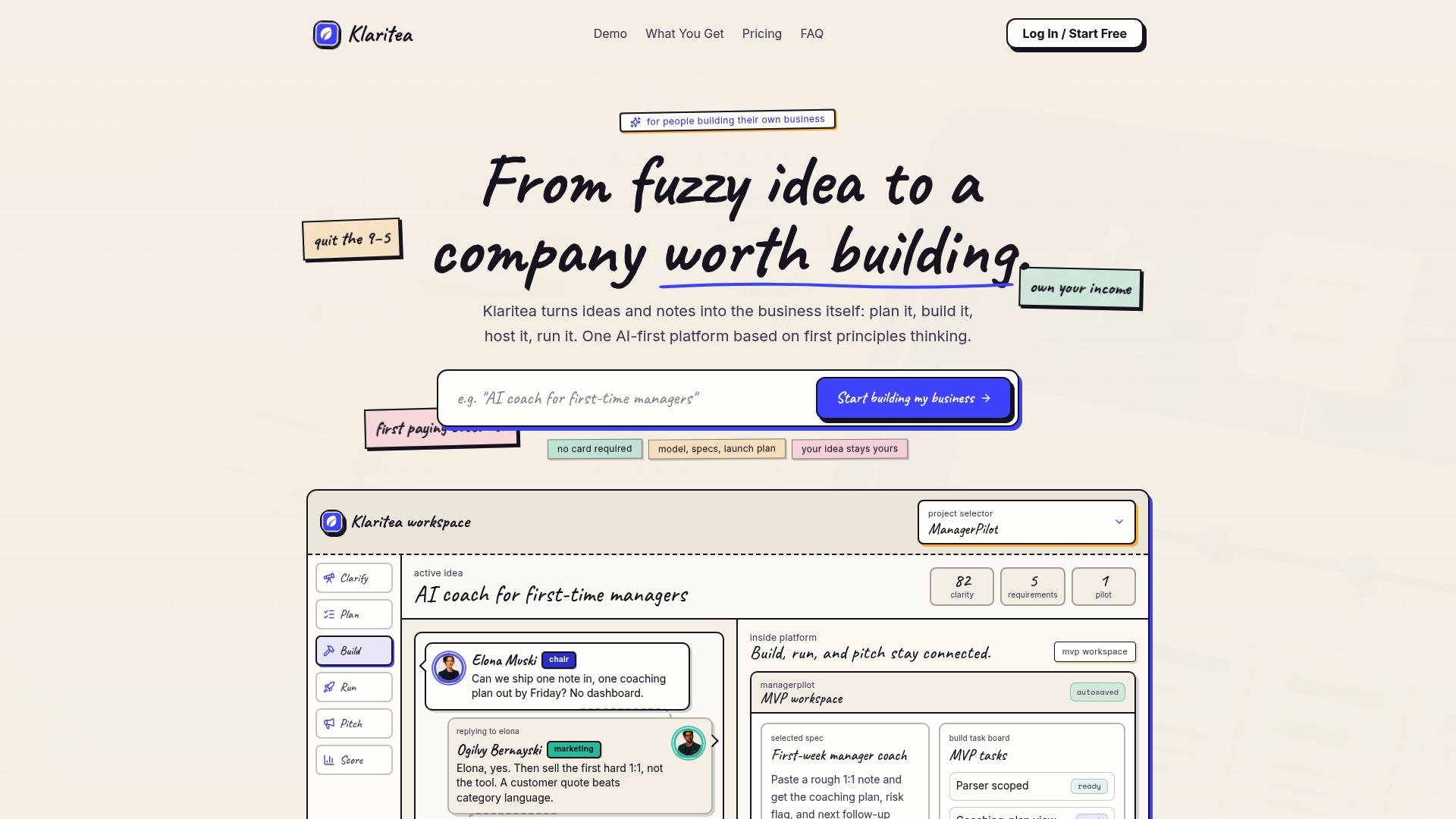
One-line idea input produces a complete, connected business model covering ICP, TAM/SAM/SOM, competitor analysis, features, requirements, build spec, and pitch. The platform logs AI decisions so you can trace and undo each step. Outputs include exportable build specs, scorecards, and sync options for GitHub, Notion, and Confluence.
Core Features
Klaritea turns a single short idea into a connected business model with multiple lenses for offer, customer, market, requirements, features, code, run, and scale. The system logs AI actions for full traceability and provides a clear step by step path to transform ideas into validated business plans. Users retain ownership of data and exported artifacts, with build specs, pitch materials, and report exports available.
Key Differentiator
The product centers on a connected, traceable model that stays aligned as you edit inputs and assumptions. That model keeps market sizing, competitor analysis, features, and requirements synchronized so a single change updates the whole plan. The trace logs let you see which AI suggestion produced a given decision and revert it if needed.
Pros
Transparency shows in the action log. You can review each AI step, accept or undo changes, and follow how the model reached a recommendation. The platform avoids vendor lock in by letting you bring your own tools for code and communication and by offering exports that move with the project. Pricing charges for AI work through TEA credits instead of taking a share of future profits, so you pay for output rather than giving away equity or revenue.
Cons
- May have a learning curve for users who are new to business modeling or unfamiliar with AI driven workflows.
Who It's For
Founders and early stage entrepreneurs building phase 0 plans will get the most value. Small startup teams that want a single place to document assumptions, run market sizing, and produce a build spec will benefit. Product leads who need traceable decisions and an auditable record for investor conversations also fit this profile.
Unique Value Proposition
Three AI advisors research, challenge, and fact check your idea across marketing, business, and operations, turning vague input into a mapped plan you can hand to engineers. That advisor structure reduces the time you spend drafting multiple documents and replaces scattered notes with a single evolving model. The result is a clearer go or no go before you spend on development.
Real World Use Case
A founder used Klaritea to map a value proposition, validate market fit, and produce a launch plan. The team exported a build spec to GitHub and a pitch deck for early investors. Trace logs showed which assumptions drove the TAM estimate so the founder could rework pricing and update the model quickly.
Pricing
Start free, then $19/month for the Klaritea plan and $99/month for Pro. AI work uses TEA credits with free starter credits and flexible top ups available. Paid plans add exports and GitHub sync options.
Website: https://klaritea.app
Preuve AI
At a Glance
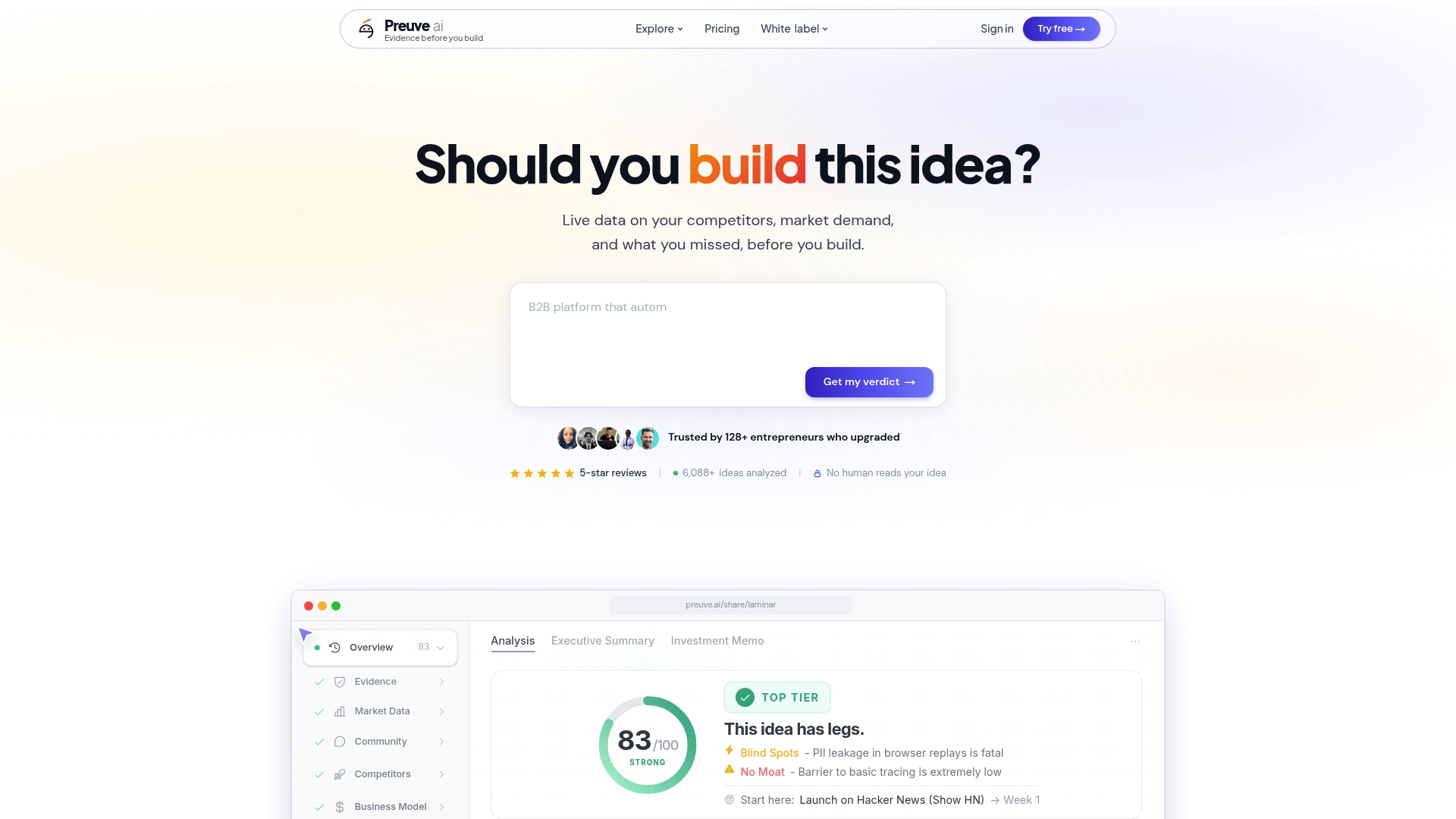
According to the company, a complete viability scan takes about 60 seconds. Preuve AI scans 50+ live data sources including Crunchbase, Google Trends, Reddit, Product Hunt, and G2 to surface demand signals. It maps up to 15 competitors and highlights pricing and funding where available. The tool offers a free quick scan and a one time founder report for $29.
Core Features
The tool generates a viability score and maps up to 15 competitors with funding, pricing, and weaknesses. It links each claim to source material so you can verify signals and trace research back to Crunchbase or Reddit. The output includes market gap notes, pivot suggestions, and investor ready documents to support early fundraising.
Key Differentiator
Preuve AI focuses on producing source linked evidence by cross checking many live sources rather than relying on a single signal. That approach makes the result auditable because every claim points to an origin you can open and inspect. AI cross validation also flags contradictory signals for review, which reduces blind trust in any one dataset.
Pros
The vendor advertises being trusted by over 6,000 entrepreneurs. It surfaces verifiable evidence rather than a standalone claim so you can follow each data point to its source. That timing pairs with quick scans and affordable one time reports such as $29 for a founder report. The interface highlights blind spots and demand signals so founders make a faster go or pivot decision. Cheaper than hiring a market researcher for an initial sweep, it helps you decide before you spend on engineering.
Cons
- Preuve AI reports 18.3% of ideas score above the “go” threshold of 70.
- Validation stays high level and does not replace detailed industry research or primary customer interviews.
- Users seeking human verified, deep competitive due diligence may find the outputs too surface level.
When It May Not Fit
Not a fit for enterprise scale, industry specific validation that requires expert interviews or deep primary research. If you need custom datasets behind a firewall, the tool depends on public sources and internet access. Also expect limits where certain niche data streams lack coverage or API access. Teams running longitudinal, manually curated studies will need a different approach.
Who It's For
Designed for first time and serial founders, solo entrepreneurs, and venture builders. Founders who must decide quickly before spending development budget will get value. Bootstrapped teams will appreciate low cost one time reports and quick evidence checks.
Real World Use Case
A SaaS founder runs a scan to check demand for a niche workflow tool. The report returns competitor mappings, Reddit demand signals, and market gap notes. Using that timing, the founder decides to pivot the idea before any engineering costs and preserves runway.
Pricing
Single reports cost $29 one time. Subscription plans start at $19/month for Radar Pro. Lifetime plans list at $499 for Pro and $999 for Business.
Website: https://preuve.ai
ValidatorAI
At a Glance
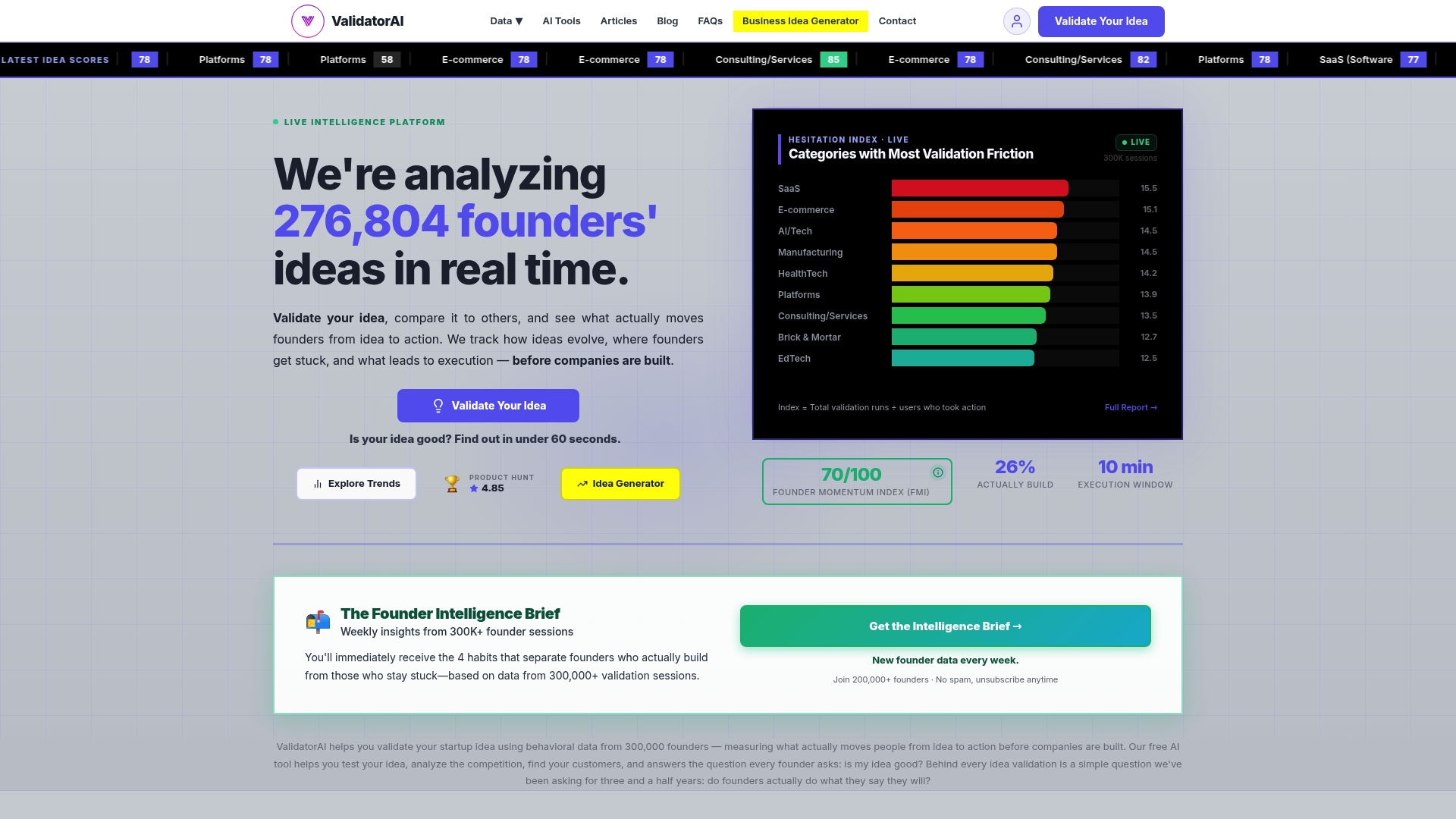
ValidatorAI reports more than 300,000 founder interactions feeding its behavioral dataset. The vendor advertises a 4.85 Product Hunt rating and states roughly 26% of users act on validated ideas. According to the company, about 84.8% of users drop off before completing validation.
Core Features
ValidatorAI scores ideas with AI powered prompts and delivers written feedback that reflects prior founder behavior. It runs market viability stress tests and produces TAM SAM SOM estimates to surface size constraints. The platform also segments potential customers and simulates likely objections to help refine positioning.
Key Differentiator
ValidatorAI centers analysis on behavioral signals drawn from founder interactions rather than solely on static market research. That focus reveals how real founders decide and where hesitation appears. This makes the product a narrower fit for teams seeking behavior driven validation instead of a full connected business model builder.
Pros
The platform derives insights from a large interaction dataset, which produces behavioral signals you can test against your own assumptions. It bundles market sizing, competitor analysis, and customer simulation into a free toolset useful at the idea stage. The product also provides written feedback and trend cues that accelerate hypothesis pruning and landing page experiments.
Cons
-
Low conversion to building: only about 26% of users move from validation to action, which highlights execution gaps.
-
High drop off: about 84.8% of visitors leave before completing validation, reducing the volume of full data points.
-
Sector bias: hesitation rates skew high in SaaS and AI tech, which may limit predictive accuracy for those industries.
When It May Not Fit
If you need a connected spec that maps features to engineering tasks, this tool will feel narrow. The platform primarily surfaces potential and behavioral tendencies rather than producing build ready requirements. If your priority is end to end planning from idea to shipped product, a modeling tool that generates a full build spec may be a better match.
Who It's For
Early stage founders and solo entrepreneurs who want rapid, behavior driven validation before they hire or build. Product teams running quick feature experiments will find the simulation and segmentation features useful. Investors doing an early filter on founder signals can use the behavioral cues to prioritize diligence.
Real World Use Case
A founder runs a new SaaS idea through ValidatorAI to score concept resonance and list top competitors. The tool refines the ideal customer segment and simulates likely objections to the pricing model. The founder uses those results to write a focused landing page and run a small paid test before committing developer budget.
Website: https://validatorai.com
Startrise
At a Glance
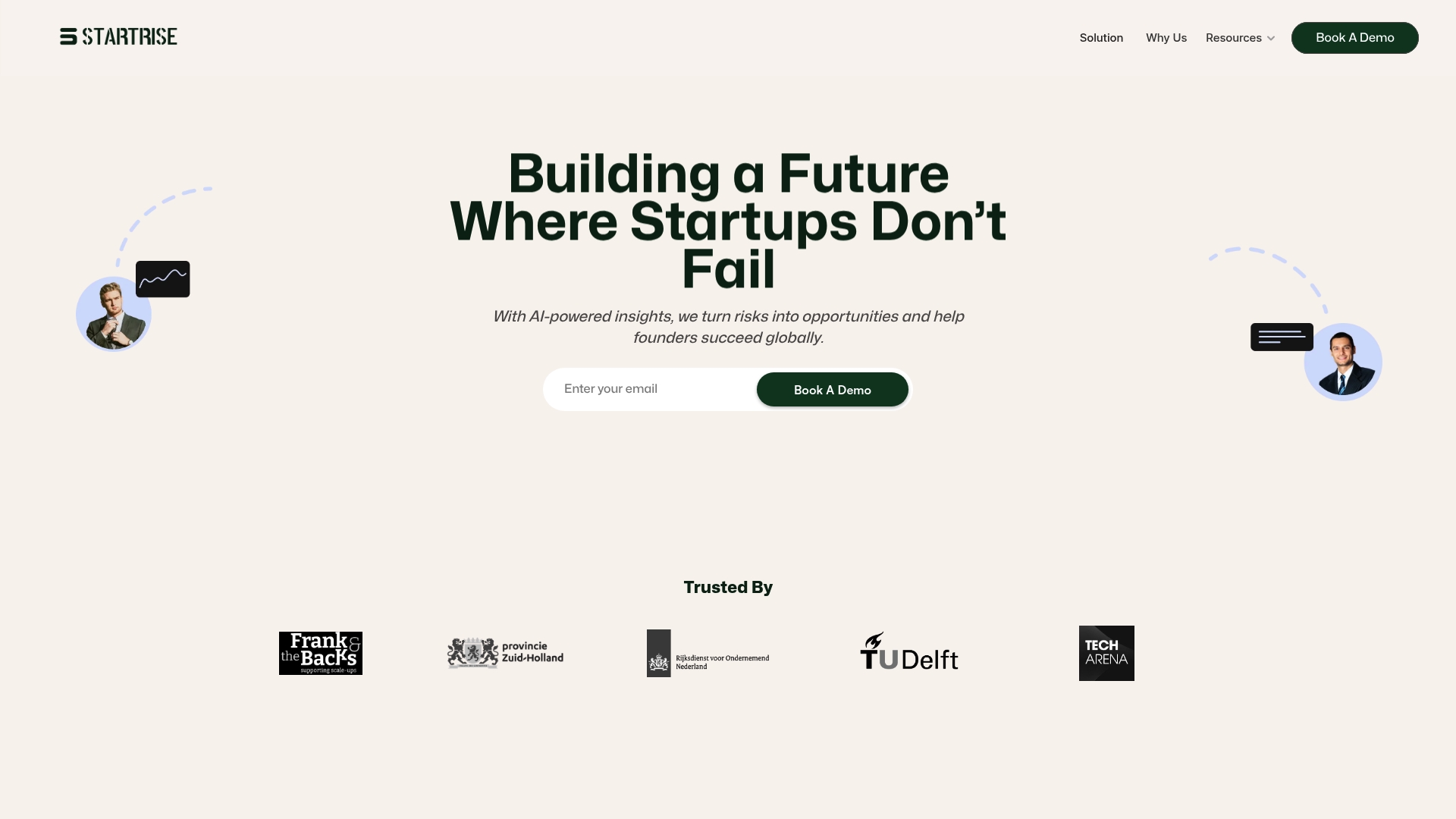
Startrise reports analysis of over 200 data points to build a startup profile. It pairs that Startup DNA mapping with a future simulation engine and community membership. The system surfaces early-stage risks and recommends specific changes founders can act on.
Core Features
Startrise runs deep startup profiling across product, market, team, and financials and then produces AI recommendations that link findings to practical next steps. Its future simulation engine lets founders run mock funding rounds with community involvement to test investor scenarios. The platform also offers community memberships that grant access to investor interactions, events, and ongoing support resources.
Key Differentiator
The standout is the combined use of DNA analysis and live funding simulation to turn risk assessment into rehearsal for fundraising. That focus on preemptive risk reduction sets Startrise apart from planning tools that only map ideas. Compared with Klaritea, Startrise targets founders who want explicit funding‑round practice and investor engagement tied to risk profiling.
Pros
The platform gives founders a clear, data-based view of weaknesses and strengths so they can prioritize fixes. Its community portal connects simulated rounds to real people, which helps test investor responses before committing to a strategy. Ongoing recommendation loops and event access support follow-through, so founders receive both diagnostic output and practical ways to act on it.
Cons
- Limited public technical detail and few user reviews make it hard to verify long-term results.
- Full access may become costly depending on subscription choices, especially for teams on tight budgets.
- Results depend on consistent founder input; shallow or infrequent data updates will blunt the outputs.
- Impact and speed vary by startup maturity and the quality of the data provided.
When It May Not Fit
If you want a plug-and-play roadmap that requires almost no effort, this product will feel demanding. Later-stage startups that already have well‑tested investor funnels will gain less from simulated rounds. Teams with very limited time to enter data should look for lighter diagnostic tools.
Who It's For
Founders of early-stage startups who want to identify and reduce failure risks before fundraising. Teams that plan to iterate product and go-to-market strategy based on quantified weaknesses will get the most value. People seeking active investor practice and community feedback will appreciate the membership features.
Real World Use Case
A tech founder used Startrise to score team gaps and product weaknesses, then ran two simulated funding rounds with community feedback. The simulations revealed a messaging problem and indicated a smaller seed ask would increase investor interest. The founder reworked the pitch and closed meetings with three target investors.
Pricing
Plans start from $29.00/month for community membership options with annual or monthly billing. The vendor lists tiered access, and higher tiers unlock deeper analysis and export features. Expect different billing levels depending on how much simulation and support you need.
Website: https://startrise.tech
Margo
At a Glance
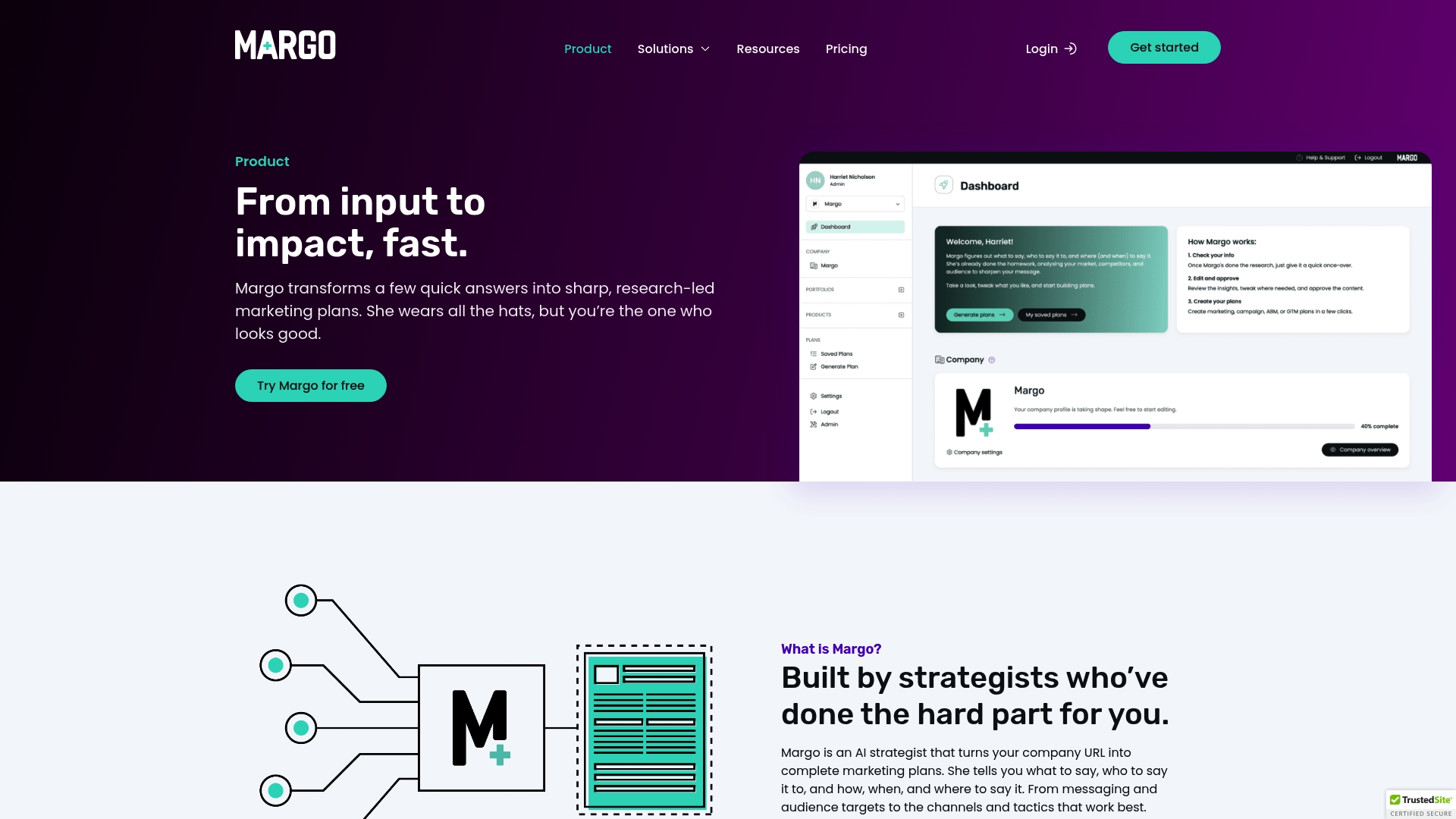
According to the company, Margo connects thousands of real time research signals into a continuously updating strategic graph that adapts as markets shift. The workspace turns a brief input into plans for branding, campaigns, content, go to market, and ABM. It targets live strategy work without constant manual prompting.
Core Features
Margo generates strategy from a company URL and combines market and competitor analysis with ideal customer profiles and personas. The tool produces messaging frameworks and identifies key accounts while also setting goals and creating campaign, content, GTM, and ABM plans. Users can review and edit outputs inside a single organized workspace.
Key Differentiator
Margo’s standout claim is the continuous strategic graph fed by live research signals. That claim implies plans update as competitors or market signals change and keep strategy current. The graph model aims to reduce stale plans and centralize strategic context across campaigns.
Pros
Margo automates complex planning tasks and saves the hours teams normally spend assembling research and frameworks. Its living insights help plans stay current as market signals change, and the workspace preserves edit history so strategy owners retain control. The product scales across teams and regions, which helps agencies and enterprises keep consistent playbooks across multiple accounts.
Cons
- Generated plans require expert review and refinement before execution. This is a common note in third party reviews.
- Cost may be high for smaller teams or solo founders who do not need enterprise capabilities.
- Some users report a learning curve when managing the AI outputs and browser integrations.
When It May Not Fit
Teams that lack stable internet access or prefer offline workflows will struggle with Margo’s browser requirement. Highly regulated industries that demand deep, context specific legal or compliance review will still need human specialists. Small one person shops that cannot absorb the price may find lighter tools more appropriate.
Who It's For
Mid level marketing teams, strategists, and business leaders who need automated, research led planning will get the most value. Agencies can use it to speed up pitches and client briefs across portfolios. Enterprise marketing groups that must align regional campaigns will find the scaling features useful.
Real World Use Case
A regional marketing manager uses Margo to refresh campaign strategy each quarter by feeding the company URL and local market inputs. The manager aligns messaging and channel plans across three markets and exports a single brief for the creative team.
Pricing
The vendor advertises pricing starting at £299 per quarter for the Starter plan, with enterprise options available. A free trial is offered so teams can validate fit before committing.
Website: https://askmargo.ai/product
StratEngine AI
At a Glance
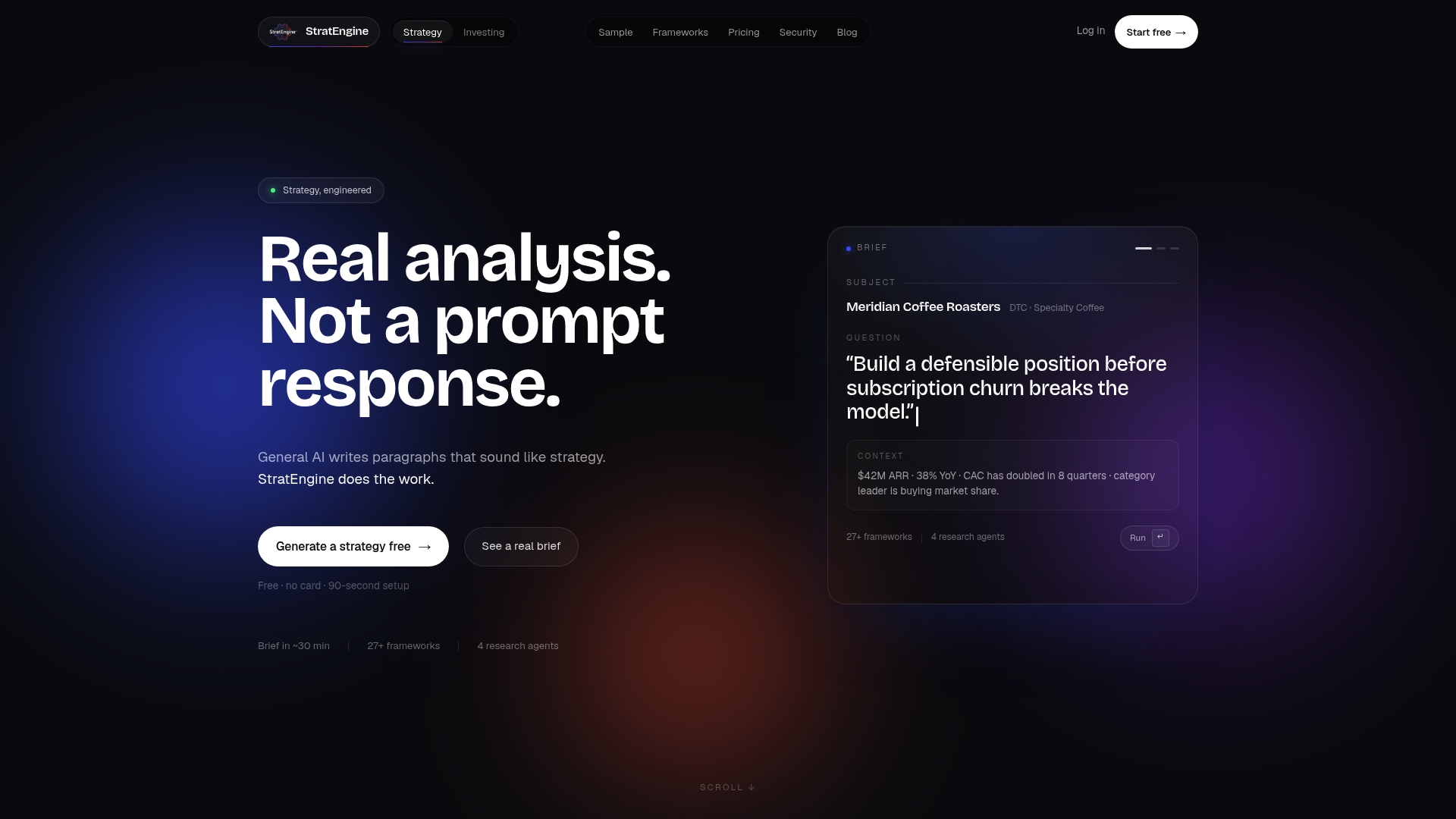
According to the company, StratEngine AI can produce a sourced strategy or investment memo in minutes while automating claim verification. The platform reports CASA Tier 2, SOC 2, and ISO 27001 compliance for its data handling. It targets executives and investors who need rapid, defensible writeups rather than manual research. The vendor also offers pay per brief and enterprise subscription models.
Core Features
StratEngine AI maps user inputs to more than 27 strategy and investment frameworks such as SWOT, Porter’s Five Forces, and Business Model Canvas while automating source collection and verification. It synthesizes that evidence into editable, presentation ready memos and supports private handling with encryption and tenant isolation. The system includes configurable scoring and framework customization to match different investment theses or corporate criteria.
Key Differentiator
The product's defining mechanism is a multi layer AI workflow that cross checks claims against sources and then outputs formatted, sourced memos. That automated verification step separates it from tools that only summarize or generate unverified text. Teams that need defensible, citation backed briefings will recognize the difference immediately.
Pros
StratEngine AI speeds research by replacing manual sourcing and synthesis with an automated pipeline that yields presentation ready memos. The platform centralizes multidisciplinary research, claim verification, and scoring so analysts keep audit trails and editable content in one place. The vendor states enterprise level security controls and data isolation, which helps buyers who must limit training data retention and meet internal privacy rules. Flexible billing lets small teams try pay per brief while larger buyers move to annual or enterprise contracts.
Cons
- Requires connectors and source access. Buyers must set up external data connections and manage permissions.
- Framework set is fixed to supported templates. Very bespoke narrative strategy work may demand manual follow up.
- Dependent on third party data availability and accuracy. Delays or gaps in sources affect outputs.
When It May Not Fit
If your analysis relies on confidential archives that cannot be digitized or connected, this platform will not work. If your team needs freeform narrative consulting rather than framework based scoring, the product will feel constrained. Small teams without the ability to provision connectors may find the setup overhead outweighs the speed gains.
Who It's For
Executives, strategy teams, management consultants, and venture investors who need fast, source backed strategic or investment documents. It fits groups that already use structured frameworks and that can provision source access. Buyers who require defensible memos and audit trails will get the most value.
Real World Use Case
A venture firm uploads a startup pitch deck and runs an automated analysis against internal thesis criteria. The tool verifies public claims, scores the company on configurable metrics, and delivers a sourced investment memo ready for partner review. That output lets partners make a call without multi day manual diligence.
Pricing
Plans start with a free tier plus a pay per brief option for occasional use. The essential plan begins at $660 annually and the professional plan at $1,164 annually. Enterprise contracts are available for high volume usage and custom security or integration needs.
Website: https://stratengineai.com
Comparison of alternatives
When evaluating startup planning software options, Klaritea.app demonstrates remarkable capabilities in forming iterative, interconnected business models tailored for early-stage planning. While strengths abound across alternatives, distinct standout features of various tools cater to specific founder needs.
Integrated Modeling and Validation
Klaritea.app stands out for its unique ability to transform vague input into an expansive, interconnected business plan, maintaining model consistency across updates. Trace logs support transparent decision-making, enabling users to review each AI-generated suggestion, accept or revert changes, and understand the evolution of their strategic plan. Conversely, Preuve AI delivers an extensive capability for live evidence validation, linking data points directly to sources such as Crunchbase and Google Trends. This provides entrepreneurs with immediate market insights and gap analyses critical for go/no-go decisions.
Community-Driven Feedback and Simulation
Startrise distinguishes itself by offering startup-specific DNA mapping alongside risk simulation, enabling founders to practice funding interactions within an active membership community. This is particularly useful for founders seeking rehearsal opportunities before approaching real investors. While Klaritea.app builds the foundation of a clear business model, it lacks the dedicated community simulation features that Startrise provides.
Best fit
- Founders requiring integrated plans from vague concepts should consider Klaritea.app for its dynamic modeling and synchronized feature mapping.
- Founders who need instant market validation before investment will benefit from Preuve AI’s live signal linking and affordability for quick scans.
- Teams seeking behavioral datasets for customer simulations may find ValidatorAI’s focus on interaction-derived tendencies most effective.
- Early-stage startups needing risk-based insights with investor simulations should explore Startrise’s DNA mapping and funding round practices.
- Enterprise groups prioritizing customizable frameworks in advanced strategic scenarios will appreciate StratEngine AI’s compliance and versatile templates.
Our pick
Klaritea.app’s transparent trace logs, interconnected adjustment capabilities, and ability to maintain consistency across all planning aspects make it the prime choice for founders aiming to build sustainable, cohesive initial strategies. However, teams focusing solely on live data validation or behavioral segmentation without integrated business modeling might prefer Preuve AI or ValidatorAI.
The comparison below highlights key features and differentiators of platforms assisting founders in startup planning.
| Platform | Key Feature | Best For | Pricing | Limitations |
|---|---|---|---|---|
| Klaritea | Connected and traceable business model | Early-stage entrepreneurs and product leads | $19/month, Pro at $99/month | Learning curve for new users to business modeling. |
| Preuve AI | Viability scoring with source-linked evidence | Solo founders and venture builders | $29 for one-time founder reports | Outputs are surface-level compared to detailed primary research. |
| ValidatorAI | Behavioral signals and customer segmentation | Founders seeking behavior-driven insights | Free, Pro tier available | Low conversion rates to executed builds. |
| Startrise | DNA mapping and investor simulation | Risk reduction for early-stage startups | $29/month for community membership | Limited user reviews and technical details on deliverables. |
| Margo | Continuous strategy graph for live updates | Mid-level marketing and agency teams | £299 per quarter for Starter plan | High learning curve for managing and reviewing outputs. |
| StratEngine AI | Source-backed strategic and investment memos | Executives and management consultants | $660/year for Essential plan | Requires external connectors setup for accessing data. |
How Can Founders Avoid Costly Mistakes Before Building?
Many first-time and serial founders face the risk of spending thousands developing apps that fail. Klaritea helps prevent this by turning your brief idea into a connected business model covering ICP, TAM/SAM/SOM, competitor analysis, features, requirements, and pitch. It uses three AI advisors who research, challenge, and fact-check your concept before you invest in development.
Bold features include instant clarity on your idea and export options like GitHub sync and reports. This tool fits early-stage founders and small startup teams who want a clear path from idea to build spec without unnecessary spending. Learn how Klaritea can provide a traceable, structured model to guide your next steps by visiting the Klaritea homepage.
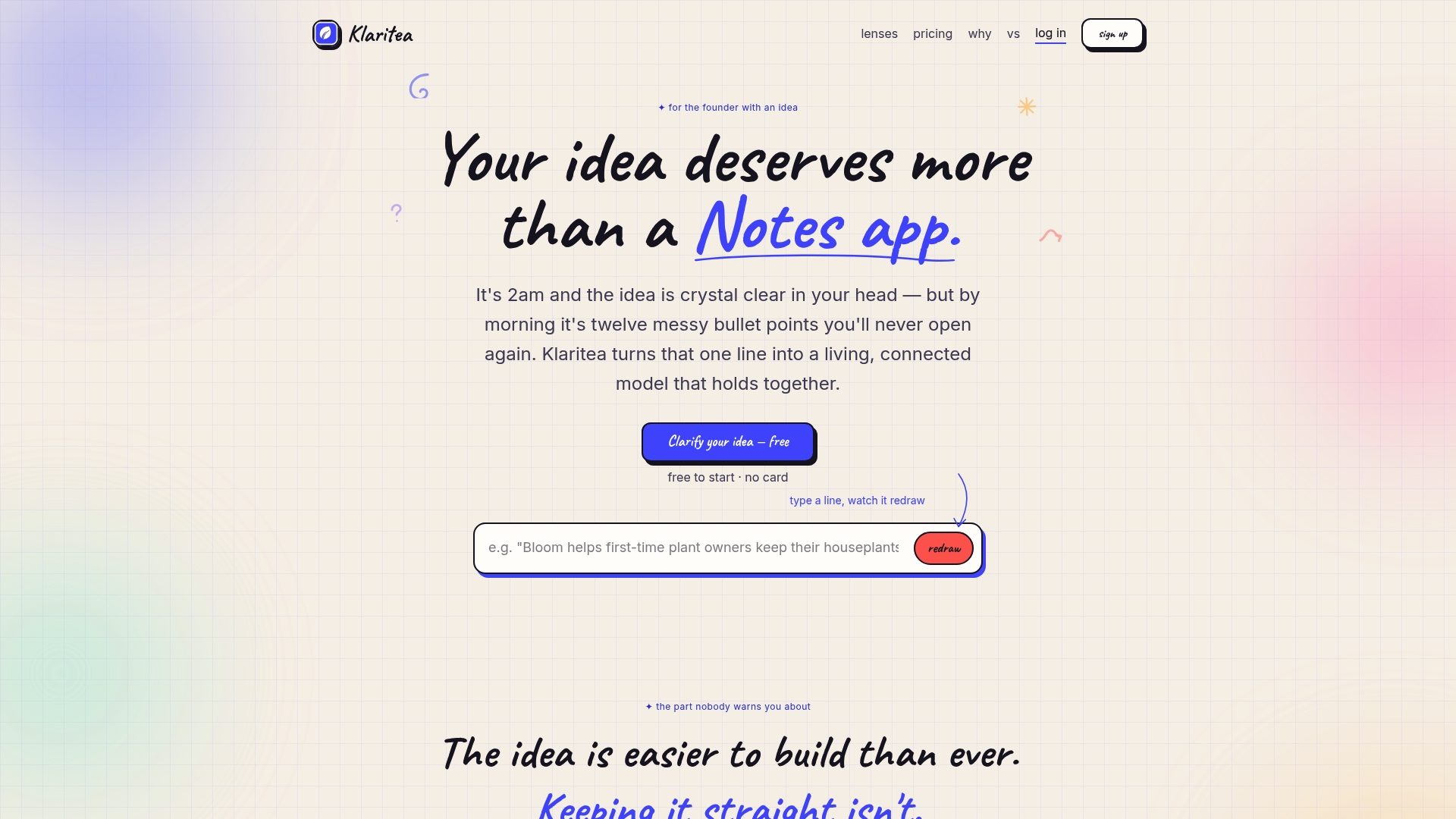
Start with a one-line idea and see how Klaritea builds your business model. Visit https://www.klaritea.app/ and turn uncertainty into a shipped product today.
FAQ
How does Klaritea support business planning for startups?
Klaritea generates a complete, connected business model from a single idea input. The platform offers features like market sizing, competitor analysis, and it produces exportable build specs to help streamline startup planning. Entrepreneurs looking to ensure thorough documentation should consider using Klaritea for detailed business plans.
What is the difference between Klaritea and Preuve AI?
Preuve AI provides a viability score and maps competitors with funding insights, which helps users quickly assess market conditions. In contrast, Klaritea offers a connected model that synchronizes multiple aspects of business strategy, making it ideal for founders wanting comprehensive documentation of their plans. If you need extensive documentation tracking while building your startup, Klaritea would be a more suitable choice.
Can I achieve market validation with Klaritea?
Klaritea allows for market validation through its connected business model that includes market sizing and competitor analysis. This capability provides users with a clear, auditable path to validate their idea against real market conditions. Early-stage entrepreneurs seeking to minimize risk should leverage Klaritea's full feature set to support their validation process.
What features does Klaritea offer for data traceability?
Klaritea logs AI actions for full traceability, allowing users to review each step and adjust assumptions as needed. The trace logs clarify how recommendations were made, which is crucial for maintaining oversight in business planning. For teams that prioritize transparency in their decision-making, Klaritea provides effective tracking tools.
What pricing options does Klaritea offer?
Klaritea starts as a free service, then transitions to a $19/month plan and a $99/month Pro plan. This tiered pricing allows users to choose the level that best suits their needs while scaling their business strategies efficiently. Founders may benefit from starting free to explore the platform's features before committing to a paid plan.